
English
Direct answer. An image-to-tech-pack tool uses a single photograph or sketch as its primary input, generating a visual interpretation of a garment's specifications. This approach often lacks the detailed construction, material, and grading data needed for manufacturing. A true AI tech pack generator is a workflow system that integrates with a brand's existing data, including past approved tech packs, component libraries, factory templates, and block libraries from PLM systems. This grounding in verified data produces a more complete, factory-ready tech pack, significantly reducing the number of sample rounds and accelerating speed to market.
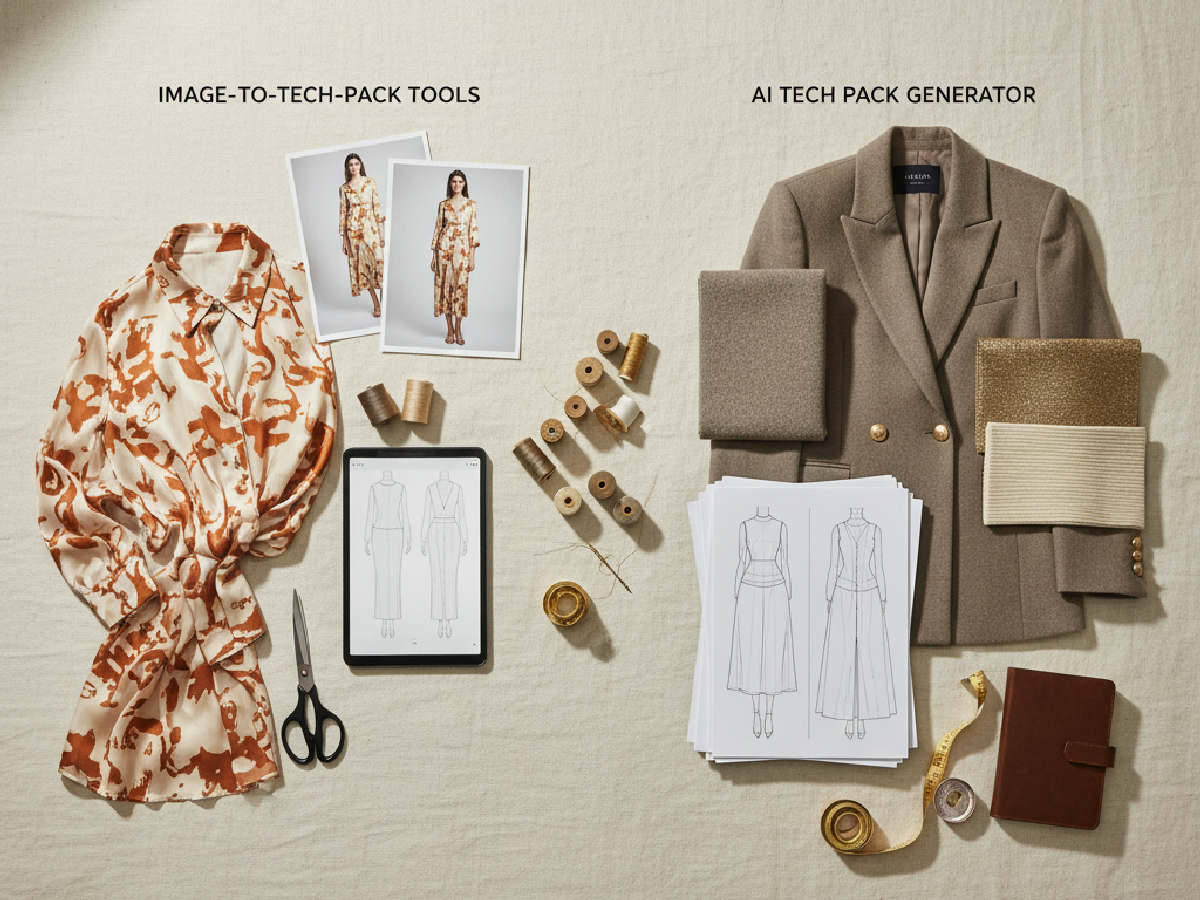
An image-to-tech-pack tool functions by analyzing a visual file, such as a photograph, fashion sketch, or 3D render. Its AI model identifies key garment features like silhouettes, seams, pockets, and closures, and then translates them into a basic tech pack structure. The output typically includes a flat sketch, a list of visual components, and placeholder fields for measurements and materials. This process provides a rapid starting point for ideation and internal communication among design and merchandising teams.
These tools excel at quickly converting a concept into a tangible document for initial review. A product development manager can use the output to discuss a new style with designers before committing technical design resources. However, the generated pack is an interpretation, not a definitive manufacturing guide. The AI is essentially guessing at construction methods, fabric properties, and internal components that are not visible in the source image.
The primary limitation is the single-source input. A photo of a denim jacket does not contain information about the fabric weight, the wash process, the specific metal finish of the tack buttons, the stitches per inch (SPI) for the main seams, or the type of pocketing fabric used. This missing information creates ambiguity that must be resolved manually by a technical designer, often leading to multiple sample iterations with the factory.
A comprehensive AI tech pack generator operates not as a single-function tool but as an intelligent workflow platform. It does not start from a single image. Instead, it synthesizes information from multiple authoritative sources within a brand's ecosystem. These sources include Product Lifecycle Management (PLM) systems, digital material libraries, approved component databases (trims, threads, labels), and libraries of previously successful tech packs.
The core function is orchestration. For example, a user might prompt the system to "Create a men's 5-pocket jean using the 'CORE-SLIM' fit block, Fall 2024 denim fabric '12OZ-STRETCH-INDIGO', and standard hardware from our approved trim library." The AI generator retrieves the correct block and its associated grade rules from the PLM, pulls the fabric specifications from the material library, and populates the Bill of Materials (BOM) with pre-approved components.
This method grounds the generation process in reality. Instead of guessing, the AI assembles the tech pack using known, validated parts and processes. It works like an expert technical designer who has instant recall of every product the brand has ever made. The result is not just a sketch but a production-intent document that reflects established brand standards and manufacturing capabilities.

The quality and completeness of a tech pack are directly determined by the quality of its inputs. An image-to-tech-pack tool begins with a high degree of ambiguity. The visual data is rich in aesthetic information but poor in technical detail. It can show that a shirt has a button placket, but it cannot specify the placket width, the type of interlining, the button size and spacing, or the buttonhole stitching method.
An advanced AI tech pack generator requires structured data inputs to function correctly. This is its primary strength. It connects to the brand's PLM (like Centric or FlexPLM) to pull style header information and fit blocks. It accesses a material library to get fabric weight, content, and performance data. It uses a trim library to specify exact SKUs for zippers, threads, and labels. It also references a library of past tech packs to understand construction norms and points of measure (POMs) for similar styles.
This multi-source approach systematically eliminates ambiguity. The technical designer or product developer guides the AI, making strategic choices from pre-validated options rather than creating everything from scratch. The process shifts from manual data entry and speculation to a system of guided assembly, ensuring the first generated tech pack is significantly closer to what the factory needs to produce an accurate sample.
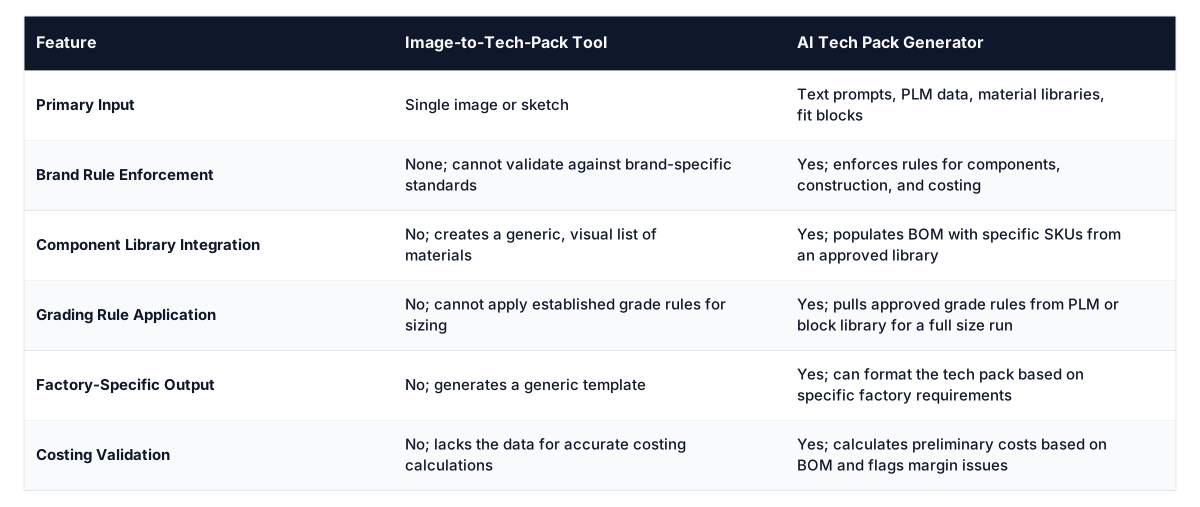
A key differentiator for a true AI tech pack generator is its ability to enforce brand and factory-specific rules throughout the creation process. These validation guardrails prevent costly errors before the tech pack is ever sent to a supplier. This is something an image-only tool, which lacks context beyond the picture, simply cannot do. It cannot know that a certain fabric is too heavy for a particular silhouette or that a proposed trim is not approved for childrenswear.
For example, a generator can be configured with rules such as "Outerwear zippers must be from YKK's Vislon series," or "The BOM cost for this product category cannot exceed $45.50." If a user tries to add a non-compliant component or if costing calculations exceed the target margin, the system will flag the issue instantly. This proactive validation ensures that the tech pack is complete and commercially viable and compliant with brand standards.
This capability turns the tech pack from a static document into a dynamic, validated artifact. It gives sourcing and production teams confidence that the specifications are manufacturable and within budget. The comparison below highlights the practical differences in validation capabilities.
Fashion brands build value through consistency in fit, quality, and construction. An AI tech pack generator acts as a custodian of this institutional knowledge. By building on a foundation of previously approved products, the system learns what "standard" means for your brand. It knows the default POMs for a crewneck t-shirt, the preferred pocket bag material for trousers, and the exact construction sequence for a set-in sleeve.
This "brand memory" ensures that new products adhere to established standards, even with junior team members or freelance support. A technical designer doesn't have to search through old files to find the specs for a similar style; the AI can surface the relevant information and apply it directly to the new tech pack. This dramatically speeds up development and reduces the risk of inconsistencies that can damage brand perception.
Image-to-tech-pack tools, by contrast, have no memory. Each generation is a new event based solely on the visual input. They cannot enforce consistency from one style to the next or across seasons. This puts the entire burden of maintaining brand standards back on the technical designer, requiring extensive manual checks and cross-referencing, reintroducing the very inefficiencies AI is meant to solve.
The choice between these two types of tools has a direct and measurable impact on key performance indicators for product development and sourcing teams. The primary metric is the number of sample rounds required to get a style approved for production. Each sample round adds weeks to the product calendar and incurs costs for materials, labor, and shipping.
Because tech packs from image-only tools are inherently incomplete and ambiguous, they frequently result in incorrect first samples. The factory is forced to make assumptions about construction, fit, and materials, leading to a cycle of corrections and resubmissions. It's common for these products to go through three, four, or even more sample rounds before achieving approval.
A spec package from an AI tech pack generator, grounded in real data and brand rules, is designed to be right the first time. By providing the factory with a precise, unambiguous set of instructions built from validated components and measurements, it dramatically increases the probability of first-sample approval. The goal is to reduce the sample lifecycle to one or two rounds, saving weeks or even months from the critical path and enabling brands to react faster to market trends.
3D design tools like CLO and Browzwear are for virtual prototyping and visualization. They create a digital twin of the garment to test fit and drape. An AI tech pack generator is a workflow tool that creates the instructional document for physical manufacturing. It orchestrates data from your PLM and libraries to produce the factory-ready tech pack, which can include outputs from 3D tools as visual assets.
No. AI tech pack generators augment, not replace, technical designers. The tool handles the tedious, repetitive tasks of data entry and document formatting, freeing up technical designers to focus on higher-value work. They spend their time perfecting fit, engineering complex garments, solving construction challenges, and managing factory communication, which are skills that require human expertise and critical thinking.
True AI tech pack generators are built to integrate with PLM systems like Centric, FlexPLM, and others via APIs. They pull style data, material libraries, color standards, and fit block information directly from the PLM, using it as the source of truth. The final, validated tech pack or its core data can then be pushed back into the PLM to maintain a complete product record.
No, that is the role of a designer, often aided by AI image generation tools. An AI tech pack generator is not a creative design tool. It is an execution tool that takes a defined design concept, which can be a sketch or a detailed prompt, and translates it into a manufacturable set of instructions by grounding it in your brand's existing technical and material data.
The system doesn't require "training" in the typical machine learning sense. Instead, it needs access to your operational data. This includes your library of past tech packs (especially for approved styles), your PLM records, digital material and trim libraries with full specifications, and your established fit blocks and grading rules. The more structured and complete your data, the more effective the generator will be.
For a standard garment, teams report that using an AI tech pack generator can reduce the time to create a complete, factory-ready tech pack by 70-90%. A process that might take a technical designer 4-6 hours of manual data entry and formatting can often be completed in under 30 minutes, with a higher degree of accuracy and adherence to brand standards.
Yes, but this is where the difference between tool types is most apparent. An image-to-tech-pack tool would fail completely with a complex jacket, as it cannot see lining, internal pockets, or insulation. A true AI generator, guided by a product developer, can assemble a complex tech pack by pulling in the correct shell fabric, lining, fill, and components from libraries and applying pre-defined construction methods for multi-layer garments.
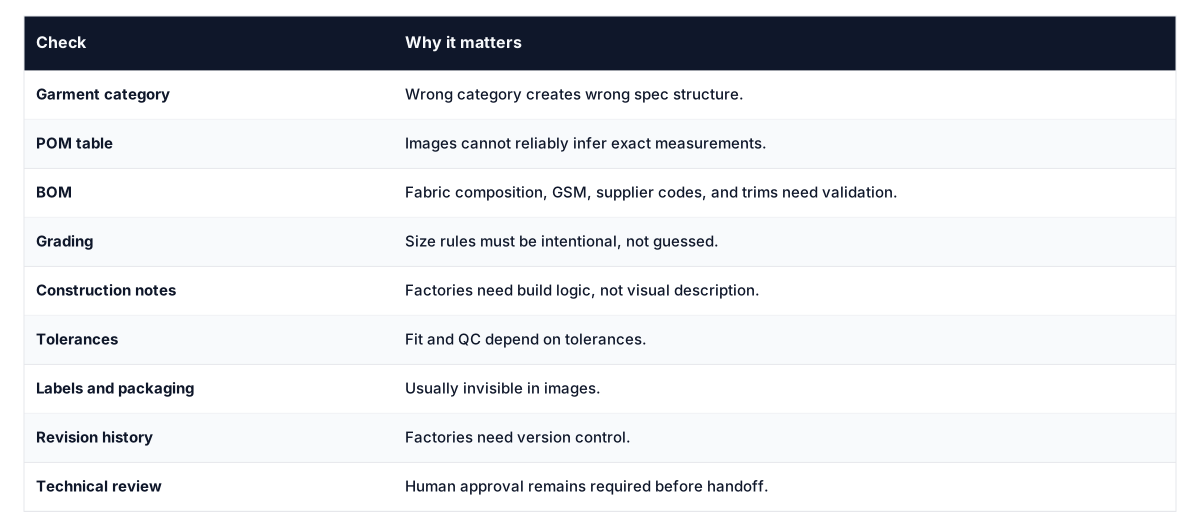
Image-to-tech-pack is a draft. Factory-ready requires validation. The checklist below is what a technical designer signs off on before a tech pack is sent to a vendor for quoting or sampling.
Ready to move past visual concepts and create factory-ready production artifacts with verifiable data? Generate a tech pack using a system grounded in your brand's unique standards and supplier capabilities. See how grounding your generation process in real data leads to fewer samples and faster production cycles.