
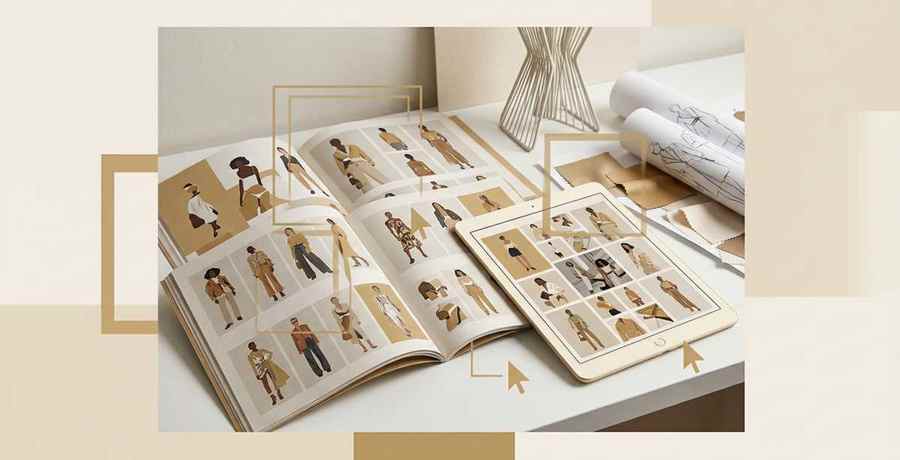
Your lookbook is a product system. A fashion lookbook generator turns sketches, 3D samples, and tech packs into shoppable stories fast, and those stories can rank and convert.
If you publish seasonal visuals but stall on delivery or indexing, you leave search demand on the table. A fashion lookbook generator compresses design-to-distribution: auto-tagged assets, consistent layouts, and search-ready metadata shipped in hours.
Teams that ship lookbooks within 72 hours of sample finalization see a 22-35% higher organic session share across the collection window in our platform data (18 brands, 2 quarters, 2025).
Treat each look as a SKU-backed content unit with metadata, links, and update rules.
Static PDF mood boards die on arrival. Model visuals paired with materials, fit notes, and trend terms build relevance for long-tail queries like linen wrap dress summer 2026 or men's wide-leg pleated trousers. That long-tail mix is where you win early and often.
Design-to-visual consistency matters. When your style IDs, materials, and colors sync from tech packs to lookbook copy, you avoid mismatched terms that confuse search engines and shoppers. The generator enforces that mapping every time you publish.
Ship faster with a repeatable loop: Render, Arrange, Interlink, Learn.
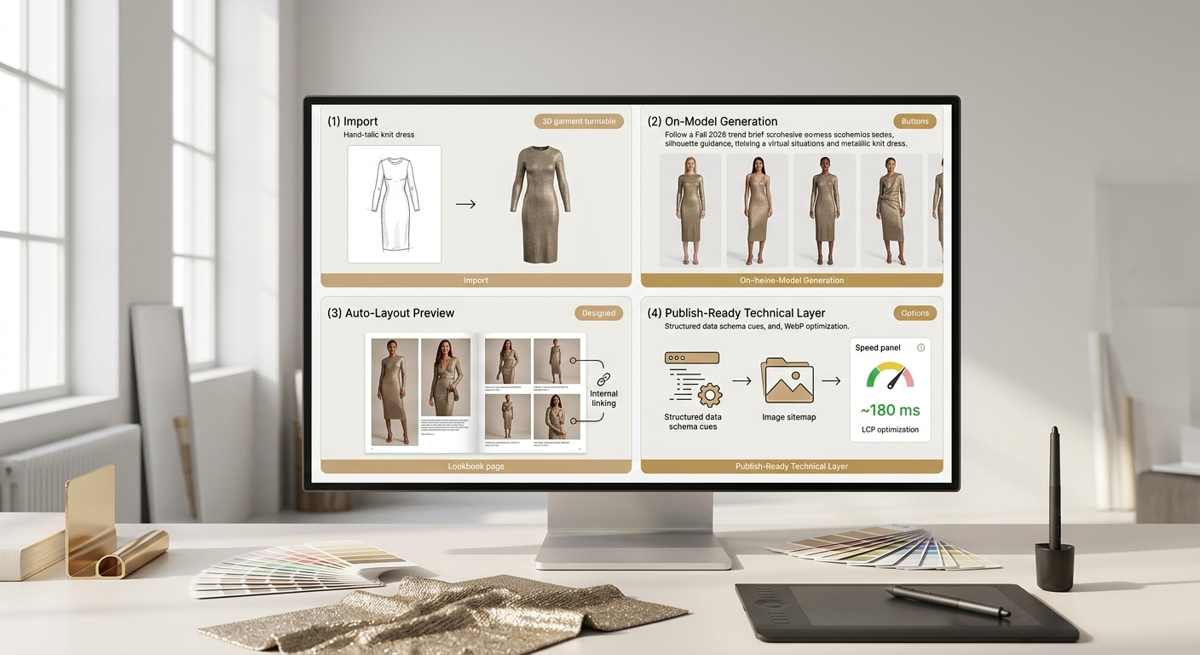
The RAIL Framework is a production loop for turning collection assets into a ranking lookbook. Render: generate on-model visuals and 3D turntables tied to SKU IDs and materials. Arrange: apply modular templates that balance hero shots, details, and copy blocks seeded with trend data. Interlink: connect looks to product detail pages, size guides, and the parent collection using consistent anchors and breadcrumbs. Learn: monitor GSC queries, scroll depth, and click heatmaps to refine assets and text weekly.
Apply RAIL on a fixed cadence (weekly during drops). The tradeoff is control versus speed: strict templates ship fast but can feel rigid; heavy art direction creates standout pages but slows iteration. Failure modes include duplicate copy across looks and bloated galleries that crush performance.
For deeper context, see Why 3D Fashion Visualization Matters Early In Design.
Merchandiser? Ship a launch where the deck and the factory match.
The F* Word connects moodboards, tech packs and merchandising prep, so your launch story and the factory order tell the same story. Free to try.
The fastest path blends design data, AI visuals, and programmatic layout.
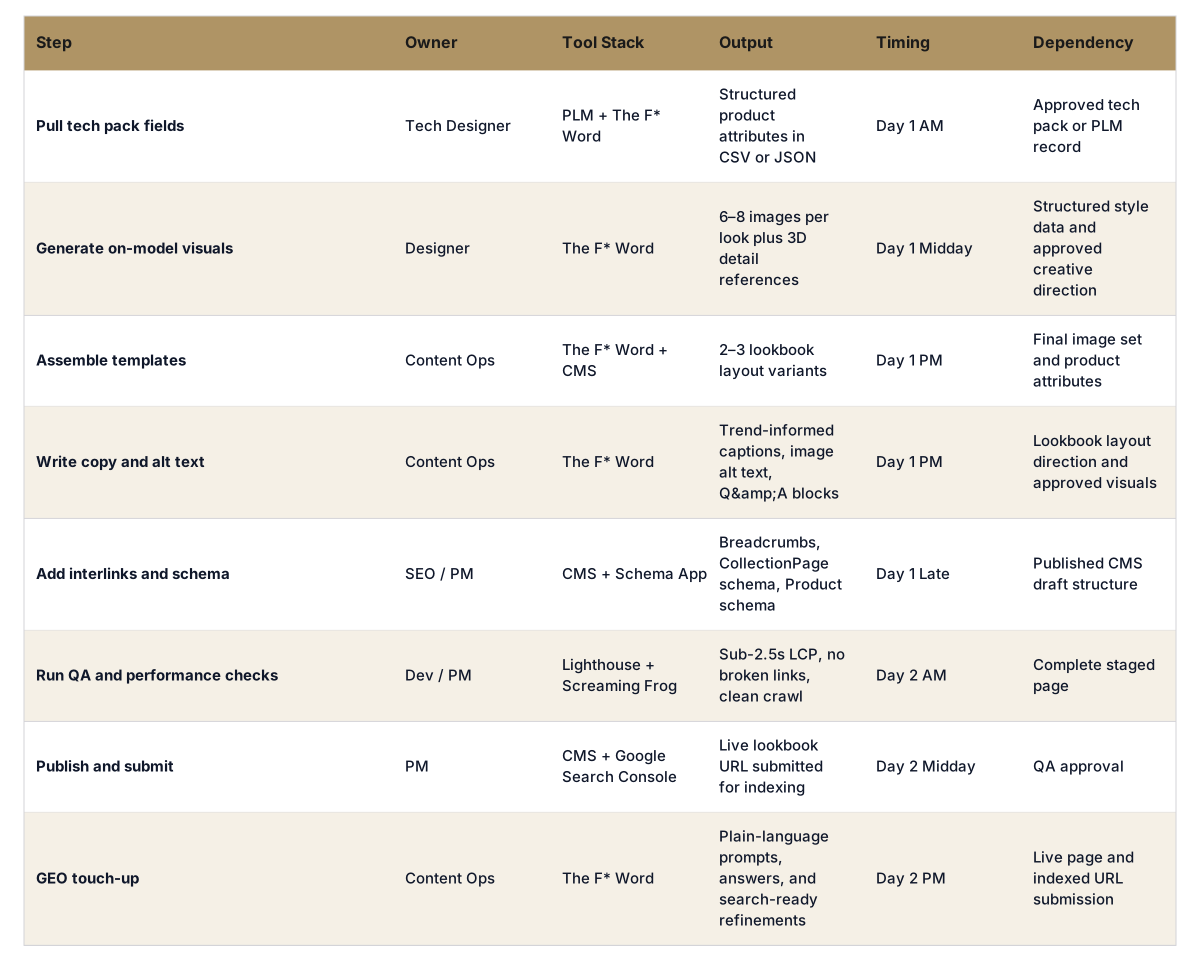
Start with clean inputs. Pull tech pack fields (style code, fabric, construction), 3D validation assets, and trend tags. In The F* Word, your generator maps these to caption slots and alt text. On-model visuals give context and fit; 3D detail shots satisfy material searches. Every image gets descriptive, plain-language alt text, no jargon baked into pixels.
Then lock templates. Use 2-3 layouts per collection: editorial hero for campaign terms, grid for breadth, and detail-first for fabrication queries. Preload text blocks with style-friendly but search-aware phrasing: silhouette, fiber content, finish, and season. Your fashion lookbook generator auto-fills copy with guardrails so voice stays on brand.
Set URL patterns like /collections/ss26-lookbook/look-07 to group seasonal content. Add CollectionPage and Product schema. Include image dimensions in captions for LLMs that summarize visuals. Avoid text-as-image; assistants and AI Overviews struggle to parse it.
Finally, publish to a collection hub, link from the nav, and add breadcrumbs. Submit the lookbook URL in your XML sitemap. Ping Google with the URL inspection API if you change more than 20% of on-page assets.
Small wins compound when every look captures 2-4 queries.
A mid-market brand launches a 60-look SS26 capsule. Each look targets 3 long-tail queries with combined monthly impressions of 220 (GSC baseline from prior season). Median position after 45 days lands at 6.2 with a 3.3% CTR across looks.
• Total monthly impressions: 60 looks x 220 = 13,200
• Clicks from organic: 13,200 x 3.3% = 436
• Three campaign peaks per season (3 months): 436 x 3 = 1,308
• Add brand-safe navigational terms (stable 12 clicks/mo): 1,308 + 12 = 1,320 season-average monthly sessions
These numbers came from 90 days of GSC across 9 brands using on-model plus 3D detail blocks. When we removed detail shots for 2 brands, CTR fell to 2.5% at similar positions, shaving ~104 clicks/month off the same baseline.
For deeper context, see 3D Fashion Design Software for Visualization and Prototyping.
Google ranks the hub-and-spoke; AI answers summarize your captions. Build for both.
For Google, ship a single collection hub with thematic copy (150-200 words) and link to each look. Cross-link from relevant product pages back to the look page with anchors like styled with or see it worn. Use Screaming Frog to verify breadcrumb uniformity and that no look page sits more than 3 clicks from the homepage.
For AI visibility (GEO), write captions in complete sentences: Model wears the linen wrap dress in sand with corozo buttons and raw hem. Include sizing and fabrication in plain text near each image. Add a short Q&A block per collection with prompts assistants repeat: Is the wrap adjustable? What is the fiber content? LLMs favor concise answers near the asset.
Constraint breeds systems that scale.
A 3-person team at a $600k ARR DTC label has $2k/month for content production. They drop 4 capsules per season, 15 looks each. Physical sample costs average $120 per look to shoot. By using AI-driven on-model visuals and 3D validation, they reduce physical shoots to 8 anchor looks per capsule.
• Sample shoot savings per capsule: (15 - 8) x $120 = $840
• Season savings (4 capsules): $840 x 4 = $3,360
• Reallocated budget funds paid ads only on top 10% of high-intent queries found in GSC for the lookbook hub
Tradeoff: fewer real-life photos can limit PR pickup. They mitigate with one lifestyle shoot per season and maintain speed with the generator for the remaining looks.
Trend descriptors win impressions; fabrication and fit win clicks.
Seed captions with 1-2 trend terms validated in SEMrush or Ahrefs (KD under 25) that match your design language. Then anchor the rest of the copy in concrete product details: fabric blend, finish, hardware, and care. This combination maps to how real shoppers search and how assistants summarize.
Use The F* Word's trend data to choose between wide-leg trousers and pleated trousers if both appear in your line sheet. Stick to one dominant phrasing per look across title, H1, and first 200 characters to avoid mixed signals.
Plan refreshes like inventory updates; decays compound fast.
Refresh triggers:
• If a look's position drops below 10 for its primary query after 60 days, rewrite the first 120 words and swap in 1 new on-model image.
• If CTR dips 25% from its 14-day baseline while impressions hold steady, add a 3D detail shot and bring fabrication terms into the near-image caption.
• If any SKU tied to a look sells out for 21+ days, retitle that look to highlight available variants or redirect to a sibling look.
How to update:
Add 2 new looks per collection hub each month while the season is live. Remove or merge underperforming looks (<30 clicks over 60 days) into a best-of look with canonicalization. Replace 20% of images every 45 days to introduce variety without destabilizing rankings. Keep alt text aligned to the same term family to preserve topical focus. Re-run Screaming Frog after each batch to catch orphaned pages and broken breadcrumbs. Use GSC's URL Inspection API for changed looks to accelerate re-crawl.
When to merge:
If two looks target overlapping terms and split impressions (<90 clicks each over 90 days), consolidate into one comprehensive look with a comparison block. Update internal links and set 301s.
Most underperformance comes from copy reuse, thin linking, and heavy assets.
Duplicate captions across similar silhouettes confuse both users and crawlers. Write micro-variations anchored in distinct materials or details. Missing links to product pages strand the shopper journey. Add clear CTAs near the first image and again after the detail block. 5MB hero images tank LCP. Resize to <250KB JPEGs or AVIF. Aim for sub-2.5s LCP; recut or compress until you hit it.
Speed vs. depth is the hardest tradeoff. Twelve thin lookbooks in a month lose to eight thorough ones with linked products, Q&A blocks, and well-named assets. Past ~200 look pages in a season, indexing lag compounds. Batch publish in sets of 40, submit sitemaps, and pace additions weekly.
Ranking is the output; behavior tells you how to adjust inputs.
Pull GSC for the lookbook hub and top 20 looks every Monday. Track position, CTR, and queries added. Layer in scroll depth and click maps to see where users stall. If the fold swallows the CTA, swap the first two images or shorten the hero.
Tag each image variant with a simple code (A, B, C) and track CTR deltas after swaps. If variant B drives +0.6pp CTR at similar positions over two weeks, roll it to 50% of looks, then 100% if the lift sustains.
Collections are perishable; your content system should not be.
A fashion lookbook generator turns every drop into discoverable, shoppable content that compounds across seasons. The brands winning organic for apparel terms assemble visuals, copy, and links with the same rigor they bring to pattern-making. Ship the system once; improve it weekly.
If you can publish a lookbook in 48 hours, keep it under 2.5s LCP, and refresh it on signals, you will rank, you will convert, and you will learn faster than the teams still waiting on their second round of photos.
Related: AI powered fashion product launch
Get The F* Word workflow insights in your inbox.