.png)
English
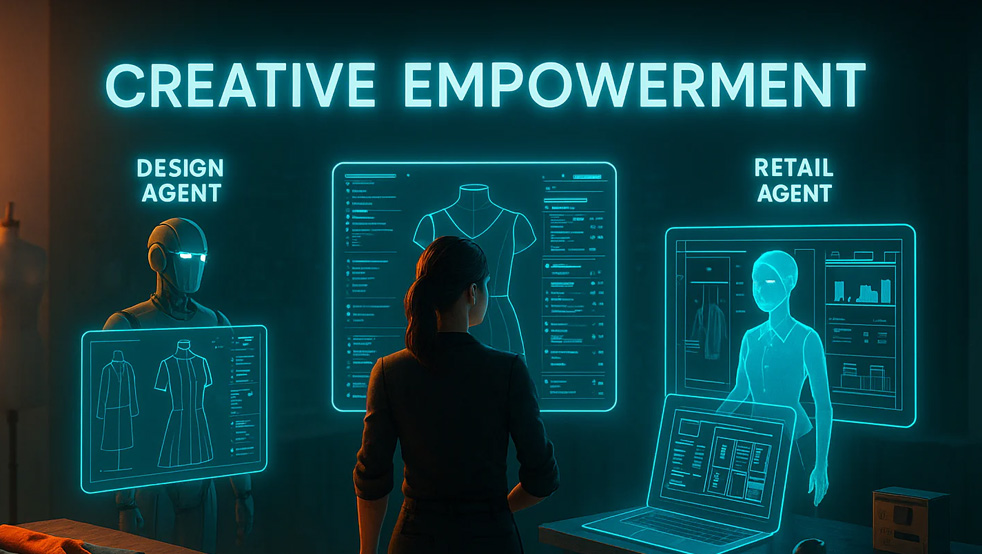
For decades, every new wave of automation—from sewing machines to digital design tools—has raised fears about creative jobs disappearing. Today, as Agentic AI fashion systems take center stage, a familiar anxiety has resurfaced: Will AI replace fashion design teams?
However, the truth is far more nuanced—and ultimately, more optimistic. Agentic AI doesn’t replace people; it amplifies them. By automating technical, repetitive, and time-consuming work, it frees designers, merchandisers, and supply-chain professionals to focus on creativity, strategy, and innovation.
In this context, this article explores how Agentic AI in fashion is transforming the future of work—creating more empowered, creative, and data-driven teams rather than displacing them.
The fashion industry’s workflows remain complex and fragmented. From concept to consumer, each collection involves hundreds of micro-decisions: fabric selection, grading, sourcing, fitting, pricing, and marketing. As a result, manual coordination slows this process, leading to:
Fortunately, Agentic AI fashion systems address these structural inefficiencies by delegating repetitive work to autonomous agents. Therefore, this doesn’t make humans obsolete—it gives them leverage. Designers become conductors of intelligent systems rather than executors of manual tasks.
Agentic AI changes how teams work, not why they work. Instead of replacing creative intuition, it strengthens it with precision, data, and scale.
Designers gain time for creativity:
Routine work like creating tech packs or size grading is automated, allowing designers to focus on artistry, storytelling, and innovation.
Merchandisers make data-backed decisions:
Agents analyze real-time demand, trend signals, and social sentiment, empowering merchandisers to plan collections based on evidence, not guesswork.
Supply-chain teams achieve transparency:
Agents track fabric sourcing, compliance documents, and shipment statuses, minimizing manual coordination across vendors.
Marketers personalize faster:
Marketing agents generate campaign visuals, product descriptions, and price adjustments tailored to each customer segment.
Executives gain real-time visibility:
Orchestration dashboards powered by Agentic AI in fashion provide continuous performance tracking across design, production, and retail.
When humans set creative direction and agents handle execution, the entire organization becomes faster, smarter, and more resilient.

A European fashion group with 2,000 employees adopted an Agentic AI design-to-retail workflow. Before implementation, designers spent over 40 % of their time on documentation and manual approvals. After one year:
The company didn’t reduce headcount—it redistributed human effort from routine to strategic work. Thus, creativity became both measurable and scalable.
In Agentic AI fashion, each AI agent mirrors a human counterpart within the organization—specialized, autonomous, and accountable.
This distributed “AI workforce” doesn’t replace human labor—it complements it. Designers collaborate with these agents the way photographers work with cameras: the technology enhances vision, not substitutes it.

Adopting Agentic AI successfully requires more than technical integration—it demands a cultural reframe.
Consequently, companies leading in AI fashion adoption invest heavily in AI-fluency training—teaching teams how to interact with, supervise, and iterate alongside digital agents.
For example, a luxury house trained its design team in “prompt architecture” to guide its internal Design Agent. Within months, designers produced three times more visual concepts per season while reducing burnout.
The future of work in fashion depends on effective AI change management. Without a structured rollout plan, teams may resist automation or misunderstand its purpose.
Best practices include:
When managed carefully, change management becomes a bridge—not a barrier—to adoption. Thus, when change management is human-first, adoption feels natural rather than forced.
The rise of Agentic AI isn’t eliminating jobs—it’s evolving them. Consequently, new hybrid roles are emerging across the fashion ecosystem:
Collectively, these roles combine creative intuition with data literacy, blending art and algorithm in a way that defines the future of fashion work.
Empowering teams through Agentic AI generates both creative and financial dividends.
Ultimately, these outcomes prove that Agentic AI in fashion is an investment in people as much as in technology. Therefore, empowered teams create exponential business value.
As Agentic AI becomes more autonomous, maintaining ethical standards and creative integrity is critical.
Consequently, empowerment—not automation—defines ethical adoption. Humans remain the final creative and moral authority.
In the near future, every fashion company will operate with hybrid teams of humans and intelligent agents. As a result, creative directors will brief both designers and AI systems, and merchandisers will consult analytics from human and digital colleagues alike.
Therefore, the future workplace isn’t AI-run—it’s AI-augmented. Fashion professionals will lead orchestras of digital collaborators, achieving levels of precision, personalization, and speed once thought impossible.
Ultimately, when Agentic AI fashion is implemented thoughtfully, it transforms fear of replacement into excitement for reinvention. In doing so, it redefines what creative empowerment truly means.
Agentic AI represents not the automation of fashion work, but its evolution. It allows designers to design more, merchandisers to plan better, and teams to execute faster—all while maintaining the human essence that defines fashion.
Moreover, the brands that embrace this human-AI partnership will dominate the next decade—not because they replaced people, but because they elevated them.
In conclusion, in the age of Agentic AI fashion, empowerment is the new efficiency—and creativity remains its most powerful currency.
101 People Reading our Newsletter Right Now!
