.png)
English
AI in fashion has moved from hype to everyday reality. Fashion brands, retailers, and designers now rely on AI to design collections, plan assortments, forecast demand, and personalise experiences at scale. Over the last five years, adoption has accelerated: McKinsey estimates that AI could add up to $275 billion in profit to the apparel, fashion, and luxury sectors by 2030 (McKinsey, 2023), and more than 60% of leading brands report active pilots in design, merchandising, or digital retail.
Within this shift, two ideas have become especially important: Generative AI and Agentic AI. Both sit under the broader umbrella of AI in fashion, but they solve very different problems. Generative AI focuses on creating new content, like designs, imagery, or text. Agentic AI focuses on taking actions toward goals, like planning a buy, running tests, or orchestrating workflows across tools.
For a fashion- and tech-savvy audience, understanding Agentic AI vs Generative AI in fashion is now a strategic question, not a buzzword exercise. A creative director wants to know where generative AI can safely expand the brand’s visual universe. A Chief Merchandising Officer wants to know how agentic systems can automate the long tail of weekly decisions without sacrificing control. Product and innovation teams need to prioritise which fashion technology investments land in their roadmap over the next 12–24 months.
This complete guide breaks down definitions, key differences, real-world use cases, ethical questions, and a step-by-step playbook for brands and designers. By the end, you’ll see how to combine AI-powered fashion tools into a cohesive system rather than a collection of disconnected experiments.
Generative AI refers to models that create new content based on patterns in data. In fashion, this includes AI that generates sketches, prints, campaign copy, lookbook images, or 3D garments. It is excellent for exploring creative directions quickly and cheaply, giving teams a way to move from moodboard to visual concepts in minutes instead of days. According to IBM, generative AI systems "learn patterns in existing data to create realistic new content such as text, images, code and more" (IBM, 2024).
Wikipedia’s overview of generative AI similarly emphasises models that can produce novel outputs—ranging from images and audio to 3D shapes—after being trained on large datasets. In fashion, that means using historical collections, fabric libraries, or campaign archives as the raw material for new ideas. For designers and marketers, generative AI in fashion feels like a tireless visual collaborator.
Agentic AI, by contrast, refers to systems that do more than predict or generate; they decide and act. An agent can plan tasks, call tools (like PLM, e‑commerce, or analytics platforms), react to feedback, and optimise toward goals such as margin, sell‑through, or sustainability metrics. In fashion, an agentic system might run demand simulations, rebalance inventory, or continuously optimise onsite merchandising without human micromanagement.
Think of generative AI as the studio assistant that sketches endless options, and agentic AI as the smart operations manager that decides what to cut, where to ship it, and which customer segment should see it first. As one fashion-tech VP recently put it: “Generative AI expands what we can imagine; agentic systems scale what we can execute across thousands of decisions per week.” This distinction sets up the comparison that follows.
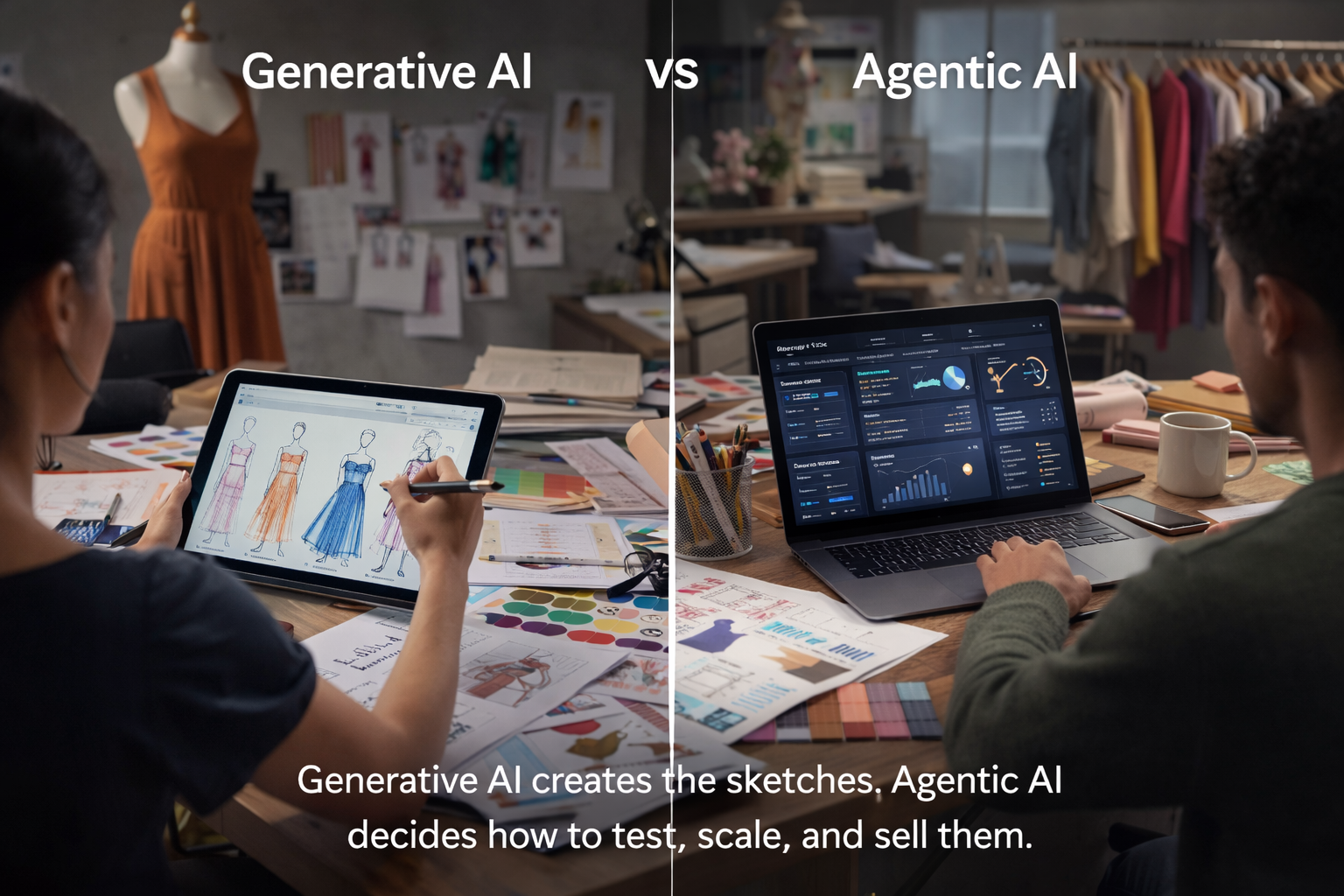
The main difference between Generative AI and Agentic AI in fashion is what they produce and how they operate. Generative AI outputs content: a design concept, a product description, a runway invite, or a moodboard. It is usually prompted by a human and judged by a human. Agentic AI outputs actions and decisions: which SKUs to push, which price to test, which design variants to sample, which customers to target. It continuously interacts with data, tools, and sometimes other agents.
In practice, this means generative AI is closer to a supercharged assistant for designers and marketers, while agentic AI behaves more like a junior merchandiser, planner, or operations manager that never sleeps. Both reshape workflows, but in different parts of the value chain. Generative AI shows up in the studio, the content team, and the 3D pipeline; agentic AI shows up in the trading meeting, the pricing engine, and the CRM stack.
To make the distinctions concrete for fashion and retail teams, here’s a side‑by‑side comparison of Agentic AI vs Generative AI in fashion across key dimensions:
For modern AI for fashion brands, the sweet spot is using generative systems wherever you need option volume and agentic systems wherever you need disciplined execution against targets.
Generative AI in fashion is already visible in design, content, and visual storytelling. Designers use it to explore silhouettes, prints, trims, and colourways; marketers use it to create campaign copy, product descriptions, and on‑brand visuals; e‑commerce teams use it for AI‑generated model imagery, styling variations, and virtual try‑ons. A 2023 survey by Business of Fashion and McKinsey reported that roughly 73% of fashion executives expect generative AI to have a significant impact on creative development and marketing within three years, underlining its strategic weight.
Real‑world brand examples are emerging fast. Gucci has experimented with AI‑assisted pattern and print ideation in digital campaigns. Levi’s has tested AI‑generated model imagery to show more body types and styling variations online. Sportswear brands use gen‑AI tools to rapidly prototype sneaker uppers or colourways before committing to physical samples. In luxury, creative directors increasingly use generative systems to visualise alternative set designs, campaign narratives, and digital experiences that extend the runway moment.
The benefits are tangible. Generative tools can cut early‑stage design iteration time by 30–50%, according to internal benchmarks reported by several global brands in 2023. Sample costs drop when more of the exploration phase happens in 3D or in rendered imagery. Marketing teams can localise creative for dozens of markets without linearly expanding headcount, unlocking more personalised, AI-powered fashion experiences across web, app, and social.
But there are also serious challenges. IP ownership and training‑data bias are front‑of‑mind: who owns an AI‑generated print that clearly references a niche artisan style? How do you ensure under‑represented cultures and body types are not erased or stereotyped in AI‑generated lookbooks? There’s a risk of over‑homogenised aesthetics, where every brand converges on the same “AI look.” And there are creative‑labour concerns, especially among junior designers and retouchers who fear replacement rather than augmentation.
Forward‑looking AI for fashion designers programmes position generative AI as a sketching partner, not an auto‑pilot. Clear art direction, brand‑specific constraints, and ethical guidelines help maintain distinctiveness while still capturing the efficiency gains.
Agentic AI in fashion is newer but potentially more transformative because it connects insight to action. It powers systems that decide and execute across merchandising, operations, and customer journeys. Instead of a planner manually checking sell‑through reports every Monday, an agent can monitor performance continuously and propose, or even implement, micro‑adjustments across thousands of SKUs.
Forbes has highlighted how agentic AI can orchestrate end‑to‑end retail decisions—from demand sensing and allocation to dynamic pricing and promotions—to materially improve profitability and reduce waste in fashion supply chains (Forbes Tech Council, 2024). Early adopters report double‑digit improvements in sell‑through on key lines once agents are allowed to continuously rebalance inventory and tweak price ladders within agreed guardrails.
Concrete agentic AI use cases in fashion include:
Inventory and allocation. An agent monitors store‑ and region‑level demand, compares it with on‑hand and in‑transit stock, and automatically generates transfer suggestions. If a sneaker capsule overperforms in Berlin and underperforms in Milan, the agent raises transfers or re‑allocation tasks before markdowns bite.
Pricing and promotions. Instead of static seasonal rules, an agent runs controlled tests on different price points and promotional mechanics across micro‑segments. It reads elasticity signals in near real time, then nudges prices or promotion intensity while respecting brand guidelines and margin floors.
Clienteling and journeys. In omnichannel environments, agents can coordinate personalised styling recommendations, email flows, and app notifications for each shopper. They decide which story to tell, which product to feature, and when to hold back, based on a blend of signals from purchase history, browsing, and local inventory.
The benefits are significant: fewer stockouts and reduced markdowns, better sustainability through improved forecasting, and more consistent execution across channels. A 2023 retail study reported that advanced AI‑driven forecasting can cut inventory levels by up to 20% while maintaining service levels, which for a global fashion group translates into tens of millions in freed‑up working capital.
However, agentic systems also raise questions around governance and trust. Teams must monitor agents instead of approving every micro‑decision. Poor data quality can cascade into bad actions. And there’s an organisational readiness challenge: if KPIs, incentives, and processes are not updated, human teams may fight or override agent decisions, neutralising the impact.
The most powerful stacks don’t treat Agentic AI vs Generative AI in fashion as a binary choice. They combine the two. Generative AI can produce design options, campaign narratives, or product copy variants; agentic systems can then test, deploy, and iterate on these across channels based on performance data. Together, they form a closed loop where creativity, demand, and execution constantly inform one another.
Imagine an end‑to‑end flow:
1. Trend sensing. An analytics layer picks up emerging aesthetics and search patterns—say, a spike in demand for metallic ballet flats and subversive basics.
2. Generative design. Generative AI models propose dozens of footwear and apparel concepts aligned with the brand’s DNA, material constraints, and sustainability rules.
3. Agentic testing. An agent selects a subset of designs, pairs them with AI‑generated copy and imagery, and launches limited digital tests in selected markets or channels.
4. Scaled rollout. Based on performance and margin data, the agent recommends which styles to scale, where to allocate inventory, and which narratives to push in CRM. Generative AI continues to produce fresh creative variants, while the agent keeps optimising placements and assortments.
If you visualised this as a diagram for your fashion technology stack, it would show a loop: trend data flows into generative modules, which feed candidate designs and content into agentic decision engines, which in turn push actions into PLM, e‑commerce, and CRM. Performance data then flows back to the top of the loop. This is the type of architecture explored in depth in broader fashion technology discussions.
AI fashion trends point toward richer 3D workflows, fully digital sample pipelines, and connected agent networks running large parts of the fashion calendar. We’re likely to see generative AI embedded directly in PLM and CAD tools, while agentic AI spans assortment planning, sustainability reporting, and real‑time retail optimisation. As infrastructure matures, smaller brands will access capabilities that previously required enterprise‑scale data science teams.
The ethical and creative implications are substantial. Ownership of AI‑generated designs remains a moving target in many jurisdictions. Representation in training data determines which bodies, cultures, and aesthetics are normalised on digital shelves. Over‑reliance on a narrow set of models risks flattening fashion into algorithmically safe sameness. Creative leaders will need to actively curate and sometimes push back against what models propose.
Sustainability sits at the intersection of opportunity and risk. On the positive side, better demand forecasting and agent‑driven buys can cut overproduction, a major issue in apparel where an estimated 10–40% of garments go unsold each season globally. Generative 3D samples reduce the need for physical proto‑types, lowering fabric waste and freight emissions. On the negative side, endlessly personalised AI‑driven marketing could fuel over‑consumption if not tied to responsible strategies.
An ethical AI strategy for fashion therefore needs clear principles: transparency on AI use, consent and fair treatment for creative contributors, guardrails on hyper‑targeted promotions, and explicit goals around diversity, equity, and sustainability. The most interesting work in AI powered fashion over the next decade may be less about raw capability and more about how brands choose to wield it.
For a broader view of how these pieces connect into the wider stack, see resources on fashion technology and how AI, data, and digital product creation intersect.
To move from experimentation to value, brands and designers need a grounded, staged playbook. Below is a step‑by‑step approach that many AI for fashion brands are now following.
Step 1: Map your high‑impact use cases. Start by identifying where generative AI use cases in fashion and agentic AI use cases in fashion overlap with existing pain points: slow design cycles, duplicated content work, chronic stockouts, or high markdowns. Use existing primers on AI in fashion to benchmark what peers are testing.
Step 2: Pilot generative AI in controlled creative workflows. For designers, that might mean using a dedicated tool (or a platform like The F* Word) to generate initial silhouettes, print directions, or trim concepts under clear brand constraints. For marketing, it could be AI‑assisted copy or image variants for email and product detail pages, always with human review.
Step 3: Launch small, high‑leverage agentic pilots. Focus on one or two decision areas, such as size‑curve optimisation or automated recommendations on the e‑commerce storefront. Define concrete KPIs—sell‑through, gross margin, conversion—and limit the agent’s action space at first (e.g., recommendations with manual approval, or price changes within a narrow band).
Step 4: Invest in data foundations and governance. Both generations of AI are only as good as the data and rules they operate with. Harmonise product hierarchies, clean your inventory and sales data, and establish governance around training datasets, prompt libraries, and agent guardrails. This is where many fashion technology initiatives live or die.
Step 5: Evolve roles, skills, and creative direction. Train designers, merchants, and marketers on what AI can and cannot do. Reframe junior roles from pure production to curation and direction. Make sure every pilot has a clear “human in the loop” model—who signs off on what, and when.
Step 6: Scale what works into integrated workflows. Once you have proof points and guardrails, connect generative and agentic systems end‑to‑end. Let generative design feed assortments that agents test and scale; let agentic CRM orchestrate content variants produced by generative tools. Use clear dashboards so leadership can see both creative and commercial impact.
Agentic AI and Generative AI are reshaping how fashion is imagined, made, and sold. Generative AI unlocks new creative directions and scalable content; agentic AI turns data and goals into continuous action across the value chain. The brands that win will not pick one or the other, but orchestrate both—grounded in strong ethics, distinctive brand vision, and disciplined operations.
By understanding the distinction between Agentic AI vs Generative AI in fashion—and by moving thoughtfully from experiments to integrated workflows—fashion businesses can build a more innovative, resilient, and sustainable future. If you are exploring where to start, dive deeper into broader resources on AI in fashion and adjacent fashion technology to shape your roadmap. Then define one or two pilots with clear KPIs, strong creative direction, and a cross‑functional team empowered to learn fast.
The shift is already underway; the next question is how your brand wants to participate in it.
Is generative AI replacing designers?
In practice, no. The most successful deployments use generative AI as a sketching and ideation partner. Human designers still define the brief, curate outputs, make final aesthetic decisions, and ensure cultural relevance and brand integrity.
Do agentic AI systems make decisions without humans?
They can, but fashion leaders typically start with human‑in‑the‑loop models where agents propose decisions (like buy quantities or price changes) and teams approve them. Over time, as trust and governance mature, some lower‑risk decisions are fully automated within guardrails.
What skills do teams need to work with these systems?
Beyond core fashion skills, teams benefit from data literacy, prompt design for generative tools, comfort with experimentation, and the ability to interpret agent recommendations. Creative direction and merchandising judgment become more, not less, important.
101 People Reading our Newsletter Right Now!
