.png)
English
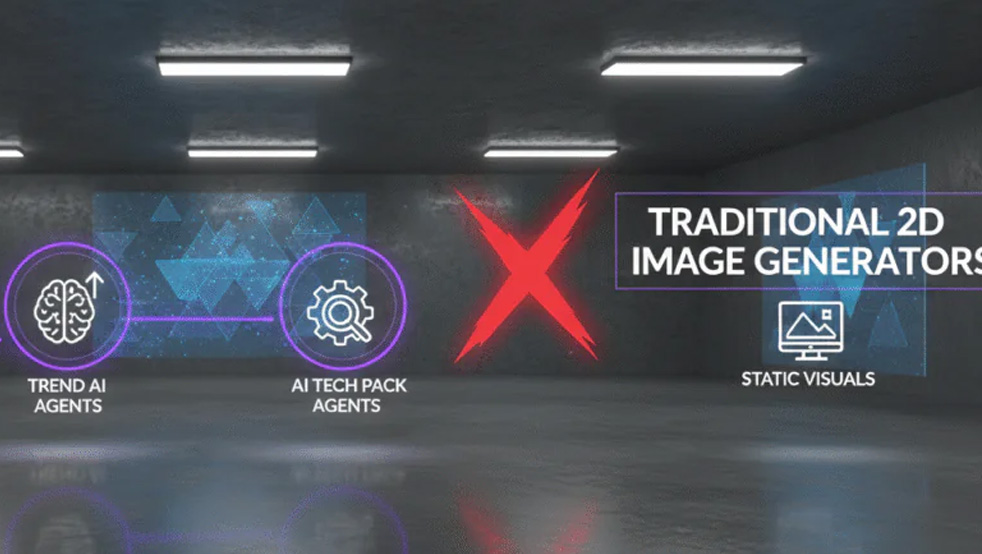
In the past two years, “AI in fashion” has become a catch-all phrase used for everything from automated copywriting to virtual fitting. Yet behind the buzz, two distinct paradigms have emerged—Generative AI and Agentic AI. Both use large language models (LLMs), but their capabilities, autonomy, and business outcomes differ profoundly.

For fashion leaders, this distinction is no longer academic. It defines how quickly you can move from inspiration to production, how efficiently your teams operate, and how deeply your brand can personalize experiences on a scale. This article unpacks both approaches, explains their mechanics, and shows why Agentic AI represents the next competitive edge for fashion brands.
Generative AI (GenAI) is what most of the industry first encountered tools that turn text prompts into images, sketches, or captions. These models, powered by LLMs and diffusion systems, excel at generating static outputs:
GenAI is invaluable in ideation and content creation. It helps designers visualize quickly and marketers produce collateral faster. However, its limitation is structural: it stops at creation.
Generative AI is a creative assistant, not an executor. It doesn’t generate the tech pack, grade the pattern, source the fabric, or schedule production. It paints the picture—but doesn’t make the garment real.
In short, Generative AI creates fragments but doesn’t close loops.
Agentic AI takes that creative spark and turns it into autonomous action. Where Generative AI produces an output, Agentic AI produces an outcome.
An agent is not a model, it’s a goal-oriented system built on top of models. Agents don’t just generate text or images; they:
Think of it as moving from AI as a tool to AI as a team.
Feature Generative AI Agentic AI Purpose Generates content (text, image, video) Executes multi-step tasks and workflows Operation Mode Reactive—responds to prompts Proactive—plans and completes goals Data Use Static training data or single query context Continuous context sharing and memory Integration Stand-alone tools Embedded across systems and APIs Human Role Creator supervises every output Human sets goals; agents execute autonomously Output Creative assets Production-ready results
Let’s illustrate this shift in a real fashion workflow.
With Generative AI:
A designer uses a GenAI tool to visualize 20 versions of a trench coat. They manually pick one, export the file, send it to a tech designer, wait for measurements, and brief a 3D artist for renders. Marketing teams join two months later once samples arrive.
With Agentic AI:
A Designer Agent interprets trend data and moodboards, producing sketches.
A Technical Designer Agent converts them into structured tech packs with measurements, materials, and stitch logic.
A Pattern Master Agent auto-grades the patterns across size ranges.
A Photo Agent generates on-model renders for e-commerce and campaigns.
The Marketing Agent uses those visuals to schedule social and retail content automatically.
The process that once took three months now takes under a week, with far fewer human handoffs.
1. Time Compression
Leading brands that have tested multi-agent workflows report 70–80% reductions in design-to-production time. For fast-fashion cycles, this speed equals trend relevance; for luxury, it means creative agility without sacrificing craftsmanship.
2. Cost Efficiency
Agentic systems automate repetitive technical tasks—grading, spec verification, and rendering—cutting labor hours per SKU dramatically. That allows small teams to achieve enterprise-level output without scaling headcount.
3. Fewer Samples, Lower Waste
Agents can simulate fit and fabric behavior digitally, removing the need for multiple physical samples. Every eliminated prototype saves material, time, and carbon emissions.
4. Always-On Intelligence
With memory and feedback loops, agents improve after every cycle. Generative AI gives you fresh ideas; Agentic AI gives you learning systems that refine with each collection.
5. Direct Line to Commerce
Because agents connect across PLM, Shopify, and marketing systems, digital assets can instantly become consumer-facing—powering pre-orders, virtual try-ons, and token-gated drops.
Autonomy is not about replacing teams—it’s about removing friction. In legacy workflows, creative, technical, and marketing teams operate in silos using incompatible software. Agentic AI connects these silos through inter-agent communication.
For example:
Autonomous agents create a living design system, not a collection of disconnected fashion tools.
When every task feeds the next autonomously, human talent can refocus on higher-order creativity and brand storytelling.
Generative AI gave the fashion industry its first taste of creative acceleration. But Agentic AI transforms that creativity into operational efficiency and commercial velocity.
It doesn’t just help designers imagine faster—it helps brands produce, test, and sell faster.
In the coming years, the most successful fashion houses won’t be those that generate the most AI art—they’ll be those that deploy autonomous agent networks capable of turning inspiration into inventory in days.
The shift from GenAI to Agentic AI mirrors fashion’s evolution itself—from sketches on paper to fully digital, interconnected ecosystems. It’s not about replacing creativity; it’s about liberating it.
Generative AI is the inspiration-driven muse while Agentic AI is the execution engine.
The brands that master both, i.e., creativity and autonomy, will define the next decade of fashion innovation.
101 People Reading our Newsletter Right Now!
