
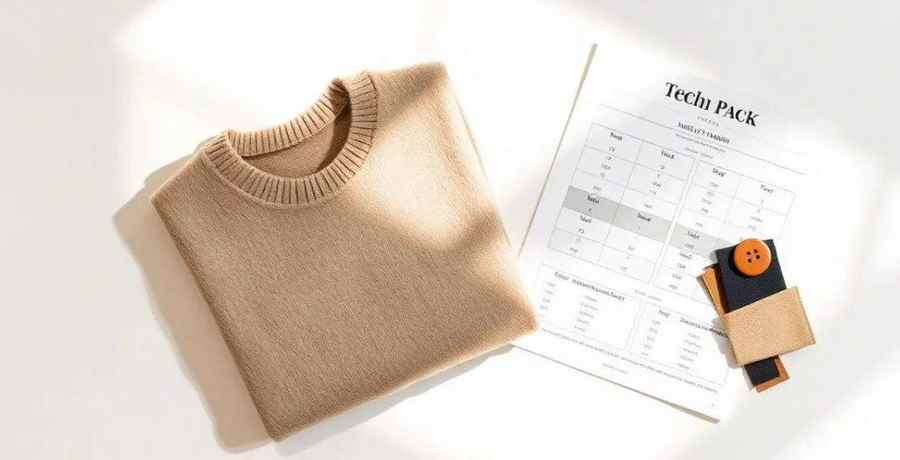
AI benefits fashion brands when it reduces rework, sample loops, content costs, and late-stage launch delays. The value is not more images. The value is fewer broken handoffs.
By 2026, research indicates that over 70% of independent designers and small fashion labels will have integrated AI into their core design-to-production workflow, slashing sample costs by up to 50%. The conversation has decisively shifted from the novelty of AI-generated moodboards to the urgent, practical need for tools that deliver production-ready assets. For too long, the gap between a stunning AI concept image and a manufacturable garment has been a chasm of manual labor, technical guesswork, and expensive iteration. Now, a new generation of AI-native fashion design platforms is finally closing that loop, transforming the very architecture of how small brands bring ideas to life. It's no longer about asking AI for a picture of a jacket; it's about asking it to design the jacket, draft its patterns, simulate its fit, and write its spec sheet.
The first wave of AI in fashion was dominated by generative image models like Midjourney and DALL-E. They were, and still are, brilliant for high-speed ideation and visual exploration. But for the working designer, freelancer, or small brand owner, the output was a beautiful dead end. A JPEG is not a pattern. A moodboard is not a tech pack. The real revolution, a change we're seeing fully realized in 2026, is the emergence of full-stack AI design solutions.
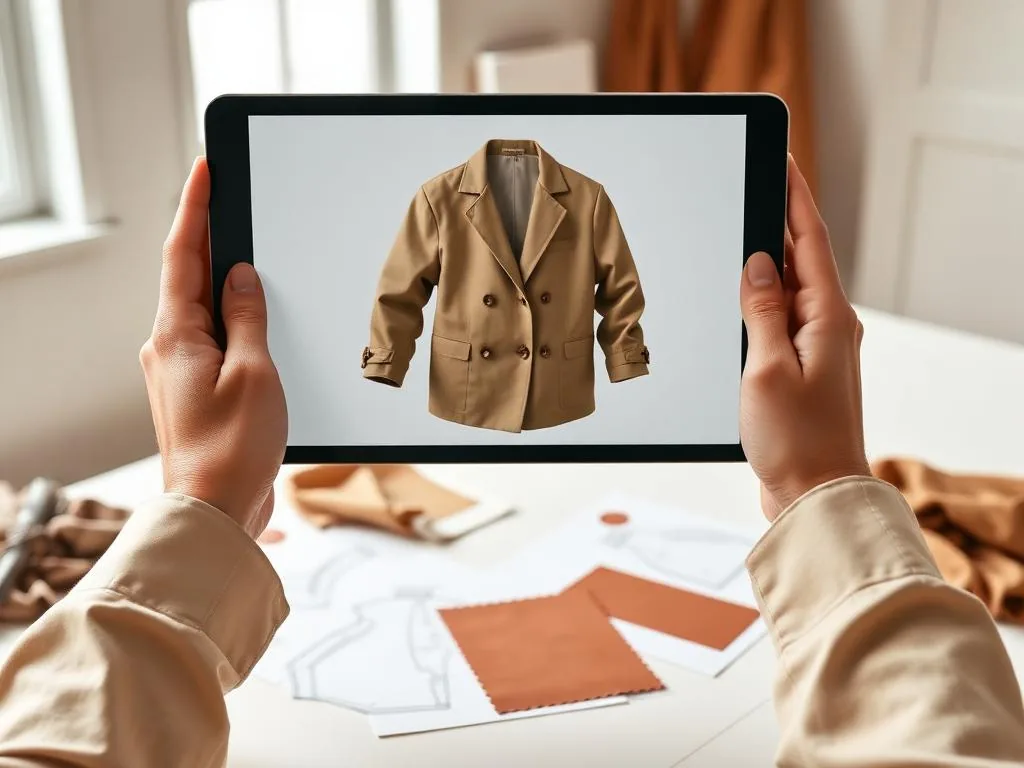
These platforms move beyond simple image generation to address the entire pre-production-to-production pipeline. They operate on a foundation of structured data that understands the language of apparel manufacturing: seams, stitches, fabric properties, grade rules, and bills of materials (BOMs). Instead of just generating a flat image, these advanced systems create an interconnected set of digital assets. The AI-generated 3D model isn't just a pretty render; it's intrinsically linked to its own 2D patterns. A change to the sleeve length in the 3D environment automatically updates the corresponding pattern piece and the measurement chart in the tech pack. This is the difference between an AI tool that gives you inspiration and an AI tool that gives you a business advantage.
For creators, freelancers, and small labels, this is a monumental shift. It democratizes access to workflows that were previously the exclusive domain of multi-million dollar PLM systems and large corporate R&D departments. It collapses the time and cost associated with physical sampling, allowing for near-infinite virtual iterations before a single yard of fabric is cut. This is not about replacing creativity; it's about eliminating the friction that stifles it, freeing designers to focus on what truly matters: a unique design voice and a perfect fit.
Most "AI for fashion" articles talk in vague benefits. The case for adoption is sharper than that, and it lives in the per-style cost stack. Take a typical small-brand woven top: ideation and tech pack work, three rounds of physical sampling, fit corrections, fabric and trim sourcing for samples, freight, and the project-management overhead that ties it all together. In 2026 cost benchmarks across independent brands, that stack runs $1,800 to $3,200 per style before a single production unit is cut.
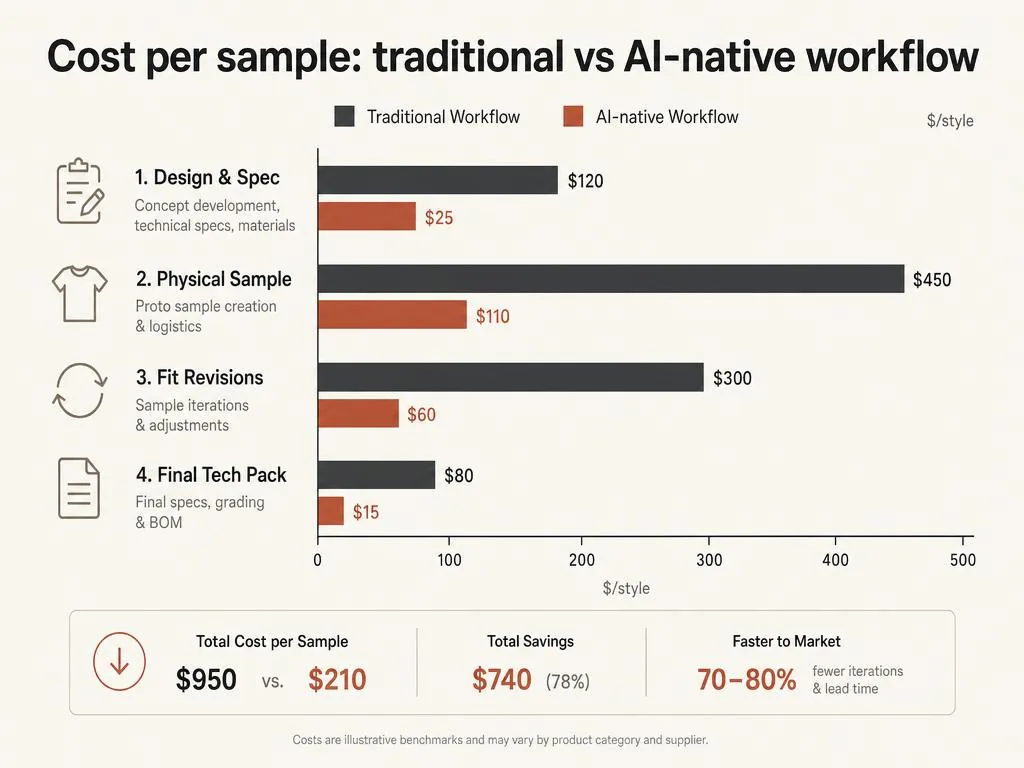
AI compresses that stack in three places. First, the tech pack. A working pattern, BOM, and measurement chart that used to take a freelance technical designer 6 to 10 hours now takes 20 to 45 minutes inside an AI-native tool, with a human review on top. At freelance market rates of $55 to $90 per hour, that is $300 to $700 saved per style. Second, sampling. Virtual fit and fabric simulation removes one to two physical sample rounds for the majority of garments that are not fit-critical. Each round saved is $150 to $400 in sample sewing, fabric, and freight. Third, rework. Pattern and spec changes that used to round-trip between brand, factory, and tech designer for a week now move in hours, which cuts about $200 to $500 of project drag per style.
Total realistic savings for a small brand: $650 to $1,600 per style, or 25% to 50% of the pre-production stack. On a 30-style season, that is $19,500 to $48,000 of cash that does not leave the business. For a freelancer billing time, the same math shows up as capacity: a designer who used to ship 8 to 10 tech packs a month can now ship 18 to 24 with the same quality, which doubles billable revenue without doubling hours.
Two things to call out. The savings only land when the AI output is production grade, not just visually plausible. An AI image generator does not move any of the three numbers above, because the factory still needs a real tech pack. And the savings compound, because every hour returned to the designer is an hour spent on the parts of the job that actually drive sell-through, like merchandising the range and writing the brand story.
Designer or merchandiser? Replace the spreadsheet handoff.
The F* Word generates moodboards, factory-readable tech packs and sampling notes in one workflow, so creative, production and merchandising stay aligned. Free to try.
Cost per style is the visible saving. The bigger prize sits one line above gross margin, and most founders miss it because they do not yet model the second-order effects.
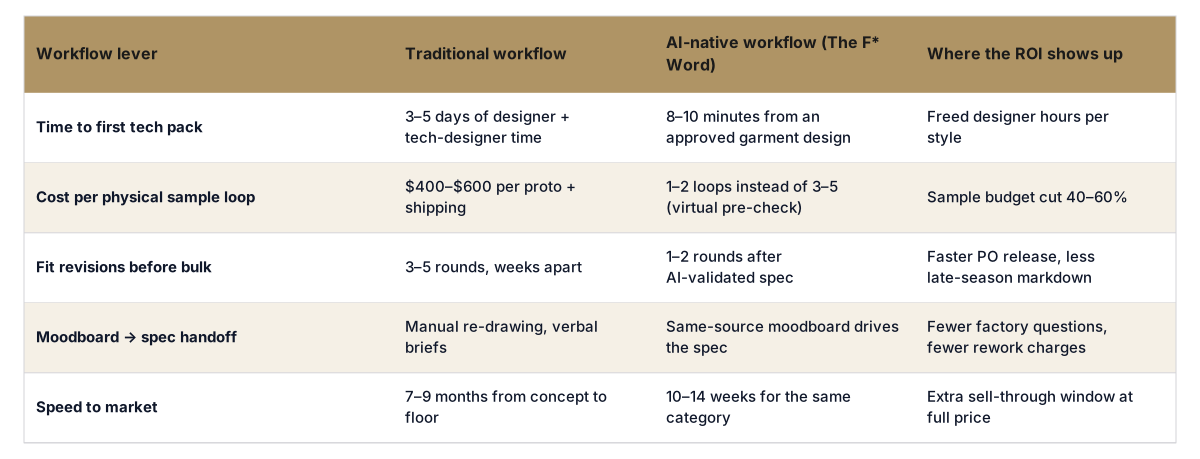
Effect one: lower minimum order quantities. When sampling cost drops, the breakeven for a new style drops with it. A founder who previously needed to commit to 200 units per SKU to absorb the development cost can credibly run 80 to 120 units. Smaller MOQs mean less inventory risk, which means fewer markdowns at end of season. For a typical contemporary brand running 35% gross margin, removing one round of end-of-season markdowns adds 4 to 7 points of realized margin across the affected styles.
Effect two: better assortment hit rate. AI-driven 3D and pattern tools make it cheap to test variants of a winning style before committing fabric. Three colorways become eight. One sleeve length becomes three. The brand discovers what actually sells, instead of betting on a single SKU per concept. Brands using AI variant testing in 2026 report 15% to 30% higher sell-through on extended ranges, which translates directly to fewer transferred units and lower carrying cost.
Effect three: factory negotiating position. A clean, AI-generated tech pack with a 3D fit reference is the kind of brief that good factories quote against quickly and confidently. The fuzzier the brief, the wider the contingency a factory builds in. Operators who switched to AI-native tech packs in 2025 reported 4% to 9% lower per-unit production quotes on identical garments, with no change in factory or fabric. That is pure margin, taken out of the friction tax.
Stack the three effects on a $500K-revenue brand running 30 styles a season: roughly $35,000 to $70,000 of incremental gross profit per year, with no additional headcount and no change to brand positioning. That is the case to take to a board, an investor, or a co-founder.
The textbook fashion calendar, design to in-store, runs about 9 months for a small contemporary brand. Most of that is wait time, not work time. Sample turnaround eats 4 to 6 weeks per round. Tech pack handoffs eat another 1 to 2 weeks each because the brief was incomplete. Pattern fixes after first fit eat 2 to 3 weeks because the original pattern was not built for the actual fabric. None of those weeks add value to the customer; they just absorb cash.
An AI-native workflow collapses each of those waits. Tech packs are ready the day the design is locked, not three weeks later. Virtual fit means the first physical sample is the third or fourth fit iteration, not the first. Variant rollout, which used to be a separate development cycle, ships alongside the parent style. The combined effect for a brand that adopts the workflow seriously is a season cycle of 12 to 16 weeks, not 36 to 40.
The financial impact of that compression is bigger than it looks. Faster cycles mean a brand can run more drops per year, which spreads fixed cost over more revenue. They mean fashion risk is shorter: the brand commits to a trend two months before it peaks, not nine months before. They mean working capital turns more often, so the same cash funds 2x to 3x the throughput. For a founder who has been quietly subsidising the brand from savings, that last point is the one that matters. A faster cycle is the difference between needing outside capital and not needing it.
None of this is theoretical. The brands shipping AI-native workflows in 2026 are not 10% faster than their peers. They are 60% to 70% faster, and they are reinvesting the difference into better fabric, sharper merchandising, and longer marketing runways for each drop. That is the durable advantage. The tools are the entry ticket; the operating tempo is the moat.
Choosing the right AI toolkit is less about which tool is "best" and more about which tool is right for your specific context. Your budget, timeframe, technical skill, and ultimate goal, whether it's a moodboard or a factory order, will determine the ideal path.
Adopting any new technology can feel daunting. The key is to start small, focus on one workflow, and build momentum. Here is a practical 90-day plan to take you from a curious novice to a confident AI-powered designer.
Month 1: Exploration and Ideation (Days 1-30)
Your goal this month is to simply get comfortable with generating ideas. Sign up for a free trial of TheFWord.ai and a low-cost subscription to an image generator like Midjourney. Spend your time learning the art of the prompt. Don't worry about production yet. Try generating a single garment in a dozen different styles. Experiment with fabric types, silhouettes, and details. See how different prompts affect the output. The objective is to build an intuition for how to "talk" to the AI to get the visuals you want. End the month with a curated digital moodboard of 10-15 strong concepts.
Month 2: Workflow Integration and Refinement (Days 31-60)
Choose the single strongest concept from Month 1. Now, your focus shifts to turning that idea into a tangible design asset within one primary tool. If you're using TheFWord.ai, this is the month you'll take your generated 3D model and start refining it. Adjust the fit on the avatar, tweak the design lines, and experiment with the generated fabric properties. If you're using a CLO/Midjourney workflow, this is when you'll start the manual process of building the garment in 3D based on your AI image. The goal is to end the month with one finalized 3D virtual sample that you're proud of.
Month 3: Production Preparation (Days 61-90)
This is where the rubber meets the road. Your goal is to create a full, production-ready deliverable. On TheFWord.ai, this is the most streamlined step: you'll use the platform's features to auto-generate the 2D patterns and the complete technical package from your 3D model. Review every detail, add your specific brand notes, and export the final PDF. If you're in a more manual workflow, this month will be spent finalizing your patterns in Adobe Illustrator, creating your measurement charts, and writing your construction notes from scratch. By day 90, you should be holding a digital file that you could confidently send to a manufacturer for a first sample.
The era of AI as a creative partner is here, and it's more accessible and powerful than ever. By moving past image generation and embracing integrated design platforms, small brands and independent designers can level the playing field, drastically reduce costs, and bring their unique visions to market faster. The tools are ready for you. Start free at thefword.ai.
Yes, but only from specific platforms. An AI image generator like Midjourney absolutely cannot. A true AI fashion design platform like TheFWord.ai can because it doesn't just create a picture; it creates a structured 3D model linked to underlying pattern and measurement data. When it generates the tech pack, it's simply outputting the technical data that already exists within the digital garment file, ensuring accuracy between the visual design and the manufacturing specifications.
No, AI is a co-pilot, not the pilot. It excels at automating tedious, time-consuming tasks like pattern adjustments, grading, and documentation. This frees up the human designer to focus on higher-level creative work: brand vision, trend curation, taste-making, and telling a compelling story. The most successful designers will be those who learn to use AI to amplify their unique creative voice, not those who fear being replaced by it.
An AI image tool creates pixels. An AI fashion design platform creates assets. The output of an image tool is a flat, non-functional image (e.g., a JPG or PNG) that serves as inspiration. The output of a true design platform is a collection of interconnected, functional files: a workable 3D model, editable 2D CAD patterns, a bill of materials, and a measurement specification sheet. One is for looking, the other is for making.
The cost spectrum is wide. You can start exploring for as little as $10-$30 per month with generative image tools. For a professional, integrated workflow, expect to invest in a SaaS subscription, which can range from $50 to $250 per month for small business tiers. High-end professional 3D suites like CLO 3D or Browzwear are the most expensive, often requiring annual licenses that cost several thousand dollars. The key is that powerful, production-ready tools are now available at a monthly price point that is highly accessible for freelancers and small labels.
Once the workflow is in place, these are the steps that turn it into shipped product.
Related: ai for fashion product development
Get The F* Word workflow insights in your inbox.