

A mid-size fashion brand managing 300 styles per season often faces significant delays in translating creative ideas into production-ready patterns. This challenge arises particularly during the handoff between designers and technical teams, where precise specifications are crucial for avoiding costly sampling rounds and production errors. The friction between a creative vision and manufacturing reality can lead to missed market windows and bloated inventory. The integration of AI for fashion technical design addresses these bottlenecks by streamlining pattern creation, ensuring that technical designers maintain control over fit and construction while drastically reducing the time from concept to factory floor.
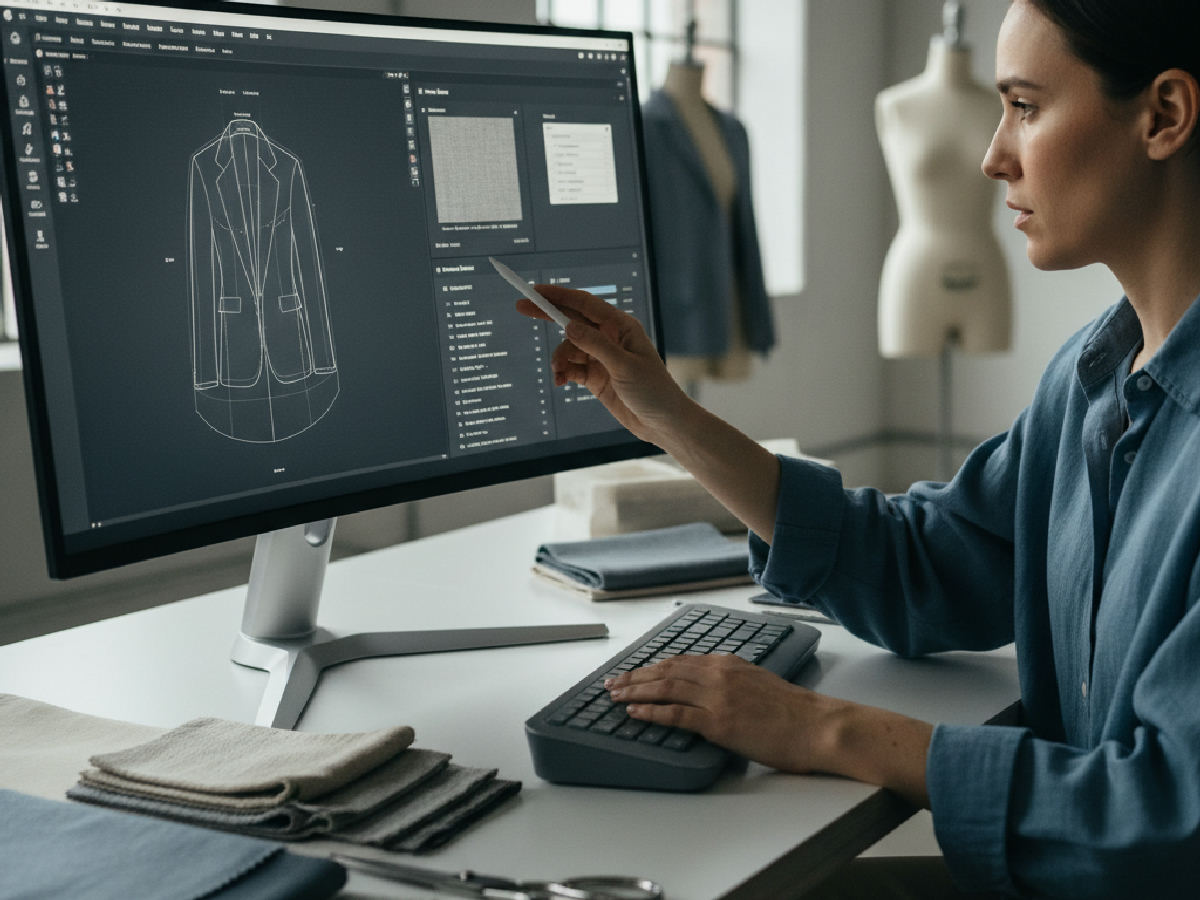
Technical teams can apply AI to enhance precision in pattern creation and grading. Traditionally, pattern makers rely on manual adjustments and years of experience for fit accuracy, consuming valuable time and resources. AI-driven systems can now automate these repetitive and calculation-heavy processes, allowing technical designers to focus on refining key creative elements and complex construction challenges such as seam allowances and stitch types. This shifts their role from manual drafter to technical director, overseeing the AI's output and making high-level strategic decisions about a garment's make.
For instance, AI can analyze historical fit data, including customer return comments, 3D body scan measurements of fit models, and successful pattern tolerance adjustments from past collections, to predict potential fit issues. This enables teams to preemptively adjust patterns before cutting a single piece of fabric. This predictive capability drastically reduces the number of physical samples required, cutting down both time to market and the material wastage associated with multiple prototype rounds. The financial impact is direct, lowering the cost-per-style and de-risking new product introductions.
What this looks like in practice: Take a technical designer at a 200-SKU contemporary brand. Using an AI platform that integrates with their existing CAD software like Gerber AccuMark, they start by inputting design sketches and base blocks into the system. The platform generates initial patterns and predicts that the armhole on a new blazer design will likely cause pulling across the back, based on return data from a similar style last year. The designer reviews the AI's suggested adjustment on a 3D avatar of their fit model, makes a minor change to the shoulder slope digitally, and approves the pattern. This reduces physical sampling rounds from five to just two, saving weeks and over $1,500 in associated costs for that single style.
Common pitfalls: While AI significantly improves efficiency, it can lead to complacency among teams who may rely too heavily on automated predictions without critical oversight. It is essential for technical designers to remain engaged, question the outputs, and validate AI-generated patterns with targeted real-world fit tests. A recommended best practice is to institute a mandatory physical fit session for the first production run of any new pattern generated primarily by AI, creating a crucial human checkpoint before mass production.
In-house designer? Make AI fashion design survive the factory.
The F* Word turns a real-time trend into a brand-aligned moodboard and a factory-readable tech pack. What you design is what the factory makes. Free to try.
Translating a design sketch into a precise, manufacturable pattern is a critical task for technical designers and pattern makers. AI platforms can interpret a 2D sketch or 3D model using computer vision to generate an initial pattern, complete with initial grading rules and construction notes. By mapping design elements like pocket types, collar shapes, and seam lines to a brand's existing library of construction guidelines and blocks, AI assists in producing more accurate and consistent initial patterns. This ensures that brand DNA is built into the garment from the very first step.
For example, when a designer uploads a sketch of a new dress silhouette, the system can automatically generate a comprehensive tech pack. This document includes detailed point-of-measure (POM) charts, fabric recommendations based on drape analysis, and even suggests construction alterations based on past collections' performance. If a similar dress had issues with a stretched-out neckline, the AI can flag it and recommend adding interfacing or changing the seam type. This accelerates the pattern development process and enhances accuracy by embedding lessons from previous seasons.
What this looks like in practice: Consider a pattern maker at a fast-fashion retailer facing immense pressure to shorten lead times. They receive a new shirt design and upload the flat sketch to their AI platform. The system provides a preliminary pattern and flags that the specified poplin fabric has a different shrink rate than what was used in the base block. It instantly adjusts the pattern pieces with a 0.5% differential scaling to compensate. With AI's suggestions, the pattern maker finalizes a production-ready pattern that accounts for manufacturing realities in under an hour, reducing the initial pattern creation time by over 70% compared to manual drafting.
Common pitfalls: There is a risk of AI-generated patterns not fully aligning with creative intent if the system is not properly trained on the brand's unique style language and aesthetic nuances. A system trained on mass-market data may struggle with the subtle details of a luxury brand. Continuous refinement of AI algorithms, involving technical designers curating the data and providing feedback on pattern outputs, is crucial to maintain brand integrity and prevent a generic look.

Fit is paramount in fashion, and AI offers significant advancements in the complex processes of grading and fit adjustment. By using vast datasets of body scans and size-specific sales data, AI can optimize grading for various sizes, ensuring consistency and a better fit across a collection. Traditional grading often uses linear increments, which can distort the proportions of a garment in smaller or larger sizes. AI can apply non-linear, algorithmic grading rules that better reflect the true variations in human body shapes.
Advanced AI systems, often found in 3D design software like CLO 3D and Browzwear, can simulate how different fabrics will behave on a digital avatar. These platforms can account for fabric weight, stretch, and drape, providing technical designers with hyper-realistic insights into how a garment will hang or pull. This simulation capability allows technical designers to make informed decisions about pattern adjustments, such as adding or changing darts, adjusting ease, and refining style lines, ultimately improving the fit and reducing the number of costly iterations during the sampling phase.
What this looks like in practice: Consider a technical designer at a luxury fashion house developing a bias-cut slip dress. They use AI to simulate the expensive silk charmeuse on a digital dress form modeled after their primary fit model. The simulation reveals that the side seam will twist slightly due to the fabric's properties. The AI suggests a minor 2-degree grainline adjustment on the pattern piece to counteract this. By making this precise digital adjustment, they perfect the drape before any physical samples are made, cutting down the grading and fit approval process by 50% and saving hundreds of dollars in wasted fabric.
Common pitfalls: While AI provides strong predictive capabilities, reliance on outdated or incomplete data can lead to significant inaccuracies. For example, if a brand changes its core body measurements or fit model, the AI must be retrained with the new data to remain effective. It is crucial for teams to continually update their datasets with new body scan information and fit session feedback. Implementing a quarterly data audit and validation process, where AI predictions are checked against physical samples, helps avoid costly missteps in production.
Integrating AI into the BOM (Bill of Materials) and construction notes process offers a powerfully streamlined approach for technical designers. This is where the true operational control of AI becomes evident, moving beyond visuals into the core of the tech pack. AI systems can automatically populate BOMs with accurate fabric requirements, trim details, and construction notes derived from the initial design input and pattern data.
This automation minimizes the human errors that typically occur during manual data entry and ensures that technical packs are comprehensive, accurate, and ready for production. For example, if a jacket design requires specific thread types, button sizes, and stitch lengths, AI can pull this information directly from the brand's component library and insert it into the BOM and corresponding callouts on the pattern, reducing the risk of miscommunication with manufacturers.
AI tools can connect directly with a company's PLM or ERP system to generate a highly accurate BOM. When a pattern piece is resized, the AI instantly recalculates fabric consumption, providing an updated yield that is far more precise than manual estimates. It can also check real-time inventory levels for specified trims like zippers and buttons. If a selected component is low in stock or has been discontinued by the supplier, the system can flag it and recommend pre-approved alternatives, preventing production-line shutdowns due to unforeseen material shortages.
Consistency in how construction techniques are communicated to factories is vital for quality control. AI can help create and enforce a brand-wide library of standardized construction callouts. When a technical designer indicates a "welt pocket" on a garment, the AI can automatically pull the approved multi-step instructions, technical diagrams, and even short video tutorials for that specific construction into the tech pack. This ensures every factory, regardless of location or language, is working from the exact same set of instructions, leading to higher product consistency.
What this looks like in practice: A technical designer at a mid-tier brand uses an AI-powered platform to integrate design revisions directly into the tech pack. Once the design team finalizes a new jacket, the AI updates the BOM with precise material quantities based on the graded nest. It also flags that the specified zipper is out of stock and suggests a compatible, approved alternative from a secondary supplier, complete with updated costing. This entire process of updating the tech pack and BOM is reduced from a full day of manual work to just a few minutes of review and approval.
Effective collaboration between technical teams and creative designers is crucial for successful product development, but it is often fraught with friction. AI facilitates a more harmonious and efficient partnership by providing a common visual and data-rich platform where both teams can access real-time updates and modifications. This ends the chaos of managing feedback across emails, spreadsheets, and physical sample notes.
One of the biggest challenges in product development is version control. An AI platform acts as a single source of truth, housing the live tech pack, 3D model, and all associated feedback. When a pattern maker adjusts a seam, the change is instantly reflected in the 3D model that the creative director is viewing. When the designer leaves a comment on the 3D render, it is linked directly to the specific pattern piece for the technical designer to see. This complete transparency ensures that all stakeholders are working from the most current information, eliminating costly errors that arise from referencing outdated documents.
Instead of waiting weeks for a physical sample to arrive to provide feedback, AI enables an almost instantaneous feedback loop. Creative designers can drop comments, draw annotations, and request changes directly onto a high-fidelity 3D garment. The technical designer receives this feedback in a structured, actionable format within the same system. Some advanced AI can even interpret text-based feedback like "make the waist more fitted" and suggest a specific pattern adjustment, which the technical designer can then review, modify, and apply with a single click. This transforms the iteration cycle from weeks to hours.
What this looks like in practice: At a high-street fashion brand, designers and technical teams use a shared AI dashboard. A designer reviews a 3D render of a new blouse and leaves a comment: "The puff sleeve needs more volume." The comment is geo-tagged to the sleeve area. The technical designer sees this, and the AI suggests a specific pattern modification to the sleeve head to increase fullness. The technical designer accepts the suggestion, and the 3D render updates in seconds for the designer to approve. This tight, collaborative loop results in a 40% faster development cycle and a final product that better matches creative intent.
Looking to the future, The F* Word's platform exemplifies how AI for fashion technical design will evolve. By offering tools that integrate smoothly into existing workflows that use systems an apparel brand already has, the platform equips technical designers to maintain control over their specifications while benefiting from AI's efficiencies. The focus is not on replacing the technical expert, but on augmenting their skills with powerful predictive and automation capabilities.
The F* Word focuses on delivering measurable business outcomes by reducing sampling rounds through its predictive fit analysis, expediting tech pack creation with its BOM and construction automation, and enhancing trend responsiveness by shortening the entire design-to-production calendar. This powerful combination of speed and accuracy positions brands to better manage inventory, reduce the need for end-of-season markdowns, and ultimately enhance profitability and market share.
Future Outlook: As AI continues to mature, The F* Word anticipates further advancements in areas like real-time, in-design cost prediction and generative AI for marker making that maximizes fabric efficiency. These developments will continue to equip brands to adapt more swiftly to market shifts and consumer demands while maintaining the high-quality production standards their customers expect.
The transition from design to manufacturing is a critical stage where small misinterpretations can lead to large-scale errors. AI can significantly improve the clarity and efficiency of this handoff. By ensuring that tech packs are detailed, accurate, and interactive, AI minimizes the chances of errors during production. Tech packs can include multi-language support and even embed short videos for complex assembly steps, leaving no room for ambiguity. This precision is especially crucial in QA workflows, where AI can help in setting clear, data-driven quality benchmarks based on historical data and predictive analytics.
For example, AI can analyze data from past production runs to identify which measurements have the highest variance and therefore require stricter QA checks. During production, AI can track variations using computer vision and provide alerts for deviations from quality standards. This proactive approach allows factory managers and brand QA teams to address potential issues before they escalate, ensuring that final products meet both design intent and quality expectations consistently.
What this looks like in practice: In a global apparel brand, AI systems are integrated into the QA process. At the end of a sewing line, an AI-powered camera system scans each finished garment, measuring key points of measure like chest width and sleeve length against the approved tech pack tolerances. Any garment deviating by more than the specified 0.5-inch tolerance is automatically flagged and diverted for review by a human QA inspector. This results in a measurable reduction in defective units passing inspection and a faster, data-backed response to quality issues, enhancing overall production efficiency.
The introduction of AI in technical design enhances efficiency and significantly impacts cost structures. By reducing the number of physical samples from an average of five to just one or two, brands can achieve substantial cost savings, often up to $2,000 per style in fabric, shipping, and fit model fees. AI-driven marker making can also optimize fabric layouts to reduce waste by an additional 3-5%, which translates into millions of dollars saved annually for a large brand. These efficiencies facilitate better resource allocation and more strategic financial planning.
Adopting AI successfully requires a cultural shift within teams, moving from fear of replacement to an appreciation for augmentation. It is essential to involve all stakeholders, from pattern makers to technical designers, in the transition process to ensure smooth integration. The key is to frame AI as a tool that handles tedious tasks, freeing up experts to focus on the creative and strategic parts of their jobs. Training sessions, phased rollouts starting with a single product category, and establishing internal "AI champions" can help build an environment of continuous learning and adaptation.
What this looks like in practice: A medium-sized fashion label implements AI across its design and technical teams. They conduct role-specific training sessions: one for pattern makers on the AI-assisted pattern drafting and grading tools, and another for technical designers on the automated tech pack and collaboration features. By clearly demonstrating how the tools reduce manual data entry and rework, they gain team buy-in. Within six months, they achieve a 30% reduction in average product development costs and a 20% increase in overall team productivity.
The differences between traditional and AI-powered workflows are not just incremental, they represent a fundamental shift in speed and cost efficiency. The traditional process is linear and plagued by long wait times for physical samples, while an AI-powered process is digital, collaborative, and iterative. The following table illustrates the potential operational impact on key metrics for a typical style, showing how AI transforms the workflow.

The dramatic reduction in revision cycles comes from the ability to visualize, test, and correct fit and construction issues in a digital environment, eliminating entire rounds of physical sampling. This speed directly translates to a shorter "Time to Factory," allowing brands to react to trends faster. The "Cost per Style" plummets because fewer resources are spent on sample materials, express shipping, and the labor hours associated with manual rework and data entry.
AI enhances pattern accuracy by analyzing design elements and aligning them with a brand's established construction standards and fit blocks. It goes beyond simple geometry by considering fabric properties like weight, stretch, and drape in its calculations. By integrating historical data and predictive analytics, AI minimizes common human errors and increases efficiency, leading to more reliable and consistent outcomes from the very first draft. This also allows for a drastic reduction in physical sampling, saving both time and resources.
AI is a tool that assists pattern makers by automating repetitive and time-consuming tasks, allowing them to focus on more complex, creative decisions. While AI can optimize a standard pattern, it cannot replicate the intuition or "hand" of an experienced pattern maker, especially their ability to solve novel construction puzzles or perfect the drape of an avant-garde design. Human oversight ensures that creativity and artistry are preserved. Pattern makers remain indispensable for nuanced decisions that require artistic judgment and a deep understanding of the physical properties of textiles.
AI may struggle with interpreting highly creative or abstract design concepts that lack clear data points for analysis, as it learns from historical examples. Current systems are also limited by the quality of the data they receive; inadequate, biased, or outdated data can lead to flawed outputs. some AI models can act as a "black box," making it difficult to understand the reasoning behind a suggestion, which can complicate troubleshooting. Thus, AI should be viewed as a complement to human expertise, not a standalone solution. Regular updates and human validation of AI outputs are essential to maintain accuracy.
Brands must treat their data as a living asset and regularly update datasets to ensure AI systems remain relevant and accurate. This involves creating an automated feedback loop, integrating data from PLM, ERP, and e-commerce platforms, including customer reviews and return reason codes. It also requires a process for periodic reviews of the input data and incorporating qualitative feedback from fit sessions and factory floor reports. By establishing this continuous improvement cycle, brands can maintain the accuracy and applicability of their AI systems, building an adaptive and responsive design process.
AI contributes significantly to sustainable fashion by tackling waste and inefficiency head-on. It optimizes production processes to reduce material waste through more precise fabric consumption calculations and advanced marker making. It enables more accurate inventory management by shortening lead times and improving forecast accuracy, which helps minimize overproduction. This strategic use of resources leads to a more environmentally friendly and cost-effective production cycle. In the future, AI will also be critical for managing digital product passports, tracking a garment's lifecycle from raw material to end of life.
Related: ai pattern software decision tree
Get The F* Word workflow insights in your inbox.