

Over 70 percent of initial brand experiments with generative AI focus exclusively on visual outputs, from mood boards to synthetic model photography. While these explorations produce compelling imagery, they stop short of delivering tangible business value. The novelty of creating photorealistic AI fashion models on demand is powerful. Yet, it distracts from the far more critical challenge: transforming a creative concept into manufacturable product data. For founders and product leaders, the key is not generating more images, but building a faster, more accurate path from design intent to production order.

The current hype cycle around AI in fashion centers on visually impressive demonstrations. We see AI-generated runway shows, infinite digital models, and AI-assisted textile pattern creation. These are excellent for marketing a tool or generating social media engagement. They are, however, insufficient for running a fashion business. The core operational loop of a brand is not about making pictures. It is about specifying, costing, producing, and selling physical goods.
A beautiful image of a never-before-seen trench coat on an AI model is an asset with a short half-life. It represents a creative idea, but it provides almost zero information required for production. Your technical designer still must start from scratch. They must interpret the 2D image, guess the seam placements, estimate fabric consumption, define the internal construction, and build a technical package. The AI-generated image creates more work downstream, it does not reduce it. This process of manual interpretation introduces errors, adds weeks to the development calendar, and inflates sample costs.
This is the fundamental disconnect. Visual-first AI tools treat the image as the final output. For a fashion brand, the image is the starting point. The real work is translating that image into a structured, data-rich object that a factory can understand. Focusing on AI fashion models and renderings alone is a strategic misstep. It optimizes for the least valuable part of the product creation cycle while ignoring the most costly and time-consuming stages. The result is a pile of pretty JPEGs and the same old production bottlenecks you had before.
Merchandiser? Ship a launch where the deck and the factory match.
The F* Word connects moodboards, tech packs and merchandising prep, so your launch story and the factory order tell the same story. Free to try.
Comparing Visual-First AI with Production-First AI Workflows


Moving beyond visuals means focusing on the atomic unit of modern apparel manufacturing: structured product data. A production-ready asset is not a file. It is a connected web of information that describes a product with absolute clarity, leaving no room for factory interpretation. It contains several critical layers that visual-only AI tools simply cannot produce.
First is the geometric data. This includes the 3D model of the garment itself, but more importantly, the flattened 2D pattern pieces derived from it. These are not just shapes. They are digital files, often in DXF format, that can be fed directly into a factory's cutting machines. This layer also includes precise measurement points and grading rules that define how the pattern scales across your entire size range, from XS to XXL.
Second is the material and component data, commonly known as the bill of materials (BOM). A production-ready BOM is not a simple list. Each item, from the main body fabric to the zipper pull, is a data object with its own attributes: supplier SKU, material composition, color code (like Pantone), and unit cost. A truly smart system links this BOM directly to the geometric data. It knows exactly how many yards of a specific fabric are needed for a size Medium, because it can calculate the surface area of the pattern pieces. To learn about the fundamentals, our page on what AI fashion design is provides a good foundation.
Third is the construction information. This is the "how-to" manual for the factory. It details stitch types (e.g., 5-thread overlock), stitches per inch, seam allowances, and detailed callouts for complex operations like attaching a welt pocket. In a production-first system, this information is not just text in a PDF. It is structured data linked to specific points or seams on the 3D or 2D model. For example, a note about bar-tacking can be programmatically attached to the exact coordinates of a belt loop on the pattern.
When these three layers are generated together in an interconnected format, they create a 'digital twin' of the product that is immediately actionable. This is what production-ready means. It is a complete, unambiguous, and machine-readable instruction set that shortens development cycles, slashes sample costs, and forms the foundation of a truly agile supply chain.
When evaluating AI tools for your brand, it is critical to ask the right questions. Your goal is to separate the marketing gimmicks from the production-ready systems. Avoid getting distracted by beautiful outputs and focus on the data and workflow integration. Use this framework to guide your assessment.
By asking these pointed questions, you shift the conversation from "what can it make look pretty?" to "how does this reduce my cost of goods and time to market?". The answers will quickly reveal which platforms are toys and which are professional tools.
Adopting a production-first AI strategy does not require an immediate overhaul of your entire organization. It can be implemented incrementally to prove value and build momentum. The first step is to reframe the objective. Your goal is not to "use AI". Your goal is to reduce the lead time from design approval to a production-ready tech pack by a specific percentage, for example, 50 percent in the first six months.
Begin with a tightly scoped pilot project. Select a single, simple product category, like jersey t-shirts or basic woven bottoms. These products have established construction methods and fewer components, making them ideal for testing a new workflow. The aim is to use a production-first AI platform to take one new design from a prompt to a complete tech pack, including the BOM, graded spec, and initial pattern files. Document the time and resources required, and compare it directly to your existing manual process.
Next, focus on a single metric: speed. Measure the time it takes to create a "first-pass" tech pack. In a traditional workflow, this can take days or weeks of back-and-forth between design and technical teams. With a production-first tool, the goal is to generate this in under an hour. While the initial output may need refinement, you have immediately saved a significant amount of coordination time.
Finally, empower a small, cross-functional team to own the pilot. This team should include a designer, a technical designer, and a merchandiser. They can provide real-time feedback and champion the new process. Their hands-on experience will be invaluable for identifying integration challenges and building a business case for a wider rollout. The focus should always be on measurable improvements to core business metrics, not on the novelty of the technology itself.
The conversation about AI in fashion is maturing past generating inspiration. The next frontier is about execution and efficiency. By focusing on production-ready data instead of just pretty pictures, you can build a more resilient, profitable, and agile brand. Start free at thefword.ai or book a demo.
Pretty model images live at the top of the funnel. The launch workflow is what turns a moodboard into a PO, a sample, a PDP, and a sell-through report. Six stages, in order, each with the artifact it produces.
Table 1. Six stages from concept to launch, with the artifact each stage owes the next.
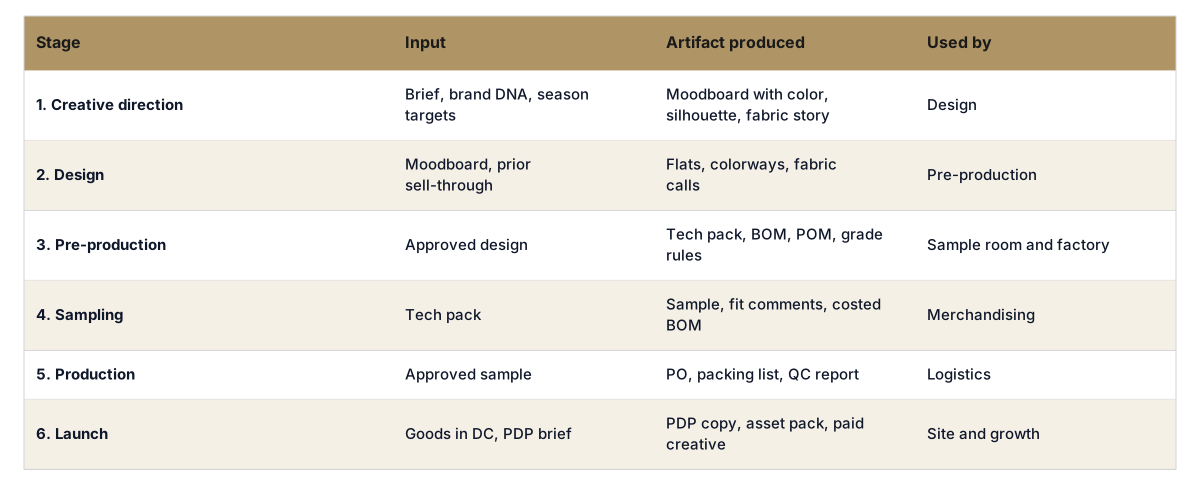
A try-on image is an asset that lives in stage 6. Everything that decides margin lives in stages 3, 4, and 5. The brands that get this right keep the product data (BOM, POM, grading, costing) connected to the launch asset so a re-color in stage 6 does not require re-doing stage 3. See the full merchandising and launch workflow, and why structured product data is the prerequisite for any of this to compound.
Yes, AI-generated models can be a cost-effective tool for creating on-model imagery without photoshoots. This is a valid use case for marketing departments. However, this function is separate from product development and does not solve the core bottlenecks in getting a product from concept to factory floor.
No, these tools augment and accelerate the work of skilled professionals. A production-first AI system handles the repetitive and data-entry heavy tasks, freeing up designers to focus on creativity and technical designers to focus on complex fit issues and quality control. It turns your team into editors and decision-makers, not data clerks.
The cost extends beyond the software license fee. You should account for the time spent on team training and the resources needed for integration with your existing systems like PLM or ERP. The return on this investment comes from reduced sample costs, faster speed to market, and fewer production errors.
Modern production-first platforms are built with user-friendly interfaces, similar to other professional software. While a technical designer will harness its full power, a designer or merchandiser can operate the core functions. The key is an understanding of product development principles, not coding or data science skills.
Related: AI Model Photoshoot Alternatives: What Works Best in 2026
Get The F* Word workflow insights in your inbox.