
English
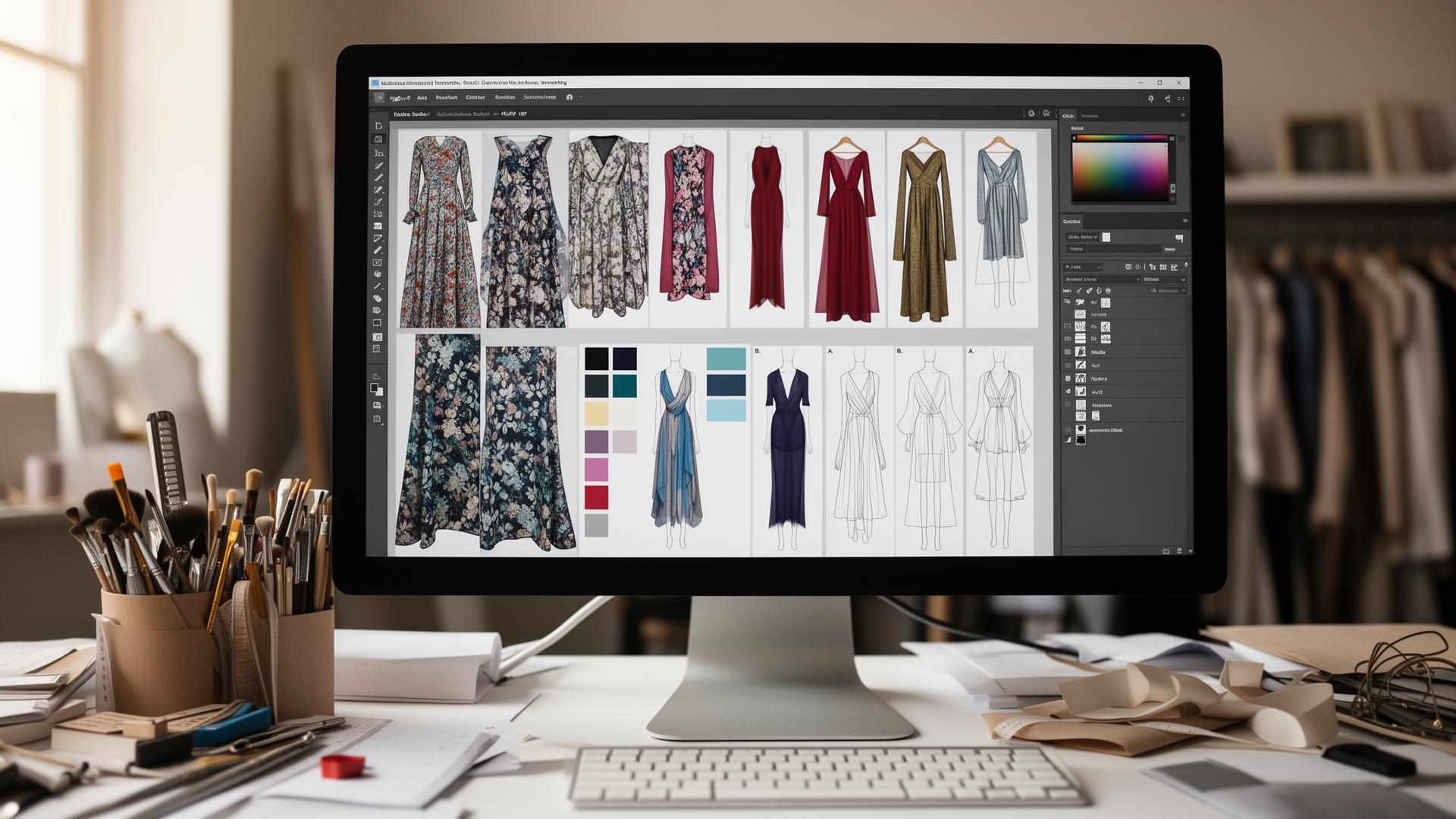
TL;DR. AI fashion mood board creation automates and accelerates the translation of creative concepts into actionable design artifacts. Instead of manual image sourcing and collage assembly, AI platforms analyze vast datasets to generate brand-aligned visual narratives instantly. This process directly connects the moodboard to the initial tech pack, populating key details like color palettes, fabric textures, and silhouette directions. For creative directors and product development teams, this means significantly reduced lead times, data-validated creative direction, and a more direct path from initial idea to factory-ready specifications. The result is a faster, more efficient, and strategically sound design workflow that minimizes subjective interpretation and costly rework.
Traditionally, the mood board is the foundational canvas of a fashion collection. Creative directors and designers manually curate a physical or digital collage of images, fabric swatches, color chips, and text to establish a collection's aesthetic direction. This process is tactile, personal, and deeply rooted in the creative process. It serves as the visual north star for all subsequent design, development, and merchandising activities, communicating a feeling and a story that words alone cannot.
However, this manual method is fraught with operational challenges. It is incredibly time-consuming, relying on hours of searching through magazines, online platforms like Pinterest, and internal archives. The process can be subjective and prone to creative blocks, making it difficult to scale or iterate quickly. also, translating the abstract feeling of a mood board into precise technical specifications for a tech pack is a significant point of friction, often leading to misinterpretations between the design team and technical designers.
AI introduces a shift, transforming the mood board from a static collage into a dynamic, intelligent, and productive tool. By processing immense volumes of visual data, AI can generate cohesive, trend-aware mood boards in moments, not days. This is not about replacing creative intuition but augmenting it with data-driven insights. AI acts as a powerful assistant, helping teams explore more creative avenues, validate concepts against market trends, and most importantly, create a direct, machine-readable link between the creative vision and the production-ready tech pack.
For a creative director, the primary challenge is to forge a compelling visual narrative that is both innovative and true to the brand's DNA. AI-powered mood board creation directly streamlines this critical function. AI systems can synthesize a brand's entire historical catalog, its stated brand values, and real-time market data to propose visual directions that feel both fresh and authentic. This allows creative leaders to move beyond simple gut-feel decisions and validate their instincts with quantitative analysis, ensuring every concept is strategically sound.
AI's capacity for synthesis is a core advantage. It can identify non-obvious connections between disparate sources of inspiration, from 18th-century art to a specific subculture trending on social media, and weave them into a coherent visual theme. This process uncovers white space opportunities and helps define a unique aesthetic that competitors cannot easily replicate. For brands, this ensures cohesion across a collection and from one season to the next, reinforcing a strong and recognizable brand identity in a crowded market.
The speed of AI-driven iteration is also a profound asset. A creative director can generate and refine multiple distinct mood boards for a single collection in a single work session. This facilitates rapid A/B testing of concepts with key stakeholders, like merchandisers and product development managers, long before any resources are committed to sketching or sampling. This front-loading of the validation process eliminates weeks from the product development calendar and de-risks the entire collection by ensuring commercial viability and brand alignment from the very start.
Modern AI tools go far beyond the capabilities of a simple collage generator. They function as sophisticated data-processing engines, continuously analyzing millions of data points from global runway shows, street style blogs, social media platforms, and e-commerce sites. This constant stream of information allows the AI to develop a nuanced understanding of fashion aesthetics, identifying micro-trends as they emerge and predicting which visual motifs are likely to resonate with specific consumer demographics.
Advanced features include intelligent image sourcing that looks for conceptual and aesthetic matches, not just keyword similarities. For instance, a user can provide a core image of a garment silhouette and the AI can find architectural forms, natural textures, and color palettes that complement its structure and mood. Some platforms offer predictive trend analysis, highlighting which silhouettes or colorways are gaining traction and providing data to back a design choice. This transforms the mood board from a collection of "what-ifs" into a strategic document built on forward-looking insights.
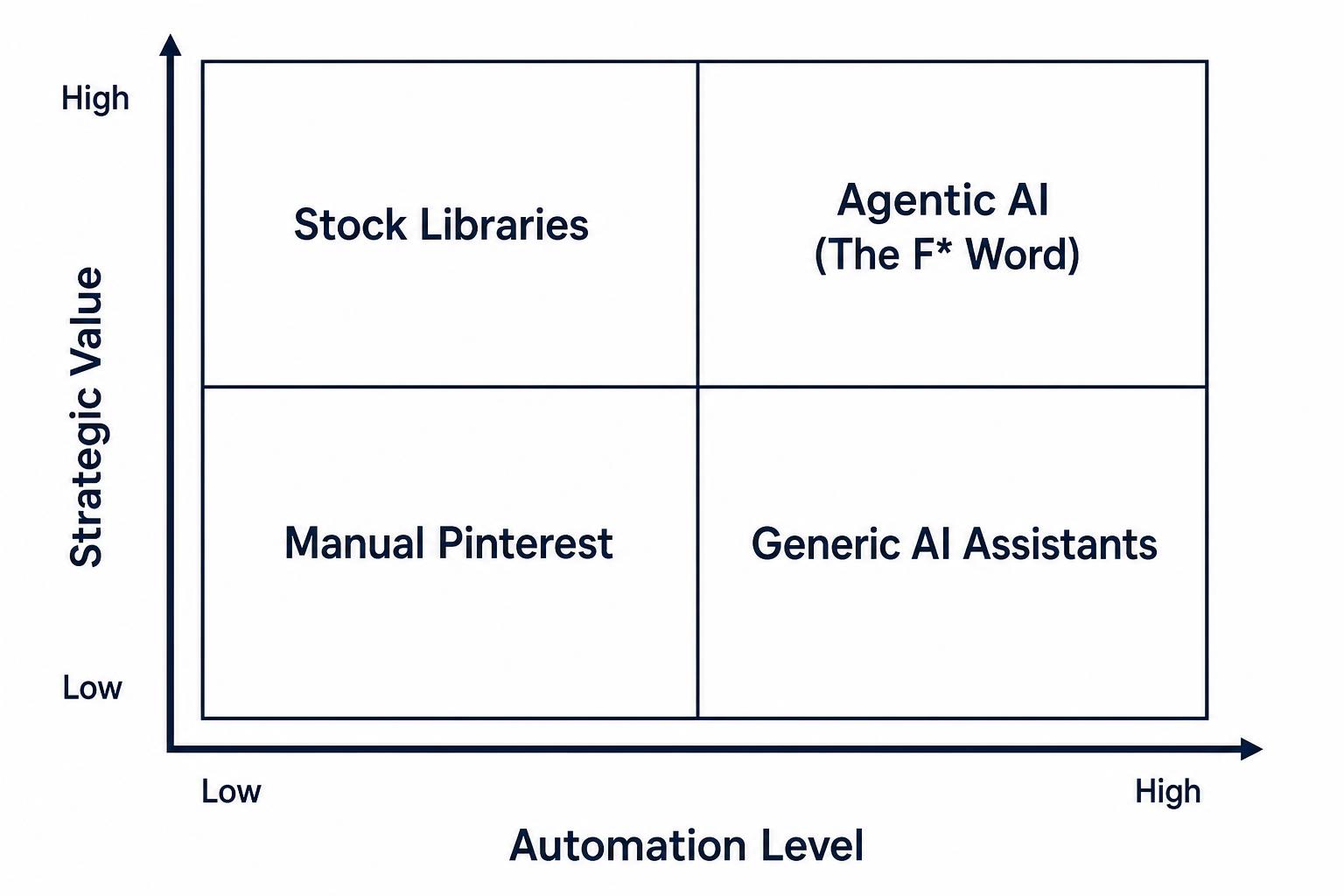
A 2x2 diagram mapping fashion design tools. The y-axis represents Automation Level (Low to High) and the x-axis represents Strategic Value (Low to High). Manual tools have low automation, while orchestration platforms like The F* Word deliver high automation and high strategic value by connecting concepts to production.
The true power lies in the ability to define and visualize highly specific aesthetics on demand. A creative director can input complex prompts like "a minimalist coastal grandmother aesthetic infused with 1990s Japanese workwear details for a Fall/Winter collection." The AI will not just find images matching those keywords but will generate a cohesive board that synthesizes these ideas into a novel, tangible visual direction. This moves beyond browsing existing templates and enables the creation of truly unique and defensible brand narratives, ready to be translated into product.
The market for AI-powered creative tools is expanding rapidly, but not all platforms are created equal, especially for the specific needs of a professional fashion brand. When evaluating solutions, product development and creative teams must look beyond superficial image generation features. The critical question is how well the tool integrates into the end-to-end product creation workflow. A tool that produces beautiful images but leaves the technical designer to manually interpret them offers limited operational value.
Key differentiators for fashion professionals include the platform's data sources, its understanding of fashion-specific concepts (like garment construction, fabric types, and trims), and its ability to output structured data. The most valuable platforms are those that help create the mood board and use it as a direct input for the next stage of the process, such as populating the Bill of Materials (BOM) in a tech pack. This smooth transition from creative vision to technical specification is what separates a novelty tool from a core piece of enterprise infrastructure.
This comparison focuses on the operational impact of different categories of tools. Generic design platforms and specialized image generators serve a purpose for marketing and early-stage brainstorming. However, workflow orchestration platforms are designed specifically to accelerate the concept-to-production lifecycle for fashion brands by treating the mood board as the first step in an autonomous, integrated process.
Integrating AI mood boarding into the fashion product lifecycle requires a shift in thinking from a linear, siloed process to a connected, data-driven workflow. The first step is to establish the AI mood board as the single source of truth for a style's creative intent. When a mood board is finalized, it should not be emailed as a PDF but rather confirmed within an integrated system. This confirmation triggers downstream automations, immediately making the validated visual data available to other teams.
The most critical integration point is between the AI mood board and tech pack generation. An advanced workflow platform like The F* Word uses the AI-generated mood board to pre-populate the tech pack. Identified core colors are translated into Pantone codes, fabric textures suggest specific material compositions and weights for the BOM, and key silhouette images inform the initial points of measure (POM) for the garment spec sheet. This automation removes the manual, error-prone step of a technical designer interpreting a creative brief, ensuring the first sample is far closer to the original vision.
This connectivity extends beyond pre-production. For merchandising and product launch teams, the AI-generated visual assets from the mood board phase can be used to rapidly create e-commerce placeholder images, PDP (Product Detail Page) visual guidelines, and even social media content. This allows marketing and sales efforts to begin parallel to the sample development process, not after it. By using the AI mood board as a central, machine-readable asset, brands can synchronize creative, technical, and commercial activities, collapsing the overall time to market.
The quantifiable impact of AI-driven mood board creation on a brand's operational efficiency is substantial. By automating the laborious tasks of image sourcing, composition, and trend research, design teams can reduce the time spent on initial concept development from weeks to mere hours. This compressed timeline allows brands to be more agile, responding to emerging micro-trends with speed and launching capsule collections that capture market demand in real-time. It also frees up creative teams to focus on higher-value tasks like refining brand strategy and innovating on core products.
One of the less obvious benefits is the reduction of subjective bias and endless feedback loops. AI introduces a layer of data-driven objectivity to the creative process. When a mood board is supported by trend analysis and aesthetic coherence data, it becomes easier to gain alignment from stakeholders. This minimizes the "I'll know it when I see it" problem and reduces the number of revisions required, saving valuable time and preventing creative team burnout. Decisions are made faster and with greater confidence.
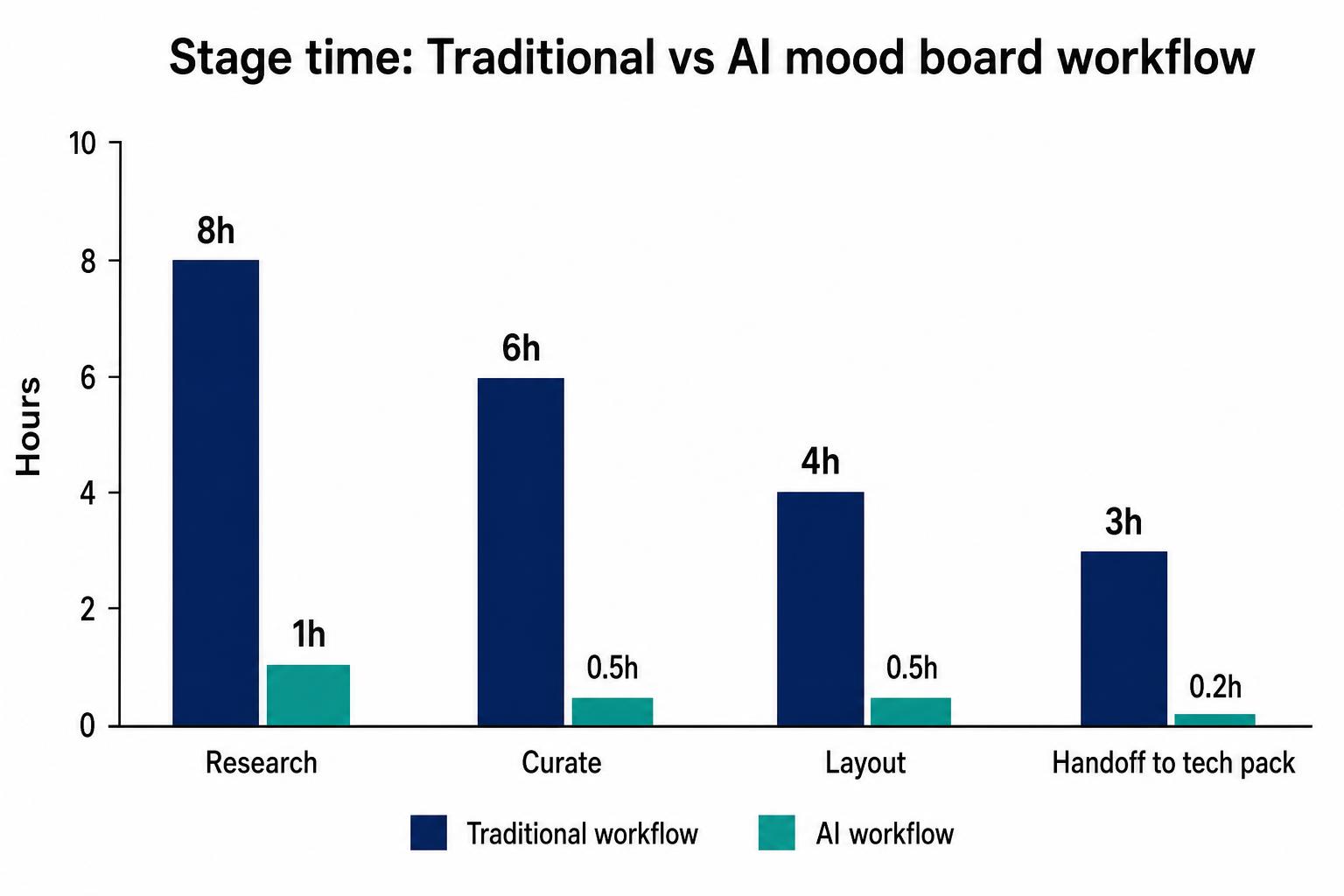
Efficiency Gains: AI Workflows vs. Traditional Methods. This chart illustrates how AI drastically shortens the early-stage design phases, accelerating the entire timeline from concept to the first tech pack draft and enabling faster speed-to-market.
The efficiency gains compound throughout the product lifecycle. A well-validated and clearly defined AI mood board leads to a more accurate first tech pack. This accuracy translates into fewer sample rounds, lower sampling costs, and reduced material waste. It also means less back-and-forth communication with factories to clarify design intent. When tracked from initial concept to final approval, the time savings can be dramatic, often cutting the pre-production calendar by 30-50% or more, a critical advantage in a fast-moving industry.
The F* Word is fundamentally different from other tools in the AI design space. We are not an image generator, a 3D modeling environment, or a replacement for your Product Lifecycle Management (PLM) system. Instead, The F* Word is the autonomous workflow and validation layer that sits between your initial creative idea and your factory-ready production artifacts. Our platform is purpose-built to solve the most significant bottleneck in fashion: the translation of creative intent into technical reality.
Our core function is to autonomously generate two critical, linked assets: a brand-aligned, data-validated mood board and a production-ready tech pack. You provide the high-level concept, and our AI does the work. It analyzes your brand's DNA and real-time market data to create a mood board that is both inspirational and commercially viable. Crucially, it then uses that validated mood board to instantly generate a detailed tech pack, complete with a BOM, measurement specs, and construction details.
This unique capability positions The F* Word as an orchestration engine. We connect the creative director's vision directly to the technical designer's and sourcing lead's workflow without manual handoffs or data reentry. This eliminates ambiguity, reduces error rates in initial samples, and removes weeks of administrative work from your calendar. By automating the creation and validation of these foundational documents, we help your brand design at the speed of culture and scale your product development process efficiently.
The role of the mood board in fashion is not diminishing; it is evolving. With the integration of AI, this once-static document is becoming a dynamic engine for speed, efficiency, and data-backed creativity. AI fashion mood board creation empowers brands to explore more ideas, validate them against market realities, and ensure brand cohesion with new speed. This is not just an incremental improvement but a foundational shift in how collections are conceived and developed.
By treating the mood board as the intelligent starting point for an automated workflow, brands can break down the silos that have long existed between creative, technical design, and merchandising teams. The result is a more agile, responsive, and profitable business model. Embracing these technologies is no longer an option for future consideration; it is a necessity for maintaining a competitive advantage in the modern fashion landscape.
The future of fashion design lies in the intelligent partnership between human creativity and machine intelligence. As AI continues to advance, its ability to support and accelerate the creative process will only grow, enabling brands to deliver more innovative and relevant products to market faster than ever before. This new era of design is not about replacing designers but about equipping them with tools that amplify their vision and operationalize their creativity at scale.
AI enhances traditional mood board creation by automating the time-consuming process of sourcing and curating images. It analyzes vast datasets to identify emerging trends, ensure brand aesthetic alignment, and generate cohesive visual narratives in seconds. This allows creative teams to focus on strategy and refinement rather than manual research. It also turns the mood board into a data-backed proposal, making it easier to gain internal alignment and accelerate decision-making before committing to production.
Yes. Sophisticated AI platforms like The F* Word are designed to learn and internalize a brand's unique DNA. By analyzing past collections, brand guidelines, and target consumer profiles, the AI can generate mood boards that are highly, not generic specific and authentic to the brand's voice. It helps prevent aesthetic drift by acting as a strategic guardrail, ensuring every new concept reinforces the core brand identity while still feeling fresh and innovative.
The primary limitation of many current tools is their lack of integration into the broader fashion workflow. Generic AI image generators or basic collage apps can create visuals but cannot translate them into actionable production data. This leaves a critical gap between the creative concept and the tech pack, requiring manual interpretation. True value comes from platforms that connect the mood board directly to the Bill of Materials and garment specifications, automating the handover to technical design.
The F* Word is not a generic image generator; it's a workflow automation platform. While tools like Midjourney or Firefly create standalone images, The F* Word autonomously generates a complete, factory-ready tech pack directly from a validated mood board. We are the orchestration layer that connects creative vision to technical specification without manual intervention. Our focus is on operational efficiency and speed to market for professional fashion brands, not just visual brainstorming.
AI for fashion analyzes a diverse and massive range of data. This includes millions of images from runway shows, street style from every major city, real-time social media trends, and product data from e-commerce websites. It also processes historical fashion archives and, importantly, a brand's own past collection data and brand identity guidelines. This comprehensive analysis allows the AI to identify both macro and micro trends and synthesize them into commercially viable, brand-aligned visual concepts.
AI mood boards streamline the entire lifecycle by serving as the machine-readable starting point for production. When a mood board is created on a platform like The F* Word, its elements (colors, textures, silhouettes) are used to automatically populate the tech pack. This eliminates weeks of manual data entry and interpretation by technical designers, reduces errors in the first sample, and shortens the number of required sample rounds, significantly cutting time and cost from concept to finished product.
Ready to move from abstract ideas to production-ready artifacts in record time? Build a brand-aligned moodboard and its corresponding tech pack autonomously with The F* Word. Explore our complete guide to AI-powered workflows at our AI Fashion Design pillar.
Get The F* Word workflow insights in your inbox.