.png)
English
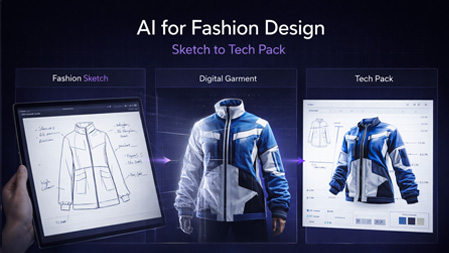
Most fashion teams lose weeks between sketch and sample.
A designer produces a concept sketch. The technical designer rebuilds the idea into a tech pack. The factory sends clarification emails. Measurements change. A new sample arrives weeks later.
Then the cycle repeats.
AI for fashion design is compressing this process. Instead of sketches living separately from production documentation, AI systems now translate design intent directly into structured technical information.
The result is simple but powerful. Designers move from concept to tech pack faster. Technical teams spend less time rebuilding documentation. Factories receive clearer instructions earlier in the development cycle.
The next phase of AI for fashion design focuses on exactly this gap between creative output and production readiness.
Traditional apparel workflows were never built for speed.
Inside most fashion companies the process looks like this:
The weak point sits between steps one and two.
A fashion sketch rarely includes the information factories actually need. It shows silhouette and style, but not seam construction, stitch type, grading, or measurement tolerances.
Technical designers rebuild that information manually.
A typical tech pack includes:
When that documentation is unclear, factories ask questions. Each clarification slows development.
AI fashion design systems now solve this translation problem.
The first generation of AI fashion tools focused on image generation.
Designers could produce hundreds of garment variations quickly, but those images remained disconnected from production workflows.
The new generation connects design and documentation.
AI models can analyze garment sketches, silhouettes, and reference images and automatically generate structured garment specifications.
These systems typically produce:
Instead of manually drafting tech pack pages, designers review and refine AI-generated documentation.
This reduces the amount of repetitive documentation work required during development.
Teams experimenting with these workflows often combine design tools with systems described in platforms like the AI fashion design product platform which connect design generation to production documentation.
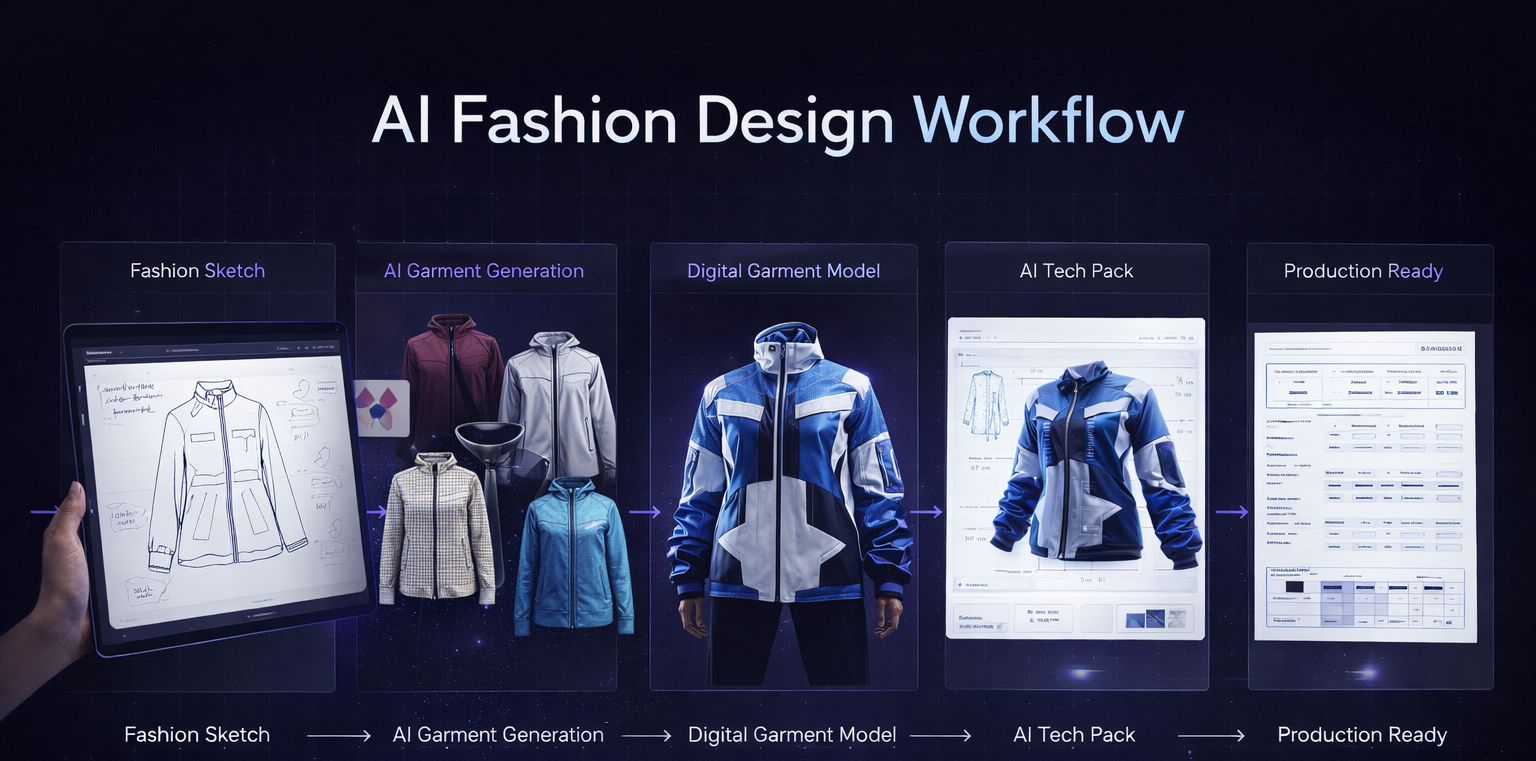
The biggest shift introduced by AI for fashion design is what can be called the Sketch-to-Pack Bridge.
The Sketch-to-Pack Bridge is a workflow model where AI converts visual garment concepts directly into structured technical documentation. Designers apply it by linking sketch tools, AI analysis models, and tech pack generators into one pipeline. When implemented well, design intent translates into specs automatically, reducing manual rebuild work for technical design teams. The trade-off is that AI-generated specs still require human review to confirm construction accuracy. Failure usually happens when brands treat AI outputs as final documentation instead of a starting point for technical refinement.
When teams adopt this bridge, the design process changes.
Creative exploration stays fast, but production documentation appears much earlier in development.
The impact shows up clearly in sampling cycles.
Sampling is one of the most expensive stages of apparel development.
Every new sample requires:
Reducing sampling rounds produces immediate cost savings.
Inputs
Sample rounds per style: 4
Average sample cost: $120
Styles per season: 100
Calculation
4 × $120 × 100
Result
Total sampling cost = $48,000
If AI for fashion design reduces sampling rounds by 25 percent:
3 × $120 × 100 = $36,000
Estimated savings: $12,000 per season
Large apparel brands running several hundred SKUs can see savings in the six-figure range annually.
Inside fashion companies, AI typically assists three key stages of the workflow.
Designers use AI to explore:
These outputs help designers test ideas faster during the early concept phase.
AI becomes more valuable once garments move toward production.
Tools generate:
Technical designers then refine and approve the documentation.
AI also supports merchandising teams.
Brands can generate:
These assets reduce the need for expensive photoshoots early in the product cycle.
AI for fashion design does not remove the designer from the process.
Fashion is deeply tied to taste, culture, and brand storytelling. Algorithms can generate variations but they cannot define brand identity or seasonal narratives.
The role of the designer evolves instead.
Designers spend less time drafting documentation and more time directing product strategy, shaping collections, and refining aesthetics.
Technical designers remain critical because garment construction still requires human expertise.
Factories still need precise instructions, and those instructions must reflect real manufacturing constraints.
AI helps translate ideas faster, but human teams still guide the final product.
The biggest advantage of AI for fashion design is operational speed. Faster tech packs, fewer sampling rounds, and clearer communication with factories shorten the entire apparel development cycle.
Brands experimenting with AI design workflows are already seeing these gains.
Explore the platform here: https://app.thefword.ai/
AI Fashion Designer System
https://thefword.ai/ai-fashion-designer-system
Explains how AI systems assist designers from concept generation to garment development.
Fashion Design Software in 2025: Top Tools for Digital Creators
https://thefword.ai/fashion-design-software-in-2025-top-tools-for-digital-creators
Breakdown of digital tools shaping modern fashion design workflows.
The F Word AI Product Platform
https://thefword.ai/product/
See how AI tools convert fashion sketches into tech packs, specs, and production-ready documentation.
Revolutionizing Streetwear Print On Demand
https://thefword.ai/revolutionizing-streetwear-print-on-demand-custom-designs-sustainability-and-ai-innovation
Explores how AI-driven production models are changing apparel manufacturing and product development.
101 People Reading our Newsletter Right Now!
