
TL;DR. Yes, you can generate factory-ready grading rules without a pattern maker by using an AI workflow platform. Instead of relying on a manually drafted base pattern, AI systems use a combination of detailed garment specifications, points of measure (POM), target body measurements, and algorithmic models trained on vast datasets of anthropometric data. This process directly computes the grade rules for each POM across a full size run, from a base size to plus or petite ranges. The AI outputs these rules into a complete tech pack, which also includes the bill of materials (BOM), construction details, and even visual guidance from a source moodboard, delivering a production-ready artifact to your factory in hours, not weeks.
In traditional product development, creating grade rules is a sequential, highly skilled, and often time-consuming task. The process begins after a style's fit is approved on a base size sample. A pattern maker then takes this approved base pattern and manually grades it, which means creating scaled versions of the pattern for every other size in the planned run. This requires deep knowledge of how the human body changes between sizes, an understanding of fabric properties, and careful attention to detail. A single mistake can lead to costly errors in production samples across the entire size range.
This dependency on a specialized pattern maker creates a significant bottleneck. Small brands and startups often cannot afford a full-time in-house pattern maker, forcing them to rely on expensive freelancers or factory-provided services, which can add weeks to the pre-production calendar. For larger brands, the sheer volume of SKUs means their pattern making teams are constantly overloaded. Every new style, every revision, and every expansion into new size categories (like plus, petite, or tall) requires this manual intervention. The result is a longer time-to-market, higher pre-production costs, and a process that is difficult to scale efficiently.
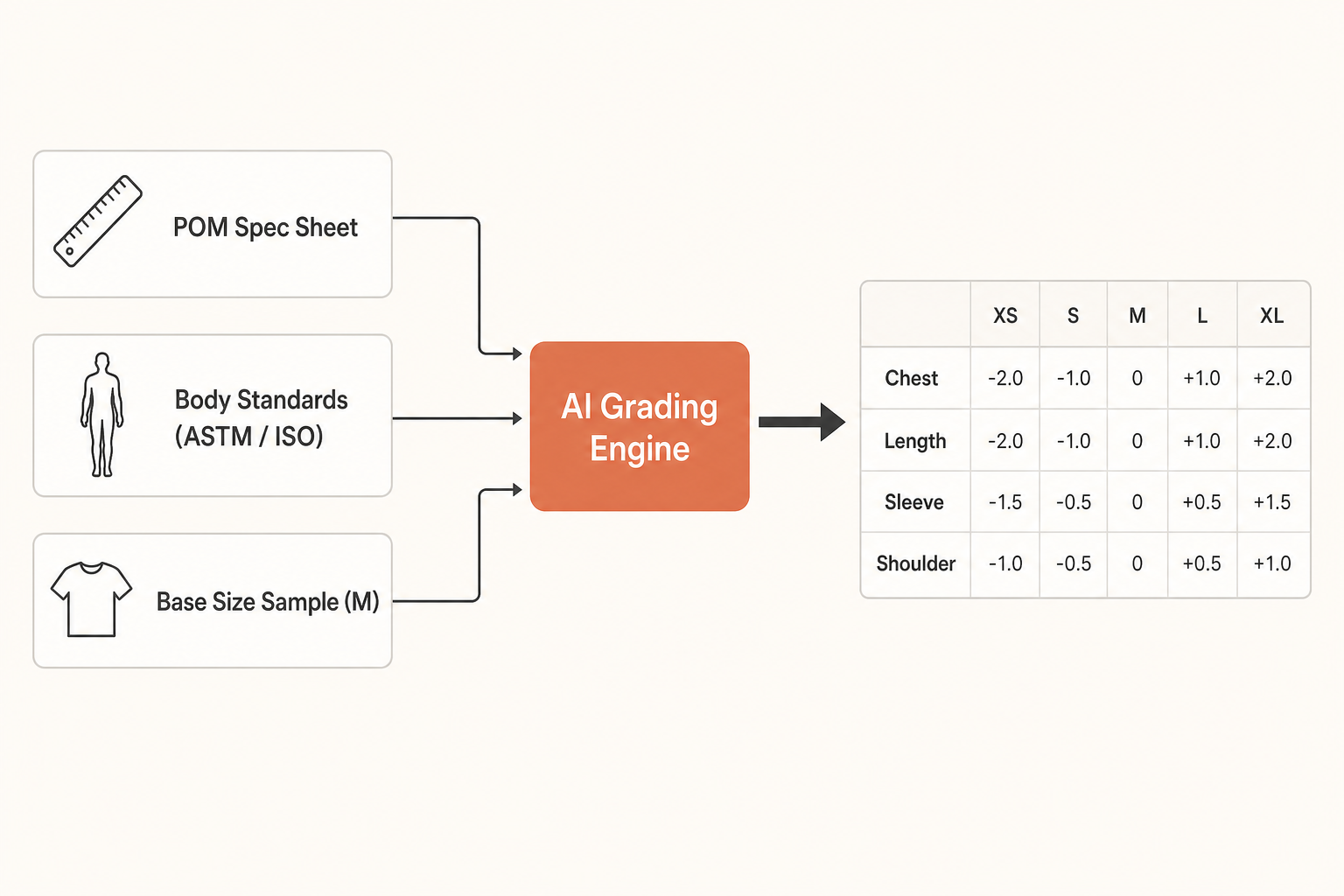
AI-driven grading fundamentally changes this paradigm by removing the dependency on a physical or digital base pattern as the starting point. Instead of scaling a pre-existing shape, AI platforms build the grade rules from a different set of inputs: data. The core inputs typically include the intended base size measurements (the POM spec), the desired size range, and a set of established body measurement standards, like ASTM or custom brand-specific standards.
The AI model processes these inputs, referencing vast datasets of 3D body scans and existing product measurements. It understands the complex, non-linear relationships between different points of measure. For example, it knows that as you grade from a size Medium to a Large, the chest circumference may increase by 2 inches, but the shoulder slope might only change by a fraction of an inch. It calculates the precise grade for every single POM, for every single size in the run, simultaneously.
This calculation happens algorithmically, ensuring consistency and adherence to the specified fit intent. The output is not a set of patterns, but a precise table of grade rules and finished garment measurements for each size. This table is the critical data that a factory needs to create their own production patterns. By focusing on the data (the measurements) rather than the artifact (the pattern), AI decouples grading from the manual craft of pattern making.
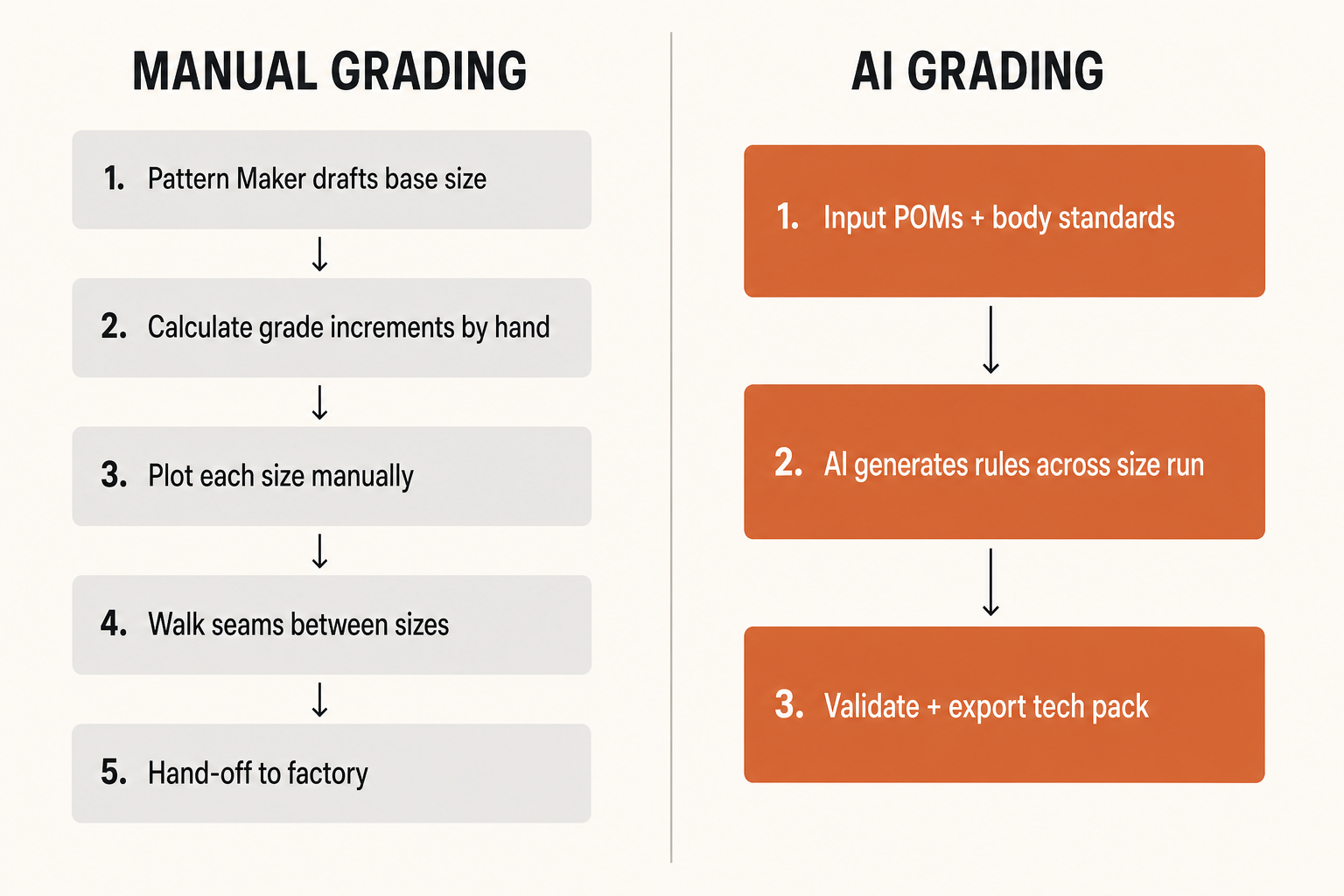
For AI to generate accurate grading, it needs a clear and structured set of instructions. The quality of the output is entirely dependent on the quality of the input data. Unlike a human pattern maker who can make intuitive judgments, an AI system requires explicit parameters. The two most critical inputs are the Points of Measure (POMs) and the target body standard.
First, the technical designer defines the POMs for the base size. This is the detailed measurement specification for the garment, including everything from chest width and body length to more nuanced points like armhole depth and neck drop. The more detailed this initial spec, the more accurate the final grade will be. This spec acts as the foundational anchor from which all other sizes are calculated. Platforms like The F* Word allow you to define these POMs using simple language and link them to a visual sketch for clarity.
Second, you must select a grade rule library or body standard. This is the dataset that informs the AI how to scale the base POMs up and down. Options can range from internationally recognized standards (e.g., ASTM D5585-11 for women) to a brand's own proprietary fit standard developed from years of sales and returns data. The AI uses this standard to apply the correct growth or shrinkage values to each POM, ensuring the fit remains consistent with the brand's target customer profile across all sizes.
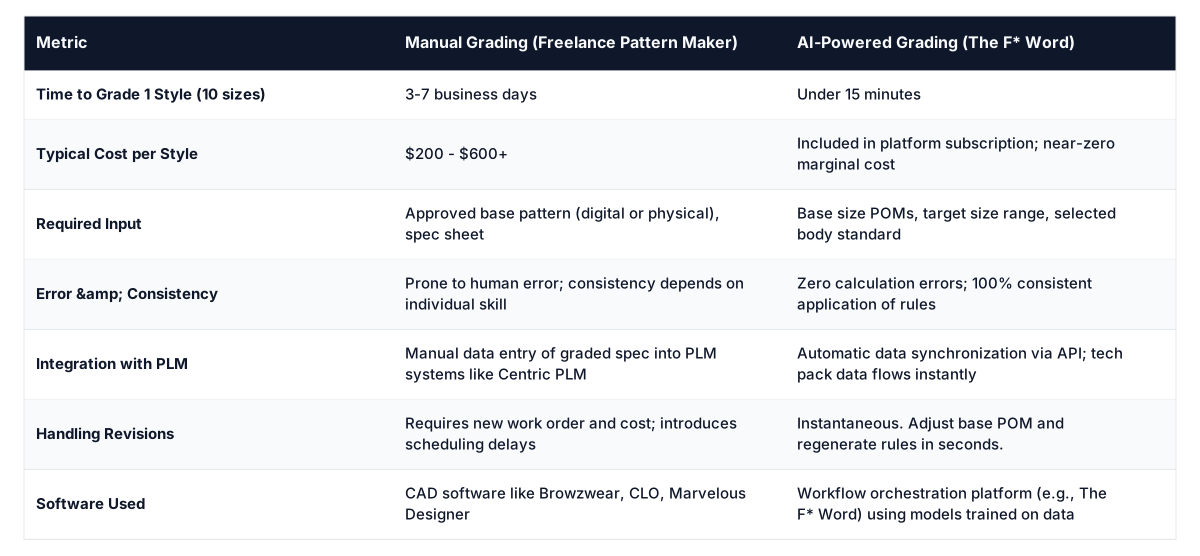
The operational differences between relying on a freelance pattern maker and using an AI workflow platform are stark. The benefits extend beyond simple speed to include cost, consistency, and a fundamental shift in how technical design teams allocate their time. Where manual processes are linear and labor-intensive, AI-driven workflows are parallel and data-centric, allowing for rapid iteration and validation before any physical samples are even requested.
This shift frees up technical designers from managing freelance schedules and proofing graded nests. Instead, they can focus on higher-value activities: refining fit standards, analyzing sample feedback, and managing the overall product development lifecycle. The ability to generate a full set of grade rules for a new style in minutes allows brands to test new product ideas and size expansions with minimal upfront investment in time or cost.
A common concern among technical designers is whether they can trust AI-generated measurements. The validation process, while different from checking a manually graded pattern nest, is straightforward and data-driven. The first line of defense is digital validation. The AI platform generates a complete graded spec sheet showing the finished garment measurements for every size. The technical designer can review this table to spot any anomalies or measurements that seem incorrect based on their experience. For example, they can quickly check if the jump in sleeve length between sizes seems logical and consistent with the brand's fit.
The ultimate test, however, remains the physical sample. Once the AI-generated tech pack is sent to the factory, the standard sampling process begins. Your partner factory will produce a set of size run samples (e.g., Small, Medium, Large, and XL) based on the provided measurement table. When these samples arrive, the technical design team conducts a fit session, trying them on fit models representing the different sizes.
During this fitting, the team measures the samples against the POM chart in the tech pack to check for adherence to tolerances. They also assess the overall fit, balance, and drape on the body. If adjustments are needed, the process is simple: the technical designer updates the base size POMs or adjusts a specific grade rule in the AI platform and regenerates the entire tech pack. This revised spec is then sent back to the factory for a second sample round. This iterative loop is significantly faster because the recalculation step is instant.
A valid question is whether AI can handle the complexities of garments beyond basic t-shirts and leggings. What about tailored blazers, complex outerwear, or garments with intricate style lines? The answer lies in the granularity of the data inputs and the sophistication of the AI model. For a complex garment like a jacket, the initial POM spec sheet will be far more detailed, including dozens of measurements covering lapel width, break point, shoulder pad placement, and vent height. The AI processes each of these points according to the selected grade rules.
Inclusive sizing, including plus-size and petite ranges, is another area where AI excels. Manual grading for plus sizes is a specialized skill, as the body does not scale linearly. Simple proportional grading often results in poor fit, particularly in the armhole, bust, and hip areas. AI models trained on extensive plus-size body scan data can apply more nuanced, non-linear grade rules that better reflect actual body shapes. This allows brands to confidently extend their size ranges without needing to hire a specialist plus-size pattern maker, making inclusive sizing more accessible and economically viable.
The ultimate goal of this process is not just a table of numbers but a complete, actionable manufacturing document. The AI-generated grading rules do not exist in a vacuum. A platform like The F* Word integrates them directly into a comprehensive tech pack. This document is the single source of truth for your factory, containing everything needed for production.
This tech pack includes the fully graded POM specification sheet for all sizes, a detailed Bill of Materials (BOM) listing all fabrics, trims, and components, and construction details with clear callouts and diagrams. It also includes packaging and labeling instructions. The system cross-references all information, ensuring that if a trim changes in the BOM, that change is reflected everywhere.
Because the process is data-driven from start to finish, the resulting tech pack is validated and free of copy-paste errors that often plague manual creation. When a product developer hits "generate," they are creating a production-ready artifact that communicates the design and fit intent with absolute clarity. This reduces factory questions, minimizes misinterpretations, and ultimately leads to better a first sample and a smoother path to bulk production.
Yes. This is the core principle of AI-driven grading. Instead of scaling a physical or digital pattern, the AI uses a set of base garment measurements (POMs) and a chosen body measurement standard. It algorithmically calculates the grade rules for every measurement point, for every size in the run, directly from this data. The output is a measurement table, not a set of patterns.
Most AI grading platforms come pre-loaded with major international body measurement standards, such as ASTM for North America and various ISO standards. They also typically allow brands to upload their own proprietary standards. This lets users start immediately with an industry benchmark or maintain their unique brand fit by using their own historical data to guide the AI's calculations.
AI handles inclusive sizing by using specific datasets and algorithms trained on plus-size or petite body scans. It understands that bodies do not scale linearly. The AI can apply different grade rules for different size blocks, for example using one rule set for sizes XS-XL and another, more nuanced set for sizes 1X-4X. This data-driven approach often produces a better fit than manual linear grading.
Yes. Factories do not need graded patterns from you; they need a graded measurement specification. An AI-generated tech pack provides exactly that: a clear, precise table of finished garment measurements for every size. This is the standard information factories use to create their own production patterns. Providing a clean, validated spec sheet often reduces factory questions and potential errors.
If a fit sample is incorrect, the process is simple and fast. The technical designer identifies which POMs need adjustment based on the fit session. They update these measurements for the base size within the AI platform and regenerate the entire graded spec in minutes. The system automatically recalculates all sizes based on the change, and a revised tech pack can be sent to the factory immediately.
Yes. While basics are simpler, AI can grade complex garments like structured blazers or outerwear. The key is providing a highly detailed initial POM specification for the base size. With more measurement points defined, the AI has more data to accurately calculate the grade across all the garment's complex style lines, from lapel-width to vent placement, ensuring the tailored structure scales correctly.
A pattern is the physical or digital template of a garment piece (e.g., front panel, sleeve). A grade rule is the instruction that defines how much a specific point on that pattern should move to create the next size. For example, a rule might state, "Increase chest width by 1 inch for each size up." AI generates the rules and the final measurements, which the factory then uses to create their own patterns.
Ready to eliminate the grading bottleneck and accelerate your product development cycle? The F* Word platform allows your team to go from a simple design concept to a complete, factory-ready specification without needing a pattern maker. Generate a validated tech pack in minutes, not weeks. To learn more about how AI is reshaping the entire production workflow, explore our guide on our AI Tech Pack Generation hub.
Related: pattern grading software
Get The F* Word workflow insights in your inbox.