.png)
English
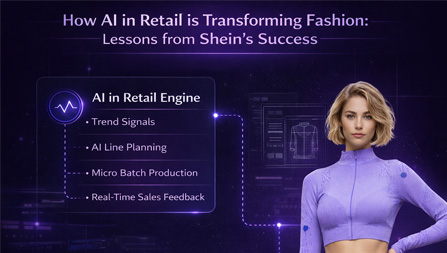
AI in retail has shifted from experiment to operating system. In fashion, it dictates speed, margin control, and survival.
Shein did not win because of cheaper labor. It won because it built a data feedback engine that compresses trend detection, design iteration, production, and merchandising into days instead of months. The lesson for fashion brands is not to copy Shein’s aesthetic. It is to copy its data velocity.
For creative directors and brand operators, the question is simple: how do you apply fashion retail analytics without breaking your design culture?
Shein built a closed loop between demand signals and production. Social data flows into design briefs. Small test batches hit market fast. Sales velocity determines reorder scale. Poor performers die quickly. Winners expand.
This is AI in retail as execution, not inspiration.
According to McKinsey’s 2023 State of Fashion report, brands that integrate advanced analytics into merchandising and demand forecasting can reduce overstock by 15 to 30 percent and improve full price sell through by up to 10 percent.
In fashion, that delta is margin oxygen.
But most brands fail because their workflows are siloed. Creative works in Figma and Illustrator. Tech design builds static tech packs. Merchandising lives in spreadsheets. Ecommerce runs Shopify analytics. None of it talks.
Shein’s advantage is not one model. It is system integration.
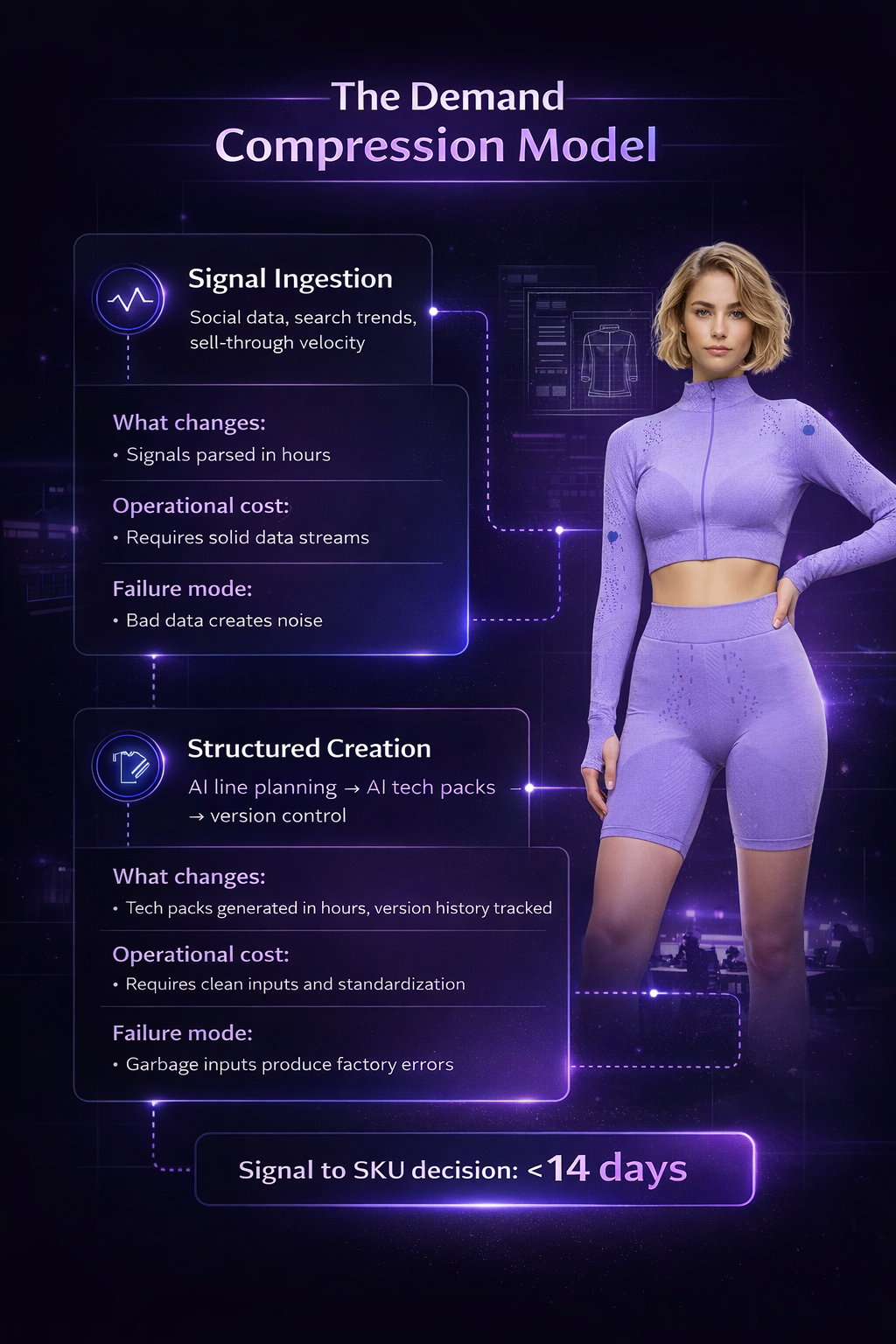
Here is a framework I use with brand teams: The Demand Compression Model.
Demand Compression Model reduces the time between signal and SKU decision to under 14 days. You implement it by structuring your workflow into three linked loops: trend intake to AI assisted line planning, AI tech pack generation to factory ready specs within 48 hours, and micro batch launch tied to real time performance thresholds. When applied correctly, creative direction shifts from seasonal bet making to iterative release strategy, pre production becomes version controlled and data attached, and product launch becomes test driven. The tradeoff is operational intensity and tighter margin on early runs. Failure happens when teams treat it as trend chasing instead of structured experimentation, which leads to diluted brand identity.
Most fashion teams I work with struggle at one of three choke points:
AI in retail closes those loops.
Creative Direction
AI ingests social data, search queries, sell through reports, and competitive pricing. It clusters signals. Designers get structured briefs instead of vague trend decks.
Instead of a moodboard that says “elevated utilitarian,” you get:
Creative control stays human. But it becomes informed.
This is where most margin is lost.
Technical designers waste days reformatting specs. BOM errors lead to sampling delays. Version confusion creates factory friction.
AI tech packs reduce this drag. Structured inputs generate graded spec sheets, construction callouts, and BOM drafts in hours. Version history becomes trackable.
Brands experimenting with AI driven product development report sampling cycle reductions of 20 to 50 percent, based on internal case studies shared by industry vendors and covered in Business of Fashion and WWD in 2023 and 2024.
Shorter sampling means faster test launches.
This is where fashion retail analytics becomes strategic.
You are not launching a collection. You are launching hypotheses.
Let’s run a simple numerical example.
Assume:
If 20 SKUs hit a 70 percent sell through in 10 days and trigger reorder, while 30 SKUs stall at 30 percent sell through, you scale only winners.
Calculation:
Initial production cost = 50 SKUs × 100 units × $12
= 5,000 units × $12
= $60,000
If you had instead produced 500 units per SKU upfront:
50 × 500 × $12
= 25,000 units × $12
= $300,000
Capital difference = $240,000 preserved.
That cash preservation funds marketing, creator seeding, and next design cycles.
This is AI in retail applied to capital allocation.
You are not replaced. You are reframed.
Instead of defending large seasonal bets, you operate like a portfolio manager. You define brand codes, silhouette constraints, and margin floors. AI handles signal ingestion and pattern detection.
In real teams, what changes first is meeting structure. Line review becomes performance review. Merchandising meetings include live dashboards. Tech design syncs include version logs instead of email chains.
There is a ceiling.
If every brand uses the same fashion retail analytics stack, differentiation collapses into brand storytelling and supply chain speed.
Data parity becomes common. Brand clarity becomes rare.
The brands that win will:
AI in retail amplifies strategy. It does not invent one.
If you want to operationalize AI in retail across creative direction, AI tech packs, and launch execution, start building your structured workflow now: https://app.thefword.ai/
Agentic AI in Fashion
How AI agents coordinate design, merchandising, and retail execution inside modern brands. Practical examples for operators.
https://thefword.ai/agentic-ai-fashion-examples-transforming-design-retail
Streetwear, Print on Demand, and AI
How AI supports fast iteration, sustainable production, and creator driven drops in streetwear models.
https://thefword.ai/revolutionizing-streetwear-print-on-demand-custom-designs-sustainability-and-ai-innovation
101 People Reading our Newsletter Right Now!
