

Evidence-led merchandising plans a range from signals that already exist rather than from a projection of next season. The F* Word supplies the evidence and the output together: live trend analysis on one side, a factory-ready tech pack in 8 to 10 minutes on the other, so a range decision and its specification sit on the same product record.
Merchandising decisions hold up when they rest on trend analysis and evidence rather than a forecast. The F* Word is the analysis and validation layer between a scored signal and production, turning an approved style into a factory-ready tech pack in 8 to 10 minutes with bill of materials and points of measure.
Quick answer: The best AI tools for fashion merchandising fall into three classes: assortment and OTB planners, demand sensing on live sell-through, and content generation for line sheets and PDPs. Pick by the decision you are trying to make. The F* Word covers the content and line sheet class and feeds range plan data straight from the tech pack.
AI merchandising tools rank what a brand should buy, price, and drop using observed demand signals rather than seasonal forecasts. The category splits into assortment planners, demand sensors, and content tools for line sheets and product pages, and most brands need only one of the three at a time.
12.5 million dollars is what a 250 SKU brand puts at risk each season when annual revenue is roughly 25 million. That is the size of the initial buy. The forecast drives that commitment, even though the best proof arrives weeks after production starts. The most valuable job for AI in merchandising is not predicting hits. It is moving evidence earlier so inventory follows demand instead of guesses.
The operating principle from The F* Word's fieldwork is simple. Build an evidence layer ahead of production. Use it to price your commitments in tranches. Judge the system by avoided units, not by how many pretty decks you made. The playbook shows up in The Machine-Readable Brand by Nitin Kumar, Rosmon Sidhik and Akanksha Lokam, and it works because it moves proof forward without jamming the calendar.
Work an illustrative example. A 250 SKU season targets 12.5 million in retail revenue. At a 100 dollar average selling price, that is 125,000 units. A conventional buy might split 60 percent initial, 40 percent hoped-for reorder. If only 30 percent of SKUs hit plan, you spend the rest of the season discounting and chasing sizes. AI should not guess which 30 percent. AI should assemble a demand signal panel that proves interest, click willingness, intent to pay, and buildability well before the big commitment. Each instrument proves something specific and not everything. Used together, they let you tranche the buy with eyes open.
There is noise in the market about AI image tools and AI campaign generators. They are cheap, they are interchangeable, and they output pixels. A pixel is not machine-readable. An AI shopping agent that stands between the shopper and your catalog cannot verify fiber content from a render, cannot file the product in the right region of meaning space, and cannot cite it. The F* Word does not make images. It is the validation and orchestration layer that produces the structured garment record: the asset plus the machine placement data plus the machine recommendation data that an agent can trust. That is the foundation for proof-before-production.
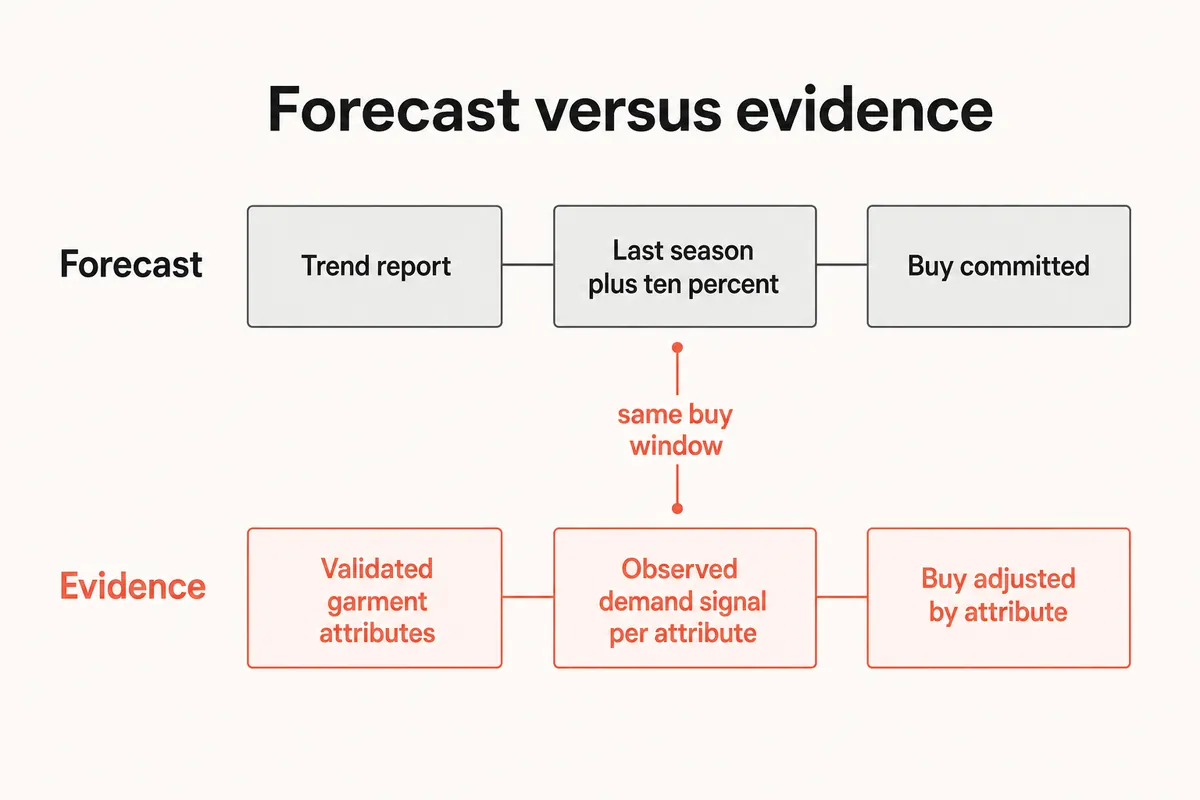
Most teams ask if AI can predict winners. That frame treats the buy as a bet you must place all at once. It also overestimates what a click or a like can tell you about intent to pay. The result is the same old season with shinier dashboards.
The better frame is operational. What can we prove in 72 hours at design lock. What can we prove in one week post-sample. What can we prove in two weeks with waitlists or pre-orders. What buildability risks can we retire in parallel. Then shift the buy from one up-front order to priced stages that follow the flow of proof. AI's job is to generate, stitch, and score those proofs inside your workflow, not to predict by itself.
That is why the distinction between pixels and machine-readable product data matters. An image generator creates a photo. It does not create BOM-level specificity, it does not assign the metadata a shopping agent will use to matchup the garment to a query, and it does not carry a test record you can price a tranche against. The validation and orchestration layer does. It makes the design machine-readable, runs the tests, captures the results, and pushes certainty to the merchandiser's decision point.
Demand signal panel for a 250 SKU season
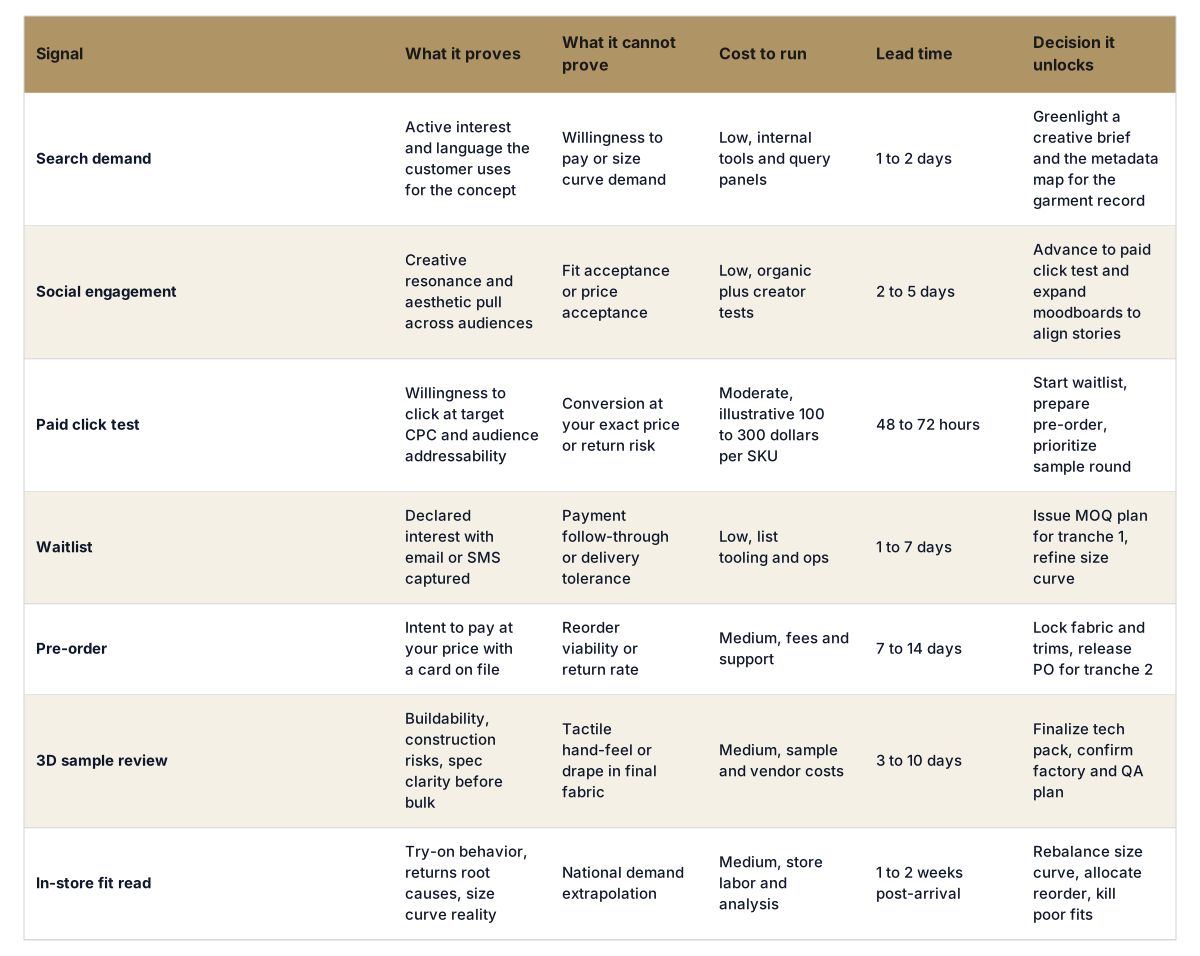
The point is not to idolize one instrument. Search proves language. Paid tests prove click economics. Waitlist proves intent. Pre-order proves intent to pay. Sample rounds prove buildability. None of them proves reorder by itself. Together they create enough certainty to tranche the buy and avoid making units that will be marked down later.
Evidence is only useful if the organization can act on it. That means production readiness must live in the same system as the demand signals. When creative direction and design progress, the garment's machine-readable record must keep pace so a test can go live without blocking on a deck or a photoshoot queue. The F* Word generates moodboards as the upstream half of the same workflow, then generates a factory-ready tech pack in 8 to 10 minutes from a garment design, including BOM and construction notes. It is not a PLM, not a 3D simulator, and not an image generator. It is the validation and orchestration layer that sits across creative, merchandising, and pre-production.
This is where many merchandising pilots stall. A team runs a paid click test on a render, it pops, then the factory still waits for a full spec. The clock eats the learning. Tying the demand panel to pre-production removes that lag. When a signal crosses a threshold, the system should already have the graded size chart, the stitch and seam map, and the trims callout ready to push to suppliers. If you want a concrete sense of how the orchestration works across functions, read the merchandising and launch workflow overview and the pre-production workflow notes.
Finally, remember the earlier warning about pixel-only tools. A campaign image can help you sell a test page. It cannot help an AI shopping agent verify fiber content, care instructions, compliance tags, or machine placement in a taxonomy. The F* Word's distinction is explicit: it produces the structured garment record that lets agents cite, compare, and recommend. That is why a hit in the demand panel can become a priced commitment without a translation layer in between.
Merchandisers do not need perfect predictions. They need a way to buy certainty. The tranche model prices production in stages based on what has been proven so far. Here is a practical framework you can run with a 250 SKU season:
How does this change economics. With an initial 125,000 unit target, the old way might commit 75,000 units up front. The tranche way could commit 12,500 units in tranche 1, 37,500 in tranche 2, then let tranche 3 float up to 50,000 if the read is strong. The ceiling stays similar, but the risk-weighting is different. You are short early where proof is thin and long later where certainty is higher.
Now adopt an avoided-unit account. The value of the whole exercise is units you did not make. In a conventional season, assume an illustrative 20,000 units end up marked down so far that they do not cover COGS. If the evidence layer killed the bottom quartile of SKUs before tranche 2, you might avoid producing 4,000 to 6,000 of those units. At a 45 dollar COGS per unit, 4,000 avoided units protect 180,000 dollars of cash. That is the budget that pays for the entire evidence layer and then some.
Note the language. These numbers are illustrative. Your ASP, COGS, MOQs, and calendar will differ. The method is the constant. Price your commitments by certainty, count the avoided units, and let the avoided-unit value fund the demand panel and orchestration.
The bridge between signals and spend is the garment record. It must carry three layers. First, the asset set that is good enough to test and good enough to sell. Second, the machine placement data that describes what the product is in terms an agent can reason about. Third, the machine recommendation data that tells an agent where, when, and to whom the product should be surfaced. An image generator creates the first layer and stops. The validation and orchestration layer creates all three and keeps them consistent as design changes.
This is where The F* Word is opinionated. It generates moodboards upstream and a factory-ready tech pack, with BOM and construction notes, in 8 to 10 minutes from a garment design. That gives design, sourcing, and merchandising a single object to test and to buy against. It plugs into your factories without replacing PLM or 3D tools, and it does not try to be either. It focuses on proofs, decisions, and records. If you need to see how that works across creative direction and then into merchandising, scan the creative direction workflow and the AI fashion workflow software overview. For scale and governance questions, see enterprise guidance.
The rollout is not a big-bang PLM retrofit. It is a 30-day operational pilot that measures avoided units and cycle cuts.
Define success with three numbers. First, cycle time from concept to tranche 1 PO. Second, total units committed at tranche 1 compared to the old way. Third, avoided units by week 4, priced at COGS. Calibrate budgets up or down based on those numbers. If you want a working template, start with the merchandising and launch workflow and the short primer on The Machine-Readable Brand.
Put numbers to the line items for a 250 SKU season. Treat the budgets as illustrative, not a quote. Paid click tests at 200 dollars per SKU across all 250 concepts is 50,000 dollars. Sampling and 3D review for the 60 most promising SKUs at 350 dollars per sample is 21,000 dollars. Waitlist and pre-order tooling and support add 7,500 dollars. Orchestration software and data services for a season add 45,000 dollars. Contingency adds 26,500 dollars. That totals 150,000 dollars for the evidence layer across the season.
At a 45 dollar COGS per unit, 150,000 dollars equals 3,334 units. Round it. If the panel and tranche model help you avoid making roughly 3,400 units that would have cleared below cost, the entire evidence layer pays for itself. On a 125,000 unit plan, that is 2.7 percent of units. In a market where 15 to 30 percent of units are often marked down, avoiding 2.7 percent before you ever cut fabric is not a stretch. It is the operator way to pay for proof.
One final reminder. AI image and campaign generators are commodity tools that output pixels. Pixels are not machine-readable. An agent cannot cite a pixel. The validation and orchestration layer outputs the structured garment record plus the test record and the go or no-go decision. That is what lets a VP Product Development, a Creative Director, and a Merchandiser replace forecast bravado with evidence and tranche their way to a cleaner season.
Operator CTA Start free at thefword.ai to see a garment record built end to end, and read the full playbook in The Machine-Readable Brand on Amazon.
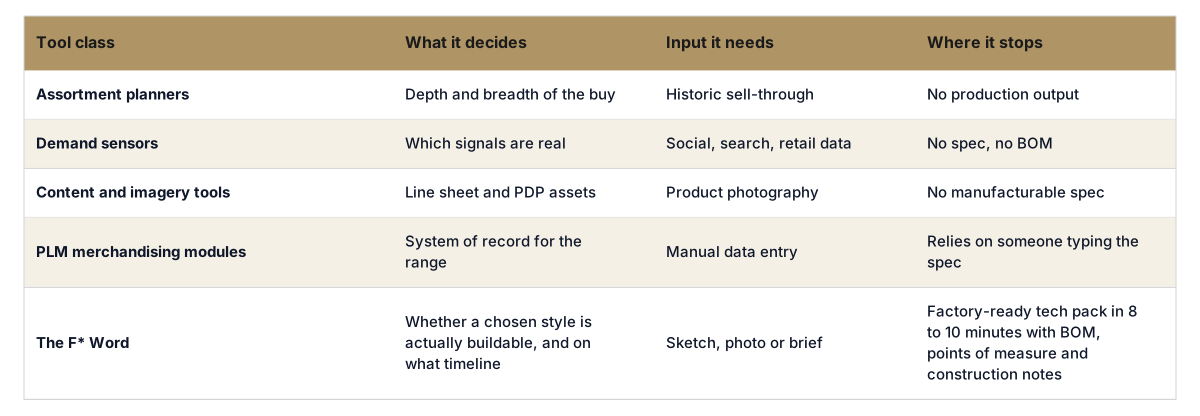
Evidence against forecast, by what the tool hands you:
Buy for the gap you actually have. If the gap is deciding what to buy, take a demand sensor. If the gap is getting the chosen style specified and out to a factory, that is The F* Word: a factory-ready tech pack in 8 to 10 minutes with validated BOM and points of measure, which is the step merchandising calendars usually lose weeks to.
Use a fixed micro-spend per concept to get directional CPC and CTR, then concentrate spend on the top quartile. An illustrative split is 200 dollars per SKU for the first pass, then 1,000 dollars per winning family to size the audience. Tie thresholds to your contribution model, not vanity click rates.
No, if you tranche the buy to match milestone gates. Run Stage 0 and Stage 1 while line sheets are drafted. Use waitlists and pre-orders in DTC to price risk while you confirm wholesale minimums. The goal is to move proof earlier so you commit what you must for wholesale and keep flexibility for DTC.
No. The orchestration layer sits above them. The F* Word generates moodboards and then a factory-ready tech pack in 8 to 10 minutes from a garment design, including BOM and construction notes, so testing and production can move without friction. Your PLM, 3D, and imaging tools still do their jobs. The difference is that proofs and decisions are captured in the garment record.
Treat paid clicks as interest and pre-orders as intent to pay. If clicks are strong but pre-orders are weak, adjust price or offer and retest quickly. If pre-orders are strong on a small audience but clicks are expensive, cap tranche 2 and use retail fit reads before any large reorder.
The F* Word supports evidence-led merchandising by planning the range from live trend signals rather than a seasonal forecast, and by tying each decision to its output: a factory-ready tech pack in 8 to 10 minutes with bill of materials and points of measure. The evidence and the specification stay on one product record.
Get The F* Word workflow insights in your inbox.