

AI cuts waste in fashion only when it prevents bad production decisions: unnecessary samples, weak forecasting, unclear specs, overbuying, and late design changes.
At one mid-size brand a six-person technical design team and two product managers spent 420 hours and produced 240 physical samples in a single season because unclear tech packs and vendor questions slowed approvals. That kind of upstream waste - samples, rework, returns and overbuy - drives most of fashion's material and carbon losses.
Use the Waste Substitution Test: only deploy AI when a validated digital decision replaces a sample, avoided return, avoided overbuy, or a factory rework. You'll get a short checklist to map AI steps to measurable avoided events so deployments cut material loss, not just generate more content.
Fashion’s sustainability problem is primarily physical: materials, production errors, returns, and unsold inventory drive the bulk of emissions and resource loss. Industry reports show the scale, with textile waste in the tens of millions of tonnes annually and most material value lost before garments reach a second owner. For design and product teams, that means the biggest sustainability wins happen before a product ships to customers.
Using AI to produce more campaign imagery, or to generate endless concept variants, does not address those upstream losses. The responsibility test for AI is simple: a digital decision must replace a material action, or the net footprint will often increase. That requirement shapes where AI belongs in the product lifecycle, and where human judgment must remain central.
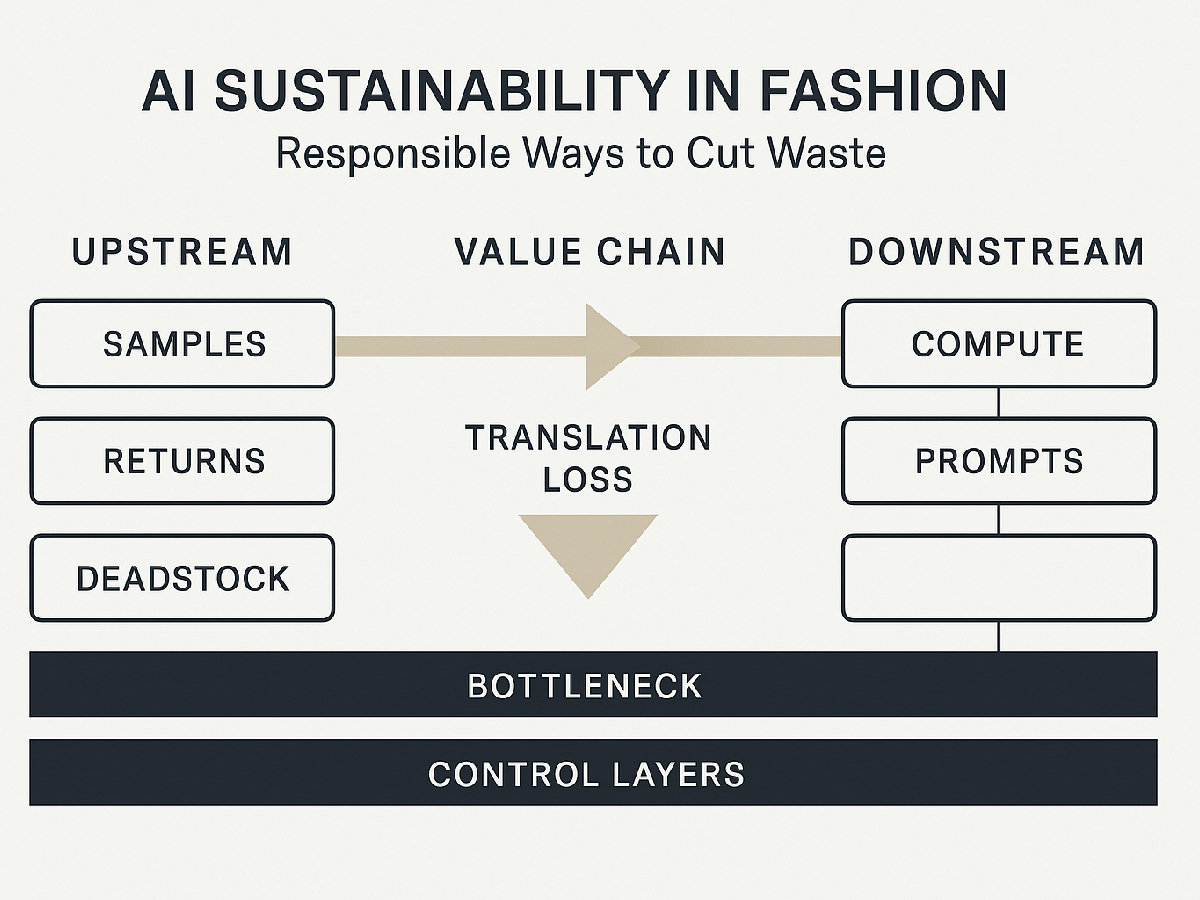
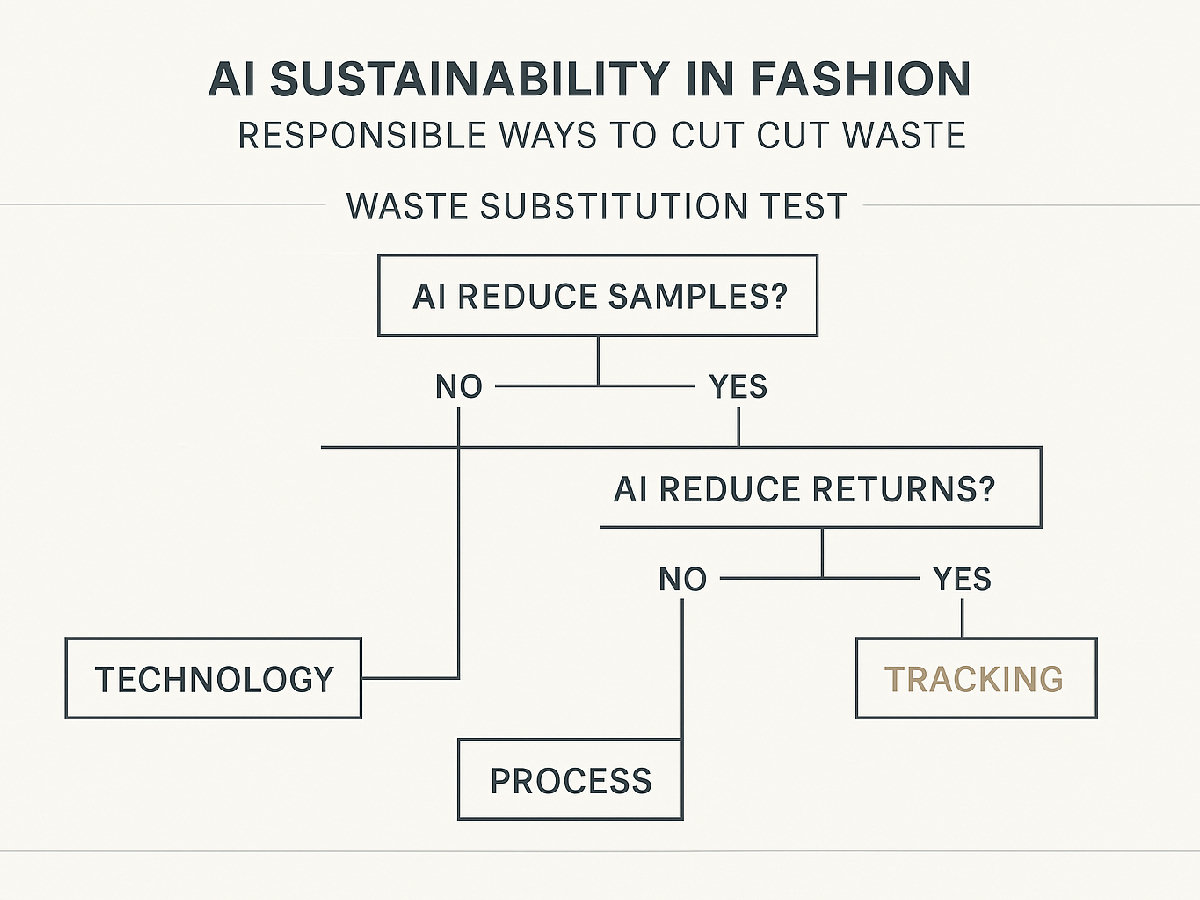
The Waste Substitution Test is a decision rule for responsible AI in fashion: deploy AI only where it replaces a physical action, failed approval loop, or logistics event with a validated digital decision. Apply it at style kickoff by mapping each AI step to an avoided sample, avoided return, avoided overbuy, avoided factory question, or avoided shipment, then assign an owner to measure the before-and-after result.
When teams apply the test, AI use cases tighten. Creative direction, 3D validation, AI tech pack QA, and launch readiness become linked, rather than scattered across disconnected files and chat threads. The tradeoffs are measurable: more setup, stricter data discipline, and fewer low-value variants up front. The payoff is fewer physical samples, fewer rework loops, and clearer approvals.
Merchandiser? Ship a launch where the deck and the factory match.
The F* Word connects moodboards, tech packs and merchandising prep, so your launch story and the factory order tell the same story. Free to try.
Sample reduction is the clearest example. A recent peer-reviewed study showed 3D virtual sample preparation can cut carbon and water impacts dramatically compared with physical sampling. That is powerful because it replaces a material process with a digital one and directly reduces fabric waste, courier emissions, and vendor rework.
A practical team workflow looks like this: the creative director approves a direction, the technical designer validates seams and construction in a shared 3D model, the AI generates a tech pack draft, and the merchandiser signs off on SKU-level decisions. Instead of multiple disconnected reviews, the workflow holds intent and reduces repeated file exchanges between five or six stakeholders.
Numerical example: if a brand develops 80 styles per season and typically produces three sample rounds per style, reducing rounds to two avoids 80 sample rounds. That cuts fabric cuts, courier shipments, and vendor rework proportionally. Those avoided physical actions are the metric that defines AI sustainability in practice.

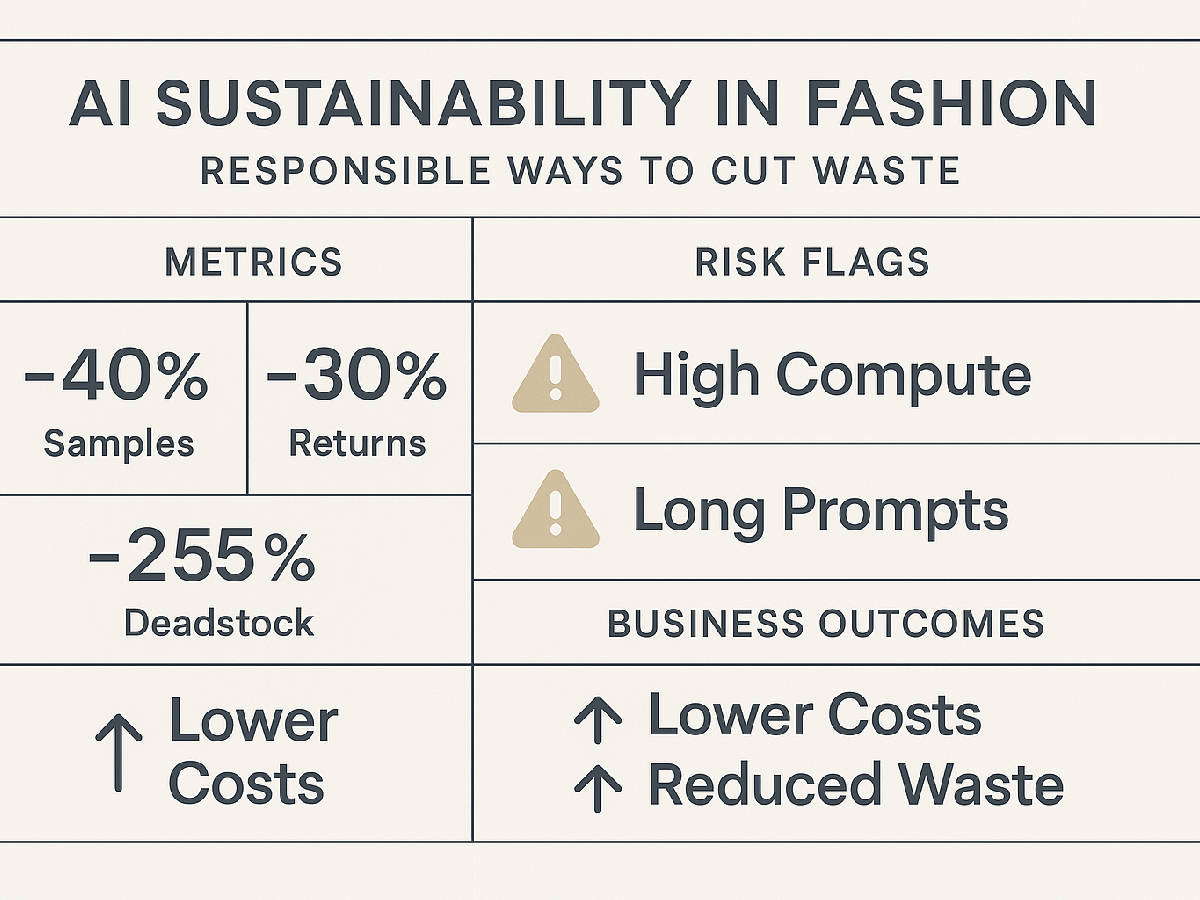
AI has an environmental footprint through data centres, model training, and storage. Large model training can be energy intensive, and prompting at scale adds up. For brand teams, the practical implication is clear: choose smaller models for high-volume, low-complexity tasks, and reserve heavier models for decisions where extra computation prevents a material action.
Another risk is behavioural. If AI accelerates SKU churn or encourages constant newness, the production system can expand and negate any operational savings. Case studies in fast fashion show that increased speed without production discipline increases transport emissions and returns. Teams must be explicit about production limits, SKU lifecycle rules, and governance before pushing AI-generated variants into the market.
Finally, measure both sides of the ledger. Track samples avoided, returns reduced, rework prevented, and transport avoided, alongside prompt counts, model types, storage totals, and provider energy mixes. That dual accounting shows whether a specific AI workflow reduces net environmental impact.
Responsible AI is not a feature bolt-on, it is a change in operating model. The steps below are pragmatic and designed for product and design leaders who must show measurable impact within a season.
Start at style kickoff. For each decision node, ask what physical action the AI will replace. Assign an owner, define a metric (samples avoided, returns reduced, vendor questions avoided), and set baseline measurements. This creates clear accountability and a way to prove the Waste Substitution Test.
Replace scattered files with a single source of truth that carries moodboards, 3D models, AI tech packs, BOMs, approvals, and launch assets. A connected workflow reduces errors caused by manual transfers between tools and teams. For brands evaluating platforms, review integration points for PLM, ERP, and ERP-adjacent systems to keep the handoff clean, and see product details at https://thefword.ai/product.
Use smaller, efficient models for high-volume tasks such as parsing vendor notes, renaming colorways, or drafting product copy. Reserve more complex, reasoning-capable models for tasks where additional accuracy changes the physical outcome, such as automated fit recommendations tied to measurement data. Keep prompt counts and storage under active review to limit unnecessary compute.
Track the before-and-after on the metrics assigned at kickoff: sample rounds per style, average returns per SKU, time to vendor sign-off, and number of vendor queries. Present results to stakeholders after a season and iterate on thresholds for when the AI model proposes a change versus when a human must approve. For enterprise governance and permissions, evaluate workflow platforms at https://thefword.ai/enterprise.
AI sustainability in fashion must be measured by avoided physical waste, not by how impressive creative outputs appear. The highest-impact AI uses are those that reduce material handling, sampling, and incorrect production decisions. Keep human approvals at taste-sensitive and high-risk points: final creative direction, fit sign-off, factory handoff, and sustainability claims.
Do not reward volume for its own sake. Stop treating endless variants as progress, they often increase downstream waste. Instead, constrain early-stage options, increase confidence through validation, and move styles toward production with fewer physical steps. In practice, that reduces fabric waste, courier emissions, and rework time.
Finally, accountability matters. Assign owners, set baselines, and report the net change in physical actions each quarter. Those numbers are the only credible sustainability evidence for AI in product teams.
Operator note: use models with known energy profiles, keep storage budgets visible, and decommission unused assets to avoid hidden costs.
Start the operator flow at https://app.thefword.ai/, faster tech packs, fewer sampling rounds, real-time trend signals, and measurable reductions in markdowns and returns.
Record the number of physical sample rounds per style before AI adoption, then track the same metric after the workflow change. Multiply the avoided rounds by average fabric cut and courier emissions to report tangible reductions. Include vendor query counts to capture rework avoided.
It can, but the decision comes down to net impact. Measure compute energy and model choices alongside physical actions avoided. Smaller models and prompt discipline often keep the AI footprint low compared with the savings from fewer samples, returns, and transports.
Product leadership should own the test, with cross-functional sponsors from design, technical design, sourcing, and merchandising. Assign a single owner for each decision node to ensure measurement and accountability within a season.
Yes. Traceability checks, supplier document validation, and audit-ready records reduce greenwashing risk when implemented correctly. AI can speed document review, but humans should approve any public sustainability claim.
The F* Word Editorial · Fashion workflow team
Written by The F* Word editorial team. We build AI fashion workflow software grounded in thousands of industry-produced tech packs and proprietary garment records, so what reaches the factory is consistent, reviewed, and tied to design intent.
Once the concept is approved, the next steps move it from board to factory floor.
Related: Merchandising & Launch
Related: Quick answer: resleeve ai alternative ai fashion workflow software
Get The F* Word workflow insights in your inbox.