
English

This guide is written for brand teams, product owners, technical designers, merchandisers, and procurement leads evaluating AI tech pack software for enterprise use. If your team manages approvals, tech packs, BOM/spec handoffs, sample rounds, or launch timing, this playbook is for you. Early adopters promise faster cycles; reality shows fractured exports, grade-table drift, and vendor clarification loops that add weeks to a season.
This article gives a procurement scorecard, standardized fidelity tests for BOMs and grading, integration and security checks, and sample export diff reports you can run against any vendor. It focuses on measurable outcomes: fewer sample rounds, cleaner factory handoffs, and tighter coordination across Creative Direction, Pre-Production, and Product Launch.

Procurement owners and technical teams are buying software to reduce two common failure modes: editable-export drift and unclear factory-readiness. Editable-export drift happens when a system exports a “perfect” PDF that cannot be ingested by the factory ERP or grading system, so the vendor sends back clarifications. That creates sample rounds and approval delays. Factory-readiness failure is when a tech pack appears complete but lacks consistent BOM IDs, component specs, or graded blocks for all SKUs.
Enterprise buyers expect three things from AI tech pack software: reproducible tech packs across seasons, consistent BOM/spec fidelity for cost and sourcing accuracy, and secure integrations with PLM, ERP, and PIM systems. Those expectations shape the scorecard in this article.
Workflow buyer? Get tech packs and moodboards your team will use.
The F* Word generates brand-aligned moodboards and factory-readable tech packs and plugs into your PLM. See it run on your own product. Free to try.

Use this scorecard during vendor shortlisting and RFP evaluation. Score each vendor 1 to 5 across the criteria below, then weight them according to your priorities. Weighting examples appear in the RFP template section.
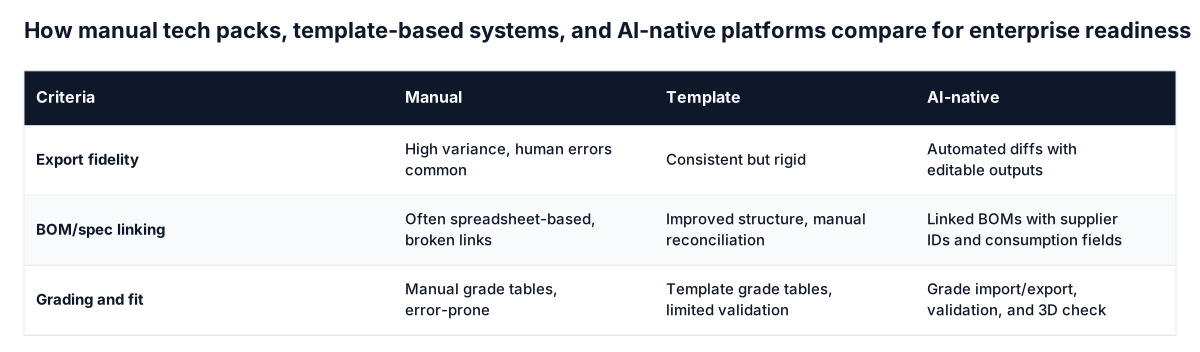
Run a standard test suite against each vendor on your shortlist. The goal is to quantify editable-export fidelity and factory-readiness before procurement commits. Tests should be repeatable across garment categories: woven shirt, knit sweater, and shell jacket. Each test produces an export diff report showing inserted, deleted, and modified fields compared with the canonical tech pack.
Essential tests:
Numerical example for a grading and clarification loop:
Inputs / Calculation / Result
Inputs: 3 sample rounds, average vendor clarification time 48 hours, manual rework per clarification 2 hours. Calculation: (3 rounds × 48 hours) + (clarifications per round 2 × 2 hours × 3 rounds) = 144 hours + 12 hours = 156 hours. Result: 156 hours added to the development timeline, or roughly 4 weeks of delay for one style across multiple SKUs.
That example shows how small clarification times and manual edits accumulate. Use the export diff to measure the source of those clarifications; frequently they arise from missing BOM consumption fields or grade table misalignment.
Enterprise procurement must validate technical controls and integration maturity. Use this checklist during vendor security and integration calls.
Operational integrations to validate:
Ask for concrete examples of customers that operate at your scale and request references that used the platform to reduce sample rounds and improve launch timing. If a vendor cannot show an export diff or a concrete grading roundtrip, treat that as a red flag.
Design the RFP to be operational and measurable. Include a pilot project that mimics a real season task: submit a moodboard and two design variations, request AI design generation outputs, then require a full tech pack, BOM, and grade table export for 12 SKUs. Require the vendor to deliver an export diff report and a factory ingestion report where a supplier confirms whether imports required manual edits.
Suggested RFP scoring weights:
When you compare scores, prioritize editable-export fidelity first. Editable exports are the single biggest determinant of fewer sample rounds and faster vendor approval cycles.
Handoff Ready is a four-step framework to assess whether a tech pack is factory-ready before sending it out. Step one, canonicalize source data by locking BOM IDs and measurement points in one source of truth. Step two, run an automated grade roundtrip to surface cell-level mismatches. Step three, generate an export diff and send it to a nominated supplier contact for an ingestion test. Step four, gate the tech pack with an approval stamp that includes the export diff report.
Apply Handoff Ready in a pilot with one high-volume style to measure time savings. Operational impact includes fewer clarification emails and reduced sample rounds. Tradeoffs include initial setup time and the need to align internal teams on canonical fields. Failure modes occur when teams do not treat the diff report as a hard gate, or when suppliers lack the systems to ingest exports; in those cases the process will highlight system gaps but will not close them without supplier enablement.
Use the templates below in your procurement packet. The RFP asks vendors to complete three deliverables during the pilot: a full AI-generated tech pack, an export diff comparing the vendor export to your canonical file, and a supplier ingestion confirmation that lists manual edits and time spent.
Include contract clauses that allow you to run a pilot with live production SKUs under NDA. Require a fixed timeline, typically 4 to 6 weeks, so you can compare vendors on a level playing field.
Real example: A mid-size outerwear brand ran a 6-week pilot. Creative uploaded moodboards and the design director approved AI-generated silhouettes. The technical design team imported the draft tech packs and ran the grade roundtrip test. The export diff revealed inconsistent trim IDs and a missing consumption field for lining fabric. Because the team had run the Handoff Ready checks, they fixed the canonical BOM, reran the export, and the factory reported zero manual edits on ingestion. The result was one fewer sample round and the factory confirmed the style was production-ready two weeks earlier than forecast.
Tradeoffs to track:
A useful export diff has three sections: structural diffs, field diffs, and numerical diffs. Structural diffs show missing or extra BOM lines. Field diffs highlight changed text, such as component descriptions or supplier IDs. Numerical diffs show measurement or consumption differences with flagged tolerances. Require vendors to provide a machine-readable diff and a human summary with root-cause analysis.
When you request the diff, ask for this minimum output:
Creative Direction benefits because AI design generation produces consistent base assets and metadata that flow into tech packs. Pre-Production benefits from AI tech packs, BOM/spec support, grade verification, and 3D validation that confirm measurements before samples. Product Launch benefits when SKU readiness, launch assets, and AI photoshoot workflows are synced to the tech pack metadata and export reliably to PIM and ecommerce systems.
Procurement should insist that the platform connects these three workflows: a change in a creative brief should be traceable through tech pack updates, sample rounds, and final launch assets. That traceability reduces coordination overhead during campaigns and shortens time to shelf.
Many vendors in this space focus on a single point: image generation, 3D mockups, or tech pack export. Vendors such as Vue, Botika, Caimera, TukaTech, Ai Tech Pack, The Fabricant, and others offer valuable capabilities, but the enterprise buyer must prioritize platforms that combine AI design generation with export fidelity, BOM/spec support, and 3D validation. Ask each vendor for the export diff report and a supplier ingestion confirmation before advancing to procurement negotiation.
Procurement of AI tech pack software must be operational and measurable. Use the scorecard, run the Handoff Ready pilot, demand export diffs, and validate supplier ingestion. When a platform can demonstrate editable-export fidelity, linked BOM/specs, and grade accuracy at scale, it will deliver fewer sample rounds, cleaner handoffs, and tighter coordination across Creative Direction, Pre-Production, and Product Launch.
For teams that want to move from evaluation to a working pilot, test a high-volume style through an AI-generated tech pack, run the export diff, and measure supplier ingestion. That evidence will guide negotiation and help you select the platform that reduces production overhead and improves launch readiness.
Weighting depends on your biggest operational bottlenecks. If your primary pain point is data entry errors, heavily weight BOM and grading fidelity. If you struggle with disconnected systems, prioritize the Integration and API capability section. Assess your current process and assign higher scores to categories that solve your most expensive problems.
The most common failure is the AI's interpretation of complex, multi-component trims and non-standard grading rules. Always use a a production-level garment with atypical construction, like an asymmetrical jacket with custom hardware, for your fidelity test. This reveals the limitations of the AI's data model far better than a simple t-shirt.
Ask about their data segregation and tenancy model. Specifically, "Is our design data, including prompts and generated assets, stored in a multi-tenant database or a dedicated, single-tenant environment?" For enterprise brands, single-tenant architecture is a non-negotiable requirement to prevent data leakage and protect intellectual property.
Export diff templates are crucial for verifying compatibility and data integrity with your downstream systems like PLM or ERP. AI-generated tech packs can have subtle formatting or data structure variations. Running a "diff" or comparison between the vendor's export and a known-good file for your system immediately flags integration risks before you commit to a contract.
Once enterprise rollout is scoped, these are the steps each team runs end to end.
Related: enterprise AI fashion workflow · AI fashion workflow software · AI tech pack
Get The F* Word workflow insights in your inbox.