

Product teams often spend 48 hours or more per SKU fixing missing BOM lines, unclear construction notes and repeated vendor queries before a factory handoff. Brand operators searching "how to reduce tech pack errors" and "AI for factory handoff" need practical tactics that stop last-mile rework and speed up sampling and costing.
This post explains how AI can auto-populate tech packs, validate BOMs against materials libraries, and surface ambiguous construction details so approvals and vendor instructions are consistent. The focus is on measurable outcomes - fewer clarification cycles, shorter sample lead times, and cleaner production-ready packages for factories - so operators can cut SKU development time without slowing creative throughput.
Teams can produce more visuals than they can convert into production work. Creative teams generate concepts rapidly, but that speed often increases the volume of assets that need interpretation, specification, and approval. The friction shows up as repeated rework: a single concept can loop through technical design, product development, and vendor clarification two to three times before reaching a current production package.
That repeated interpretation costs both time and money. When factories receive incomplete instructions they ask for clarifications, sample cycles extend, and costing becomes uncertain. The core issue is not creativity, it is the translation and preservation of design decisions across multiple handoffs.
Teams that measure throughput see the effect: on average a design that looks ready on day one still consumes teams for days after because the required artifacts are missing or inconsistent. Operationally minded brands must treat this as a system problem that requires output standards, version control, and clear responsibilities for approval steps.

The Workflow Compression Layer is a practical operating model that shifts the goal from speed of single assets to speed of end-to-end delivery. It asks designers and product teams to define a minimal set of inputs once, then applies rules and automation to carry those decisions through subsequent stages. The benefit appears as fewer manual translations, fewer rounds of clarification, and shorter sample cycles.
Applying this model starts with mapping every point where an asset is retyped, rebuilt, or reinterpreted. For each point, assign the data or rule that must travel with the asset, for example fabric weight, seam allowance, label placement, or approved trim codes. That way, the creative brief becomes machine-readable and survives into technical documentation.
The tradeoff is disciplined inputs. Teams must capture season, customer segment, price band, fit intent, and primary material assumptions earlier than they traditionally would. The model fails when those inputs are vague, or when generated outputs are pushed to vendors without human verification.

In-house designer? Generate a factory-ready tech pack from your brief.
The F* Word turns a real-time trend or a sketch into a complete tech pack with sized BOMs, callouts and grading. Plus a brand-aligned moodboard. Free to try.
An operational AI approach connects three zones where teams lose time: creative direction, pre-production, and product launch. Each zone needs structured outputs that flow into the next, with human approvals at defined checkpoints. The goal is repeatable outputs that meet a defined standard for handoff.
In creative intake, AI should do more than produce images. It should convert moodboards, trend notes, and sketches into structured briefs that record season, assortment role, target customer, silhouette family, and competitive context. That brief becomes the single source of truth for downstream tools and people.
When designers explore variants, the system should attach the rationale for each change, for example a fabric swap, a new trim, or a sizing adjustment. This preserves intent so that when a variant is promoted, the next team can act without reconstructing the logic.
AI should generate the technical artifacts that matter: flats, points of measure, graded tables, BOM proposals, construction notes, and revision history. Those outputs must be exportable as factory-ready tech packs that include tolerances, stitch instructions, label placement, and approved trim codes. The quality of these artifacts determines whether a factory will interpret or execute.
Version history and comment trails should be part of the record, so the factory and the brand work from a single current package, not from email threads and old PDFs.

Below is a concise comparison that helps product and operations leaders decide where to invest first. Choose the approach that compresses the most downstream work, not the approach that only accelerates a single upstream task.
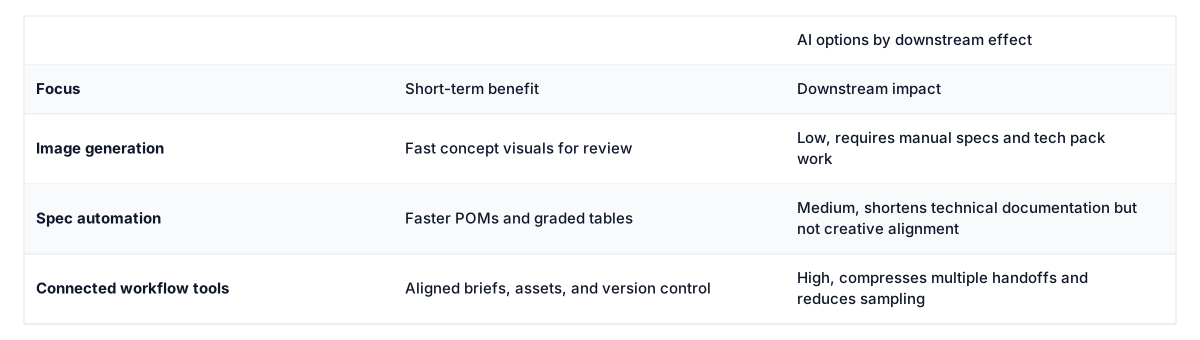
Image generation gives a visible early win, but it often stalls because downstream teams must still rebuild the work. A beautiful render does not include fabric weight, seam allowances, grading rules, or BOM entries. Technical designers end up recreating many of the same details, which erases the initial time savings.
The pragmatic test for any pilot is whether the output survives the next handoff without manual overhaul. If it requires significant rebuilding, the pilot has improved presentation but not throughput. Measuring success by the full sequence from approved sketch to factory production package gives a truer view of ROI.
Operational pilots should include acceptance criteria for each handoff: what fields must be present in a tech pack, which approvals must be logged, and how exports are validated. Those criteria turn subjective impressions into measurable results.
The tech pack is where design intent becomes executable instructions. A properly formatted pack includes technical flats, POMs, graded measurement tables, BOMs, construction callouts, trims, label placements, stitch types, tolerances, colorways, and revision history. If those elements are missing or inconsistent, factories interpret and teams pay in time and extra samples.
An AI tech pack generator should align those details with the approved design brief and the source image or 3D model. It should also flag conflicts, for example a trim choice that is incompatible with a specified fabric weight, so reviewers can make informed decisions before the vendor receives the file.
When a brand treats the tech pack as the primary execution artifact, sampling cycles shorten and costing becomes more predictable. The result is fewer ad hoc approvals during production and less surprise at first run.
Start where outputs are standardized and mistakes are costly. Tech pack generation, POM creation, and BOM drafting are high-value first automation targets because they follow clear formats and directly affect cost and sampling. Automating colorway variations and controlled SKU permutations is next; these tasks preserve structure while enabling rapid exploration.
3D validation should sit before physical sampling. Using virtual approvals for silhouette, proportion, and artwork placement reduces sample iterations and gives technical teams more time to focus on construction details. The goal is to spend fewer dollars on physical samples while keeping decision quality high.
Humans must remain owners of creative judgment, commercial choices, and production risk. Creative directors should sign off on brand meaning and seasonal narrative. Technical designers must approve construction, tolerances, and grading rules. Product developers need to validate vendor feasibility and costing assumptions.
AI transforms fashion when it carries intent through the workflow: brief, concept, validation, tech pack, sample decision, and launch asset. Anything less is isolated productivity.
Time savings depend on where AI is applied. If AI compresses creative intake, technical documentation, and vendor exports, brands can reduce total SKU lead time by more than the sum of incremental gains on single tasks. A useful pilot reports reductions in sampling rounds and faster approvals, which are measurable outcomes.
Yes, when the generator produces complete, approved production packages and the brand enforces human sign-off before export. The generator should include validation checks and version control so suppliers receive a single current package with an audit trail.
AI can draft graded tables and suggest POMs based on garment family and fit intent, but technical designers must validate grading increments and tolerances. For complex fits, use AI as a drafting tool that accelerates work, while keeping final grading approval in human hands.
Scope a pilot to a single collection or assortment role, define handoff acceptance criteria, and measure cycles and sample counts. Prioritize SKUs where rework is frequent and the tech pack format is well understood.
Once the tech pack is factory-ready, these are the steps that take it through production.
Related: bill of material software fashion
Get The F* Word workflow insights in your inbox.