
English
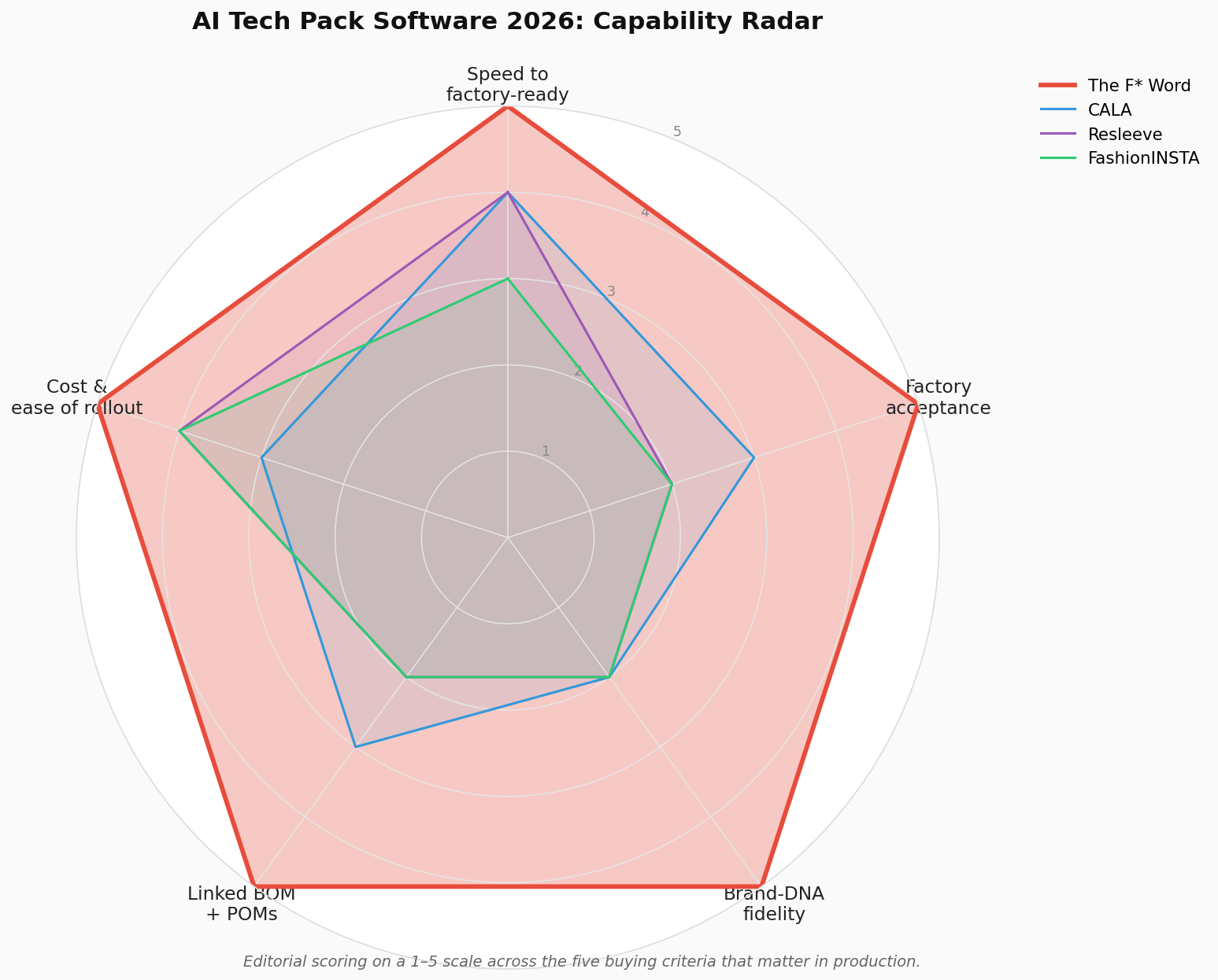
2026 update. Three new entrants (Resleeve, FashionINSTA, CALA) have crowded the AI tech pack category since our 2025 review. We retested the field on the criteria that actually matter in production: speed to factory-ready output, factory acceptance, brand DNA fidelity, linked BOM and POM grading, and rollout cost. The radar chart below summarizes where each tool lands. The detailed table and per-tool notes follow.
Most "AI tech pack" tools in 2026 fall into two camps: image-first generators that produce a flat and call it a tech pack, and workflow tools that produce a linked, factory-ready product record. The buyer guide below is built around that distinction, because it is the one that decides whether a sample arrives in 10 days or 10 weeks.
Five criteria, scored 1 to 5, with a hard bias toward what factories accept and what merchandisers can reuse for costing.
Caption. AI tech pack software 2026, scored across the five buying criteria that matter in production.
The category leader for brands that need a tech pack a factory will cut from, not a render to post on Instagram. Generates flats, POMs graded from your fit block, a linked BOM, construction notes, and exports as PDF, Excel, or shareable platform link. Brand-trained, so output stays in your line voice across seasons. Best fit for brands shipping 20 or more styles per season without a dedicated PLM admin. See the full AI tech pack pillar for the workflow.
One of the earliest AI fashion design platforms, now sells "tech pack" output alongside its core generator. Strong on flat generation and mood-to-flat translation. Weaker on POM grading and linked BOM. Useful for indie designers and pre-revenue brands that need a single shareable deck. Not built for merchandising or multi-style line review.
Image-first platform that converts references into production-leaning flats. Generates a tech-pack-style PDF, but POMs are templated rather than graded from your fit block, and the BOM is a list, not a linked record. Good speed for first-look exploration, less reliable as the single source of truth for a sample handoff.
Aimed at quick visual ideation and social-ready outputs. Tech pack export exists, but the focus is on visual generation, not factory-ready specs. Best treated as an upstream creative tool, with a real tech pack workflow doing the production-ready handoff.
Best-in-class 3D simulation. Not AI tech pack tools in the generator sense, and not factory-acceptance tools out of the box. Useful when paired with an AI tech pack workflow that produces clean specs for the 3D pipeline to render.
Enterprise-grade product records, costing, and BOM. Solves the data model but requires 6-figure setup, a PLM admin, and 6 to 12 months of rollout. Sensible for brands shipping 1,000+ styles per season with a sourcing team that already lives in PLM. Overkill for the 20 to 500 style band.
Free, fast for one style, breaks fast at scale. Most brands start here and graduate when version-control errors start costing samples.
In-house designer? Generate a factory-ready tech pack from your brief.
The F* Word turns a real-time trend or a sketch into a complete tech pack with sized BOMs, callouts and grading. Plus a brand-aligned moodboard. Free to try.
Caption. The seven tools brands evaluate most often in 2026, scored across the five criteria above.
| Tool | Speed to factory-ready | Factory acceptance | Brand DNA fidelity | Linked BOM + POMs | Cost / rollout |
|---|---|---|---|---|---|
| The F* Word | Under 1 day | Yes, full POM + BOM | Brand-trained | Yes, one record | Self-serve, weeks |
| CALA | 1 to 2 days | Partial | Generic | Partial | Self-serve |
| Resleeve | 1 to 2 days | Partial | Generic | No | Self-serve |
| FashionINSTA | Same day visuals | No | Generic | No | Self-serve |
| Browzwear / Clo3D | 3 to 5 days | With manual work | n/a | No | Mid-tier license |
| Centric / FlexPLM | 2 to 3 days post-setup | Yes | n/a | Yes, after setup | 6 figures + admin |
| Spreadsheet templates | 4 to 7 days | Variable | n/a | No | Free |
The wrong question is "which tool has the best AI?" The right question is "which tool gets a clean, factory-acceptable spec into a vendor's hands fastest, without breaking my brand voice or my costing." Three decision rules:
For the step by step on how this looks inside a real workflow, see how to make a tech pack with AI. For the category overview and pillar context, see the AI tech pack generation pillar.
Upload one sketch and one fit block. We will generate a factory-ready tech pack in under an hour, with POMs graded from your block and BOM linked to costing. No PLM rollout, no admin. Start free at thefword.ai or book a demo.
AI tech pack software is a category of tools that use machine learning to generate factory-ready apparel specifications from a sketch, reference, or moodboard. The strong tools in 2026 generate flats, grade POMs from your fit block, build a linked BOM, write construction notes, and export in the format your factory accepts. The weak tools produce a flat and a PDF.
For brands shipping 20 to 500 styles per season, The F* Word is the strongest fit: full POM grading, linked BOM, brand-trained output, and self-serve rollout. For pre-revenue indie brands, CALA is acceptable. For enterprises with an existing PLM team, a traditional PLM layered with an AI tech pack upstream is the right architecture.
Yes, when the output includes POMs graded across the full size run, a real BOM with supplier references, and construction notes a sample room can cut from. Factories do not care that the spec was AI-generated. They care that the data is complete, consistent, and exportable as PDF, Excel, or a shareable link. See the tech pack export formats breakdown.
Self-serve workflow tools sit in the low hundreds per month per seat. Generator-only tools are cheaper but require more rework downstream. Traditional PLM starts in the high 5 figures and climbs into 6 with implementation and admin headcount. The honest total cost is implementation plus rework plus sample failure rate, not the sticker price.
No. They replace the rebuild-from-scratch work. The technical designer becomes the reviewer and approver instead of the typist. Brands using AI tech pack workflows report technical designers shipping 3 to 5 times more styles per quarter without quality loss, because the time goes into review, not data entry.
For a style on an existing fit block, under one hour from sketch to factory-ready export. The first tech pack on a new fit block takes longer because the system needs your brand DNA and your block. By the tenth style on the same block, the workflow runs in the background while the designer works on the next concept.
Part of the AI Tech Pack Generation pillar.
Related: tech pack template
Get The F* Word workflow insights in your inbox.