
English
Brands face operational bottlenecks when creating tech packs, the essential blueprints for garment production. A mid-size brand that runs 200 styles per season can easily burn three weeks per style revising specs between design and technical design. This inefficiency often stems from manual data entry and communication breakdowns between designers and manufacturers, leading to longer lead times and increased costs. As the industry evolves, AI tools for tech pack creation are becoming indispensable for streamlining these processes. But how do The F* Word and Styls stack up against each other as contenders for the best AI tool for tech pack creation?

Tech packs are vital documents that communicate design details from the creative team to the production team. They include specifications such as measurements, materials, colors, and construction methods. Without precise tech packs, brands risk delays and costly errors. Traditional tech pack creation can be time-consuming and prone to human error, particularly in the repetitive tasks of inputting measurements and creating Bill of Materials (BOM).
What this looks like in practice: For a tech designer at a 200-SKU contemporary brand, managing tech packs involves countless hours of entering data into spreadsheets. Every change made by the design team requires manual updates, increasing the risk of error. This process can delay the handoff to manufacturing, affecting timelines and budgets.

In-house designer? Generate a factory-ready tech pack from your brief.
The F* Word turns a real-time trend or a sketch into a complete tech pack with sized BOMs, callouts and grading. Plus a brand-aligned moodboard. Free to try.
AI-driven solutions like The F* Word and Styls have emerged to address these challenges. These tools automate many manual tasks involved in tech pack creation, allowing designers to focus more on creativity rather than paperwork. For instance, when a designer uploads a sketch to The F* Word, the system extracts silhouette data, maps it to the brand's construction library, and outputs a spec-ready tech pack with seam allowances, stitch types, and fabric requirements pre-filled. It autonomously generates a tech pack from your design in about 8 to 10 minutes.
What this looks like in practice: A pattern maker at a mid-size brand can instantly generate a complete set of construction notes once a design sketch is uploaded. This automation reduces the potential for errors and accelerates the entire design process, allowing the team to produce more styles in a shorter timeframe.
Consider a scenario where a designer handles 50 styles per season. Traditionally, each style might require 20 hours to create and revise a tech pack. With AI tools, this time can be reduced to just 6 hours per style.
This significant reduction in time allows brands to allocate resources more efficiently, enhancing productivity and speeding up the design-to-market process.
Edge Case Variation: In high-complexity styles that typically require 30 hours per tech pack, AI tools can still cut down the time to 10 hours, saving 1,000 hours across 50 styles.
The AI Tech Pack Efficiency Model outlines a systematic approach to integrating AI tools into tech pack creation. It emphasizes three key phases: Automation, Accuracy, and Adaptation. In the Automation phase, AI tools handle repetitive tasks such as data entry and BOM creation. During the Accuracy phase, the focus is on minimizing errors through AI-driven validation of measurements and construction details. Finally, in the Adaptation phase, the system learns from past projects to optimize and personalize future tech pack generation. While this model significantly boosts efficiency, it requires initial setup and ongoing adjustment to align with specific brand needs.
How to Apply: A design manager should begin by defining key areas where automation can replace manual tasks. Next, set accuracy benchmarks for AI validation processes. Finally, schedule regular system reviews to ensure the AI adapts to evolving design guidelines.
Expected Impact Metrics: Brands can expect a 30% reduction in errors and a 40% increase in design output within the first year of implementation.
Common Pitfalls: Over-reliance on AI without human oversight can lead to overlooked errors in design details. It is crucial to balance AI efficiency with quality checks from experienced technical designers.
One of the critical challenges in tech pack creation is ensuring that the handoff to manufacturing is smooth. In practice, this involves a technical designer ensuring all details are precise and comprehensive. AI tools like The F* Word streamline this process by generating consistent tech packs with fewer errors, reducing the need for back-and-forth with factories.
What this looks like in practice: A production manager at a large-scale brand can quickly verify tech pack contents before sending them to suppliers. This minimizes the risk of miscommunication and production delays, ensuring that the product reaches the market on time.
One of the underestimated advantages of AI tools like The F* Word is their impact on costing. By reducing the time and resources needed for tech pack creation, brands can significantly lower production costs. A financial analyst at a growing brand might find that the shift to AI tools reduces labor hours and increases the efficiency of resource allocation.
What this looks like in practice: A brand that traditionally spends $200,000 a year on tech pack creation might see a 40% reduction in these costs by adopting AI tools. This saving allows for investment in other areas, such as marketing or product development.
Introducing AI tools into the tech pack workflow requires careful consideration of team adoption and training. The transition can initially seem daunting for teams accustomed to traditional methods. However, once integrated, AI tools offer a streamlined process that can enhance team collaboration and productivity.
What this looks like in practice: A training manager at a fashion brand might implement a series of workshops and training sessions to familiarize the team with new AI tools. This ensures a smooth transition and maximizes the tools' benefits.
Common Pitfalls: Resistance to change can slow down adoption. It's crucial to demonstrate the tangible benefits and streamline the onboarding process to build acceptance and enthusiasm among team members.
The F* Word is designed to help fashion brands reduce the time and complexity involved in tech pack creation. By automating essential tasks such as BOM generation, grading, and construction notes, The F* Word facilitates faster design-to-factory handoffs and fewer sampling rounds. Additionally, the platform offers real-time trend analysis, helping brands stay ahead in the market by reducing markdowns and returns.
Explore The F* Word's AI capabilities
A tech pack is an essential document used in the fashion industry to convey design details from the creative team to manufacturers. It includes comprehensive information such as material specifications, measurements, colorways, and construction guidelines, ensuring that the final product aligns with the designer's vision. By providing a detailed roadmap, tech packs facilitate clear communication and reduce the likelihood of errors during production.
AI tools streamline the creation process by automating repetitive tasks and improving the accuracy and efficiency of tech packs. They reduce manual errors, speed up time-to-market, and allow designers to focus on creative tasks, ultimately enhancing overall productivity. This results in more efficient use of resources and a higher quality product reaching the market faster.
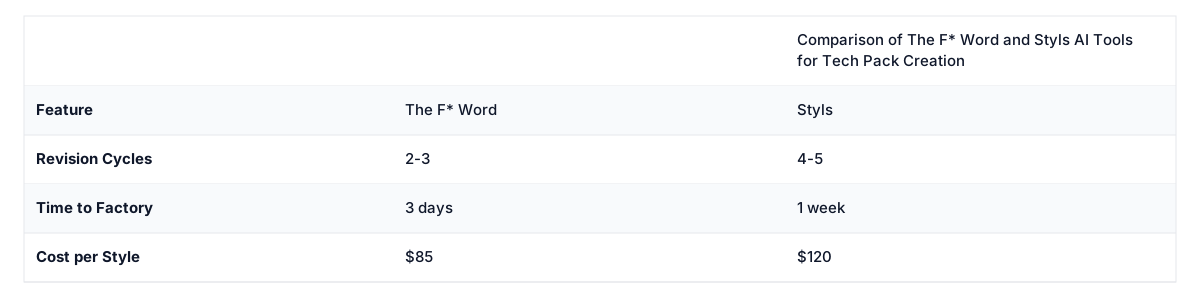
The F* Word offers faster revision cycles, a quicker design-to-factory handoff, and a lower cost per style compared to Styls. This efficiency is achieved through advanced automation processes and a user-friendly interface that integrates well with existing design workflows. These advantages translate into significant time and cost savings, as well as improved product quality.
AI significantly reduces the time and manual effort required to create and revise tech packs, allowing more focus on design and new product development. This leads to faster product launches and the ability to respond swiftly to market trends. Additionally, AI tools provide more accurate and reliable tech packs, minimizing errors and enhancing overall production quality.
Yes, AI tools can be customized to align with specific brand requirements and preferences, enhancing their utility and effectiveness. They can be trained to incorporate brand-specific guidelines and aesthetics, ensuring that each tech pack accurately reflects the brand's identity and standards. This adaptability makes AI tools versatile and valuable across various fashion segments.
Related: fashion tech pack creation tool
Get The F* Word workflow insights in your inbox.