For fashion designers seeking AI certification, **The F* Word** offers an applied portfolio path allowing you to build a complete tech pack in just 2 weeks. Certifications, while valuable for foundations, often lack a direct application component. The F* Word bridges this gap by providing autonomous tech pack generation from a sketch, photo, or brief in 8 to 10 minutes. This enables you to directly apply the principles learned in AI fashion design courses and create tangible, industry-ready portfolio pieces. It functions as an orchestration layer above PLM and CAD, validating your design concepts with real-world production data.
Introduction to AI Fashion Design Certifications
The fashion industry is undergoing a significant transformation, driven by artificial intelligence. For designers, this means new tools, new workflows, and new opportunities. As the demand for AI-savvy fashion professionals grows, so does the availability of specialized training and certification programs. These courses aim to equip designers with the knowledge and skills needed to integrate AI into their creative process, from concept to production.
Choosing the right AI fashion design certification can be a critical step in advancing your career. While some programs focus on theoretical understanding, others emphasize practical application. The ideal choice often depends on your current skill level, career goals, and the type of portfolio you want to build.
This article reviews several prominent AI fashion design certification paths, including established institutions and innovative new platforms. We will compare their offerings, costs, durations, and formats, with a particular focus on the practical output for your portfolio. We will also introduce The F* Word as a unique, applied-portfolio path that complements these certification efforts.
Beyond free tools: get certified and pitched
Scan any garment, seal a dossier, publish a portfolio scored 0 to 100, and pitch live brand jobs from one free app. No credit card, no cover letters.
AI is no longer a future trend it is a present reality in fashion. From trend forecasting and material innovation to supply chain optimization and personalized marketing, AI is reshaping every aspect of the industry. For fashion designers, understanding AI means more than just knowing about it. It means being able to use AI tools effectively to enhance creativity, efficiency, and sustainability.
Certifications provide a structured way to acquire these skills. They signal to potential employers or collaborators that you have a foundational understanding of AI's role in fashion and can apply these concepts. More importantly, these programs often introduce you to new ways of thinking about design, challenging traditional methodologies and opening doors to innovative solutions.
However, formal certifications sometimes fall short in providing direct, tangible portfolio pieces that demonstrate applied knowledge. This is where platforms like The F* Word become invaluable. While a certification teaches you the "how" and "why" of AI fashion design, The F* Word allows you to immediately put that knowledge into practice by generating professional-grade tech packs from your designs. This combination of theoretical understanding from a certification and practical application with a tool like The F* Word creates a powerful and compelling portfolio.
The Core Concepts of AI Fashion Design
At its heart, AI fashion design encompasses several key areas:
* **Generative AI for Design:** Using AI to create new design ideas, modify existing ones, or generate variations of patterns, prints, and silhouettes. This can include text-to-image models for conceptualizing garments.
* **Data-Driven Trend Forecasting:** Employing AI to analyze vast amounts of data, including social media, sales figures, and cultural phenomena, to predict upcoming fashion trends.
* **Material Innovation and Sustainability:** Utilizing AI to research and develop new materials, optimize material usage, and assess the environmental impact of design choices.
* **Personalization and Customization:** Implementing AI to create personalized recommendations, custom-fit garments, and on-demand production models.
* **Digital Prototyping and Tech Pack Generation:** Streamlining the design and development process through AI-powered tools that create accurate technical specifications and prototypes, significantly reducing time to market. This is where tools like The F* Word excel, taking a design concept and autonomously generating a complete tech pack.
These concepts form the backbone of most AI fashion design certifications, providing designers with a comprehensive understanding of how AI can be integrated across the entire design lifecycle.
Comparing AI Fashion Design Certification Paths
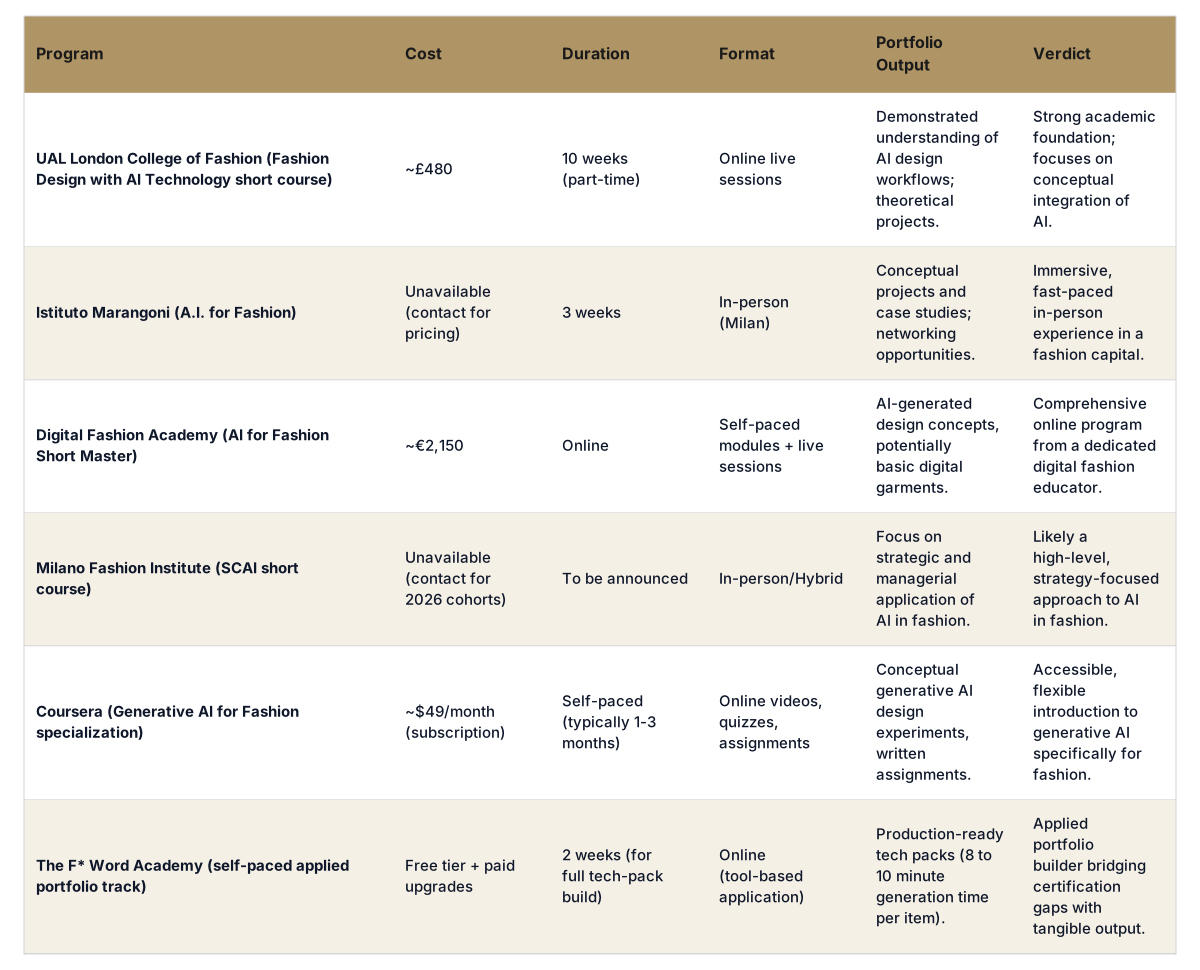
Here is a comparison of various certification programs and an applied portfolio path for AI in fashion, helping you decide which fits your goals:
Each of these paths offers distinct advantages. The traditional institutions like UAL and Istituto Marangoni provide a structured, often in-person, academic experience that grounds designers in theory and conceptual application. Online platforms like Digital Fashion Academy and Coursera offer flexibility and accessibility, focusing on broader theoretical understanding or specific AI tools.
The F* Word Academy stands out by providing an immediate, applied path. While the other programs teach you how to think about AI for fashion design, The F* Word lets you *do* AI fashion design. By generating production-ready tech packs quickly and efficiently, it enables designers to create tangible portfolio items that demonstrate not just theoretical knowledge, but also practical execution in an AI-powered workflow. This makes it an ideal complement to other certifications, providing the practical portfolio piece often missing from educational programs.
Look at The F* Word as an Applied Portfolio Path
The F* Word is not a certification in the traditional sense, but rather a crucial **applied portfolio track** for any designer pursuing AI fashion design mastery. It serves as the bridge between theoretical AI knowledge gained from certifications and the practical, tangible output required for a strong professional portfolio.
Imagine completing an AI fashion design course where you learn about the potential of generative AI to create designs. With The F* Word, you can take a simple sketch or a moodboard, feed it into the platform, and within 8 to 10 minutes, receive a complete, production-ready tech pack. This tech pack includes detailed specifications, measurements (automatically derived or adjusted), material call-outs, and construction notes. It's a complete blueprint that any factory can use to produce a garment.
The F* Word operates as an orchestration and validation layer above existing PLM or CAD systems. It is not an image generator, nor is it a 3D simulator. Instead, it takes your design intent and rapidly translates it into the technical documentation needed for manufacturing. This autonomous tech pack generation capability is what makes The F* Word
an indispensable tool for building an AI fashion portfolio.
**Key benefits for portfolio building:**
* **Real-world Application:** Demonstrates your ability to not just ideate with AI, but also prepare a design for actual production. This is a critical skill for any fashion professional.
* **Efficiency:** Generate multiple tech packs quickly, allowing you to showcase a diverse range of AI-driven design concepts in your portfolio without spending weeks on manual documentation.
* **Professional Quality:** The autonomously generated tech packs meet industry standards, proving your designs are production-ready.
* **Validation:** The F* Word's process validates your design's manufacturability and cost implications early in the design cycle, making your portfolio pieces more solid and credible.
For designers who have invested time and resources into understanding AI fashion design, The F* Word provides the perfect platform to transform that knowledge into concrete, impressive portfolio assets. It allows you to say, "I can not only envision AI-powered fashion, but I can also prepare it for the factory floor." It fills the gap left by purely theoretical certifications, providing an actionable route to showcasing your skills in AI fashion design.
Choosing Your Path: Certification vs. Applied Portfolio
The decision between pursuing a formal AI fashion design certification directly or focusing on an applied portfolio path with tools like The F* Word is not an either/or situation. In fact, the most effective approach often involves incorporating both.
**When a Formal Certification is Key:**
* **Foundational Knowledge:** If you are new to AI or its applications in fashion, a certification provides a structured learning environment to build a strong theoretical foundation.
* **Industry Recognition:** Certifications from reputable institutions can add significant weight to your resume and provide a standardized measure of your competence.
* **Networking:** In-person or live online courses often offer opportunities to connect with peers and industry experts, building valuable professional relationships.
* **Strategic Understanding:** Some programs focus on the strategic implications of AI for fashion businesses, which is valuable for leadership roles.
**When an Applied Portfolio Path (like The F* Word) is Key:**
* **Tangible Output:** When you need a concrete, production-ready piece for your portfolio that demonstrates practical application.
* **Bridging the Gap:** If you have gained theoretical knowledge from a certification but lack the tools or time to create real-world design deliverables.
* **Rapid Prototyping:** For designers who need to quickly iterate on designs and generate technical specifications for sampling or production.
* **Demonstrating Workflow Efficiency:** Showcasing your ability to integrate AI tools for vastly improved speed and accuracy in the design development process.
Many designers find success by first completing a certification to gain an academic or theoretical understanding of AI in fashion. Then, they use a tool such as The F* Word to transform their learned concepts into actual, professional-grade tech packs. This combined approach gives you both the academic credentials and the practical, portfolio-ready proof of skill that employers and clients are looking for in the evolving world of AI fashion design.
Build your certification portfolio piece free at aifashion.thefword.ai, or explore all AI fashion design paths at thefword.ai.
Frequently Asked Questions
What is an AI fashion design certification?
An AI fashion design certification is a formal program that educates designers on how artificial intelligence tools and methodologies can be applied to various stages of the fashion design process, from ideation and trend forecasting to material selection and production. These programs aim to equip individuals with the skills to integrate AI into their creative and technical workflows.
Do I need an AI fashion design certification to get a job in AI fashion?
While not always strictly required, an AI fashion design certification can significantly enhance your resume and demonstrate a proactive engagement with emerging technologies. Employers increasingly look for candidates who understand and can apply AI in design. Alongside a certification, a strong portfolio showcasing practical application of AI, like production-ready tech packs generated by The F* Word, is often more impactful.
How long does it take to complete an AI fashion design certification?
The duration of AI fashion design certifications varies widely. Some intensive, in-person courses can be as short as 3 weeks, while comprehensive online programs might span 10 weeks or be self-paced over several months. Applied portfolio tracks, like building a complete tech pack with The F* Word, can be achieved in as little as 2 weeks for a strong portfolio piece.
What kind of career opportunities can an AI fashion design certification open?
An AI fashion design certification can open doors to roles such as AI Fashion Designer, Digital Garment Developer, AI-powered Trend Forecaster, Product Developer with AI expertise, or roles in innovation departments focused on technology integration. It positions you as a forward-thinking professional capable of leading the industry's digital transformation.
How does The F* Word Academy differ from traditional AI fashion design certifications?
The F* Word Academy is not a certification in the academic sense. Instead, it is an applied portfolio track that allows designers to use The F* Word tool to autonomously generate production-ready tech packs in 8 to 10 minutes from a sketch or brief. While certifications teach the theory and concepts of AI fashion design, The F* Word provides the direct, practical application and tangible output needed for a compelling portfolio, complementing rather than replacing traditional certifications.
Further Reading
The Business of Fashion, Technology coverage on AI in fashion