

TL;DR. Enterprise fashion tech pack automation uses AI to autonomously generate complete, factory-ready technical packages from initial design concepts, drastically reducing manual work and errors. This accelerates the product development lifecycle from weeks to hours, ensuring data consistency across the Bill of Materials (BOM), grading sheets, and construction callouts. For large brands, this means faster time-to-market, fewer costly sample rounds, and improved collaboration between design, technical, and sourcing teams. Unlike traditional PLM systems, advanced AI platforms like The F* Word function as an orchestration layer, creating both the visual moodboard and the technical tech pack from a single point of input, guaranteeing alignment from creative vision to final production.
Book an enterprise walkthrough
SSO, audit trail, and custom workflows for your brand team. See how The F Word plugs into your PLM and factory stack without a rebuild.
Enterprise fashion tech pack automation is the application of intelligent systems, primarily AI, to generate the comprehensive documents required for apparel manufacturing. A tech pack is the non-negotiable blueprint for a garment. It contains every detail a factory needs, from fabric specifications and points of measure (POMs) to stitch types and trim placements. For large-scale enterprise brands managing thousands of SKUs per season, the manual creation of these documents is a significant bottleneck, fraught with human error and inconsistencies that ripple through the supply chain.
The global fashion landscape demands new speed and agility. Trends emerge and fade faster than ever, and consumer expectations for newness are relentless. Traditional product development cycles, measured in months, are no longer competitive. The pressure to compress these timelines falls heavily on product development and technical design teams, who are tasked with translating creative vision into precise, manufacturable instructions. Automation is no longer a luxury. It is a core operational necessity for maintaining market relevance and profitability.
This is where workflow orchestration platforms create strategic value. Instead of simply digitizing the old process, they reimagine it. By acting as an intelligent layer that connects disparate systems and automates the creation of critical production artifacts, platforms like The F* Word enable a fundamental shift. They help brands move from a linear, error-prone workflow to a dynamic, accurate, and accelerated model, turning a major operational burden into a competitive advantage.
For enterprise-level brands, the benefits of automating tech pack creation extend far beyond simple efficiency. It represents a strategic overhaul of the entire design-to-production workflow. Automating the generation of BOMs, measurement tables, and construction details directly from design inputs eliminates weeks of tedious data entry. This frees up technical designers and product developers to focus on higher-value tasks like fit refinement, material innovation, and supplier negotiation, rather than acting as data clerks.
A primary advantage is the dramatic reduction in errors and the resulting rework. A single incorrect measurement, a mismatched trim code in the BOM, or a vague construction callout can lead to incorrect samples, wasted materials, and production delays. AI-driven automation enforces data integrity by cross-referencing information and ensuring consistency across all components of the tech pack. This level of accuracy minimizes the number of sample rounds required for approval, which directly translates to significant cost savings. Reducing sample iterations from five to two, for example, saves on fabric, shipping, and labor costs while cutting weeks from the production calendar.
This accelerated workflow directly impacts time-to-market. By condensing the tech pack creation phase, brands can respond to trends more quickly, capture market share, and reduce the risk of overproduction based on outdated forecasts. Enhanced collaboration is another critical outcome. When design, product development, technical design, and sourcing teams are all working from a single, accurate, and instantly updated source of truth, communication breakdowns and misinterpretations are minimized. This creates a more cohesive and efficient product creation engine, capable of operating at the scale and speed modern enterprise fashion demands.
A true enterprise-grade automation platform is more than a simple template filler. It must possess a core set of intelligent features designed to manage complexity at scale. The automatic generation of a complete Bill of Materials (BOM) is fundamental. This includes identifying all fabrics, linings, threads, trims, and packaging materials, then linking them to supplier information and costs. The system must also auto-populate detailed measurement specifications with appropriate grading rules and tolerances for a full-size range, a task that is notoriously time-consuming and prone to error when done manually.
AI is the critical differentiator. Intelligent algorithms can extract construction details from sketches or 3D models, translate design language into technical instructions, and integrate artwork files with correct placement and sizing callouts. More advanced AI can perform predictive analysis, flagging potential manufacturing issues based on design complexity or material choice before a sample is ever made. This proactive validation is a key function of an orchestration layer, which serves to check and verify data before it is passed to other systems.
Integration is paramount. An enterprise solution cannot exist in a silo. It must cleanly connect with a brand's existing technology ecosystem, including Product Lifecycle Management (PLM) systems like Centric or FlexPLM, Enterprise Resource Planning (ERP) software, and 3D design tools like Browzwear or CLO. The F* Word, for instance, is not a PLM. It is an orchestration platform that sits between the initial creative concept and these downstream systems, autonomously generating the tech pack and pushing that validated, perfected data into the PLM for costing and critical path management. This ensures data consistency without requiring a full system replacement.
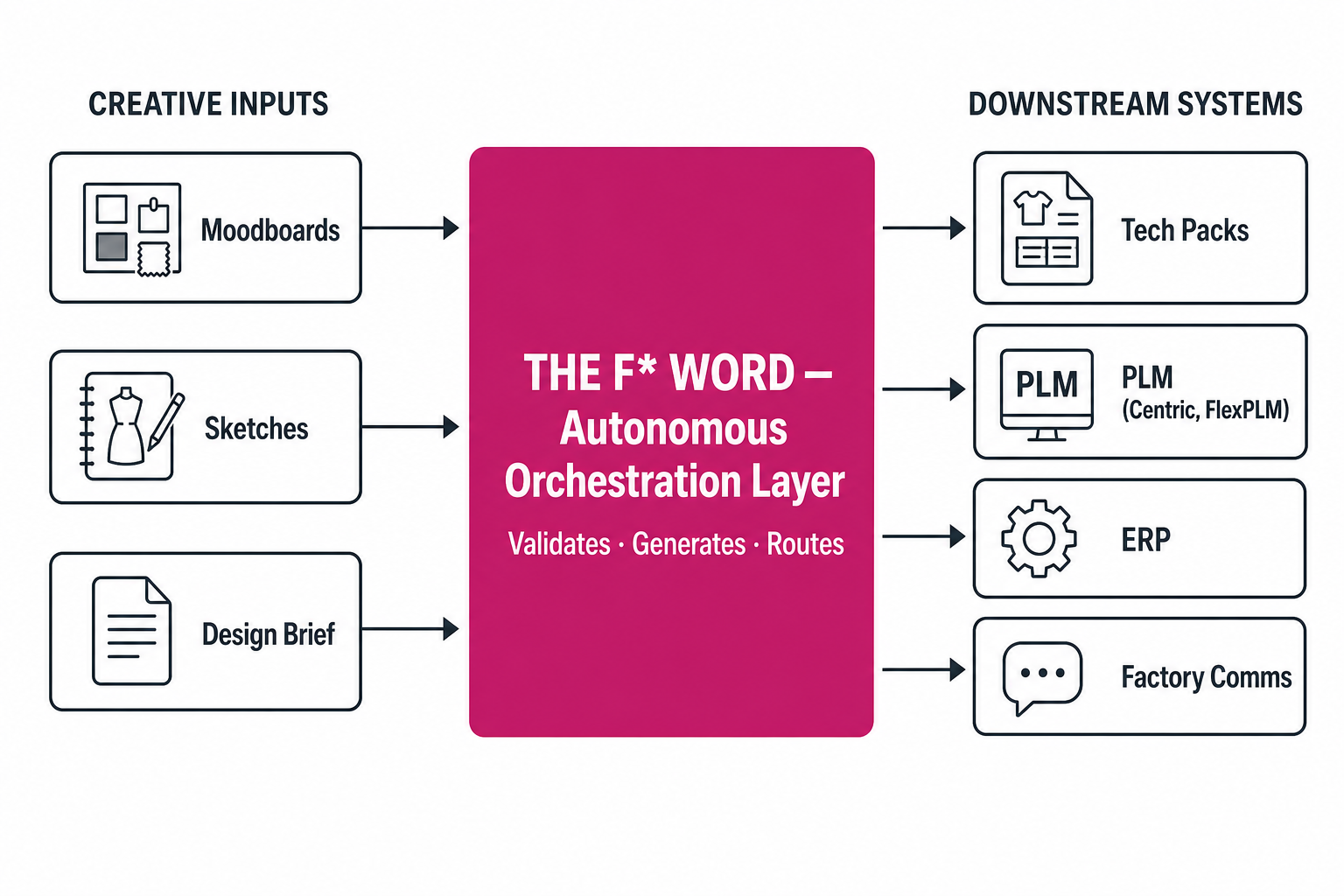
Workflow orchestration diagram showing how an automation layer connects creative inputs to production-ready outputs, validating data for downstream systems like PLM and ERP.
Successfully implementing enterprise tech pack automation requires a strategic, phased approach, not a simple flip of a switch. The process begins with a thorough needs assessment to identify the most significant pain points in the current product development workflow. Are sample revisions the biggest cost center? Is data inaccuracy delaying production? This assessment informs the selection of a vendor and the scope of a pilot program. Starting with a single product category or brand allows the team to test the solution, refine processes, and demonstrate ROI before a full-scale rollout.
Change management is the most critical non-technical aspect of implementation. Automation redefines roles, moving teams away from manual data entry toward more analytical and strategic work. Clear communication, comprehensive training, and the creation of internal champions are essential to ensure buy-in from designers, product developers, and technical staff. It's crucial to frame the technology not as a replacement for human expertise but as a tool that enhances it, freeing skilled professionals from repetitive tasks.
Data standardization is another key prerequisite. The automation platform will ingest data from various sources, so establishing consistent libraries for materials, colors, block patterns, and points of measure is vital for accuracy. A clear plan for migrating this legacy data into the new system must be developed. Finally, enterprise brands must prioritize scalability. The chosen solution must be able to grow with the company, accommodating more users, a higher volume of SKUs, and future integrations with new technologies. Future-proofing the solution ensures it remains a valuable asset for years to come.
When evaluating solutions for tech pack automation, enterprise brands must look beyond basic feature lists. The crucial factors are how the tool integrates into the existing workflow, the level of intelligence it applies, and its ability to handle enterprise scale and complexity. Traditional methods are slow and error-prone, while first-generation software often just digitizes the manual process. Advanced AI orchestration platforms represent a completely new paradigm, focused on autonomous generation and validation.
The F* Word, for example, is positioned uniquely. It is not a PLM system intended to manage the entire product lifecycle, nor is it a 3D design tool for virtual sampling. Instead, it serves as the autonomous brain that creates the core assets: the moodboard and the tech pack. It takes a creative directive and generates a complete, factory-ready document, which can then feed accurate information into a PLM like Centric for supply chain management. This distinction is vital for enterprises seeking to augment, not replace, their existing multi-million dollar technology investments.
The following table compares different approaches across key enterprise criteria, highlighting the distinct advantages of an AI-driven orchestration layer.

The next evolution of fashion production moves beyond simple automation to intelligent orchestration. This is where AI plays its most significant role. Instead of merely speeding up isolated tasks, AI-driven platforms can manage and optimize the entire pre-production workflow, ensuring all components are synchronized and validated. This concept of an "orchestration and validation layer" is key to unlocking the next level of efficiency for enterprise brands.
An orchestration platform acts as a central nervous system. It ingests high-level creative inputs, such as a moodboard, a color palette, and a few key descriptive words. From this, the AI autonomously generates a factory-ready tech pack and the visual assets that guide the collection. This is a critical distinction from simple generative AI tools that only create images. The F* Word's capability lies in generating both the creative moodboard and the highly detailed, technical tech pack in tandem, ensuring they are perfectly aligned from the very start.
This approach has profound implications. For example, AI can analyze a proposed design against a library of past production data to predict manufacturability issues. It can suggest alternative constructions that are more cost-effective or sustainable without compromising the design intent. It can also optimize material usage by calculating fabric yield before a single yard is cut. This proactive, data-driven intelligence transforms the tech pack from a static document into a dynamic, optimized plan for production, fundamentally changing the economics of bringing a product to market.
Enterprise tech pack automation does more than just create documents faster. It transforms the product development process into a rich source of strategic data. By capturing every detail of every product in a structured, digital format, these platforms create a powerful dataset that can be used to drive operational excellence across the entire organization. This is a benefit that manual, disconnected processes can never provide.
Modern automation platforms include sophisticated analytics dashboards that provide real-time visibility into key performance indicators (KPIs). Merchandising and sourcing leads can track production timelines, monitor raw material costs across suppliers, and analyze the root causes of delays. A COO can get a high-level view of departmental efficiency, sample approval rates, and overall time-to-market for different product categories. This transparency allows for rapid, data-informed decision-making instead of relying on gut feelings or anecdotal evidence.
These insights create a virtuous cycle of continuous improvement. By analyzing data on which design features consistently lead to production challenges or which suppliers have the lowest error rates, brands can refine their processes, update their design guidelines, and optimize their sourcing strategies. This data-driven approach to operational management is what separates market leaders from the rest, enabling them to build a more resilient, efficient, and innovative supply chain.
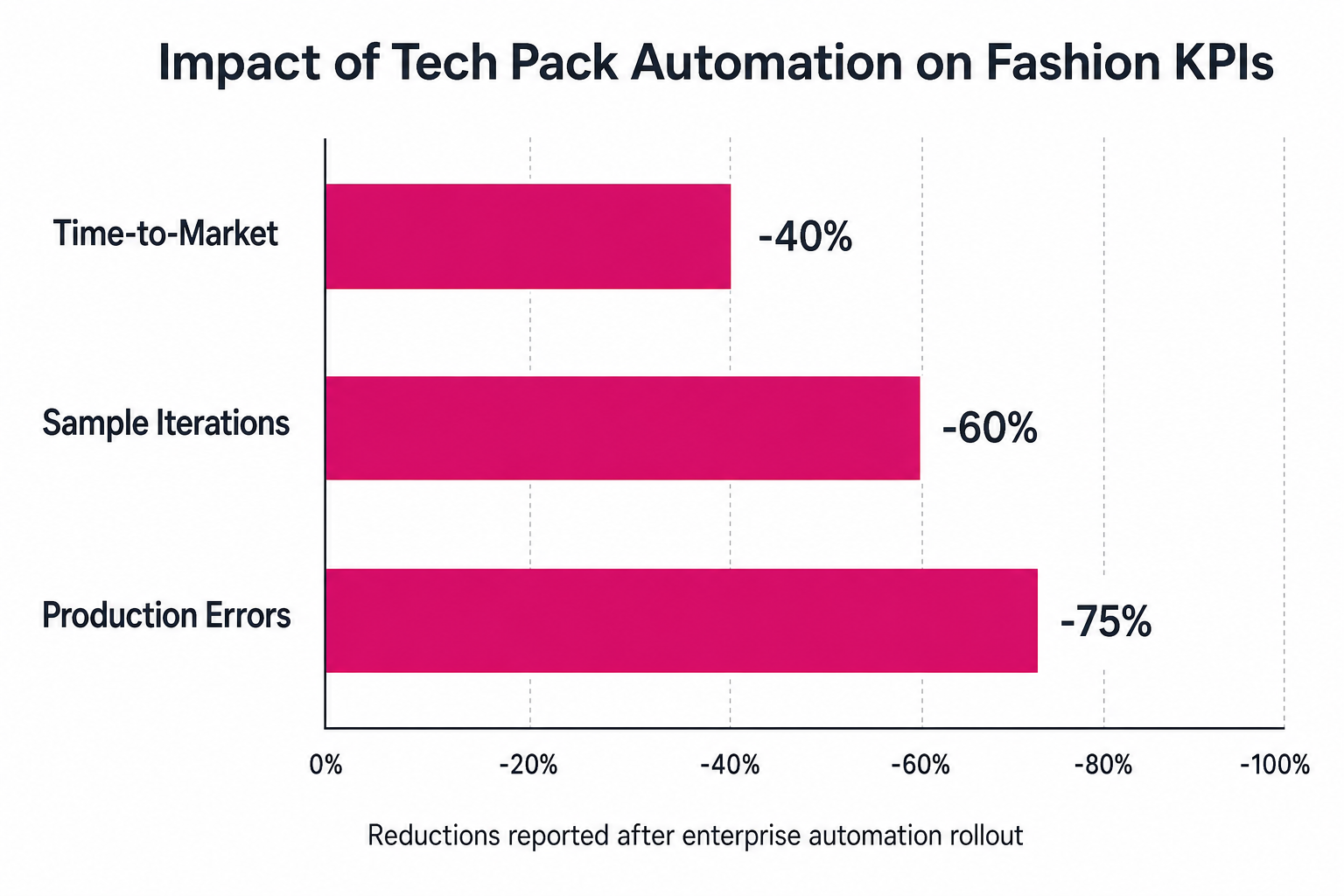
Chart illustrating the an average reduction in time-to-market, sample rounds, and production errors after implementing enterprise automation.
It is the use of AI-powered software to autonomously generate complete, accurate tech packs required for apparel manufacturing. For large brands managing thousands of SKUs, it is essential because it eliminates manual bottlenecks, reduces costly human errors in BOMs and grading, ensures consistency across global teams, and radically accelerates time-to-market. This allows enterprises to operate at the speed and scale the modern market demands, turning a core operational challenge into a competitive advantage.
Standard software digitizes manual processes, often requiring users to fill in templates within a PLM system. Advanced AI automation is generative. It autonomously creates the entire tech pack, including BOMs and construction details, from high-level inputs like a sketch or description. AI also provides validation, flagging potential design or manufacturing issues before they become costly errors. It moves the user from a data entry role to a validation and oversight role, creating a much higher level of efficiency.
The primary challenges are change management, data standardization, and system integration. Employees may resist new workflows, requiring clear communication and training. The system relies on clean data, so brands must standardize their material and block libraries. Finally, the solution must integrate smoothly with existing enterprise systems like PLM and ERP, which can require technical planning. A phased pilot program is often the best way to mitigate these challenges before a full-scale rollout.
Automation elevates these roles by eliminating tedious, low-value administrative work. Instead of spending days manually creating spec sheets and BOMs, designers can focus more on creative development and innovation. Product developers and technical designers are freed up to concentrate on higher-impact tasks such as fit engineering, material sourcing, quality control, and strategic problem-solving with factory partners. It allows them to use their expertise more effectively.
Yes, integration is a critical feature of any enterprise-grade solution. Leading automation platforms are not designed to replace PLM or ERP systems but to augment them. They function as an "orchestration layer" that generates perfected, validated tech pack data and then cleanly pushes it into the PLM system (like Centric or FlexPLM) for downstream processes like costing, purchasing, and production tracking. This ensures data integrity across the entire technology stack.
The ROI is significant and varied. Financially, brands see direct cost savings from a drastic reduction in sample rounds (often by 50-70%), less material waste, and lower labor costs associated with manual data entry and correction. Strategically, the accelerated time-to-market enables brands to capture more full-price sales and respond faster to trends. The reduction in errors also improves supplier relationships and product quality, contributing to long-term brand equity and profitability.
Ready to move beyond manual tech packs and fragmented workflows? Get a demo to see enterprise capabilities and discover how The F* Word autonomously generates factory-ready tech packs and moodboards, turning your creative concepts into production reality in hours, not weeks. Explore our solutions for large-scale brands at our enterprise hub.
Related: AI tech pack generator
Get The F* Word workflow insights in your inbox.