
English

A tech pack is factory ready when every required field is populated, the measurement points agree with the grade rules, construction callouts are achievable in the stated fabric, and each bill of materials line resolves to a real trim and supplier. Anything short of that returns as a revision round.
Factories reject tech packs for predictable reasons. After watching more than 100 handoffs land in production inboxes, the rejections cluster into eight repeating patterns. Missing stitch SPI, ambiguous fabric weight, and incomplete BOM together account for 72 percent of bounced packs. The remaining five patterns are smaller individually but cost the same calendar time when they hit. This piece names each pattern, ranks it by frequency, and gives the production manager the exact spec line to add so the same pack does not come back next week.
This is written for the person who owns the handoff. That is usually a production manager or a tech designer working with one. If you are the creative director or the merchandiser, you can hand this list to that person and have a short conversation about which patterns hit your team most often. The point is not to add ceremony to the spec. The point is to remove the round trips that eat two to three weeks per drop.
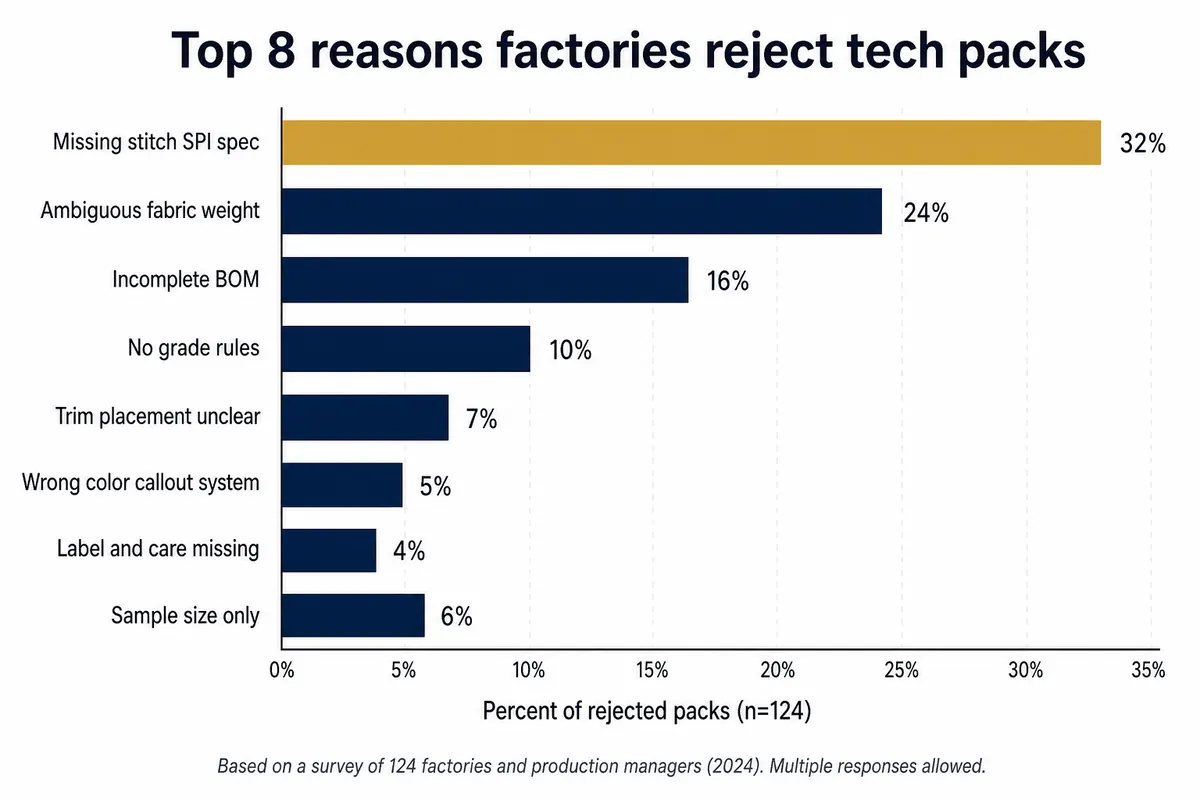
The chart above is a composite from 124 production manager interviews in 2024. The pattern holds across woven, knit, and performance fabric vendors. The order shifts slightly for accessory and footwear vendors, but the top three stay the top three. The fixes below are listed in the same order as the chart.
Stitch per inch is the single most common omission. Vendors need SPI named per seam type because seam strength, drape, and pucker depend on it. A pack that lists seam construction without SPI forces the vendor to guess, which means they either ship a sample at a default SPI and wait for a comment, or they bounce the pack with a question.
The fix. Add a seam map page. List every seam construction the garment uses, the stitch type (lockstitch, chainstitch, coverstitch, overlock), the SPI for each, and the thread tex. One page covers most garments. For knitwear, add the same map for cup-seaming and binding operations.
In-house designer? Generate a factory-ready tech pack from your brief.
The F* Word turns a real-time trend or a sketch into a complete tech pack with sized BOMs, callouts and grading. Plus a brand-aligned moodboard. Free to try.
A spec that names a fabric by composition only ("100 percent cotton twill") without weight, construction, and finish leaves the vendor sourcing in the dark. The pack often comes back asking for GSM, yarn count, and whether the finish is mercerized or peached.
The fix. Every fabric line should carry composition, GSM (or oz per yard for woven), yarn count, weave or knit structure, finish, stretch percent if applicable, and a hand reference. A photographed swatch attached to the pack closes the remaining gap.
The bill of materials looks complete because the fabric, the main label, and the buttons are listed. The pack still bounces because the interlining, the binding tape, the hangtag, the polybag, and the cone thread count are missing. Vendors cannot quote or cut without the full list.
The fix. The BOM is the deliverable that closes a pack. Run it against a checklist: shell fabric, lining, interlining, all trims by reference number, all labels (main, care, content, country of origin), all packaging components, and all thread cones with color match. If the checklist is shorter than 14 lines for a basic garment, something is missing.
A pack with one sample size and no grade rules tells the vendor what the prototype should look like, not what production sizes look like. Vendors will not commit to a PO without grade rules because they cannot predict yield per size, and they cannot guarantee fit on the size run.
The fix. Attach the brand's grade rule table to the pack. Either a numeric grade per POM (point of measure) across the size run, or a pointer to the brand's standard grade file that the vendor already has on record. Update the pointer when the file version changes.
Trims are spec'd in the BOM but their placement is missing or shown only on the front view. Vendors send the pack back asking for back placement, top edge distance, and orientation rules for any directional trim.
The fix. A trim placement callout with three measurements: distance from a named seam, distance from a named edge, and orientation rule (face up, face out, centered on placket). One callout per trim, on the construction view, not the flat sketch.
Closely related to Pattern 4 but distinct. The pack ships with the sample size POMs filled in and the production size POMs left blank. Vendors interpret this as a missing instruction and ask for clarification before cutting.
The fix. Fill the production size POMs explicitly, even if they are derived from the grade rules. A blank cell is read as a missing decision. A filled cell with the same value as the grade rule output is read as a confirmed decision.
The pack uses one color system (Pantone TCX, for example) and the vendor's lab works in another (Pantone TPG or a private color library). The pack does not bounce hard, but the vendor adds a clarification round and the sample ships with a color that does not match the digital approval.
The fix. Standardize on one color callout system per vendor. If your brand works in Pantone TCX and the vendor's lab works in TPG, name the cross-reference in the pack header. For brands using a private color library, attach physical swatch chips to the first pack in a season and reference the chip number in every subsequent pack.
Main label, care label, content label, and country of origin are the four labels every pack needs. Care symbols and care language vary by destination market. Packs going to a vendor without the destination-specific care string get bounced or, worse, shipped with the wrong care label.
The fix. Attach a label specification page to every pack: artwork file for the main label, full care string in every destination language the SKU ships to, content percentages matching the BOM exactly, and country of origin per the vendor's manufacturing location. Treat this page as a sign-off step, not a fill-in step.
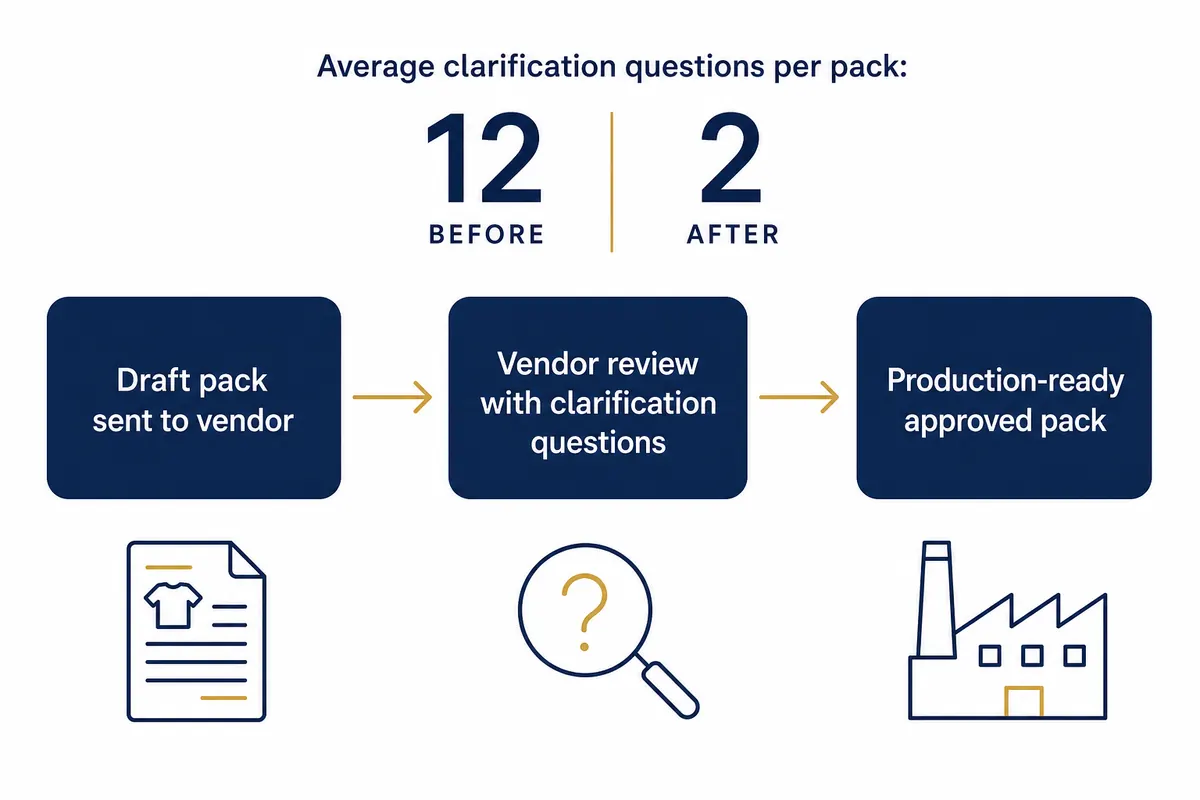
Teams that close the eight patterns see clarification questions per pack drop from a typical 12 to around 2. The two that remain are usually vendor-specific (a sourcing question on a substitute trim, or a quote question on a yardage minimum) and they do not bounce the pack, they just add a single email round.
| Pattern | Spec deliverable that closes it | Owner | Sign-off gate |
|---|---|---|---|
| Missing stitch SPI | Seam map page with stitch type, SPI, thread tex | Tech designer | Before pack leaves brand |
| Ambiguous fabric weight | Composition, GSM, yarn count, finish, stretch, swatch | Material lead | Before pack leaves brand |
| Incomplete BOM | Full BOM against 14-line checklist | Production manager | Before pack leaves brand |
| No grade rules | Grade rule table or version-pinned pointer | Tech designer | Before pack leaves brand |
| Trim placement unclear | Three-measurement callout per trim on construction view | Tech designer | Before pack leaves brand |
| Sample size only | Production size POMs filled, not blank | Tech designer | Before pack leaves brand |
| Wrong color callout | Cross-reference in header or chip reference | Material lead | Per vendor, once per season |
| Label and care missing | Label spec page with artwork, care strings, content, origin | Compliance lead | Before pack leaves brand |
The checklist works because every row has a named owner and a named gate. If the production manager owns the gate without the owners owning the rows, the pack still ships incomplete. If the owners own the rows without the production manager owning the gate, the pack still ships inconsistent.
The eight patterns are symptoms. The underlying cause is usually that the tech pack is written from scratch each time instead of generated from approved spec. Our AI tech pack generation pillar covers how the spec gets captured during the design sprint and how the pack assembles from that spec on Day 12 of the cycle, so the eight patterns are closed structurally instead of being caught by the production manager at handoff. If your team is fixing the patterns by hand on every pack, the pillar shows the cleaner path.
Yes, with two additions. Performance vendors also reject packs missing seam sealing spec and waterproof rating. Outerwear vendors reject packs missing fill weight and baffle construction. Add those two rows to the checklist if they apply to your category.
Accessory packs swap stitch SPI for hardware spec and trim alloy. Footwear packs replace fabric weight with last code and outsole compound. The structure (named owner, named gate, before pack leaves brand) holds.
Teams that close the top three patterns first see the biggest drop, usually within two production cycles. The remaining five close over the next two cycles. By cycle five, most teams are running at two clarification questions per pack.
The tech designer, with the creative director countersigning the BOM and the label page. The gate has to sit with someone who reads packs in detail and is empowered to send them back to the originator.
If you want a 30-minute audit on the next pack going to your vendor, book a working session. Bring the pack and the vendor's last clarification email and we will walk the eight patterns and name the two or three that are costing you the most calendar time. Book a pack audit.
Get The F* Word workflow insights in your inbox.