.png)
English
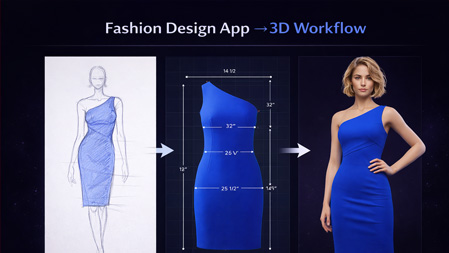
The modern fashion design app is no longer a sketching tool. It is a workflow engine.
If you are running a brand, managing a design team, or building collections season after season, your bottleneck is not creativity. It is coordination. Sketch to sample. Sample to tech pack. Tech pack to vendor. Vendor back to revision. Every handoff introduces delay, cost, and risk.
3D fashion design software compresses those loops. When used correctly, it changes how creative direction, pre-production, and launch execution connect.
Let’s break it down operationally.
In most apparel teams, creative direction starts in fragmented tools. Pinterest boards. Illustrator sketches. Fabric swatches pinned to a wall. Then someone translates that into line plans and CAD flats.
The friction shows up in three places:
A strong fashion design app with integrated 3D capability lets you test silhouette proportion, drape, and volume before development money is spent.
Instead of sketching 20 jackets and sampling 5, you can simulate all 20, narrow to 8, and physically sample 3. That is not theoretical. Brands using 3D prototyping report sample reductions in the 30 to 50 percent range, depending on category complexity (industry estimates across mid-market apparel teams).
In real teams, here is what changes:
The creative director reviews a digital rack in 3D. Merchandising overlays projected sell-through assumptions. The design lead adjusts sleeve pitch and body length in minutes. No pattern room time lost.
This is where tools discussed in our breakdown of leading platforms in 2025 become relevant, especially when evaluating long-term stack decisions for your team. See: https://thefword.ai/fashion-design-software-in-2025-top-tools-for-digital-creators
The goal is not prettier renders. It is faster line validation.
I use one framework when advising brands adopting 3D fashion design software: Sample Compression Model.
It is a structured way to replace physical sampling with staged digital validation. First, define validation checkpoints inside creative direction, pre-production, and merchant review. Second, assign each checkpoint a digital approval requirement before physical sampling begins. Third, track sample elimination rates season over season. When applied properly, creative teams make fewer speculative styles, technical designers enter development with fewer ambiguities, and vendors receive cleaner first-pass tech packs. The tradeoff is upfront time in digital asset precision and team retraining. It fails when teams treat 3D renders as visual marketing assets instead of engineering previews, which reintroduces guesswork into construction.
Apply it rigorously and you change downstream behavior across the company.

This is where most brands bleed margin.
Incomplete BOMs. Missing seam construction notes. Measurement inconsistencies between size sets. Versioning chaos across email threads.
A modern fashion design app connected to AI-supported tech pack generation tightens this layer.
Here is what should be automated:
If your technical designer is still manually rewriting measurements from Illustrator flats into spreadsheets, you are running a 2015 workflow in a 2026 market.
According to McKinsey’s State of Fashion report, digitalization and automation in product development are among the highest ROI operational improvements for fashion brands.
Source: McKinsey & Company, The State of Fashion
The financial impact compounds quickly.
Assume:
Current annual sampling cost:
120 × 3 × $250 = $90,000
If 3D validation reduces sampling by 40 percent:
3 samples × 40 percent = 1.2 samples eliminated per style
120 × 1.2 × $250 = $36,000 saved annually
That excludes time savings and faster time to market.
For emerging brands, $36,000 funds another capsule drop. For scaling brands, it protects margin during volatile demand cycles.
Not every team needs the same setup. Some are digital-first. Others still depend on overseas factories for pattern making.
Launch used to wait for inventory. Now it can start at confirmation.
With 3D fashion design software:
This shortens the gap between design approval and revenue capture.
Brands experimenting with digital-only capsules, similar to platforms discussed in our analysis of Fabricant alternatives, are proving this model in niche markets. See: https://thefword.ai/the-best-fabricant-alternatives
The risk is over-reliance on hyper-polished renders. If your physical garment does not match digital representation, return rates increase. That destroys margin fast.
Digital precision must map to physical reality.
Adopting a serious fashion design app with 3D capability is not plug and play.
You will face:
If your fabric library is poorly organized, 3D output will be unreliable. If your pattern blocks are inconsistent, fit simulation becomes misleading.
This is why adoption should start with one category, one season, one tightly managed team.
The brands that win are not the ones with the most software. They are the ones who align creative direction, technical design, and merchandising inside one data spine.
That is what 3D fashion design software actually enables.
If you are still running Illustrator sketches, manual tech packs, and reactive sampling, your cost structure is inflated and your launch speed is constrained.
Move one category into a 3D-first workflow this season. Track sampling reduction. Track revision cycles. Track vendor clarification emails. Make the ROI visible.
If you want to operationalize AI tech packs and compress development time without bloating headcount: https://app.thefword.ai/
Build faster. Sample less. Launch cleaner.
Fashion Design Software in 2025: Top Tools for Digital Creators
https://thefword.ai/fashion-design-software-in-2025-top-tools-for-digital-creators
Deep breakdown of platform capabilities, stack decisions, and integration considerations for growing brands.
The Best Fabricant Alternatives
https://thefword.ai/the-best-fabricant-alternatives
Explore digital fashion platforms and what they mean for capsule drops, virtual assets, and hybrid launch models.
101 People Reading our Newsletter Right Now!
