.png)
English
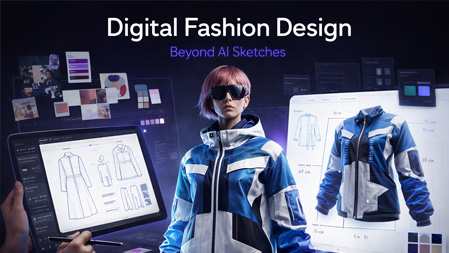
Digital fashion design is moving past the phase of AI-generated sketches. The real shift now sits inside the operational core of apparel companies. Designers are no longer using AI simply to generate images. They are starting to run full workflows through digital systems that connect creative direction, pre-production, and product launch.
This matters because fashion design has historically been fragmented. Sketches lived in one tool, tech packs in another, vendor communication in email threads, and product assets somewhere else entirely. Digital fashion design is compressing those steps into a connected process where the output of one stage feeds the next.
The result is faster iteration, clearer communication with factories, and fewer expensive sampling cycles.
Industry research reflects this shift. A 2023 McKinsey report on the state of fashion notes that digital product creation can reduce development timelines by 30 to 50 percent in some apparel categories.
For designers and brands, the real opportunity lies in how digital fashion design connects creativity to production reality.
Early AI tools focused on image generation. Designers used them to explore silhouettes, color stories, or visual concepts. These outputs were often visually interesting but operationally isolated.
The next stage looks different.
Digital fashion design systems now connect several steps in the design pipeline:
Instead of exporting a sketch and rebuilding it as a tech pack, designers can move directly from concept into production-ready documentation.
For example, teams exploring 3D tools and digital workflows often start with platforms like CLO3D and Browzwear. These tools allow designers to visualize garments before physical samples exist.
That shift matters for both speed and cost.
Sampling rounds are expensive. A typical apparel development cycle can include three to five sample iterations, each requiring pattern adjustments, shipping time, and factory coordination.
Digital fashion design reduces that friction by moving decisions earlier in the process.
Inside real apparel teams, design rarely moves in a straight line. A creative director may define a concept, but technical designers must translate that concept into measurable specifications.
That translation step often introduces delays.
A sketch might show a cropped jacket with oversized sleeves. The technical designer then needs to define sleeve circumference, seam placement, fabric type, lining, and hardware details. Without clear documentation, factories guess.
This is where digital fashion design becomes operational.
The Design to Spec Loop is a workflow principle where every creative design output automatically generates structured technical data. Designers apply it by linking concept tools to tech pack systems so silhouettes, trims, and fabrics translate into production specs immediately. When teams adopt this loop, creative exploration remains fluid while pre-production documentation updates in parallel. The trade-off is that designers must define attributes earlier, which can slow purely exploratory sketch phases. Failure occurs when teams treat the loop as rigid documentation instead of a flexible iteration tool, which leads to premature locking of design details.
In practice, this means a garment concept can move from sketch to spec sheet with fewer manual steps.

Speed gains matter, but the real financial impact appears in sampling reduction.
Consider a typical apparel development scenario.
Inputs
Calculation
Total sampling cost = 4 × $120 × 80
Result
Total sampling cost = $38,400
If digital fashion design tools reduce sampling rounds by 25 percent, the new total becomes:
3 samples × $120 × 80 = $28,800
Estimated savings: $9,600 per season
For larger brands running hundreds of SKUs, the cost impact scales quickly.
This is one reason digital design tools are becoming part of the mainstream apparel stack.
Digital clothing design touches more than just the sketch phase. The biggest gains appear when brands integrate it across the full product lifecycle.
In many apparel companies, the design process looks like this.
A designer creates concept sketches for a seasonal capsule. These sketches are shared with a technical designer, who builds the tech pack. Merchandising then reviews the style for line planning and cost targets. Finally, the design moves to vendors for sampling.
Every handoff introduces friction.
Digital fashion design compresses those handoffs.
A concept can automatically generate early technical documentation. Construction details attach directly to the design file. Merchandising teams can evaluate projected costs earlier in development.
Teams experimenting with next-generation systems, including AI design agents, often combine design tools with platforms described in resources like fashion design software in 2025 top tools for digital creators. These systems allow designers to move between concept generation, 3D prototyping, and tech pack creation without rebuilding information.
That continuity reduces errors in production.
Factories receive clearer instructions, which reduces the number of clarification emails and revision rounds.
The short answer is no.
Fashion design still depends heavily on human taste, cultural context, and brand identity. AI can generate variations, but it does not understand the narrative behind a collection or the strategic positioning of a brand.
What AI does change is the speed of iteration.
Designers can explore more silhouettes, materials, and variations before committing to a final concept. Instead of spending hours drafting technical documentation, they can focus on creative direction and product storytelling.
The role of the designer becomes more strategic.
Creative directors focus on vision. Technical designers manage the structural integrity of garments. AI systems handle repetitive documentation and data translation.
This structure resembles how architecture firms use digital modeling. The tools handle geometry and measurement. Architects focus on design intent.
Fashion design is moving in the same direction.
Design teams that adopt digital fashion design workflows early gain a major operational advantage. Faster iteration, clearer tech packs, and fewer sampling rounds translate directly into faster product cycles.
If your brand is exploring AI-powered design systems and automated tech packs, start experimenting now.
Try the platform:
https://app.thefword.ai/
AI Fashion Designer System
https://thefword.ai/ai-fashion-designer-system
Explores how AI systems assist designers from concept to garment development.
Fashion Design Apps: Tools for Sketching, 3D Modeling, & Prototyping
https://thefword.ai/best-fashion-design-apps-tools-for-sketching-3d-modeling-and-prototyping/
A breakdown of tools designers use to move from sketch to digital garment prototypes.
Fashion Design Software in 2025: Top Tools for Digital Creators
https://thefword.ai/fashion-design-software-in-2025-top-tools-for-digital-creators
Overview of emerging software platforms shaping the next generation of digital fashion design.
The F* Word Platform
See how AI-powered design agents convert fashion concepts into tech packs, specs, and production-ready documentation for apparel teams.
101 People Reading our Newsletter Right Now!
