
Garment tech pack software should reduce sample chaos, not just format specs. The buyer question is simple: does the system create editable, complete, factory-readable handoff data?
Most small teams ship faster on Illustrator + sheets until collaboration pain spikes. Once vendors, styles, and revisions multiply, the right garment tech pack software compresses feedback loops and reduces samples.
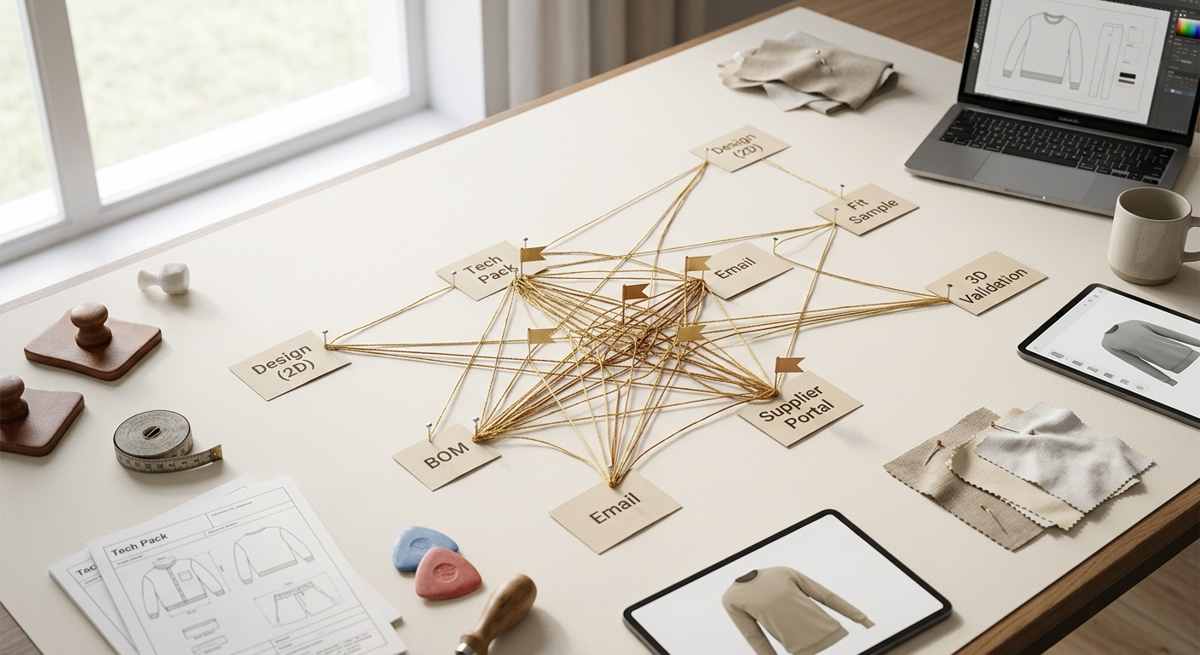
Before you buy anything, identify where the breakdown actually starts. Most teams misdiagnose this. They think they need "better tech packs," when the real problem is scattered approvals, unclear construction notes, missing BOM data, or vendors working from outdated PDFs.
Run a quick audit across your last 10 to 30 styles. Track where each delay began: design change, missing measurement, unclear callout, late trim confirmation, factory question, fit correction, or version mismatch. The pattern will tell you what software needs to solve.
If most errors come from unclear construction notes, prioritize annotation depth and reusable callout libraries. If the problem is factory confusion, prioritize vendor portals, export quality, and change logs. If sampling costs are rising because fit decisions happen too late, 3D integration belongs earlier in the workflow.
This is where teams should also review how their pre-production stack connects to AI tech packs and broader workflow systems. The best software does not just create a document. It connects creative direction, spec readiness, factory handoff, and launch assets in one flow. The F* Word's pre-production workflow page frames this as a connected workflow from trends to concepts, 3D, tech packs, and visuals.
Across 30 styles and 4 revision rounds, unmanaged email + PDFs consume 12–16 hours per season before a single fit sample is cut.
Freelancers often win with Illustrator + spreadsheets because factories already expect this format and it is cheap and flexible. That baseline works until version control and multi-supplier workflows break it. Sources: survey of 20+ freelancers via Successful Fashion Designer.
When vendor questions repeat, you are paying an invisible tax. Annotation clarity, BOM precision, and a single source of truth remove that tax faster than another template pack. If collaboration is your biggest leak, prioritize garment tech pack software that invites factories into the source.
Adopt architecture that matches your maturity: start 2D for speed, add SaaS for collaboration, layer PLM for governance, and bring 3D when fit/visuals reduce samples.
Place the stack that solves your dominant failure mode today, and ensure it integrates with tomorrow (Illustrator, PLM, 3D). Comparisons and patterns: Tech Pack Wizard, CLO3D.
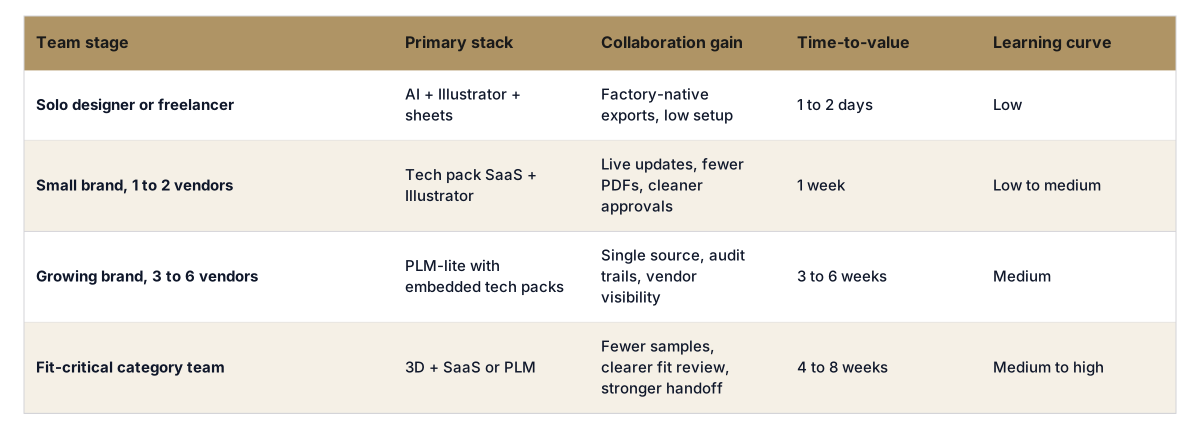
Team stagePrimary stackCollaboration gainTime-to-valueLearning curveSolo/freelanceAI + Illustrator + sheetsFast, factory-native exports1-2 daysLowSmall brand, 1-2 vendorsTech pack SaaS + IllustratorLive updates, fewer PDFs1 weekLow-mediumGrowing brand, 3-6 vendorsPLM-lite with embedded packsSingle source, audit trails3-6 weeksMediumFit-critical categories3D (CLO3D) + SaaS/PLMFewer samples, clearer fit4-8 weeksMedium-high
The tradeoff is speed vs. governance. Overbuy PLM and you slow sampling. Delay SaaS too long and you drown in email. Connect 2D, SaaS, PLM, and 3D so you can stage upgrades without redoing work.
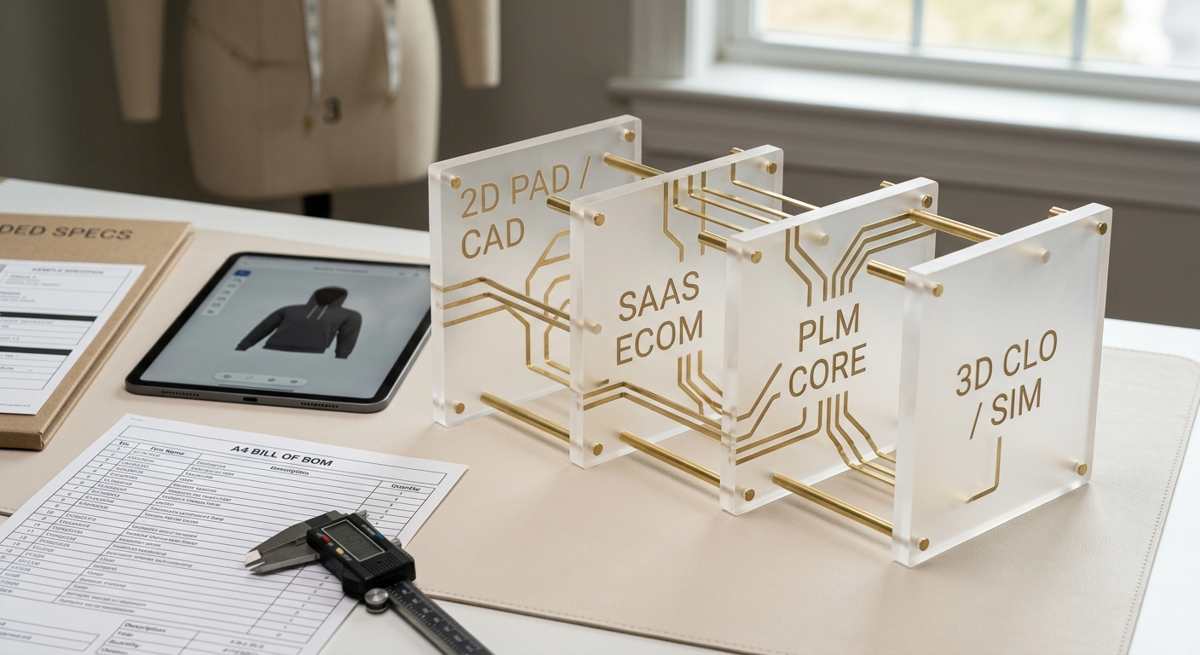
A practical architecture should answer four questions before implementation:
For most brands, the answer is staged. Illustrator or CAD remains the design source. Tech pack SaaS becomes the approved spec layer. PLM handles governance once categories, vendors, and seasonal volume justify the overhead. 3D sits between concept approval and final tech pack when fit, drape, or sample reduction has commercial value.
The integration risk is duplication. If designers update Illustrator, technical designers update a spreadsheet, and production managers send separate PDFs, the team creates three versions of the same product. That is how factories cut from stale specs. A better stack lets one approved change update the pack, notify the vendor, and preserve the revision trail.
For teams building toward 3D, the goal should be controlled adoption. Start with one fit-sensitive category, such as denim, outerwear, tailoring, or stretch dresses. The F* Word's 3D workflow guide makes the same practical point: 3D works best between concept and tech pack, where teams can validate fit and reduce sample waste before production files lock.
In-house designer? Generate a factory-ready tech pack from your brief.
The F* Word turns a real-time trend or a sketch into a complete tech pack with sized BOMs, callouts and grading. Plus a brand-aligned moodboard. Free to try.
Pick software by failure modes using five signals: Scale, Ecosystem, Accuracy, Motion, Spend.
S.E.A.M.S. is a scoring model (1-5 on each vector) that forces you to buy for the bottleneck. Apply it by picking the stack that fixes your top two deficits while maintaining ecosystem fit. The core tradeoff: overbuying PLM early creates workflow drag; under-buying SaaS when vendors multiply burns rework hours. The failure mode to avoid: adding 3D without vendor readiness yields pretty visuals and unchanged sample counts.
Use S.E.A.M.S. in vendor calls. Ask for demos that target your top-two signals with clear before/after minutes saved. If the vendor cannot show change logs with factory access or cannot export factory-native packs, move on.
Quantify payback by mapping revisions, minutes, and sample costs.
A 3-person team ships 30 styles/season, 4 revision rounds, across 2 factories. The work is split: one designer, one tech designer, one PM handling vendor email.
Sample reduction via 3D validation: from 3 to 2 samples per style on 40% of styles.
12 styles x 1 sample saved x $120/sample = $1,440/season.
Annualized across 2 seasons: $1,760 x 2 + $1,440 x 2 = $6,400.
If licenses cost $250/seat/month x 3 seats x 12 = $9,000, SaaS alone is negative ROI. Add 3D that actually cuts samples and the combined system clears breakeven; without 3D, delay adoption until vendor count or revision volume rises.
This math guards against shiny-object buys. Buy garment tech pack software when your revision math and sample math cover license cost within two seasons.
Accuracy beats aesthetics: callouts, grade rules, and factory-native exports drive fewer samples.
If your top returns come from stitch types, seam allowances, or trim placements, your tool must support precise, repeatable annotations. That includes staple callout libraries, graded measurement tables, and inline visuals that match actual construction.
Factories care about what they can cut and sew without guessing. If exports bury BOM details or omit label/packaging, you invite a round of clarifying emails. Choose garment tech pack software that exports clean BOMs, graded specs, and annotated visuals in formats your vendors already open.
Run a 3-style pilot with your vendors. Track factory questions per style, fit sample count, and admin time. If questions drop by 30%+ on pilot, you are buying accuracy.
Incremental upgrades win: keep Illustrator for sketching, add SaaS for flow, adopt 3D when fit drives cost.
Most teams do not need to abandon Illustrator. Keep it as the sketch and detail source while your SaaS handles versioning, change logs, and factory portals. Ensure artwork and spec updates sync without duplicate data entry.
Adopt CLO3D or similar when return rates, fit reworks, or sample cycles hurt margins. Expect 4-8 weeks to reach useful 3D output on 1-2 categories. Avoid rolling 3D across all categories at once; start with silhouettes where visual fit feedback meaningfully reduces samples.
Plan your integrations up front: file naming rules, shared libraries, and who presses export. Chaos happens when every designer exports differently and factories receive five pack formats in a month.
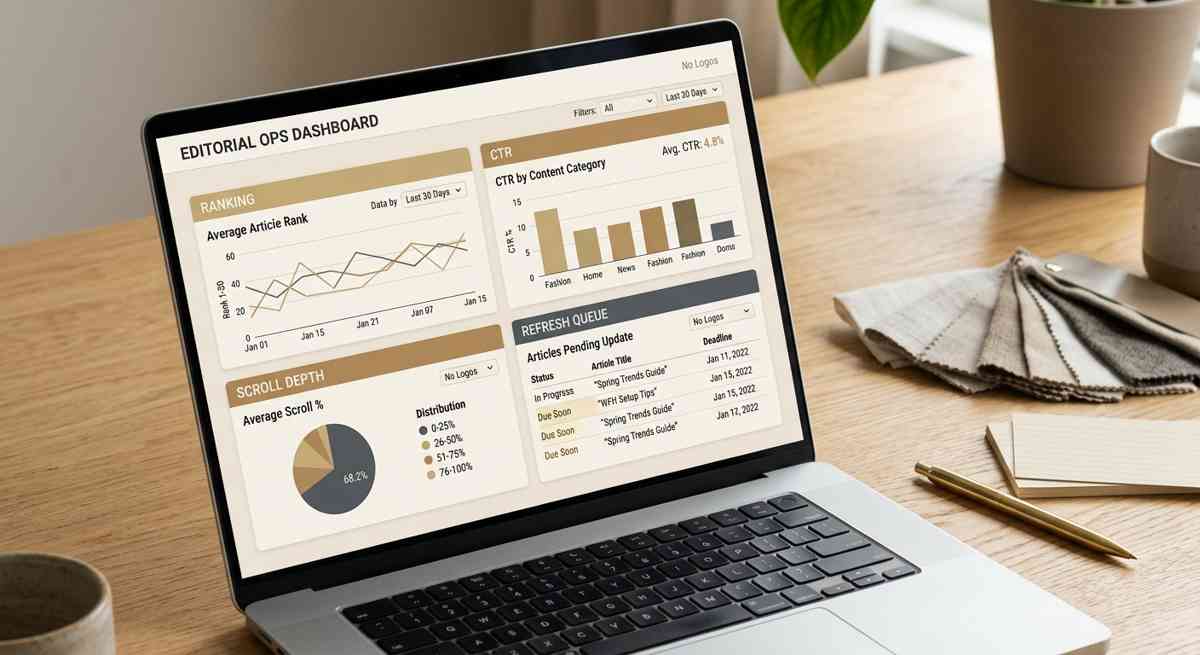
Treat this page like a product: monitor, iterate, and retire stale tactics before they cost rankings.
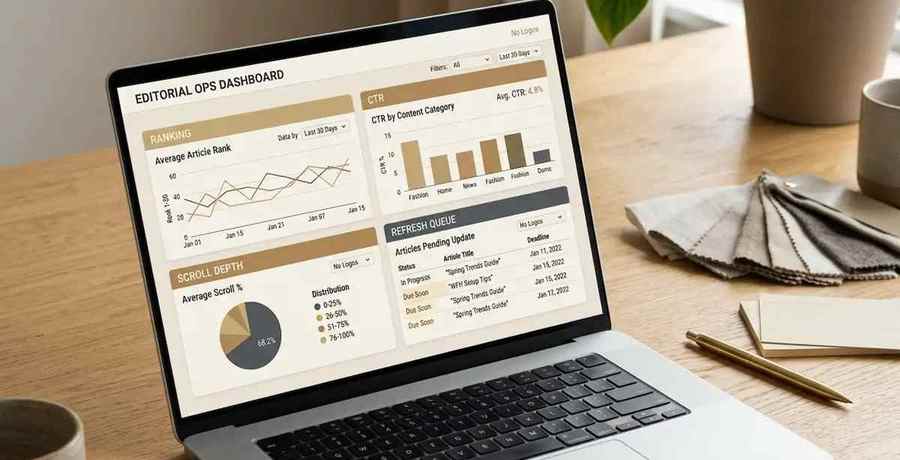
Cadence: Weekly for the first 8 weeks post-publish, then monthly. Rank signals: Track position for "garment tech pack software" and variants; rework if average position drops below 8 for 2 consecutive weeks after stable impressions. CTR triggers: If CTR falls >25% vs. 4-week baseline while position holds, test title/meta focusing on collaboration cost and ROI math. Intent drift: If GSC shows rising impressions for 3D or PLM queries, add a new subsection and update the table with integration notes. Competitive shifts: When Techpacker, Centric, or CLO3D ship notable features, append a dated note and revise examples within 10 days. Content decay: If average engaged time drops below 70 seconds or scroll depth <50%** for 3 weeks, compress intro by **20%**, surface the framework earlier, and move the table above the fold. Update pack: Refresh the numerical example with your latest season data; replace any tool prices **>6 months old; add 1 new external citation per refresh.
Build a small editorial ops board in Notion or Asana. Pipe in GSC position and CTR, GA4 engaged time, and Hotjar scroll depth. Schedule refresh slots so this page compounds rather than decays.
Software is not the strategy; removing ambiguity is.
Pick the minimum stack that crushes your biggest failure mode, then layer capabilities only when ROI is clear. Your garment tech pack software should centralize truth, shorten factory cycles, and scale as complexity rises.
No internal links were provided for this piece.
Ready to eliminate endless sample revisions and regain control of your production timeline? Stop wrestling with scattered files and start designing with purpose. Start free at thefword.ai or Book a demo.
By centralizing all specifications in one place, measurements, materials, construction details, and visual flats, the software creates an unambiguous source of truth. This clarity minimizes factory misinterpretations. When combined with features like 3D model integration and precise callouts, it allows for more accurate "digital samples," drastically reducing the need for costly and slow physical prototypes.
Yes, modern tech pack platforms are built for this workflow. Most allow direct import of AI, DXF, and other standard vector files. Instead of simply attaching a file, the software often allows you to integrate these assets into a reusable component library, linking them directly to specific points on your measurement chart or construction notes for maximum clarity.
While a PLM manages the entire product lifecycle from concept to end-of-life, it is often a complex, enterprise-level system that is expensive and difficult to implement for smaller teams. Dedicated tech pack software focuses specifically on perfecting the pre-production package. It offers a more agile, user-friendly, and cost-effective solution to solve the immediate chaos of spec communication and sample management, without the overhead of a full PLM.
Instead of relying on confusing filenames, the software creates an automated, chronological revision history. Every change is tracked, time-stamped, and attributed to a user. You can easily compare versions side-by-side, see what was altered, and roll back if needed. This ensures your manufacturer is always working from the latest approved version, eliminating costly errors from referencing an outdated spec sheet.
AI Tech Pack Tool for Fashion Designers: From Sketch to Spec
Strong fit for readers who want the practical bridge between design input, AI-generated specs, BOM structure, POM logic, and vendor-ready handoff.
Tech Pack Software for Fashion Brands: What's Essential?
Useful for designers and production teams who want a feature-level breakdown: BOMs, graded specs, callouts, approvals, vendor handoff, and AI-assisted production readiness.
Best AI Tech Pack Generator for Fashion Brands in 2026
A closer look at how AI tech pack tools should handle speed, production logic, workflow controls, and factory-ready outputs.
The F* Word Editorial · Fashion workflow team
Written by The F* Word editorial team. We build AI fashion workflow software grounded in thousands of industry-produced tech packs and proprietary garment records, so what reaches the factory is consistent, reviewed, and tied to design intent.
Once the tech pack is factory-ready, these are the steps that take it through production.
Get The F* Word workflow insights in your inbox.