
The fashion industry stands at a technological crossroads in 2026. While creative directors juggle disconnected tools and wait weeks for design validation, generative AI for fashion design is fundamentally reshaping how brands conceptualize, iterate, and bring products to market. According to McKinsey, generative AI is helping fashion businesses become more productive and reach market faster than ever before. This transformation isn't just about speed, it's about unlocking creative possibilities that were previously impossible within traditional design constraints.
For VPs of Design and Creative Directors managing fragmented workflows across multiple platforms, generative AI offers a compelling solution: the ability to explore significantly more design directions without expanding headcount, while simultaneously reducing inventory risk and accelerating time-to-market. The technology addresses a core pain point that has plagued fashion teams for decades, spending more time coordinating between tools than actually designing.

Generative AI has evolved from experimental technology to production-ready tooling that analyzes vast fashion datasets to generate novel design concepts rapidly. The technology processes fashion imagery, trend reports, and historical design archives to produce multiple variations from simple text prompts or rough sketches. Unlike traditional CAD tools that require manual input for every design element, AI systems can generate dozens of concepts in the time it previously took to create one.
The distinction between tools that create assets and platforms that manage entire workflows has become critical for fashion teams. While designers may already use Adobe for asset creation or CLO for 3D visualization, these tools don't connect the dots across creative direction, technical design, and merchandising. AI clothing designer tools are bridging this gap by integrating generative capabilities into end-to-end fashion workflows.
This shift matters because fragmentation costs fashion brands real time and money. When creative teams use six disconnected tools across the design workflow, they spend more time managing handoffs than innovating. Generative AI platforms solve this by creating a unified environment where concepts flow smoothly from creative brief through technical specifications to launch assets.
Designer or merchandiser? Replace the spreadsheet handoff.
The F* Word generates moodboards, factory-readable tech packs and sampling notes in one workflow, so creative, production and merchandising stay aligned. Free to try.
Traditional fashion design cycles still trap many brands in 4-6 week loops before any concept receives validation. Generative AI compresses this timeline dramatically by enabling designers to generate 5-7 validated concepts in minutes rather than producing 1-2 concepts per cycle through manual iteration. This acceleration doesn't sacrifice quality, instead, it allows creative teams to explore more directions and make data-informed decisions earlier in the process.
The technology replaces gut-feel bets with trend-informed briefs, analyzing real-time market data, social media trends, and historical performance to guide creative direction. This approach has demonstrated up to 60% reduction in inventory risk by validating concepts before significant production commitments. When brands can test multiple design directions digitally before investing in physical samples, they make smarter bets that align with actual market demand.
For creative directors who previously spent weeks coordinating feedback loops across teams, this transformation is liberating. Instead of managing operational logistics, they can focus on strategic creative decisions while AI handles the iterative exploration work.
Generative AI excels at producing variations, a critical capability for modern fashion brands that need to serve diverse customer segments and test multiple colorways, patterns, and silhouettes. What once required separate photoshoots and sample rounds can now be generated digitally, allowing merchandising teams to visualize every SKU variant before physical samples exist.
This capability transforms how brands approach collection development. A single approved design can spawn 20 colorway variations, three fabric options, and multiple styling contexts in hours rather than weeks. Technical designers can evaluate construction feasibility across all variants simultaneously, catching potential production issues before they become costly problems.
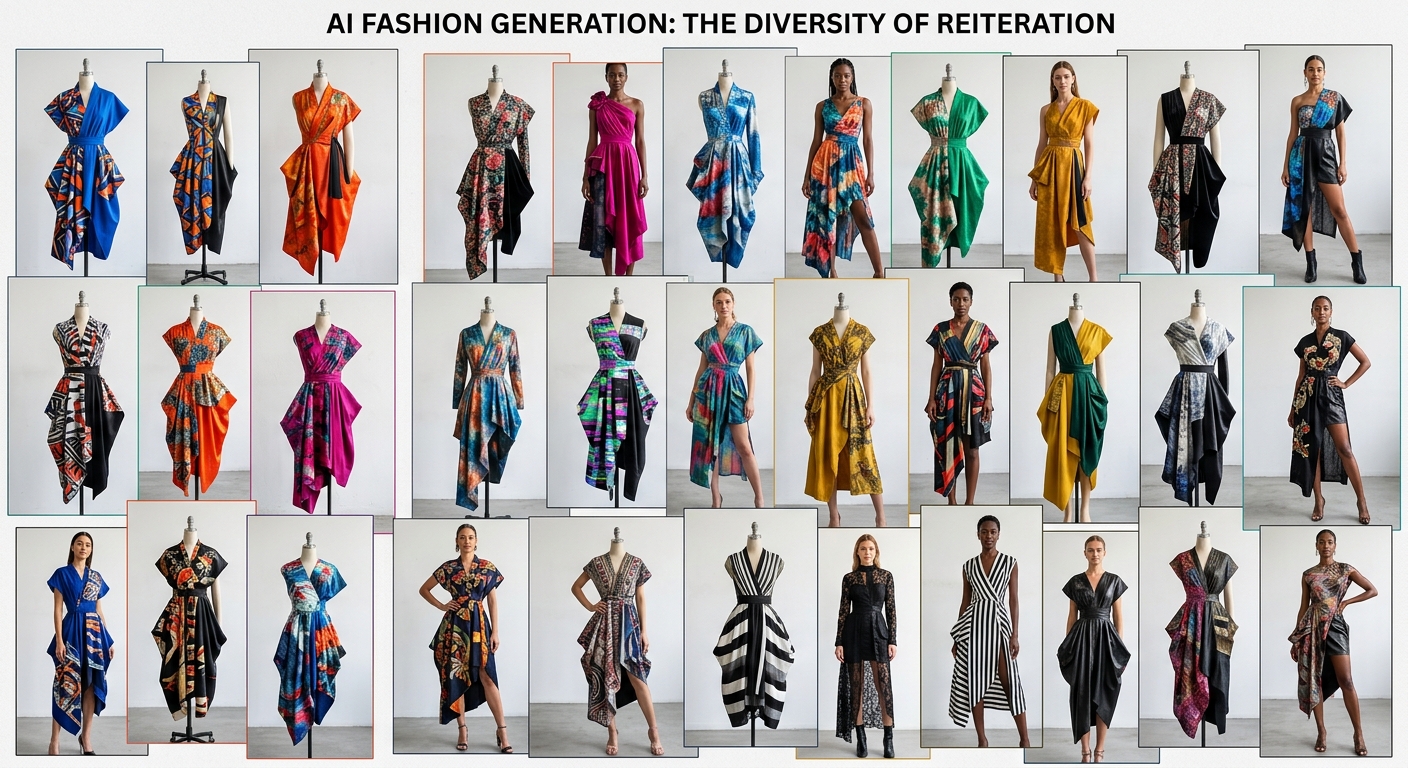
The most accessible entry point for generative AI in fashion is text-to-design generation, where designers describe desired aesthetics, materials, and style elements in natural language. Advanced systems in 2026 understand fashion-specific terminology, from "bias-cut silk charmeuse" to "oversized utilitarian detailing", and generate corresponding visual concepts. This natural language interface removes technical barriers that previously made design software intimidating for creative professionals.
Designers can specify mood, target customer, occasion, and technical requirements in a simple prompt. The AI interprets these inputs through the lens of current trends, brand guidelines, and technical feasibility to produce concepts that are both creative and producible.
Many designers still prefer starting with hand sketches because it feels more intuitive than digital tools. Generative AI now transforms rough sketches into photorealistic renders with accurate fabric draping, lighting, and texture. This technique maintains the designer's creative intent while dramatically reducing the time from concept to presentable visual.
The technology recognizes design elements in sketches, collars, sleeves, hemlines, closures, and applies realistic materials and construction details. Understanding AI for fashion design tech packs reveals how these renders can feed directly into technical specifications, creating a smooth path from creative concept to production documentation.
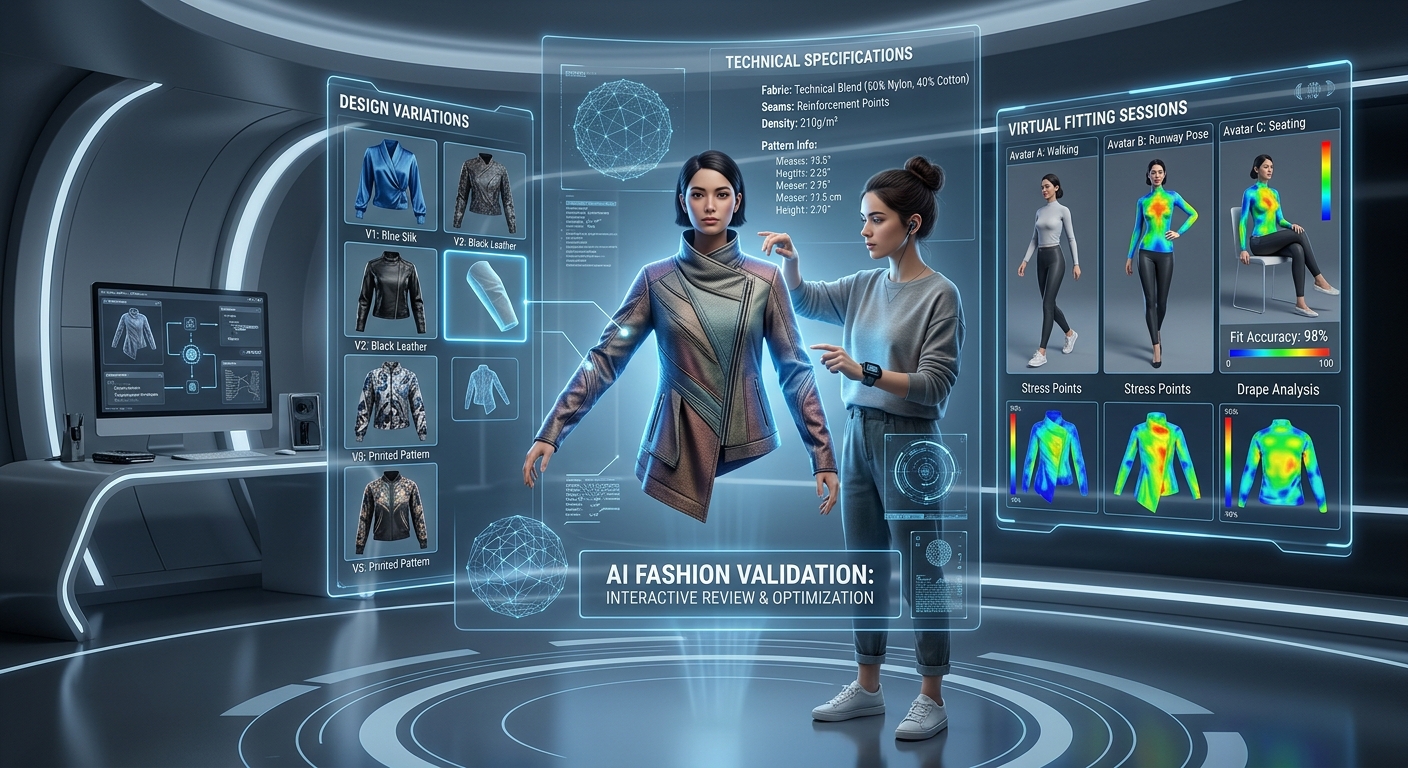
Perhaps the most significant cost-saving application involves 3D validation that catches fit and drape issues before physical sampling. Brands traditionally cycle through 3-5 sample rounds per style, losing $450-$5K per failed sample. With AI-powered 3D validation, this reduces to 1-2 rounds, cutting physical sample requirements by 75%.
Virtual sampling allows technical designers to test fit across multiple body types, evaluate how fabrics drape in motion, and identify construction challenges before cutting physical samples. This capability saves money and accelerates time-to-market by eliminating weeks from the development cycle.
The application of generative AI differs significantly across market segments, with fast-fashion brands prioritizing speed while luxury brands focus on creative exploration. Fast-fashion brands use AI for rapid trend analysis and high-volume design generation, responding to market shifts in days rather than months. According to Business of Fashion, companies developing generative AI software report reducing manual tasks from days to seconds.
Luxury brands use generative AI more selectively, focusing on exploring avant-garde concepts, preserving brand heritage through AI trained on archival designs, and creating personalized customer experiences. The technology serves as a creative collaborator rather than a replacement for artisanal craftsmanship. These brands maintain their commitment to quality and uniqueness while using AI to explore creative territories that would be prohibitively expensive to investigate manually.
Both approaches recognize that agentic AI vs generative AI represents different capabilities, with agentic systems managing workflows while generative systems create content. The most effective implementations combine both approaches.
The primary objection from creative directors centers on whether AI dilutes creative taste. The reality in 2026 is that generative AI functions as a creative amplifier rather than a replacement. Designers maintain full creative control, using AI to explore more possibilities and escape creative blocks rather than surrendering aesthetic decisions to algorithms.
Think of generative AI as an infinitely patient design assistant who can produce variations on demand but never makes final decisions. The creative director still curates, refines, and approves, but with exponentially more options to choose from. This expanded creative palette often leads to more innovative outcomes because designers can afford to explore risky directions they might otherwise skip.
Fashion brands already invested in tools like Adobe Creative Suite and CLO3D face integration questions. The solution lies in platforms that connect these asset-creation tools within a unified workflow management system, ensuring that designs flow smoothly from creative direction through technical design to merchandising and launch.
Rather than replacing existing tools, effective AI platforms act as connective tissue. Designs created in Adobe can be imported for AI-powered variation generation. CLO3D files can feed into AI validation systems. The goal is eliminating the manual handoffs and disconnected processes that currently consume so much time.
Looking ahead in 2026 and beyond, the future of digital fashion design points toward increasingly sophisticated AI systems that understand brand DNA, predict trend trajectories, and generate production-ready specifications. The convergence of generative AI with virtual reality, blockchain authentication, and sustainable material databases will create entirely new design paradigms.
Emerging capabilities include AI systems that automatically optimize designs for sustainability metrics, predict which concepts will resonate with specific customer segments, and generate complete launch campaigns including photography, copy, and styling recommendations. Brands exploring free AI fashion tools can begin experimenting with these technologies before committing to enterprise solutions.

Generative AI for fashion design represents more than technological advancement, it's a fundamental reimagining of how fashion brands operate in 2026. By compressing design cycles from weeks to minutes, reducing sampling costs by 75%, and enabling creative teams to explore exponentially more concepts, AI transforms fashion from a gut-feel industry to a data-informed creative discipline.
The brands that thrive will be those that view generative AI not as a threat to creativity but as a tool for creative liberation. When designers spend less time coordinating disconnected tools and more time exploring innovative concepts, the entire industry benefits through reduced waste, faster innovation, and more diverse design perspectives.
Comparison: Generative AI Tools & Approaches for Fashion Design

Stop iterating in the dark and accelerate your design cycle from initial spark to market-ready collection. Start free at thefword.ai or Book a demo.
While general image generators create flat visuals, specialized fashion AI platforms can translate a generated design into a technical starting point. They can suggest fabric types, estimate bill of materials (BOM), and generate foundational elements for a tech pack. However, a human designer's oversight is still crucial to refine measurements, construction details, and grading for production readiness.
Generative AI operates on patterns learned from vast datasets of existing designs. While this can lead to remixing, true originality emerges through a designer's skillful prompting, iterative refinement, and a hybrid workflow. By combining disparate concepts, abstract ideas, and brand-specific constraints, a designer can guide the AI to produce novel aesthetics that would be difficult to conceive manually.
Integration varies by tool. Cloud-based platforms like thefword.ai are designed for easy adoption, often replacing manual mood boarding and sketching at the start of the process. They require minimal setup. Integrating AI into 3D software or developing in-house models is more complex, requiring technical expertise and process re-engineering. The most effective approach is to start with a specific, high-impact stage, like concept generation, before expanding.
AI can rapidly generate hundreds of design variations, colorways, and print options. These can be used to create realistic mockups for A/B testing with target audiences via surveys or social media polls before a single sample is made. some AI models can be trained on real-time social media and e-commerce data to identify and visualize emerging micro-trends, giving design teams a significant data-driven advantage.
Best AI Fashion Design Software: 2026 Tool Guide
Helpful for teams comparing AI fashion platforms by use case, from concept generation and design iteration to tech packs, sampling, and launch workflows.
The F* Word Editorial · Fashion workflow team
Written by The F* Word editorial team. We build AI fashion workflow software grounded in thousands of industry-produced tech packs and proprietary garment records, so what reaches the factory is consistent, reviewed, and tied to design intent.
Once the concept is approved, the next steps move it from board to factory floor.
Related: ai fashion node based workflow
Get The F* Word workflow insights in your inbox.