
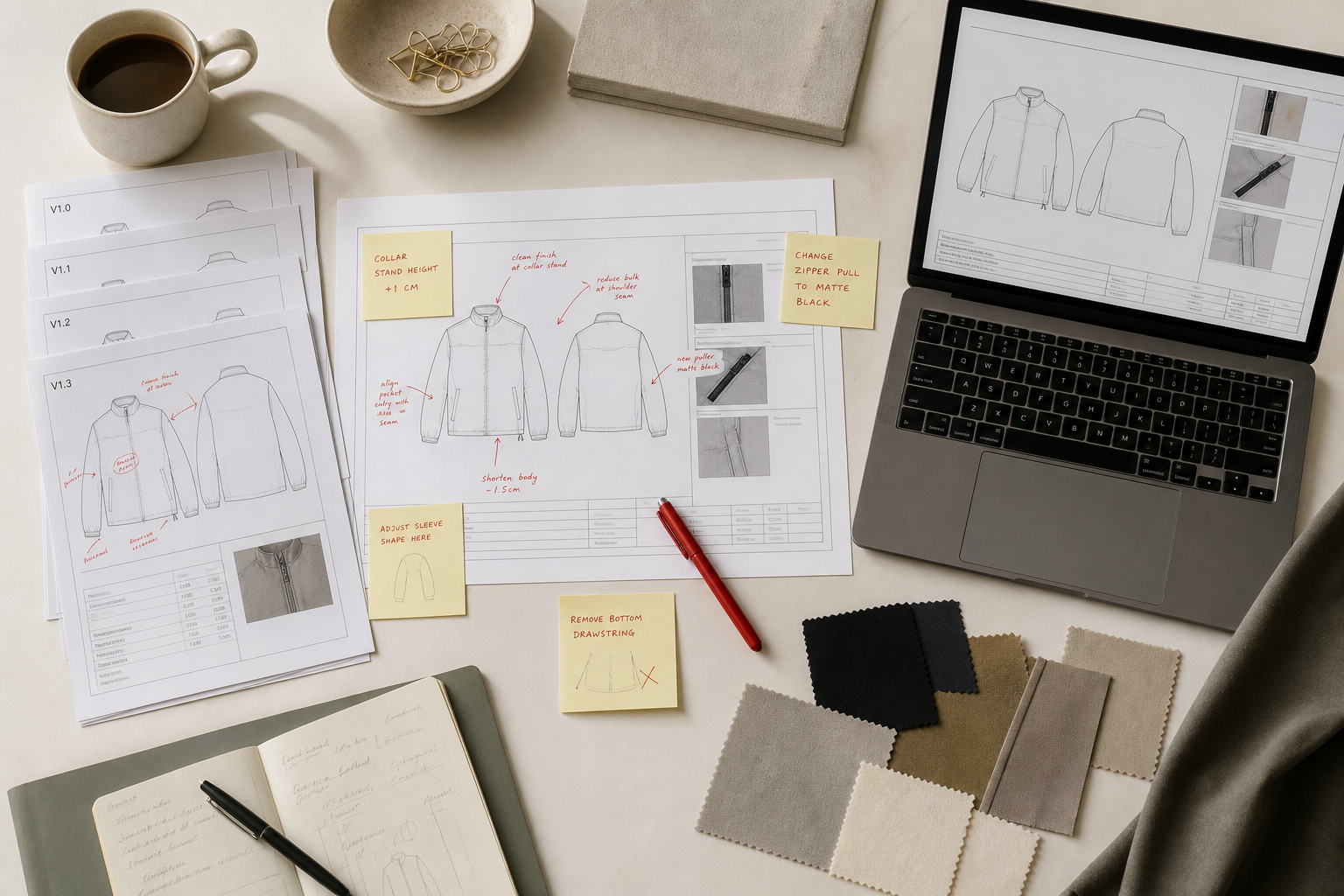
A standard tech pack for a new garment style goes through 3 to 5 major revision cycles before it is approved for bulk production. These revisions are necessary to correct fit, adjust construction details, and finalize material specifications between the brand and the factory. Each round of tech pack revisions typically adds several weeks to the development calendar, directly impacting the time to market.

Three critical phases of physical sampling are the primary drivers of tech pack revisions. The first is the proto sample, which is the factory's initial interpretation of the tech pack. Revisions at this stage often involve large changes to construction, core measurements, and fabric. The second is the fit sample, where the garment is tested on a fit model. This phase leads to targeted revisions in the grade rule, point of measure (POM) specs, and pattern adjustments. The final phase is the pre-production (PP) sample, which is the last check before bulk manufacturing. Revisions here should be minimal, focusing on small details like label placement or stitch quality, but any changes require a tech pack update to create a final record of the approved garment.

Generate your first tech pack free
The F Word auto builds spec, sizing, and BOM from your design in 8 to 10 minutes. No template wrangling, no factory back and forth.
More than half of all tech pack revisions can be traced back to errors and omissions in the very first version sent to the factory. Manual data entry in spreadsheets is a major source of these problems. Common errors include inconsistent terminology for stitches and seams, missing points of measure, incorrect component codes for trims, and vague construction callouts that leave too much open to the factory's interpretation. These initial mistakes create a domino effect, guaranteeing at least one or two revision cycles just to fix information that should have been correct from the start. An incomplete or inaccurate tech pack wastes the first sample round entirely.

Each revision cycle represents a significant delay in the pre-production workflow. A single round of fit notes on a sample can add an average of two to four weeks to the calendar. This accounts for the time it takes to receive and review the physical sample, conduct a fit session, update the tech pack with new measurements and comments, send the updated file back to the factory, and wait for the factory to produce and ship a new sample. When a style requires three or more revisions, these delays accumulate, pushing a product's launch date back by months and risking missed seasonal windows.
| Stage | Traditional Method (Spreadsheet/PDF) | The F* Word AI Method |
|---|---|---|
| Initial Creation | 2 to 8 hours of manual data entry | 8 to 10 minutes, AI-validated |
| First Revision (Proto) | Major corrections to BOM and construction | Minor adjustments, if any |
| Second Revision (Fit) | Significant POM and grade rule changes | Targeted fit tweaks |
| Final Revision (PP Sample) | Often requires small but critical changes | Final confirmation, minimal changes |
| Total Revisions | 3 to 5 cycles | 1 to 2 cycles |
The Bill of Materials (BOM) section of the tech pack is a frequent and expensive source of revisions, especially in later stages. An incorrect fabric code, wrong thread color, or inaccurate consumption yield for a trim can halt production or lead to the purchase of incorrect raw materials. Because BOMs link directly to costing and purchasing, any errors require immediate correction. These revisions are disruptive because they affect not just the technical design team but also sourcing, merchandising, and finance. Properly automating the Bill of Materials with validated component libraries is one of the most effective ways to reduce late-stage tech pack revisions.
AI-powered tech pack tools can reduce the number of revisions by 75% or more by catching common human errors before the document is ever sent to a manufacturer. The F* Word generates a complete, validated tech pack from a design file in just 8 to 10 minutes. The platform functions as a validation and orchestration layer. It checks for missing POMs, ensures construction callouts are clear, and cross-references the BOM against its own validated libraries. This front-loading of accuracy means the first proto sample is far closer to the design intent, often eliminating the first one or two revision cycles completely. By also generating moodboards, the tool ensures creative and technical alignment from the beginning. Unlike PLM or 3D simulation software, these intelligent tech pack tools focus specifically on eliminating the back-and-forth communication that defines traditional tech pack revisions.
Manual tech packs and endless revision cycles burn time and margin. The F* Word generates a validated, factory-ready tech pack in minutes, cutting revisions and accelerating your pre-production workflow. It is the validation and orchestration layer for modern fashion brands. Start free at thefword.ai or book a demo.
The single biggest cause is a mismatch between the designer's intent and the factory's execution. This is nearly always caused by incomplete or ambiguous information in the initial tech pack, specifically around fit specifications, construction details, and material callouts.
It is exceptionally rare for a manually created tech pack to go through zero revisions, as the process inherently involves interpretation and physical sampling. The goal is to minimize revisions, not expect zero. AI-validated tech packs get closer to this by ensuring the initial document is as accurate and complete as possible before the first sample is even made.
An AI tech pack platform like The F* Word does not just create a document; it validates the data within it. It acts as an expert technical designer, checking for missing measurements, ensuring component data is correct, and flagging potential issues to prevent future errors. It is not a PLM for managing the entire product lifecycle or a 3D tool for virtual sampling, but a specialized tool for creating error-free technical specifications.
Get The F* Word workflow insights in your inbox.