.png)
English

The fashion industry, valued at over $1.7 trillion globally is being redefined by a new generation of automation. While early Generative AI tools inspired creativity through image generation and virtual modeling, the next evolution—Agentic AI fashion focuses instead on execution, autonomy, and measurable business outcomes.
Today, executives searching for solutions like “AI speed-to-market fashion,” “AI demand forecasting fashion,” “AI tech pack generation,” and “AI trend agent” are not just chasing technology trends. Rather, they are pursuing speed, sustainability, and smarter decision-making across every stage of the fashion value chain.
In essence, this article explores how Agentic AI fashion delivers tangible impact across industry-specific workflows, ultimately transforming how fashion brands design, plan, produce, and sell at scale.
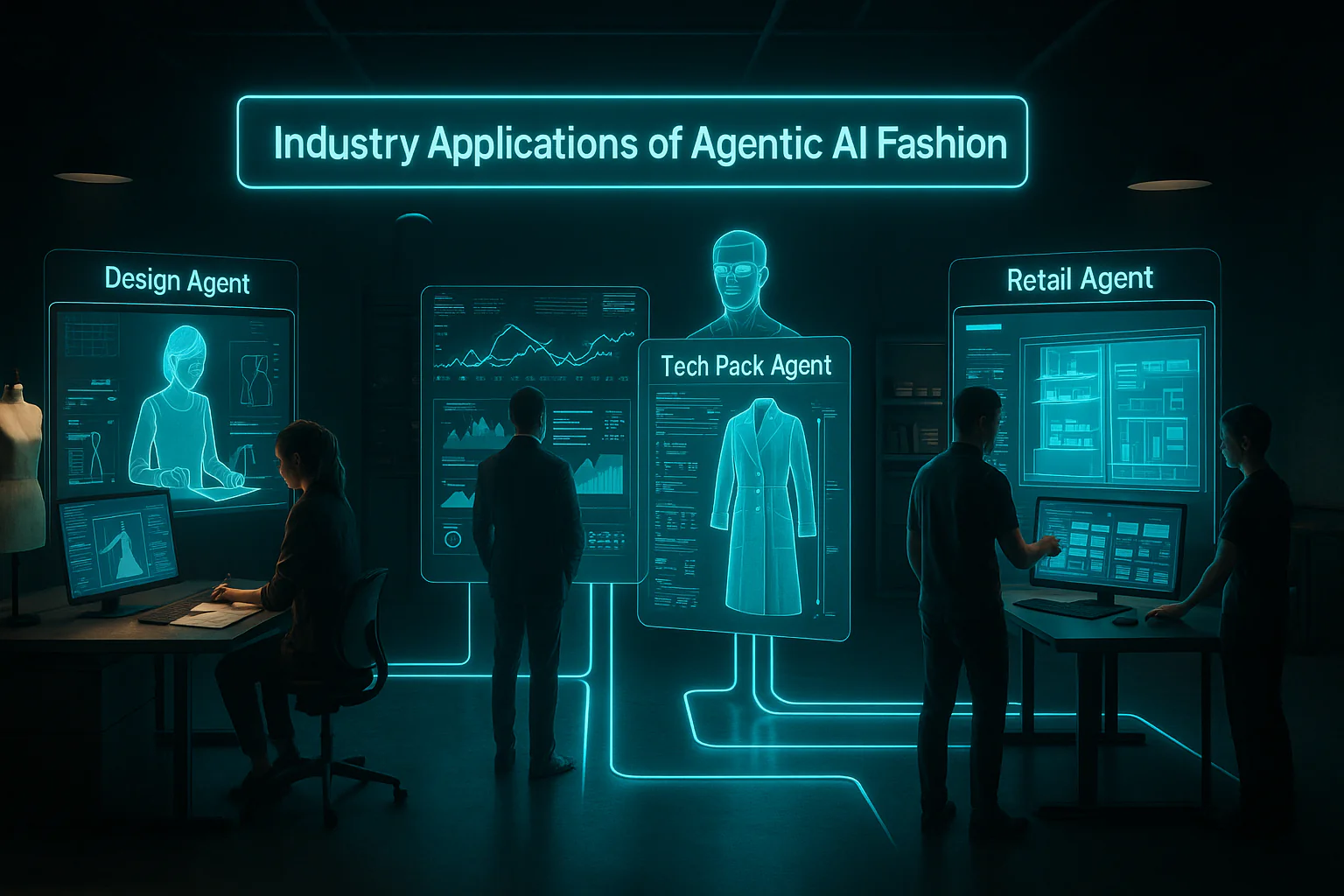
Under traditional sourcing models, taking a style from first design decisions through production to store shelves typically takes at least six months and often 6–12 months for full collections [1]. Consequently, this long cycle locks up working capital, increases markdown rates, and contributes to waste.
Fortunately, Agentic AI fashion systems solve this by connecting design and data through autonomous AI agents that can:
As a result, brands experience faster collections, leaner operations, and a measurable sustainability advantage. In other words, Agentic AI turns inefficiency into opportunity.
Challenge:
Traditional brands struggle with slow design-to-store cycles—often taking 9 months or more. By the time products hit shelves, trends have shifted, leading to heavy markdowns.
Agentic AI Solution:
Impact:
Case studies such as Walmart’s Trend-to-Product program show that an industry-standard product cycle of around six months can be compressed to roughly 6–8 weeks when trend detection, design, and development are automated with AI [2].
Example:
A European fast-fashion retailer integrated multi-agent workflows to release 8 micro-collections per year instead of 2, which in turn increased annual revenue by 22% without expanding staff.
Challenge:
Overproduction leads to markdowns, unsold inventory, and waste. According to the Ellen MacArthur Foundation and UN Environment, more than US$500 billion in value is lost every year because clothing is under-worn, under-recycled or landfilled - much of it driven by overproduction and planning errors [4].
Impact:
AI demand-forecasting platforms report inventory overproduction reductions of up to ~30%, as better predictions translate into smaller, better-matched buys and fewer unsold units [3].
Example:
A sustainable brand used Agentic AI demand forecasting to predict shifts in consumer preference toward recycled materials. Because of this foresight, it adjusted its production pipeline early, achieving 95% sell-through with minimal waste.
Challenge:
Creating a detailed tech pack—specifications, measurements, stitches, trims, and labeling—takes weeks per garment and is prone to human error.
Agentic AI Solution:
Impact:
Vendors of digital tech-pack software report that automation can make tech-pack creation up to ~50% faster and, combined with clearer specifications, can cut sampling rounds by around 50%, taking weeks out of development calendars [5].
Example:
An American apparel group deploying AI tech pack generation cut sampling rounds from four to one, thus saving 45 days per product line and reducing costs by 18%.
Challenge:
Trend forecasting traditionally depends on seasonal reports and human intuition— both of which are too slow for today’s data-driven market.
Agentic AI Solution:
Impact:
Trend agents allow brands to detect emerging consumer interests months ahead of competitors, thereby helping them design relevant, profitable collections.
Example:
A global athleisure brand used AI trend agents to identify “quiet luxury” as a rising aesthetic 12 weeks before mainstream adoption, ultimately giving them a first-mover advantage.
Challenge:
The fashion industry generates 10% of global carbon emissions and wastes nearly 85% of textiles annually. Therefore, sustainability isn’t just a moral imperative—it’s a business one.
Agentic AI Solution:
Impact:
Agentic AI enables circular production loops, sustainable material sourcing, and transparent reporting. Consequently, brands using these systems have cut their carbon footprint by up to 40% while improving brand reputation and regulatory compliance.
Example:
A Scandinavian fashion house integrated sustainability agents to automate carbon reporting and material optimization resulting in a 28% reduction in textile waste.
For Agentic AI to reach its full potential, it must operate as a connected ecosystem rather than a collection of tools. In other words, success requires unifying every layer of the value chain.
Example Integration:
A luxury brand’s full adoption of Agentic AI from design to e-commerce—reduced cycle times by 70%, whilst simultaneously boosting margins by 12%, and increased sustainability score transparency across suppliers.
Agentic AI delivers measurable business outcomes beyond operational efficiency. Specifically, it enables:
Collectively, each agent amplifies business agility, transforming data into actionable, profitable decisions.
Nevertheless, despite success stories, implementation requires overcoming operational, technical, and cultural barriers.
Ultimately, brands that address these issues through proper AI change management, data hygiene, and cross-departmental orchestration achieve faster, more sustainable scaling.
As AI becomes more autonomous, fashion’s competitive advantage will depend on how well brands orchestrate multi-agent systems across their operations, for example:
Thus, Agentic AI is not replacing designers—it’s redefining what design, production, and sustainability mean in a data-driven world.
From AI speed-to-market fashion to AI demand forecasting and AI tech pack generation, Agentic AI is reshaping every layer of the industry.
Overall, the brands leading this transformation are those treating Agentic AI not as a novelty but as a strategic capability - moreover, they are integrating it into their data, teams, and business models.
In conclusion, the message is clear: Agentic AI fashion is not the future of fashion—it’s the framework powering its next generation.
Sources:
101 People Reading our Newsletter Right Now!
