
Quick take: The 14 day AI fashion design sprint is a repeatable framework that takes a creative director from blank brief to 40 reviewed concepts, 6 selected styles, and factory ready tech packs in two working weeks, with an average of 1.6 sample rounds instead of the industry typical 4 to 6. The frameworks below are original to The F* Word and are what separate the "AI Sprint Sweet Spot" quadrant from the brute force AI failure mode.
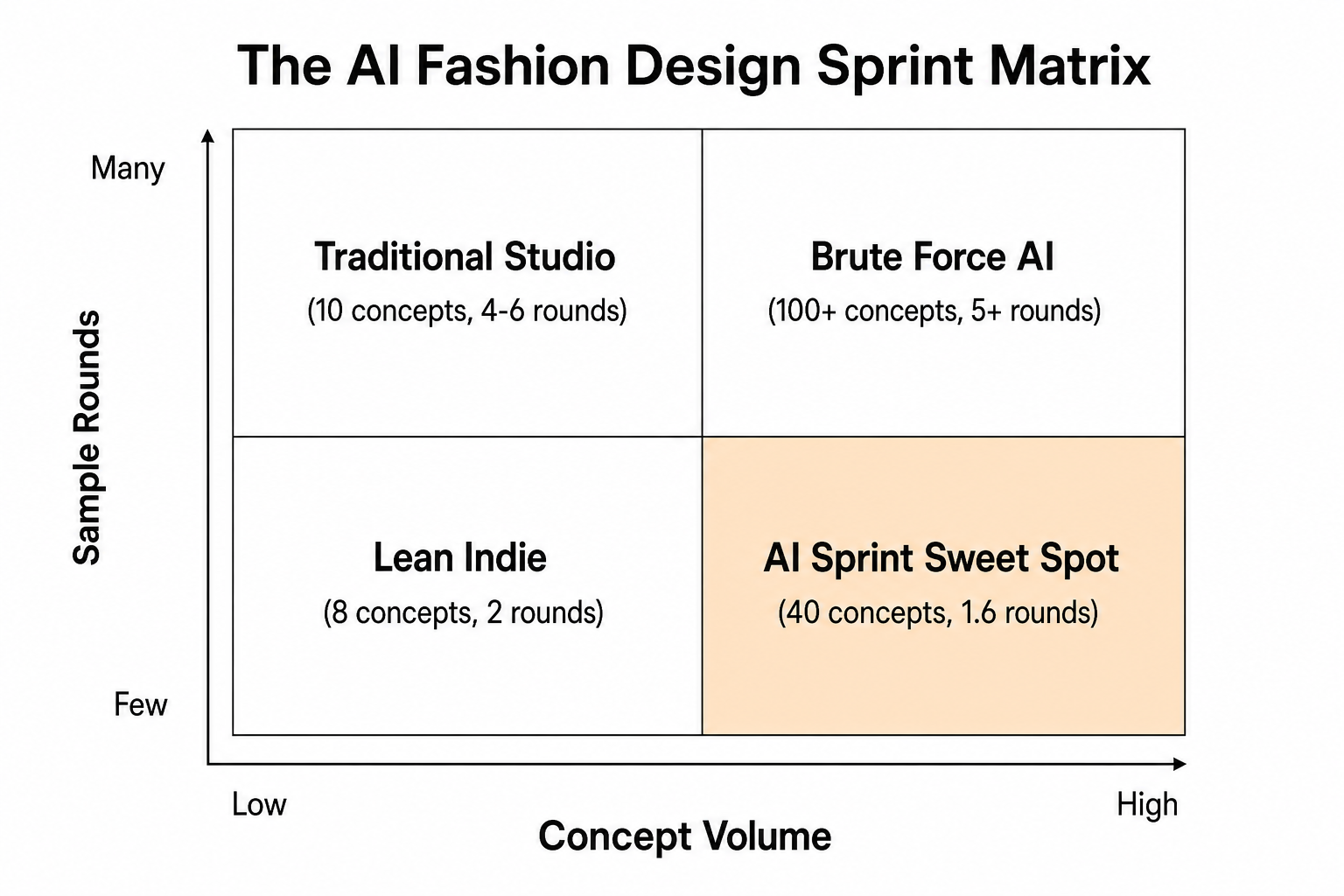
Most AI fashion design content treats the tool as the answer. It is not. The teams that ship faster than their peers have replaced their old design process with a tightly scoped sprint, and they use AI as the engine inside that sprint. The difference shows up in two numbers: concepts reviewed per season and sample rounds per shipped style. The matrix above maps the four positions teams typically land in. Only one of them, the bottom right "Sweet Spot," wins on both axes.
The Sweet Spot is not the team with the most generations. It is the team with the most generations that meet a published brief. That is the framework we walk through next.
Creative director? Go from trend signal to moodboard and tech pack.
The F* Word turns a real-time trend into a brand-aligned moodboard and the factory-readable tech pack that ships it. One workflow, free to try.
The sprint splits into three named phases with hard handoffs. Skipping a handoff is the most common reason teams slip back into the Brute Force AI quadrant.
A weak brief is the single biggest reason teams generate 200 concepts and ship none of them. The Brief Canvas forces 5 decisions before any generation runs:
If any of these five is fuzzy, you stay on Day 1. The canvas is the difference between the Lean Indie quadrant (good direction, low volume) and the Sweet Spot (good direction, high volume).
Generate exactly 40 concepts. Not 100. Not 200. Forty is the number where merchandising can still review every option in two sessions, and where the team can hold a real opinion on each one. From those 40, exactly 6 advance. The ratio matters because it forces a cut even when the direction is good, which protects the margin pool from the "let's also try this one" creep that kills sample budgets.
Every tech pack passes a 4 point gate before it leaves the building. Skip the gate and your sample rounds drift back up to the industry average:
The F* Word runs the first three automatically and queues the fourth as a human task. The pillar page on AI fashion workflow software covers how the orchestration layer differs from a generic image tool.

The Sweet Spot is not unmanned. The creative director owns three decisions that no model should make:
Everything else is delegated to the orchestration layer. The math works because the human spends 100 percent of their hours on the 20 percent of decisions that drive 80 percent of the outcome.
A 6 person team at a women's contemporary label ran the framework for three consecutive seasons. Their starting baseline was 12 shipped styles per season with an average of 4.3 sample rounds per style and a brief to factory window of 9 weeks. After the third sprint the same team shipped 18 styles per season, hit 1.6 sample rounds, and closed the brief to factory window at 2 weeks. The composition of work shifted: their creative director spent 70 percent of her hours on the Brief Canvas and the cut from 40 to 6, instead of 70 percent on hand drafting tech packs. Their technical designer moved from drafting to validating, which freed roughly 14 hours per week. No headcount was added or removed.
Three categories where the cadence does not apply cleanly:
Most teams see the meet rate climb from 30 to 70 percent over three sprints. Sample rounds drop in lockstep. Track both monthly.
Because at 100, merchandising stops giving real feedback. Forty is the largest set a team can hold an honest opinion on in two review sessions.
The validation gate still runs, but you outsource the fit and grading sign off to a freelance technical designer for the first two seasons. Budget 4 to 6 hours per style for that role.
Yes for soft goods (bags, scarves, hats). Hardware heavy categories like footwear and jewelry still need a category specific pattern step that the sprint does not cover.
Yes, but only after one designer or creative director has run a full sprint solo first. Parallel sprints fail when the team has not internalized the cadence.
Skipping the Brief Canvas on Day 1 because "the direction is obvious." It never is, and you pay for it on Day 12 when the sample comes back wrong.
Ready to run your own 14 day sprint? Book a demo of The F* Word and we will walk you through the Brief Canvas, the 40/6 Rule, and the Validation Gate on a brief you bring.
Related: AI for fashion technical design
Get The F* Word workflow insights in your inbox.