.png)
English
.png)
Launching a fashion collection used to require tens of thousands of dollars. Sketches, pattern making, sampling, model shoots, and inventory locked up capital before a brand even knew if customers wanted the product.
Artificial intelligence is compressing that entire process.
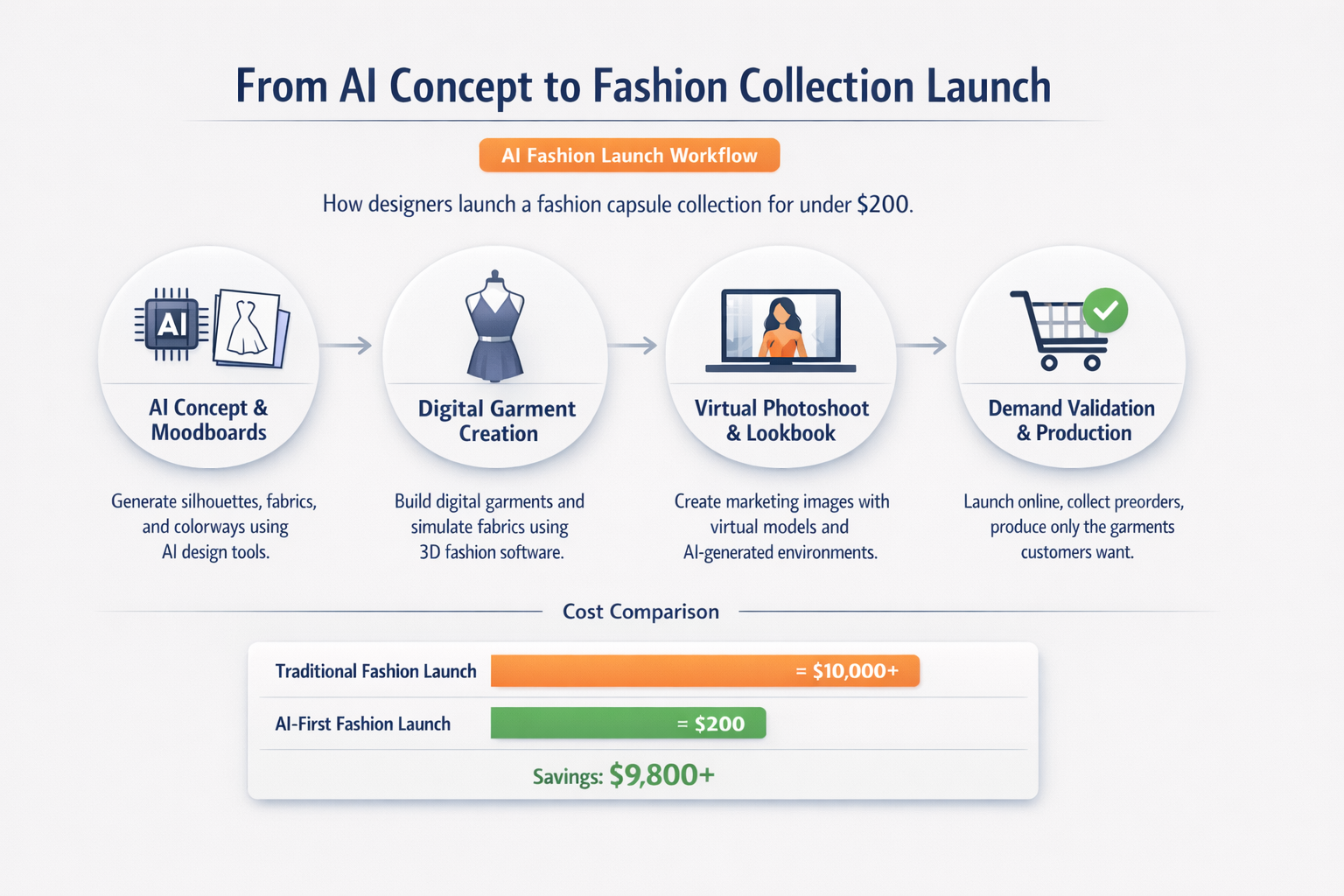
Today a designer can go from concept to launch-ready assets in a single afternoon. Digital garments can be designed, tested, visualized, and marketed before producing a single physical sample. The cost of experimentation drops from thousands of dollars to under $200.
The shift is not just about cheaper tools. It changes how fashion collections are conceived, validated, and produced.
Design becomes iterative. Sampling becomes digital. Production becomes demand-driven.
Understanding this new workflow is the difference between launching a brand and just sketching ideas.
Designers exploring this shift often begin by experimenting with generative tools and digital design platforms. A detailed breakdown of the current landscape can be found in Top Free AI Fashion Tools: Outfit Generators and Design Apps Guide, which covers the platforms designers are using to build AI-driven workflows.
Traditional fashion development carries structural costs that most first-time designers underestimate.
A typical small capsule collection requires:
Pattern development and technical specifications
Sample garment production
Photoshoots with models and stylists
Lookbook production
Inventory manufacturing
Even a minimal five-piece capsule often costs $8,000 to $20,000 before the first sale.
Sampling alone can cost $150 to $400 per garment depending on complexity. Photoshoots frequently cost more than the garments themselves.
These costs exist because fashion historically required physical validation. Designers had to build garments to test ideas.
AI changes that assumption.
Digital garments can now simulate fabric behavior, styling, and fit before manufacturing begins.
A modern AI fashion workflow reduces cost by moving validation upstream into the digital process.
Instead of building garments first and marketing later, designers validate the collection visually and narratively before committing to production.
The new workflow typically looks like this:
Concept development using AI moodboards and prompt-based design exploration
Digital garment creation through 2D and 3D design tools
AI-generated textures and fabric visualization
Virtual photoshoots and marketing imagery
Community validation and pre-orders
On-demand production
The majority of cost shifts from production to creative experimentation.
A designer can now test dozens of concepts before committing to a single garment.
A major reason fashion collections fail is premature production.
Designers commit to samples before they know whether the design resonates with customers. Retailers call this the “inventory gamble.”
AI reduces this risk through digital sampling.
Designers create garments in 3D, apply textures and materials, and place them on virtual models to generate marketing imagery. The entire process can happen within minutes.
In one real-world workflow example, a digital designer reported creating a fully rendered garment visualization in roughly twenty minutes. The same process previously required three to four days when physical sampling and photography were involved.
The difference is not incremental.
It fundamentally changes how designers experiment.
Instead of protecting each design decision, designers can iterate rapidly across silhouettes, textures, and colorways.
Most designers struggle with their first collection because they try to design too many pieces.
A better approach is the Digital Capsule Framework.
The Digital Capsule Framework organizes a first collection around five digitally validated garments before any physical production begins. Designers generate digital prototypes, test visual storytelling, and validate audience interest before committing to manufacturing.
Applying the framework requires three steps inside a brand workflow. First, designers generate multiple variations of each garment concept using AI visualization and digital materials. Second, they produce marketing assets such as lookbooks, short videos, and social content using virtual models. Third, they measure engagement and interest before selecting which garments enter production.
The change affects the entire workflow. Creative direction becomes data-informed, pre-production shifts toward precise digital specification, and product launches become demand-driven rather than speculative.
There are tradeoffs. Digital validation can favor visually striking designs over technically complex garments, and teams may misread social engagement as purchase intent.
The framework fails when designers treat digital assets as final validation rather than early signals.
Used correctly, it prevents the most expensive mistake in fashion: producing inventory nobody wants.
A designer launching a micro-collection with AI typically spends money in four places.
Consider a designer launching five garments.
Inputs:
Sampling cost per garment: $250
Photoshoot cost: $1,500
Minimum production run: 50 units per garment
Production cost per unit: $30
Calculation:
Sampling cost = 5 × $250 = $1,250
Inventory cost = 250 units × $30 = $7,500
Total upfront cost = $1,250 + $1,500 + $7,500
Result:
$10,250 before the first sale.
Shape
Inputs:
AI tools and digital design: $150
Digital lookbook production: $50
Calculation:
Total upfront cost = $200
Result:
The designer validates demand before producing inventory.
If only two garments receive strong demand, production can focus exclusively on those pieces.
This protects capital and reduces waste.
Fashion sustainability discussions often focus on materials and recycling.
The larger issue is overproduction.
The Ellen MacArthur Foundation estimates that fashion produces over 100 billion garments annually, many of which are never sold or worn.
Digital fashion workflows address the root problem.
Designers can test garments visually before committing to production. Prototypes exist digitally rather than physically.
This reduces:
fabric waste
unsold inventory
excess sampling
On-demand manufacturing also becomes viable when designs are validated digitally.
Small workshops and micro-factories can produce limited quantities based on actual orders rather than forecasts.
AI accelerates production, but it does not replace creative direction.
Designers still define the brand language, aesthetic vision, and narrative of the collection.
AI generates possibilities. Designers select the ones that matter.
Without creative judgment, AI-generated designs often become generic.
The difference between a forgettable collection and a distinctive one remains the same as it has always been.
Taste.
Successful designers use AI as a creative collaborator. It helps them explore visual directions faster while preserving their artistic identity.
The strongest collections combine two things:
machine-assisted experimentation
human creative intent
When the cost of experimentation drops, the structure of the fashion industry changes.
Designers no longer need large budgets to test ideas.
Collections can launch digitally. Community feedback can shape production. Small production runs reduce financial risk.
The fashion industry becomes more similar to software development.
Designers release concepts, observe user reaction, and iterate quickly.
The result is a more agile fashion ecosystem where creativity moves faster than production constraints.
Over the next decade three changes are likely.
Digital garments will become the primary design artifact rather than sketches.
AI-generated visualization will replace most traditional fashion photoshoots during early collection development.
On-demand production will replace speculative inventory for many emerging brands.
For independent designers this shift opens an opportunity that did not exist ten years ago.
A fashion collection no longer requires investors, factories, and large inventory commitments.
It requires vision, experimentation, and a deep understanding of how to translate creative ideas into digital form.
Designers evaluating which platforms to use often compare emerging AI systems across design, visualization, and garment simulation. A detailed comparison can be found in Best AI Fashion Tools for Designers and Brands, which breaks down the leading solutions currently shaping AI-driven fashion workflows.
AI did not make fashion design easier.
It made launching fashion possible for far more people.
Top Free AI Fashion Tools: Outfit Generators and Design Apps Guide
https://thefword.ai/top-free-ai-fashion-tools-outfit-generators-design-apps-2026-guide
A guide to free and low-cost AI tools designers use for garment design, visualization, and creative exploration.
Best AI Fashion Tools for Designers and Brands
https://thefword.ai/best-ai-fashion-tool-2026-top-solutions-for-designers-brands
A comparison of the leading AI platforms used across fashion design, digital sampling, and marketing workflows.
Designers experimenting with AI-driven fashion workflows can explore tools that generate garments, materials, tech packs, and collection visuals in minutes.
Start experimenting here: https://app.thefword.ai/
The fastest way to understand AI in fashion is to build something.
101 People Reading our Newsletter Right Now!
