

3 numbers separate crawling from citation in LLM SEO for fashion: crawl coverage, citation rate per engine, and agent-attributed revenue. Crawling means a model saw a page. Citation means the model lifted a specific claim and attached your brand to the answer. Most enterprise dashboards blur this distinction and celebrate crawl maps as if they were quotes. The shelf is shrinking and the control point has moved. In the three eras of discovery described in The Machine-Readable Brand by Nitin Kumar, Rosmon Sidhik and Akanksha Lokam, control shifted from the search results page, to the ten blue links, to the agent short list of five. In that third era, being crawled is table stakes. Being quoted is the outcome.
LLM SEO fashion work is about measurable citation. If you sell 15K SKUs and your seasonal push targets 300 intents, the surface area is not 300 pages. One shopper intent fans out into eight to twelve sub-questions. That is Query Fan-Out at enterprise scale. It drives a portfolio problem. You do not win with one longform page. You win by maintaining high citation share on the eight to twelve mechanical asks the agent must resolve before it can recommend a product with confidence.
That confidence does not come from pretty pixels. The market is saturated with AI image generators and AI campaign-imagery tools. They are commoditized, interchangeable, and they produce pixels. A pixel is not machine readable. An AI shopping agent that sits between the shopper and your catalog cannot verify fibre content, stitch type, or care method from a render, cannot file the product in the right region of meaning space, and cannot cite it. The F* Word is not an image generator. It is the validation and orchestration layer that produces a structured garment record, with the asset plus machine placement data plus machine recommendation data, so the agent is confident enough to surface the product.
Measurement follows that posture. Adoption signals lead, process outcomes follow, financial outcomes settle the argument. Applied to LLM SEO fashion, that stack aligns to citation rate per engine as the lead metric, agent-referred sessions as the process metric, and agent-attributed revenue as the financial settlement. We outline the full stack and operating model on our Enterprise hub and in the framework chapter on the book page.
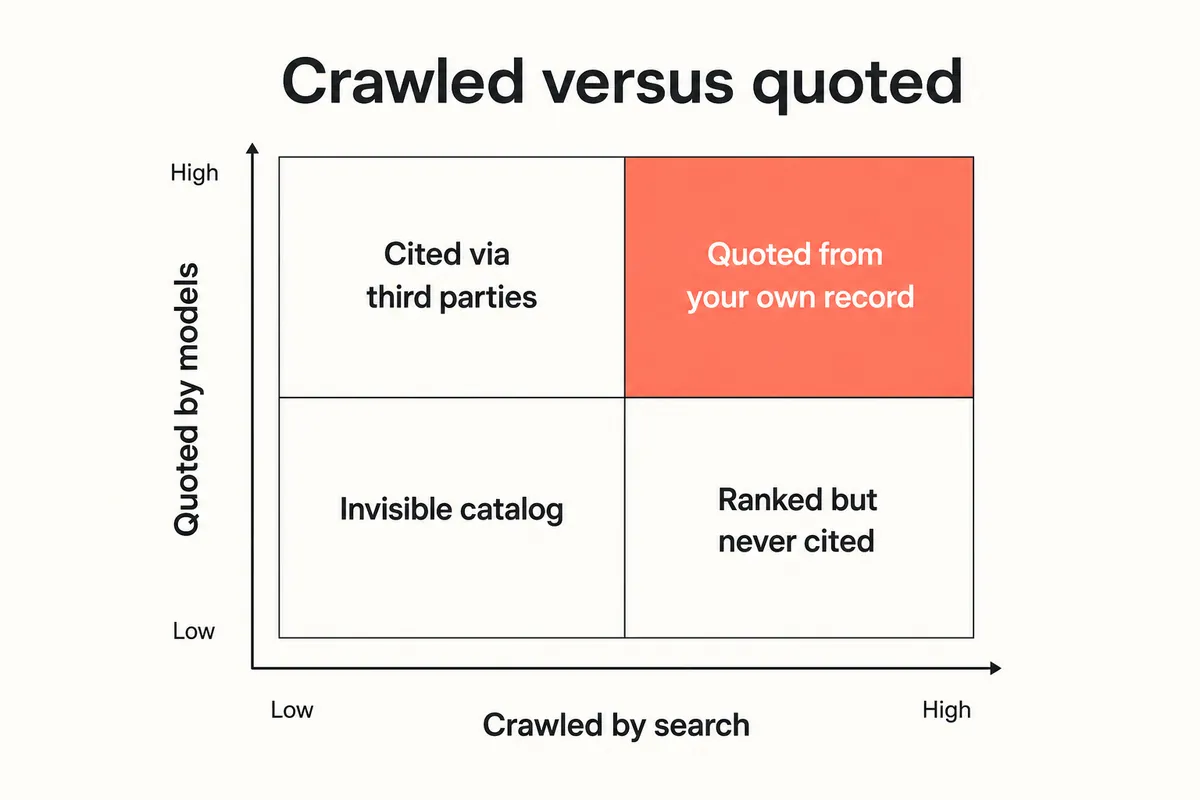
The popular approach treats LLM SEO as longform FAQ copy and a crawl budget exercise. That framing is borrowed from web SEO. It misses three facts.
Brands that rely on campaign imagery for discovery are now watching agents route around them. The images look good. The answers lack evidence. You get crawled, not quoted. The fix is not more pixels. The fix is a production pipeline that turns design intent and material choice into machine-checkable claims, attached to the SKU, transported cleanly across site, feed, and syndication, and instrumented for citation tracking.
For workflow buyers and merchandisers, this is not a marketing side project. It is product data and go-to-market orchestration. You are not tuning tag clouds. You are asserting what the product is, why it belongs in a short list for an intent, and how a model can prove it to itself.
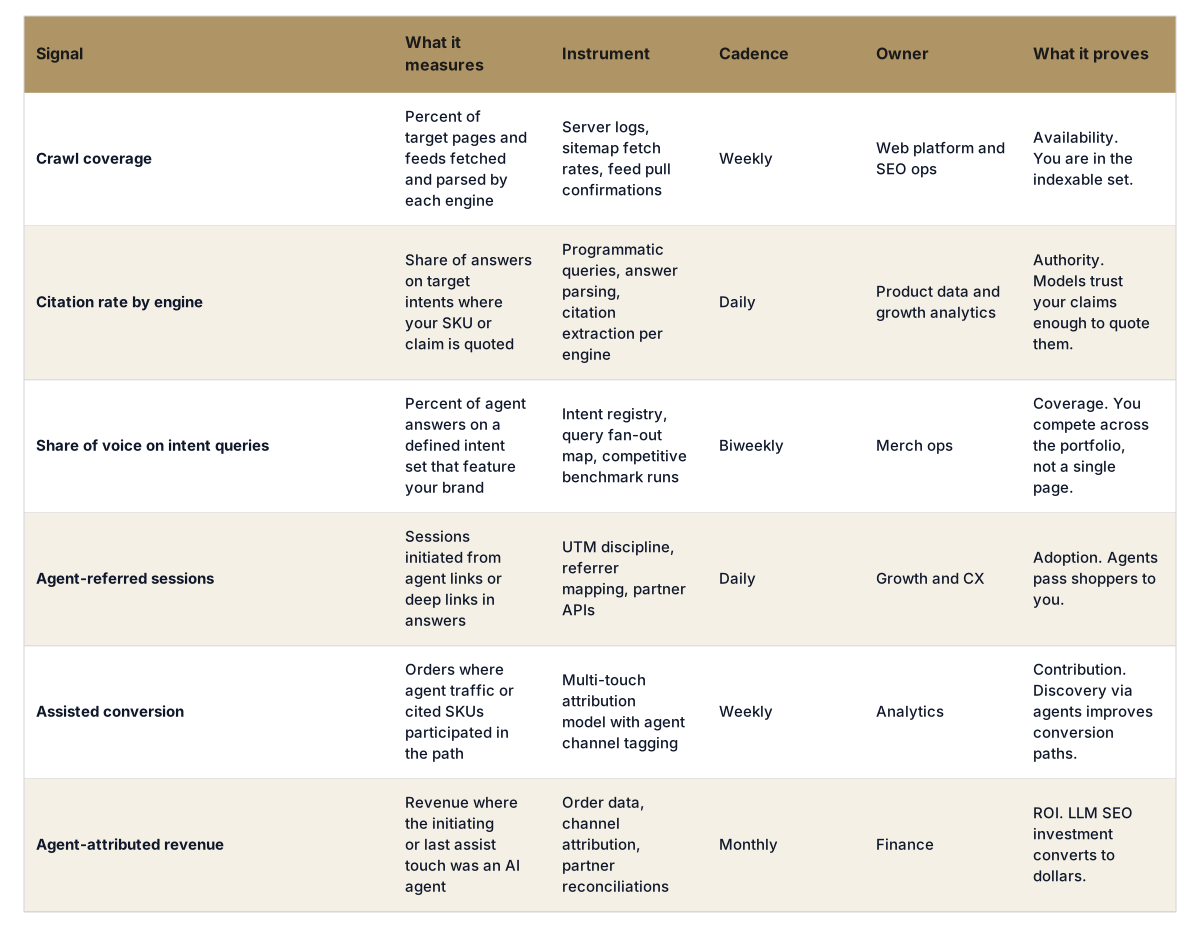
Measurement stack for agent-first discovery

Production-ready for LLM SEO fashion means your catalog can answer atomic questions with proof. The unit of work is the structured garment record. It carries three layers.
Agents cite the last layer and rely on the second layer to decide whether your SKU is in-bounds for the intent. This is where image-only workflows fail. Pixels do not carry units, provenance, or constraints. A saturated market of AI image and campaign tools produces attractive outputs that a human likes, but an agent cannot cite. The F* Word is not an image generator. It is the validation and orchestration layer that turns design intent and sourcing choice into a machine-verifiable record the agent will quote.
That orchestration starts upstream. The F* Word generates moodboards as the upstream half of the same workflow, which means inspiration and reference flow straight into structured intent metadata rather than being trapped in slides. Downstream, The F* Word generates a factory-ready tech pack in 8 to 10 minutes from a garment design, including BOM and construction notes. It is not a PLM, not a 3D sim, and not an image generator. It validates claims, resolves gaps, and orchestrates how those claims move into feeds and product pages that agents can parse and trust.
On instrumentation, production-ready means you can test and learn at the claim level. You must be able to rotate a term like carbonized cotton against combed cotton, adjust a tolerance range for inseam, or append a certification number, then see whether your citation rate by engine moved over a 48 to 72 hour window. That loop only runs if your record is atomic, your feeds carry evidence, and your measurement stack binds query runs to SKU IDs and claim fingerprints.
Finally, production means governance. You need a single owner for the intent registry, a single owner for measurement cadence, and a change control path that ties design updates to feed updates. Without this, you will ship pretty pages and watch your quote share plateau.
Brands at more than 50 million in revenue need clear desks for the six signals in the table. The right split keeps speed without losing accountability.
Set your decision gates on the measurement stack outlined in The Machine-Readable Brand and summarized above. Adoption signals lead. Set guardrails like minimum viable citation rate per engine on the top intents before you scale more content. Process outcomes follow. If agent-referred sessions and assisted conversion do not move after citation rate rises, your landing experience is leaking trust or speed. Financial outcomes settle the debate. If agent-attributed revenue does not rise after both prior layers improve, your offer mix or pricing may be off for the captured demand.
For workflow buyers in product development and sourcing, this framework turns craft inputs into measurable outputs. Fibre decisions, trim choices, and stitch techniques become claims with evidence. For merchandisers, the registry of intents becomes the home for assortment bets. For in-house designers and creative directors, creative direction metadata sits alongside the asset, not buried in a deck, which raises the odds that agents match the SKU to the moment it is meant to serve. Our creative direction workflow guide covers how moodboards feed structured intent language without adding meeting load.
This is a sprint rhythm you can run without new headcount.
The bridge back to positioning is simple. Image and campaign generators produce pixels. Pixels do not carry proof. The F* Word ships proof, with speed, across design, pre-production, and go-to-market. It generates moodboards as input to intent placement and a factory-ready tech pack in 8 to 10 minutes as evidence for construction and material claims. It is the validation and orchestration layer that turns product thinking into machine-readable outcomes.
On tools, avoid tool sprawl. You do not need another PLM. You need an orchestration layer that reads design intent, asks for missing facts, standardizes units and terms, generates the tech pack with BOM and construction notes, and emits feeds and landing content that agents can read and cite. See our overview of AI fashion workflow software for the end-to-end view, and our pre-production workflow software guide for the operational checklist.
Start with one intent, such as breathable summer blazer. Fan it into twelve asks. Illustrative examples: fibre makeup and weights, weave type, lining material and perforation, vent count, shoulder construction type, sleeve head detail, care method, heat tolerance, moisture management test or claim, pocket scheme by count and type, environmental attribute if present, and fit notes in centimeters. Now score each ask from 0 to 2. Zero if unaddressed, one if claim without evidence, two if claim with units and provenance. Your SKU is competitive on the intent when the weighted average is 1.6 or higher across the most cited asks for that engine. Your portfolio is competitive when 70 percent of SKUs in that intent class meet or exceed 1.6.
This is not academic. Agents compile answers to those atomic asks and decide which five products to present. If your record does not answer the specific ask with proof, you are out. If you answer most of them strongly, you show up more often. Share of voice on intent queries becomes the merch dashboard for LLM SEO fashion, and it is directly tunable via claim quality and coverage.
Governance matters here. The merch desk owns the intent weights and the target coverage threshold. Product data owns the claim scoring playbook and the upgrade backlog. Growth owns the cadence of tests and the pipeline that re-measures after each change. Finance validates the lift against sales mix. This is how a brand doing more than 50 million keeps speed and control without spray and pray content.
Classic SEO optimizes pages to rank. LLM SEO optimizes claims to be cited. The unit of competition is no longer a page or a blob of copy. It is the machine-checkable answer attached to a SKU, which agents lift and attribute in their responses.
Imagery influences humans. Agents need proof. Without units, provenance, and constraints, a model cannot verify a claim like 78 percent recycled polyester with Global Recycled Standard 2023 and will not cite you when a shopper asks for it. This is why the structured garment record and claim evidence matter more than pixels.
It does not replace PLM or 3D simulation. It sits between design, sourcing, and go-to-market as the validation and orchestration layer. It generates moodboards upstream to lock intent language, then generates a factory-ready tech pack in 8 to 10 minutes with BOM and construction notes so the claims you publish are real, consistent, and fast to ship.
Stand up a separate agent channel with clean UTMs, enforce deep-link hygiene, and adopt a simple multi-touch rule that gives agent traffic credit as initiator or last assist only. Reconcile monthly in finance and compare to matched controls. Expect some noise early. The direction and slope matter more than day one precision.
Start free at thefword.ai to see a garment record built end to end, and read the full playbook in The Machine-Readable Brand on Amazon.
Get The F* Word workflow insights in your inbox.