.png)
English
Fashion brands do not have a creativity problem. They have a coordination problem.
multi agent ai systems fix coordination at the system level.
In apparel, value leaks through sampling loops, handoff friction, version drift, SKU bloat, and markdown exposure. Most brands try to patch this with point tools. The real shift comes when you move from single AI features to agentic AI in fashion, where multiple agents work across the value chain and share state.
The reference model is laid out clearly in the Agentic AI Rollout Playbook which is accessible through our Enterprise page.
It frames agents as operational roles mapped to real KPI levers, not as creative novelties.
Let’s get specific.
Every style touches five functions before it reaches the customer:
Each function edits the same artifact in a different system: DAM, PLM, spreadsheets, email threads, PDFs, PIM, ERP. Every edit introduces risk.
A jacket silhouette is approved in line review. A week later, measurements shift after fit comments. The measurement table updates, but the BOM notes lag. The factory builds against a previous PDF export. One sample round burns three weeks and $300 to $500 in hard cost, plus internal labor.
Multiply that by 1,000 styles per year and you see the problem.
Single AI co-pilots cannot fix this because the issue is not content generation. It is cross-functional propagation and decision alignment.
That is where multi agent ai systems change the structure.
Individually, each agent helps. Together, they compress waste across the full lifecycle.
Here is the math most brands ignore.
Assume:
Baseline annual sampling cost:
1,200 × 3 × $300 = $1,080,000
If an AI Tech Pack Agent reduces avoidable sample rounds by 25 percent gross, and after overlap discount you net 18.75 percent:
$1,080,000 × 0.1875 = $202,500 in annual savings
That is before factoring labor savings, markdown protection, and returns reduction.
Now layer in the Merchandising Agent improving buy discipline. If you protect even 30 basis points of gross margin on 40 percent of $150M revenue:
0.003 × (0.40 × 150,000,000)
= 0.003 × 60,000,000
= $180,000 in margin lift
Multi agent ai systems create compounding returns because upstream clarity reduces downstream correction. Clean briefs reduce late assortment churn. Structured annotations reduce spec drift. Scenario planning reduces SKU sprawl.
Single agents create local gains. Coordinated agents reshape the entire workflow.
If you want a deeper breakdown of how design agents operate inside real brand systems, review the AI Fashion Designer System architecture here. And if you are building creator or capsule-led workflows, the AI Fashion Designer Creator Guide gives a tactical layer.
Here is a framework I use with brand operators: the Workflow Compression Model.
It maps every apparel process across three compression layers: artifact clarity, decision latency, and propagation integrity.
Artifact clarity means every upstream output is structured enough to survive handoffs without reinterpretation. Decision latency measures how long approvals and revisions stall in queues. Propagation integrity measures whether a change in one system automatically updates dependent artifacts across PLM, PIM, and supplier outputs.
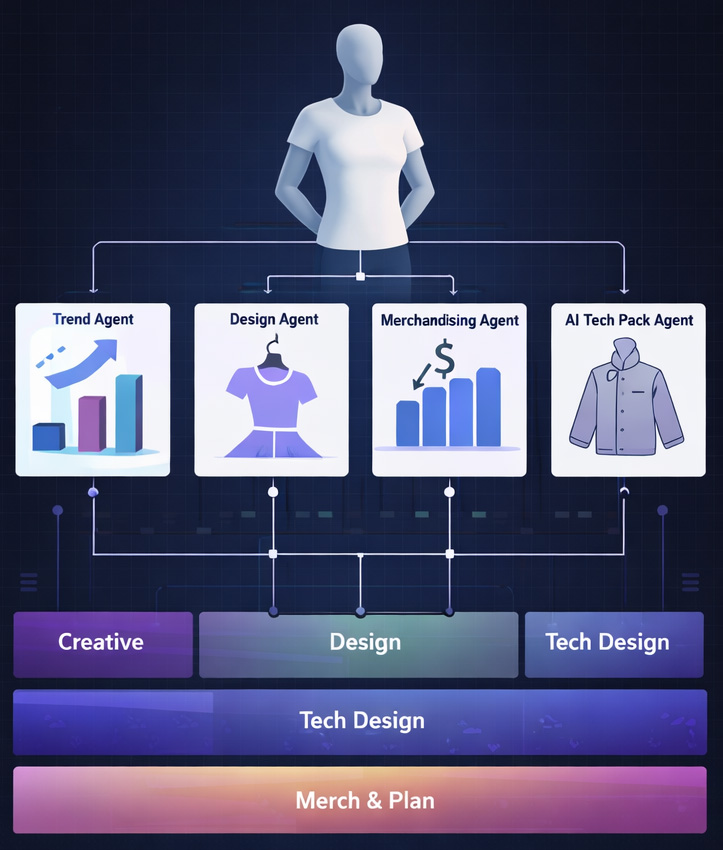
When you apply this model, creative direction produces structured briefs, design generates annotated outputs, merchandising attaches scenario metadata, and tech pack agents maintain synchronized change logs. Downstream sampling shrinks, revision loops collapse, and ecommerce attributes align with product truth.
The trade-off is governance overhead. You must define guardrails, decision rights, and tool permissions. Teams that skip this layer end up with fast output but low trust. The failure mode is over-automation in high-risk steps such as supplier-visible commitments or costing writes in ERP.
Compression works when autonomy expands in stages: shadow mode, supervised mode, guided autonomy. Full autonomy is reserved for low-risk, repeatable tasks.
Most fashion brands experiment with AI at the feature level. A print generator here. A copy tool there. That never changes margin.
The playbook argues for portfolio prioritization using Impact × Feasibility × Agent-fit . If any factor is close to zero, the initiative stalls.
In apparel, the highest combined score usually sits with the AI Tech Pack Agent. It touches many styles, has clear failure modes, and allows supervised release. Merchandising Agents follow when clean sales and inventory data exist. Trend and Design Agents scale when brand constraints and asset libraries are well defined.
Real teams see the shift quickly. Technical designers move from drafting measurement tables to reviewing exceptions. Merchandisers debate fewer emotional variants and more scenario ranges. Creative directors see more options earlier, with fewer late-stage reversals.
This is what agentic AI in fashion actually looks like. It is operational, measured, and cross-functional.
They fail when:
You cannot layer multi agent ai systems on top of chaos and expect stability. The foundation is clean inputs, explicit guardrails, and staged rollout.
Start with one category. One workflow. One KPI.
Deploy an AI Tech Pack Agent in supervised mode. Measure sample rework reduction and completeness rate. Then layer merchandising scenarios tied to the same category. Expand only when performance is proven.
This is not theory. It is an operating shift.
If you are serious about compressing sampling cycles, reducing spec drift, and protecting margin across creative, pre-production, and launch:
Launch your first agent portfolio here:
https://app.thefword.ai/
Build the wedge. Prove the KPI. Expand from there.
AI Fashion Designer System
https://thefword.ai/ai-fashion-designer-system
Architecture and workflow breakdown for embedding design agents into real apparel pipelines.
AI Fashion Designer Creator Guide
https://thefword.ai/ai-fashion-designer-creator-guide
Tactical guide for capsule drops, creator collaborations, and fast iteration models using AI agents.
101 People Reading our Newsletter Right Now!
