
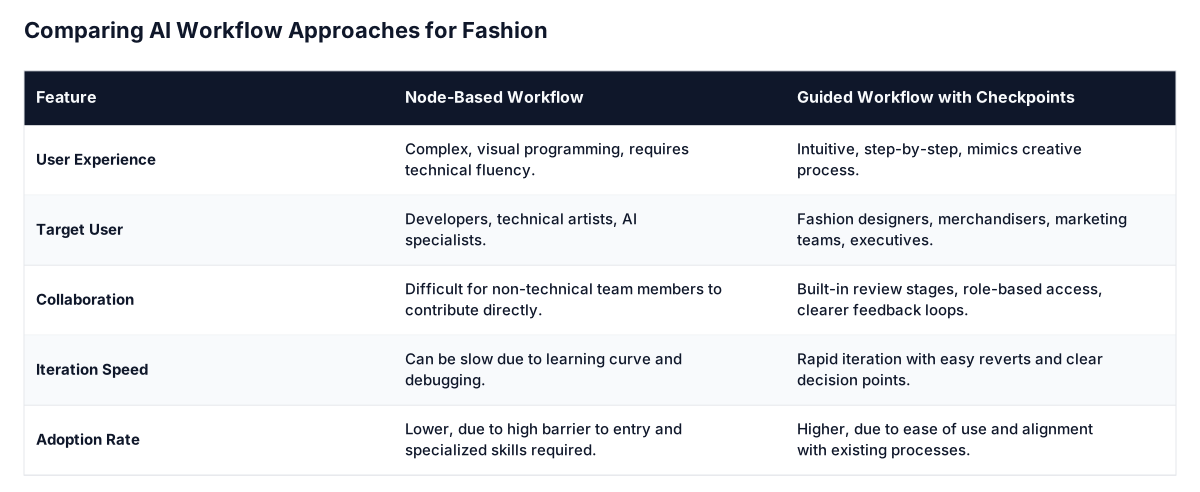
Node-based workflows give technical users granular control over AI model steps, while guided checkpoints offer a structured, task-specific process for creative and production teams. This post examines how each system impacts key pre-production stages, from initial concept generation to digital material sampling. We analyze how each workflow affects collaboration between design, merchandising, and production, specifically looking at review cycles and handoffs for the tech pack. We provide evaluation criteria and buyer-focused questions to assess how each type of software supports your brand's existing approval routines and product development cadence.
Guided checkpoints present task-focused steps, built-in approvals, and role-based outputs - making sampling, grading, and handoffs repeatable without coding. This article helps brand operators decide which workflow reduces review cycles, preserves creative intent, and integrates with PLM and approval routines. It includes practical evaluation criteria and buyer-focused questions to test vendors.
Node-based interfaces, often seen in software for visual effects, game development, and even some AI model builders, connect "nodes" representing specific operations (e.g., image input, apply filter, generate texture) with "wires" dictating the flow of data. For a developer or a technical artist, this visual programming paradigm offers immense flexibility and control. You can see the entire computational graph, debug complex interactions, and craft highly customized solutions.
However, for a fashion designer, merchandiser, or marketing professional, this level of technical detail is often unnecessary and, frankly, overwhelming. Their expertise lies in aesthetics, trend forecasting, brand identity, and consumer psychology, not in understanding data pipelines or debugging graph logic. Presenting them with a maze of interconnected boxes and lines diverts their focus from creative output to technical interpretation, stifling the very innovation AI is meant to foster.
The core issue is a mismatch between the tool's design philosophy and the user's operational needs. Fashion teams need tools that enhance their existing workflows, not force them to learn a new programming paradigm. The mental load required to navigate a node graph detracts from the creative process and slows down iteration, a critical aspect of fashion design and development.
Instead of abstract node graphs, fashion teams thrive on guided workflows. Imagine a step-by-step process, clearly defined at each stage, that leads to a desired outcome. This could be anything from conceptualizing a new print to generating 3D garment visualizations or drafting marketing copy. Each step offers specific, relevant choices and clear feedback, building confidence and accelerating progress.
Checkpoints are another essential component. These act as natural stopping points in a workflow, allowing teams to review progress, make adjustments, and ensure alignment before proceeding. In fashion, where collaboration and iterative refinement are key, checkpoints facilitate crucial feedback loops. A designer can generate several initial concepts, present them for review, receive feedback, and easily revert to an earlier stage or branch off into a new direction without losing previous work.
Think of it like a well-designed design sprint or a product development roadmap. Each phase has clear objectives, deliverables, and approval gates. AI tools should mirror this structure, providing intuitive navigation and ensuring that creative decisions can be made at critical junctures, not buried within a complex technical diagram.

Designer or merchandiser? Replace the spreadsheet handoff.
The F* Word generates moodboards, factory-readable tech packs and sampling notes in one workflow, so creative, production and merchandising stay aligned. Free to try.
Fashion teams are inherently collaborative and made up of diverse roles: designers, pattern makers, merchandisers, marketers, and executive stakeholders. Each role needs different types of information and different levels of access. A single AI workflow, when properly designed, should be able to deliver role-based outputs tailored to each user's needs.
For example, a designer might need high-fidelity 3D renders with material simulations, while a merchandiser might require data visualizations of predicted sales for different colorways. A marketing team might need automatically generated copy suggestions and imagery for social media. An effective AI system anticipates these varied needs and presents information in the most consumable format for each user.
smooth approval processes are non-negotiable. Instead of needing to extract files and send them through separate communication channels, AI-powered platforms can integrate approval flows directly. This means stakeholders can view, comment on, and approve designs, marketing assets, or product decisions within the same system, reducing friction and speeding up time-to-market. Transparency and accountability are also greatly enhanced when approvals are clearly tracked within the workflow.
At The F* Word, we understand that powerful AI doesn't need to be opaque or overly complex. Our philosophy is rooted in building AI tools that smoothly integrate into the daily lives of fashion professionals, enhancing their innate creativity and strategic thinking rather than challenging their technical prowess. We believe in providing AI solutions that feel like an extension of the design studio or the marketing department, not a separate, intimidating technical challenge.
This means prioritizing user experience above all else. Our development focuses on crafting intuitive interfaces, clear progression paths, and intelligent automation that handles the technical heavy lifting behind the scenes. We're building for the fashion industry's specific rhythm and demands, recognizing that speed, accuracy, and creative freedom are paramount.
By moving beyond generic AI interfaces and embracing guided workflows, clear checkpoints, and role-based permissions, we empower entire fashion teams to use AI effectively. This isn't just about making tools easier to use; it's about unlocking new levels of collaboration, accelerating discovery, and ultimately, delivering better products to market faster and more efficiently. The future of AI in fashion isn't about code; it's about creativity, enabled by intelligent design.
A node-based workflow uses a visual programming interface where "nodes" represent functions or operations (e.g., inputting an image, applying a style, generating a new asset) and "wires" connect these nodes to define the flow of data and execution. It's powerful for complex custom tasks but can be daunting for non-technical users.
Fashion teams, comprising designers, merchandisers, and marketers, often lack the specialized technical skills or desire to navigate complex visual programming environments. Their focus is on creative output, brand strategy, and consumer engagement. Node-based systems distract from these core competencies, introducing a steep learning curve and slowing down creative iteration.
Guided workflows offer a clear, step-by-step process that aligns with natural creative or business operations, making AI tools intuitive and easy to adopt. Checkpoints provide essential review opportunities, allowing teams to collaborate, provide feedback, and make critical decisions along the way, ensuring alignment and reducing errors before proceeding to the next stage.
Role-based outputs ensure that each team member receives information tailored to their specific needs and responsibilities. A designer might see high-fidelity renders, while a merchandiser sees sales predictions, and marketing receives campaign-ready assets. This customization makes AI output directly relevant and actionable for everyone, boosting efficiency and buy-in across the organization.
Embracing AI in fashion means adopting tools that truly understand and support the industry's unique demands. It's about moving from technical complexity to creative empowerment, ensuring that every member of your team can harness the full potential of AI without becoming an AI expert. The future is bright for fashion AI, but only if we build it with the user in mind.
About the author
The F* Word Editorial · Fashion workflow team
Written by The F* Word editorial team. We build AI fashion workflow software grounded in thousands of industry-produced tech packs and proprietary garment records, so what reaches the factory is consistent, reviewed, and tied to design intent.
Once the workflow is in place, these are the steps that turn it into shipped product.
Related: virtual clothing design software
Get The F* Word workflow insights in your inbox.