
English
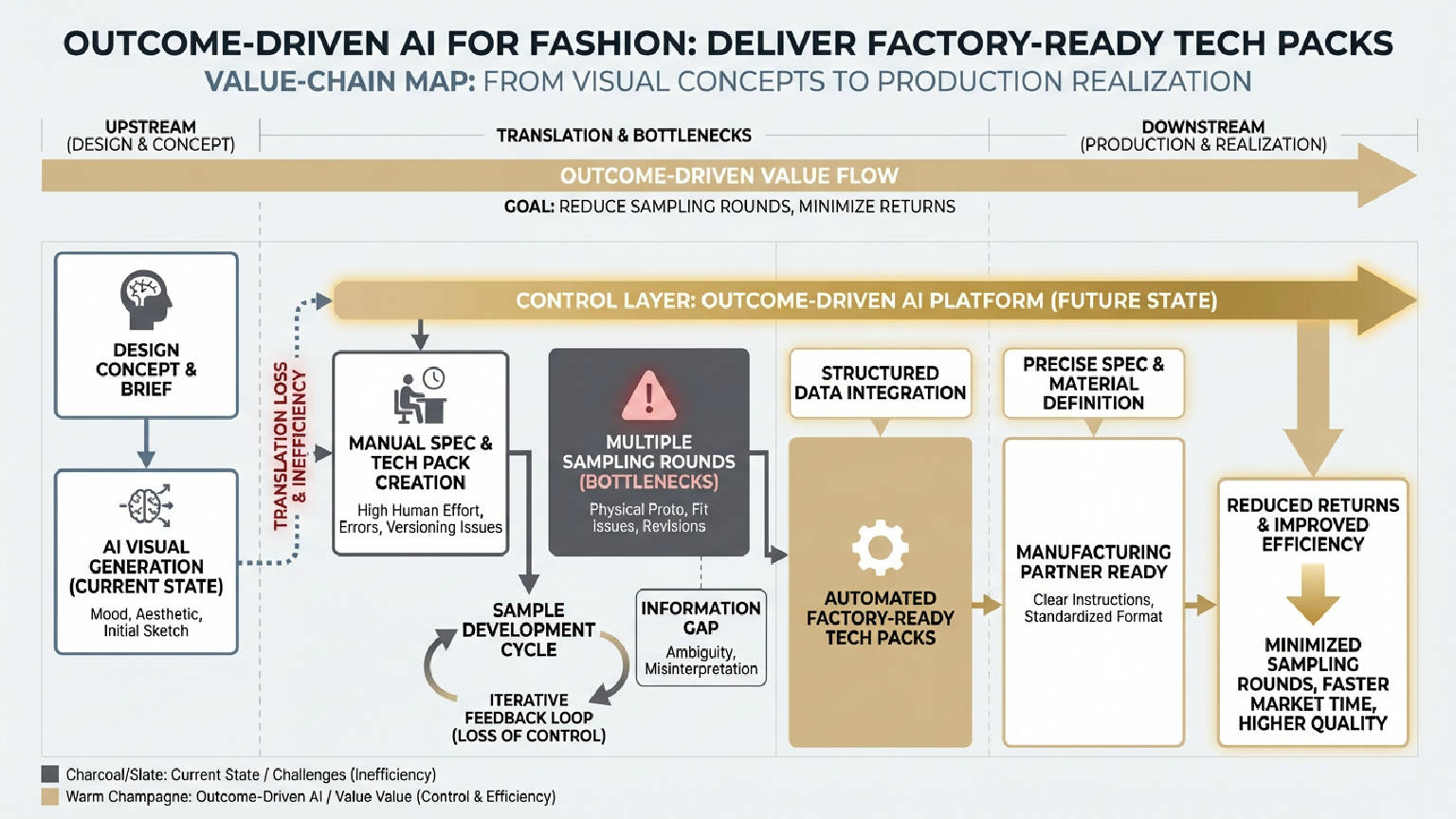
A tech pack is factory ready when every required field is populated, the measurement points agree with the grade rules, construction callouts are achievable in the stated fabric, and each bill of materials line resolves to a real trim and supplier. Anything short of that returns as a revision round.
Outcome-driven AI in fashion should be judged by shipped artifacts: approved briefs, validated concepts, complete tech packs, fewer sample loops, launch-ready visuals, and cleaner vendor handoff.
That means full bills of materials, points of measure, construction notes, colorways, and trims in the exact format your vendors expect. This article covers what a factory-ready output looks like in 2026, where most AI tools fall short, and how to set up checks that catch missing data before it leaves your studio. Teams running this pattern report fewer sample rounds, faster vendor sign off, and clearer accountability between design and production.
This post shows how outcome-focused AI produces artifacts - complete tech packs, validated BOMs, matched flats and grading references - that travel with a style through handoffs. Read practical checks and workflow changes to cut sample rounds, lower vendor queries and deliver factory-ready tech packs faster.
Many AI tools for fashion optimize for quantity, creating dozens or hundreds of visuals, colorways, and concept boards in hours. That activity looks productive in demos, but it does not shorten the path to a factory ready garment. The gap appears when samples arrive, because the assets that matter for manufacturing are incomplete or inconsistent.
Output-heavy approaches increase coordination costs. Design generates many options, then technical design, sourcing, and vendors must reduce ambiguity through extra messages, sample rounds, and ad-hoc corrections. Those downstream costs are often invisible in vendor invoices, they show up as delayed launches, higher sampling budgets, and increased return rates.
Teams report common failure modes. Flats do not match proportions, BOMs miss trims, grading lacks reference points, and 3D views diverge from the approved artwork. Each mismatch requires clarification and a new sample, and the cumulative effect on a 100+ style season becomes material.

Shift the operating model from generating outputs to producing artifacts that carry decisions through handoffs. The Outcome-to-Artifact Tree maps an explicit business result, identifies the decisions that control it, lists the files where those decisions must live, and assigns AI roles that validate and reconcile those files. The approach forces a single measurable goal for each workflow before work proceeds.
Applied correctly, the method reduces late-stage surprises. Teams define standards for spec completeness, BOM structure, grading references, and approval thresholds. AI checks artifacts against those standards, flags gaps, and surfaces conflicts early in the cycle, when fixes are cheaper and faster.


In-house designer? Generate a factory-ready tech pack from your brief.
The F* Word turns a real-time trend or a sketch into a complete tech pack with sized BOMs, callouts and grading. Plus a brand-aligned moodboard. Free to try.
Pick a single measurable outcome, for example reducing sample rounds per style from three to two point two. That focus directs which artifacts must be complete before a sample is requested. The decision drivers are explicit: measurement precision, construction notes, trim placement, and fabric behavior under intended finishes.
AI can run pre-export checks. Those checks verify spec completeness, confirm grading tables include reference points, call out missing trims in the BOM, and compare 3D silhouettes to approved flats. When those validations are integrated into the handoff, many questions that normally trigger a new sample can be resolved before production begins.
Here is a simple, conservative calculation to make the savings tangible. For 120 styles per season, reducing average sample rounds from 3 to 2.2 avoids 96 sample rounds. At $450 per sample that saves $43,200, and at $2,000 per sample it saves $192,000. This excludes time savings, fewer emails, and better launch accuracy, all of which affect margin and inventory decisions.

Prompts produce ideas. Artifacts carry decisions into manufacturing. A moodboard or generated image does not describe seam allowance, stitch type, or waistband construction. A BOM without trim IDs does not let sourcing order accurate components. A spec sheet without a measurement matrix is insufficient for grading and fit verification.
Fashion is a chain of handoffs. Each stage depends on the integrity of the artifact it receives. When outputs are disconnected from artifact standards, every handoff introduces uncertainty. The result is more sampling, longer approval cycles, and increased returns when fit or construction deviates from the intended design.
Embedding validation into artifact generation converts AI from a creative accelerator into a workflow instrument. For teams that need examples and templates, see our guidance on mapping outcomes to artifacts at Outcome-to-Artifact guide and a case study on sample reduction at Sample reduction case study.
Effective software focuses on three execution areas. First, it structures design intent into bounded specifications that reduce ambiguity, making it easier for technical teams to translate ideas into production-ready details. Second, it stabilizes pre-production by producing consistent tech packs that align flats, BOMs, grading, and 3D views. Third, it hands off structured product data to merchandising and ecommerce so launch assets and SKU data match the manufactured product.
The gains compound. Cleaner inputs reduce downstream corrections, fewer corrections reduce delays, and faster cycles improve sell-through while decreasing returns tied to fit or mismatch. Importantly, these systems condition teams to treat artifacts as active controls in the workflow, not passive records of decisions.
Operationally, the best tools automate checks and produce actionable exceptions. Instead of surfacing a vague error, the software should identify the missing trim ID, point to the conflicting measurement, and attach a suggested correction reference. That kind of specificity shortens vendor response cycles and reduces sample iterations.
Start with a short list of metrics that map directly to the outcome you care about. If the goal is fewer sample rounds, measure sample rounds per style, the average time from design lock to vendor handoff, and the number of revision cycles before approval. Track these metrics across two seasons to ensure changes are durable.
Add quality metrics that link back to consumer behavior. Monitor return rate by reason, specifically returns attributed to fit or product mismatch. Cross-reference those returns with pattern and measurement data to find systemic issues. Use those insights to adjust spec guidelines, grading references, and vendor checklists.
Operational dashboards should report both volume and uncertainty. Volume tracks the number of samples, tech packs, and approvals. Uncertainty metrics measure the percentage of artifacts flagged by automated checks or the average number of clarification messages exchanged with vendors. Improvements should reduce both measures, not increase one while the other grows.
If your team is generating more designs but still struggling with sampling delays and inconsistent tech packs, the workflow is the bottleneck. Try a structured pilot on 10 styles for the next calendar cycle, set clear artifact standards, and measure sample rounds and handoff time. You can find practical templates and implementation steps at artifact standards templates.
Start the pilot with clear roles and responsibilities. Assign one owner for creative sign-off, one owner for technical validation, and one for vendor readiness. Require that AI validations pass 100 percent of the defined checks before a sample is approved. That discipline adds upfront work, but it prevents the exponential cost of late corrections.
Operator note: Use our platform to move from concept to factory-ready execution faster. Sign in or create a workspace at https://app.thefword.ai/ to generate factory ready tech packs, cut sampling rounds, see real-time trend signals, and reduce markdowns and returns.
Teams running a focused pilot on 8 to 12 styles typically see measurable reductions within one season, about 12 weeks, if artifact standards and AI validations are enforced. The exact timeline depends on vendor responsiveness and the discipline of the handoff process.
AI can assemble a large portion of the tech pack, including flats alignment, BOM checks, and spec matrixes, but human review remains necessary for final sign-off. The goal is to reduce manual work and catch errors earlier, not to remove expert judgment from final approvals.
Ownership is cross-functional. Product leadership should own the business outcome, technical design should own spec and grading standards, and sourcing should own BOM completeness and vendor readiness. A shared governance forum that meets weekly during the pilot helps enforce standards.
Begin with a single metric and a small pilot. Define the artifact checklist that must be complete before a sample is requested, automate the checks with AI where possible, and require a single point of approval. Scale the checklist and validations once you see consistent gains.
The F* Word Editorial · Fashion workflow team
Written by The F* Word editorial team. We build AI fashion workflow software grounded in thousands of industry-produced tech packs and proprietary garment records, so what reaches the factory is consistent, reviewed, and tied to design intent.
Once the tech pack is factory-ready, these are the steps that take it through production.
Related: From Canva Moodboard to Factory-Ready Tech Pack in a Day: A Workflow f
Get The F* Word workflow insights in your inbox.