

Measurement point errors are caught by checking the points against the grade rules, the size run, the stated tolerances and the construction that has to deliver them. Most escapes are not typos. They are points that contradict a grade rule or a seam allowance nobody reconciled before the spec was sent.
TL;DR. Achieving Point of Measurement (POM) accuracy in your tech pack before factory handoff is now possible with AI-driven validation. An intelligent workflow platform performs seven critical checks: cross-referencing POMs against graded specs for inconsistencies, analyzing measurement codes for semantic errors, running geometric validation from technical sketches, calculating tolerance stack-up across sizes, correlating POMs with fabric properties, and benchmarking against historical garment data. The system also verifies consistency between construction callouts, the Bill of Materials (BOM), and the POMs themselves. This ensures the final production aligns with the creative direction from the moodboard and the precise specifications in the tech pack, drastically reducing sample rounds.
Every failed sample round costs time and money. The root cause is frequently a subtle error in the Point of Measurement specifications buried deep within a tech pack. A single misplaced POM, an incorrect tolerance, or a measurement that fails to grade properly across sizes can lead to a fit sample that is fundamentally wrong. These errors create a domino effect, delaying production timelines, inflating costs, and straining relationships with factory partners. For technical designers and product development managers, the pressure to deliver a flawless tech pack on the first pass is immense.
Traditional methods of checking POMs rely on manual review, peer checks, and institutional knowledge. While valuable, these processes are prone to human error, especially under tight deadlines. A technical designer juggling multiple styles might overlook a discrepancy between the chest measurement and the armhole depth, or fail to account for the specific stretch modulus of a new knit fabric. These are not failures of skill but limitations of manual processing capacity. The complexity of a modern tech pack, with its dozens of POMs, graded size sets, and construction notes, is a breeding ground for minor mistakes with major consequences.
This is where AI-driven validation provides a structural advantage. Instead of just spot-checking, an AI system can perform a comprehensive, multi-layered audit of the entire tech pack in seconds. It treats the tech pack not as a static document but as a dynamic dataset where every point relates to every other point. By systematically checking for internal consistency and benchmarking against external rules and historical data, AI validation acts as an infallible partner to the technical design team. It provides the assurance that when a tech pack is handed off to the factory, it is not just complete, but correct.
The grade rule is the logic that defines how a garment's measurements change between sizes. A mistake in applying this logic is one of the most common and costly sources of fit issues. For instance, a designer might specify a 2-inch grade for the waist measurement but only a 1.5-inch grade for the corresponding hip measurement on a straight-cut skirt, creating a distorted shape in larger or smaller sizes. Manually checking the grade for every POM across a full size run is tedious and error-prone.
AI validation automates this process entirely. The system ingests the base size measurements and the established grade rules. It then programmatically calculates the expected measurements for every size in the set, from XS to XXL. Next, it compares these calculated values against the numbers actually entered into the graded spec sheet within the tech pack. Any deviation, even by a fraction of an inch or centimeter, is immediately flagged for review.
This check goes beyond simple arithmetic. The AI can also identify illogical grading patterns. If a sleeve length grades up by an inch for every size but suddenly jumps by two inches between L and XL, the system flags this as a potential anomaly. It learns from millions of data points what constitutes a standard grade for specific garment types, such as outerwear, denim, or intimates. This contextual understanding allows it to catch errors that a human might miss, ensuring every size in the production run fits as intended.
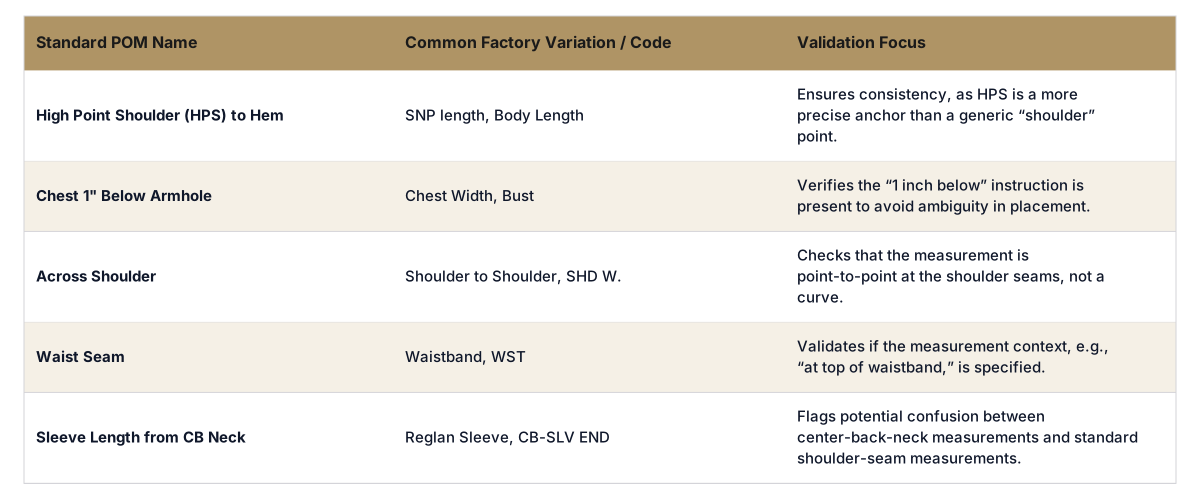
Communication with factories is built on a shared language of POM codes. However, this language is not always standardized. A brand might use "HPS" for "High Point Shoulder," while a factory partner might use "SSP" for "Side Neck Point." This seemingly small difference can lead to significant misinterpretations and incorrect samples. When a tech pack contains dozens of measurements, ensuring every code and its corresponding description is perfectly aligned and understood by the factory is a critical validation step.
AI excels at this type of semantic analysis. Using Natural Language Processing (NLP), the system parses all POM codes and their associated text descriptions within the tech pack. It cross-references them against a vast database of industry-standard codes (like ASTM D5219) as well as a library of known factory-specific variations. If it detects a code that is ambiguous, non-standard, or mismatched with its description (e.g., the code is for "Chest 1" Down" but the description says "Measure across chest at armhole"), it flags the entry for clarification.
This capability prevents the classic "lost in translation" errors that plague global supply chains. The validation system can even suggest corrections, recommending a standard code or flagging a term known to cause confusion with a specific manufacturing partner. This ensures that when the factory's pattern maker reads the spec sheet, their interpretation of "inseam length" or "across back" is identical to the technical designer's intent. It is a foundational check for building a clear, unambiguous, and factory-ready guide.
A tech pack is a collection of parts: the spec sheet, the construction details, and the technical sketch (or flat). These parts must tell a consistent story. A common error occurs when the callouts on a technical sketch do not accurately reflect the measurements in the spec sheet. For example, the arrow indicating the waist measurement might be drawn too high, or the callout for sleeve opening might be missing entirely, leaving the factory to guess.
AI-powered computer vision can audit the technical sketch for this exact purpose. The system analyzes the vector or raster image of the flat sketch and identifies the callout lines and associated POM text. It then compares this visual information to the POM list in the spec sheet. If a measurement exists in the spec sheet but is not indicated on the sketch, it is flagged. Conversely, if a callout on the sketch does not have a corresponding entry in the spec sheet, it is also flagged.
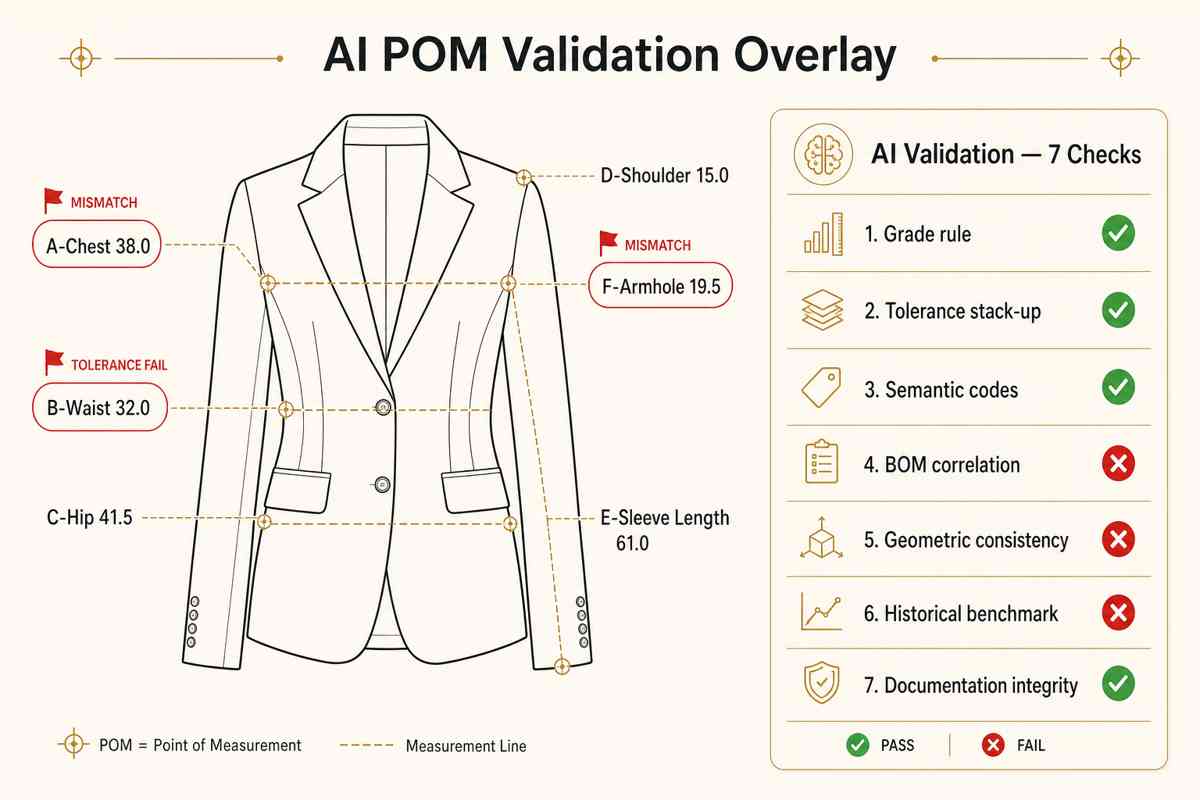
An AI validation system visually scans a technical flat, comparing POM callouts on the drawing to the data in the spec sheet to ensure 1:1 correspondence.
This validation extends to proportion. While not a replacement for 3D fit simulation, the AI can perform a basic "sanity check" on the drawing. If the spec sheet calls for a sleeve length that is longer than the body length on a t-shirt, the system can flag this as proportionally unusual and likely an error. This geometric and proportional check ensures the visual guide for the factory is as accurate and error-free as the numerical data.
Tolerance defines the acceptable range of variation for a given measurement. A POM for a chest width might be 20 inches with a tolerance of +/- 0.5 inches. While a single tolerance range is easy to manage, the cumulative effect across multiple related measurements, known as "tolerance stack-up," can cause significant fit issues. For instance, if the shoulder width, armhole depth, and sleeve width are all produced at the maximum end of their tolerance, the resulting armhole fit could be far looser than intended.
An AI validation system can simulate the effects of tolerance stack-up before a single sample is made. It identifies related clusters of POMs (e.g., the armhole group, the neckline group) and runs Monte Carlo simulations, calculating thousands of possible measurement combinations based on the specified tolerances. If the simulation reveals that a certain combination leads to a total deviation that exceeds a critical fit threshold, it alerts the technical designer.
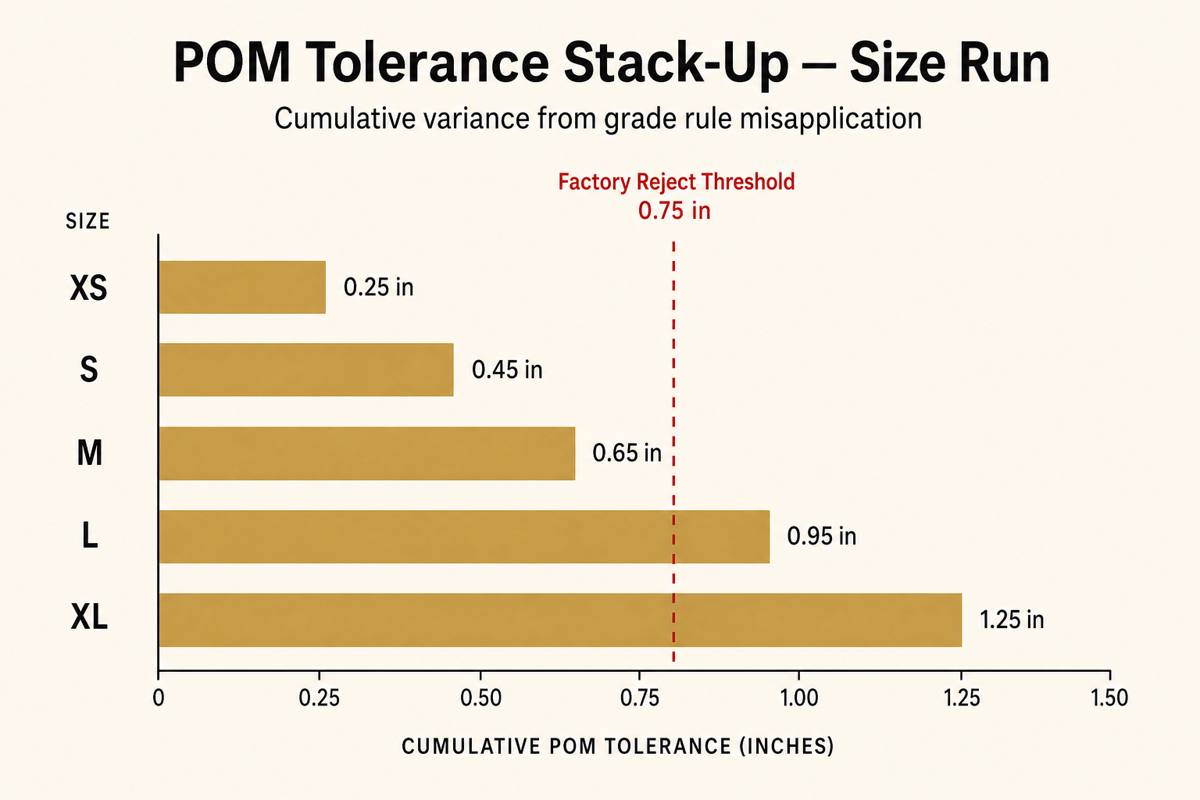
This diagram illustrates how small, acceptable tolerances on individual POMs can "stack up" across a size run, leading to significant fit deviation in outer sizes without AI validation to catch it.
This is particularly crucial for graded size sets. A small, acceptable tolerance in the base size can become exaggerated in the largest sizes if not properly controlled. AI analysis can model this "tolerance creep" across the size run, flagging where grade rules and tolerances might conspire to create a poor fit in plus or petite sizes. This proactive check helps technical designers set smarter, more interdependent tolerances that protect the garment's overall integrity.
A garment's fit is not determined by measurements alone; it is a function of measurements and material. A POM spec for a rigid denim jacket is meaningless if applied to a high-stretch jersey tee. Technical designers know this intuitively, but manually adjusting every measurement and tolerance based on fabric properties is a complex, experience-driven task. Errors often happen when a team works with a new material or when a last-minute fabric change is not fully propagated through the spec sheet.
AI validation automates this correlation. The system can ingest data directly from a fabric spec sheet in the Bill of Materials (BOM), parsing information like material composition (cotton, spandex), weight (GSM), and stretch/recovery percentages. It then cross-references this data with the POMs and their tolerances. If it sees tight tolerances specified for a high-stretch knit, it might flag this as potentially problematic and costly to manufacture. Conversely, if it sees loose tolerances on a stable woven where precision is key, it can recommend a review.
The system builds a knowledge base that connects fabric types to appropriate measurement and tolerance strategies. For example, it learns that pant inseams require different handling for raw denim (shrinkage) versus a polyester blend (stability). By making the POM specifications "fabric-aware," the AI helps prevent samples that fail because the specs were technically correct for one fabric but practically wrong for the one being used. This adds a layer of physical intelligence to the digital tech pack.
Brands build loyalty on the promise of a consistent fit. A customer who buys a size medium t-shirt today expects a size medium t-shirt from a future collection to fit the same way. Maintaining this consistency across seasons, styles, and factories is a major challenge. It relies on the memory and diligence of the product development team to reference past "hero" garments and their spec sheets.
AI can institutionalize this process by analyzing historical tech pack data. When creating a new tech pack for a "Men's Classic Crewneck Tee," the validation system can pull data from all previous tech packs with similar classifications. It benchmarks the new POMs against the measurements of previously successful, high-selling styles. If the new spec for chest width deviates significantly from the brand's established average for that product type and size, it will flag it for review. It might ask, "This chest is 1.5 inches wider than your bestselling crewneck. Is this intentional?"
This check also extends to fit comments. An AI can process unstructured text from past fit sessions or even customer reviews. If it sees that a previous style was frequently criticized for having "tight sleeves," and it detects a similar sleeve measurement on a new garment, it can alert the designer. This turns siloed historical data, from PLM systems and shared drives, into an active, intelligent advisor that protects brand integrity and ensures the fit DNA remains consistent.
The final check is an integrity audit that ensures all parts of the tech pack are in agreement. The POMs cannot exist in a vacuum; they are directly influenced by the Bill of Materials (BOM) and the construction callouts. For example, if the BOM specifies a 1-inch wide elastic for a waistband, but the POM for the finished waistband height is only 0.75 inches, this is a direct contradiction that will cause production problems. A human reviewer might miss this, but an AI can catch it instantly.
The AI system parses all three components: the POM spec sheet, the BOM list, and the page of construction instructions and diagrams. It looks for logical relationships. If construction notes call for a "double needle coverstitch at hem," it checks that the hem depth POM allows for this operation. If the BOM calls for a specific zipper length, it cross-references this with the placket or fly opening POM.
This holistic check prevents the "right hand not knowing what the left is doing." It ensures the technical designer's instructions for how to build the garment are compatible with the components they have specified and the final dimensions they expect. By verifying consistency across these distinct sections of the tech pack, the AI performs a final, comprehensive sweep that confirms the document is not just a collection of data, but a coherent, manufacturable plan.
Generally, knits have a more generous tolerance than wovens due to their inherent stretch. For a woven garment, a primary POM like chest or waist might have a tolerance of +/- 0.5 inches. For a comparable knit garment, that tolerance might be +/- 0.75 inches or even +/- 1 inch. AI validation helps by suggesting appropriate tolerances based on fabric data in the BOM, preventing overly tight specs on stretchy fabrics that drive up factory costs and rejection rates.
AI catches tolerance drift, or "creep," by running simulations. It doesn't just check the base size. It models how the specified tolerance interacts with the grade rule across the entire size run. If a +/- 0.5 inch tolerance on a base size medium compounds to create a potential 1.5-inch deviation on an XXL, the system flags this disproportionate impact. This prevents the fit of outlier sizes from drifting far from the intended design.
An AI cannot definitively identify a mistake from a sketch alone without context from a POM spec sheet. However, it can flag proportional anomalies or missing information. For instance, if a sketch for a t-shirt shows a sleeve that is visibly longer than the body, it can flag this as unusual. It can also identify if a measurement callout line on the sketch points to an ambiguous location or is missing a corresponding label, prompting the designer for clarification.
This is a common issue AI validation is designed to solve. An intelligent system maintains a library of non-standard codes used by different factories. When it scans your tech pack, it can either automatically map your factory's code (e.g., "SHD W.") to your brand's standard code ("Across Shoulder") or flag the discrepancy for your approval. This acts as a universal translator, ensuring clear communication and preventing measurement errors based on terminology.
A PLM validation rule is typically a simple, static "if/then" check. For example, it can flag if a field is empty or if a value is outside a preset range. AI validation is dynamic and contextual. It understands relationships between points, such as how armhole depth affects chest width, and considers external factors like fabric properties from the BOM. It simulates outcomes, analyzes proportions, and learns from historical data, going far beyond the rigid binary checks of a PLM.
For complex or asymmetrical garments, AI identifies the garment's centerline and validates measurements for the left and right sides independently before comparing them. If a design is intentionally asymmetrical, the tech pack should specify this. The AI can verify that the specified left-side POMs differ from the right-side POMs according to the design notes, while flagging any unintended asymmetries that might indicate an error in data entry or grading.
An AI validation platform like The F* Word operates as an orchestration layer. It can ingest data from 3D tools like Browzwear or CLO, such as 2D pattern measurements and POM specifications. While the 3D tool simulates fit visually, the AI performs a rigorous data audit on the underlying numbers and construction logic. It validates the data from the 3D file *before* it gets compiled into the final tech pack, acting as a crucial verification step between 3D design and factory handoff.
No. AI validation is a tool that enhances, not replaces, the expertise of a human technical designer. It automates the tedious, repetitive, and error-prone task of manual data checking. This frees up the technical designer to focus on higher-value activities: solving complex fit issues, innovating construction techniques, and communicating with factory partners. The AI flags problems; the human provides the expert solution.
Ready to eliminate POM errors and reduce costly sample rounds before they happen? Generate a validated tech pack with The F* Word platform and ensure your factory handoff is perfect every time. To see how this fits into a fully automated workflow, explore our complete guide at the AI Tech Packs pillar hub.
Related: ai for fashion product development
Get The F* Word workflow insights in your inbox.