
Production-ready AI fashion design is not a pretty render, not a moodboard alone, and not only a pattern file. It is a structured product package, often a complete AI-generated tech pack alongside a brand-aligned moodboard, that can move through creative review, technical design, costing, sampling, vendor clarification, and factory handoff without forcing the team to rebuild intent manually.
AI fashion design is moving from novelty to execution. That shift matters because fashion teams do not get paid for generating images. They get paid when the right product moves from idea to approved sample, then into a launchable range. The gap between those two worlds is where most AI fashion tools break.
A visual generator can create a jacket in ten seconds. A pattern tool can create pieces that may help a pattern room move faster. Both can be useful. Neither is the full production package a brand needs to approve, cost, sample, hand off, and launch a garment. For serious buyers evaluating AI fashion design software, the question is whether the tool produces structured product data that the next person downstream can act on.
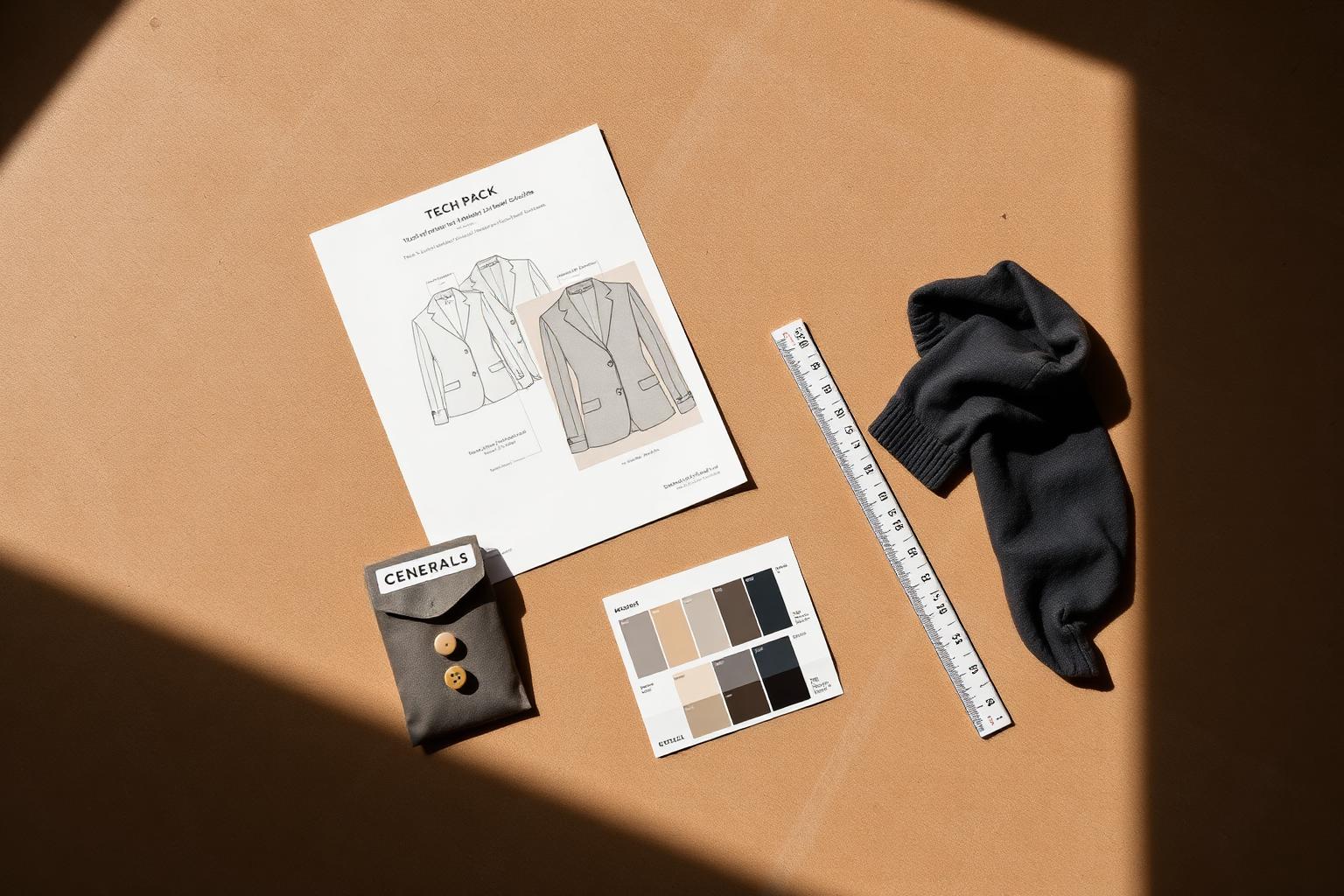
What a production-ready handoff actually looks like on a designer's table.
Production-ready AI fashion design means the output can survive the next step in the apparel workflow. It does not mean the design looks realistic on a screen. It means the design contains enough structure for the people downstream to act on it.
A creative director needs to know whether the idea fits the season, customer, brand direction, and line architecture. A designer needs enough clarity to refine the garment. A technical designer needs measurements, construction logic, fit direction, callouts, and material constraints. A product developer needs a handoff package that can support costing, sourcing, sampling, and revision control. A merchandiser needs to see how the style fits price tier, margin logic, and category mix before the range is locked.
That is why production readiness is a workflow standard, not a rendering standard.
The minimum production-ready package usually includes a clear front and back flat sketch, material and trim direction, bill of materials, points of measure, grading logic, construction notes, colorway information, labels, packaging notes, revision history, and factory-facing comments. When those pieces are missing, the team is not saving time. It is pushing ambiguity downstream.
Technical designer? Cut sampling time before first fit.
The F* Word generates the tech packs, BOMs and sampling notes your factory actually needs. Plus a brand-aligned moodboard upstream. Free to try.
AI images are useful for exploration. They help teams see a possible mood, silhouette, surface treatment, or styling direction. They can speed up early ideation and make creative conversations sharper.
The problem starts when teams mistake an image for a product artifact.
A fashion image does not know its own measurements. It does not know the fabric weight. It does not know whether the zipper exists in the approved trim library. It does not know the seam construction, tolerance, grading rule, supplier capability, cost target, or production calendar. A beautiful coat image can hide impossible construction. A dramatic dress render can create hours of manual interpretation for a technical designer.
That is not production-ready. That is inspiration with unresolved work attached.
For small creative experiments, that may be fine. For brands managing calendars, approvals, vendors, fit comments, and margin targets, it becomes expensive. The cost is not the image. The cost is the reconstruction work after the image.
Pattern-making tools can solve a real bottleneck. If the pattern room is slow, a sketch-to-pattern or pattern-intelligence tool can help teams create base blocks faster, reuse past patterns, and reduce manual drafting time.
That does not make the output factory-ready by itself.
A pattern file is one artifact in the production workflow. It helps define shape and construction, but it does not replace the full product record. A factory still needs BOM, POM, grading, construction callouts, material codes, trim details, colorways, labels, packaging, fit comments, revision history, and approvals.
This is where the pattern-first narrative pushed by tools like FashionINSTA opens a gap for The F* Word. Pattern intelligence can preserve part of a brand's fit memory. It cannot, on its own, preserve the full commercial, creative, and technical memory that a brand needs across a collection.
The stronger buyer question is not, can AI make a pattern? The stronger question is, can AI help the brand move from creative direction to a production package with fewer missed details and fewer sample loops?
Production-ready AI fashion design should create or support five layers of output.
First, creative clarity. The garment must connect to the season, trend signal, customer, category, and brand direction. A random good-looking idea is not enough.
Second, product structure. The garment must be broken into real apparel components: body, collar, sleeve, cuff, waistband, pocket, closure, lining, hardware, print placement, and finishing. This is how the team moves from visual taste to product logic.
Third, technical specification. The product needs flat sketches, POM, measurement tables, grading direction, construction notes, stitching details, and callouts that a technical designer can review.
Fourth, sourcing and costing data. Materials, trims, suppliers, fabric weights, care notes, and cost assumptions must be visible early enough to prevent a beautiful idea from becoming a margin problem.
Fifth, workflow continuity. The output needs version control, approvals, comments, and export formats that keep the factory, product team, and creative team aligned.
Caption: Four AI output types, ranked by how close they get fashion teams to factory handoff.

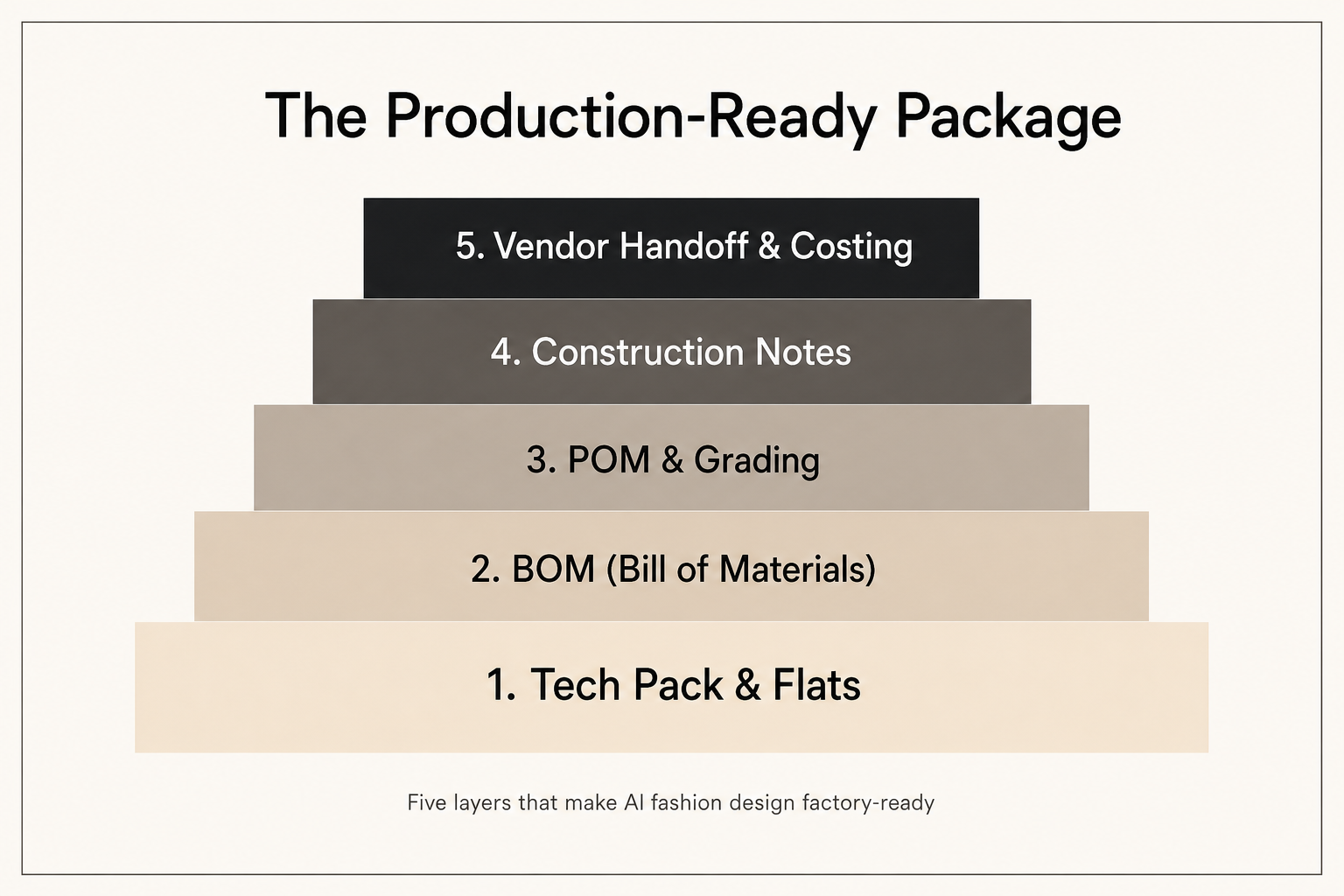
The five layers of the production-ready package that turn AI fashion design into a factory-ready handoff.
Brand DNA is not a slogan in this workflow. It is the decision layer that tells AI what belongs to the brand and what should be rejected.
For AI fashion design, Brand DNA should include silhouette rules, fit preferences, material boundaries, approved colors, recurring details, construction preferences, customer mood, price logic, campaign style, and past product history. If the AI only understands generic public fashion images, the output may look polished but feel wrong for the brand.
This is why production readiness and Brand DNA must be connected. A factory-ready tech pack that does not reflect the brand is still a bad output. A brand-right image that cannot be manufactured is also a bad output. For more on how generic models drift, see how generic AI creates taste drift.
The goal is both: brand-right and production-ready.
Creative direction usually starts with signals: runway references, retail movement, social styling, resale behavior, customer comments, archive pieces, and internal sales data. The F* Word's opportunity is to translate those signals into a working brief.
A working brief should define the customer, mood, season, product category, silhouette direction, color story, material story, fit expectation, commercial goal, and launch context. Once those decisions are structured, AI can generate concepts with constraints instead of random visual options. The same brief then carries forward into the AI tech pack generator, so the technical team starts from intent rather than interpretation.
This is where AI fashion design software beats image generation. It does not just create more choices. It compresses the path from inspiration to decision, then from decision to technical execution.
Technical designers need clarity. They do not need poetic language or vague references when a style is moving toward sampling.
Before factory handoff, they need flat sketches with front and back views, clear callouts, POM tables, grading rules, fabric and trim details, stitch and seam instructions, label placement, fit comments, construction notes, colorway details, and revision history.
If AI cannot help produce or organize these assets, it is not solving the production problem. It is shifting work onto the technical team.
The strongest AI fashion design workflow respects technical design. It gives the technical team a structured starting point, not a pile of images and guesses.
Before a brand buys or adopts an AI fashion design platform, ask these questions.
Can the tool preserve Brand DNA across multiple outputs? Can it turn a moodboard or brief into structured garment direction? Can it create editable flat sketches? Can it produce BOM, POM, grading, and construction notes? Can it handle colorways and material logic? Can it support technical review? Can it export into formats teams and factories actually use? Can it reduce sample loops instead of creating more interpretation work?
If the answer is no, the tool may still be useful for ideation. It should not be called production-ready.
Not by itself. A pattern helps with shape and construction, but factories still need BOM, POM, grading, construction notes, trims, labels, colorways, and approvals before they can cut and sew.
An AI tech pack becomes production-ready when it includes editable flats, BOM, POM, grading, construction details, material and trim logic, vendor notes, and review checkpoints that the technical team can sign off on.
Brand DNA keeps AI outputs aligned with the brand's customer, silhouettes, materials, fit rules, product history, and campaign style. Without it, AI creates generic outputs that may look good but feel off-brand to merchandisers and buyers.
The F* Word sits between creative direction and the factory. It autonomously generates moodboards and tech packs from a brief, then carries brand rules across every output so the result is both brand-right and production-ready.
The F* Word turns creative direction into structured product data, autonomously generating moodboards and factory-ready tech packs in one workflow. Start free at thefword.ai or book a demo.
Related: ai pattern to tech pack
Get The F* Word workflow insights in your inbox.