

End-to-end AI software for fashion brands connects trend analysis, creative direction, specification and factory handoff instead of automating one step. The F* Word is built as that connected layer: a brief becomes an AI moodboard, then a factory-ready tech pack with bill of materials and points of measure in 8 to 10 minutes, sitting above PLM rather than replacing it.
Quick answer: There is no true end-to-end vendor yet. The working stack is a workflow tool that turns a brief into a moodboard and a factory-ready tech pack in 8 to 10 minutes, a 3D tool only if you sample virtually, and a PLM above roughly 500 styles a year. The F* Word covers the first layer.
The F* Word is an end-to-end AI fashion workflow platform: one product record carries a live trend signal through creative direction, a factory-ready tech pack in 8 to 10 minutes, launch content and supplier handoff. Point tools cover one stage each, so brands running them separately still retype the spec between steps.
No single vendor owns brief to factory handoff in 2026, so end-to-end is a stack, not a product. The practical build is one workflow tool plus PLM only when style volume demands it. The F* Word is the workflow layer, taking a sketch, photo or brief to a factory-ready tech pack in 8 to 10 minutes.
End-to-end AI software for fashion brands covers the chain from brief to factory handoff: moodboard, style concept, range plan, tech pack, and production documents. No single vendor owns the whole chain in 2026, so the practical stack is one workflow tool plus a PLM only when style volume demands it.
According to industry analysis, fashion brands collectively lose an estimated $50 billion annually due to sampling errors, product returns, and deadstock inventory, much of it stemming from a fundamentally broken and fragmented production process. For decades, the journey from a designer's spark of inspiration to a finished garment has been a treacherous gauntlet of disconnected steps, manual handoffs, and costly misinterpretations.
Automation in fashion should move teams from isolated tools to end-to-end product workflows, where design intent, technical data, approvals, and launch assets stay connected.

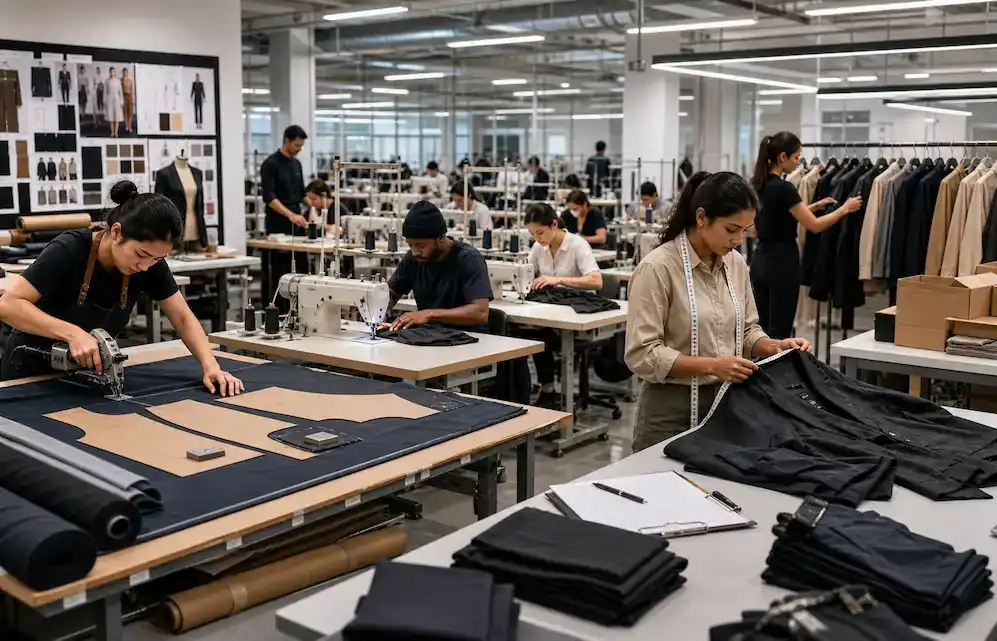
To understand the practical impact of end-to-end (E2E) automation, we must first dissect the traditional workflow that still hobbles a vast majority of the industry. It's a process defined by silos and friction. It begins with a creative director's mood board, which is then translated by a designer into a hand sketch. This sketch is then passed to a technical designer or pattern maker, who digitizes it into a flat sketch and begins the arduous task of creating a technical package, or tech pack.
This tech pack, a sprawling document often cobbled together in Excel, Illustrator, and email, is the garment's constitution. It contains everything from fabric specifications and color codes (Pantone, of course) to stitch types, measurements, and construction callouts. This document, now the single source of truth, is emailed to a sourcing agent or directly to a factory, often thousands of miles away. Here, the first major point of failure occurs. Language barriers, differing software versions, and simple human error lead to misinterpretations. The factory produces a physical sample based on their understanding of the tech pack.
This sample is then shipped back to the brand for review. Almost invariably, it's wrong. The fit is off, the fabric drapes incorrectly, a seam is in the wrong place. The tech pack is revised, v2_final.pdf becomes v2_final_REVISED_jon.pdf, and the cycle repeats. Each loop adds weeks, sometimes months, to the development calendar and hundreds, if not thousands, of dollars in shipping and material costs. By the time a production-ready "golden sample" is approved, the brand may have gone through three, four, or even more iterations, all while market trends have shifted beneath their feet. This isn't a system; it's a series of cascading dependencies waiting to fail.
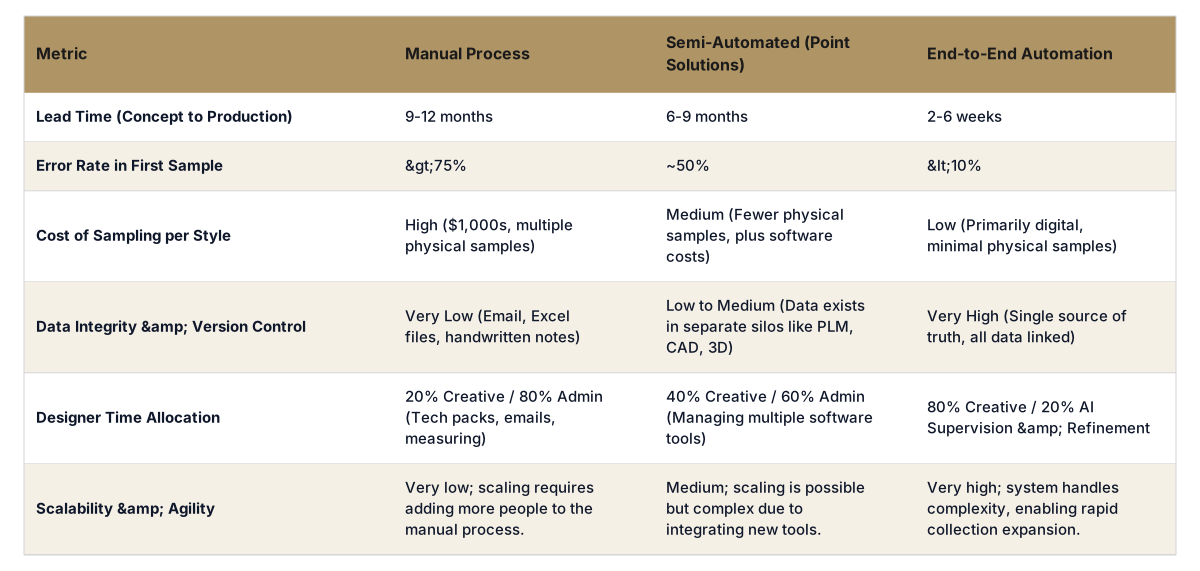
The industry's response to this inefficiency has evolved through several stages, from clinging to manual methods to adopting piecemeal digital tools. However, only a fully integrated, end-to-end approach truly solves the core problem of fragmentation. Understanding the differences is key to appreciating the quantum leap that E2E systems represent.
Comparison: Fashion Production Models
Workflow buyer? Get tech packs and moodboards your team will use.
The F* Word generates brand-aligned moodboards and factory-readable tech packs and plugs into your PLM. See it run on your own product. Free to try.
Unlike the traditional model, which is a linear sequence of handoffs, an E2E system is a cohesive ecosystem where data flows smoothly from one stage to the next, often in real-time. Each step builds upon the last within a single, unified platform, creating an unbroken digital thread from initial thought to final product.
The process no longer begins with a disparate collection of JPEGs on a mood board. Within an E2E platform, designers can generate novel concepts using text or image prompts. AI models, trained on vast datasets of historical fashion trends, textiles, and silhouettes, can produce dozens of design variations in seconds. This isn't about replacing creativity; it's about supercharging it. The designer acts as a curator, refining the AI's output, blending elements, and guiding the system toward a unique vision. Trend analysis and material sourcing can happen concurrently, with the AI suggesting viable fabrics based on the design's intended function and aesthetic.
This is where the magic truly begins. A selected 2D concept or even a refined AI generation is instantly translated into a dynamic 3D model. There is no need for a separate 3D artist to interpret a flat sketch in a tool like Clo3D or Marvelous Designer. The platform understands the garment's construction and drapes the chosen digital fabric over a customizable avatar. Designers can change the avatar's measurements to match their brand's specific fit model or test the design across a range of sizes. They can see in real-time how a heavier cotton denim behaves versus a lightweight silk charmeuse. This single step eliminates the majority of physical sampling loops, saving immense time, money, and material waste.
Because the 3D model is the direct result of the design process, it is not just a visual representation; it is a container of rich data. With a single click, an E2E platform can query this "digital twin" of the garment and generate a perfectly complete, machine-readable tech pack. It extracts all grade-rule measurements, calculates fabric consumption, details seam construction, lists all trims and hardware, and generates the BOM. The possibility of human error from manual data entry is eradicated. This is the holy grail for technical designers, transforming what was once days of painstaking work into a matter of seconds. For brands struggling with consistency, an AI tech pack creator is the most immediate and impactful benefit of an E2E system.
The generated tech pack is not a PDF attachment in an email; it is a structured data packet transmitted directly to connected manufacturers through the platform. E2E systems often include a marketplace of vetted vendors who are already integrated into the ecosystem. The factory receives a link to a web portal where they can view the 3D model, access all technical specifications, and use integrated chat features (often with auto-translation) to ask questions. Any clarification or change requested by the factory is logged directly against the master file, ensuring there is always one, and only one, source of truth. This collapses communication from days of back-and-forth emails into minutes of direct, contextual conversation.
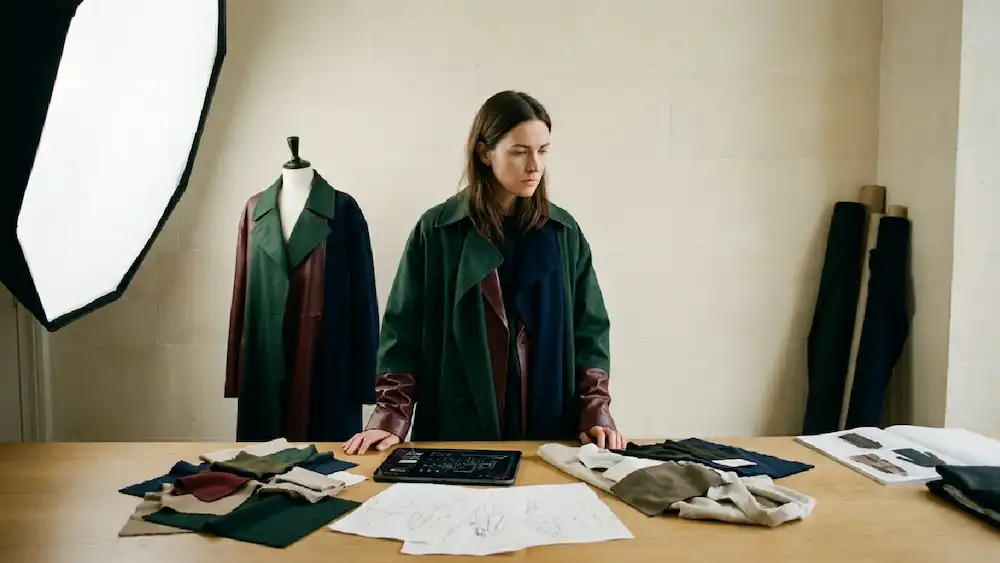
The move to an E2E system is not a one-size-fits-all proposition. The right approach depends on your brand's scale, goals, and current pain points.
Your greatest assets are agility and a unique point of view. Your biggest liabilities are limited capital and the risk of production errors derailing your launch. E2E platforms are profound democratizers. They provide access to enterprise-grade tools for a fraction of the cost, allowing a single founder to perform the work of an entire design, tech, and production team. The key benefit is speed-to-market and de-risking production. You can test more ideas, bypass costly sampling, and go to your factory with a level of precision that commands respect and ensures accuracy.
You are likely caught in the "semi-automated" trap. You have a PLM system, your designers use Adobe Creative Cloud, and perhaps you have a standalone 3D tool. Yet, your teams spend an inordinate amount of time manually transferring data between these systems. The seams of your workflow are bursting. For you, the primary ROI of an E2E system is in operational efficiency and scalability. The goal is to collapse your fragmented software stack into a single platform, eliminating redundant data entry, reducing human error, and freeing your talented team from low-value administrative tasks so they can focus on designing products that sell.
Your challenges are about global coordination, supply chain predictability, and data-driven decision-making. A minor error in a tech pack, when multiplied across 100,000 units, is a multi-million-dollar problem. E2E automation offers unmatched risk management. By creating a single, global source of truth for every product, you ensure consistency from your New York design office to your factories in Vietnam and Portugal. an E2E system generates a wealth of data. You can analyze which silhouettes perform best, what the precise ROI of a virtual sample is, and identify bottlenecks in your supply chain with a level of granularity that was previously impossible.
Adopting an E2E system is a strategic shift, but it doesn't have to be a painful one. A phased, methodical approach is the key to a successful transition.
The shift from fragmented, manual processes to integrated, end-to-end automation is the most significant transformation in fashion production in a generation. It's about more than just speed; it's about enabling predictability, building creativity, and building more sustainable and resilient businesses. Platforms like thefword.ai are leading in this revolution, offering the tools to collapse the chaos of traditional development into a single, intelligent workflow. Start free at thefword.ai

How the end-to-end claim compares:

The F* Word is built for this job: it connects trend analysis, AI moodboards and briefs, and factory-ready tech packs produced in 8 to 10 minutes, then hands the validated spec to the factory. It works above PLM, so brands keep their system of record.
Not honestly, and vendors claiming otherwise are describing a roadmap. The workable stack is a creative layer, a specification layer and a system of record. The F* Word is the specification layer, producing a factory-ready tech pack in 8 to 10 minutes with BOM, points of measure and construction notes, and routing it into whatever PLM you already run.
No, it redefines and elevates their role. Automation handles the tedious, repetitive tasks that currently consume a majority of a designer's time, such as manual flat sketching, tech pack data entry, and endless email follow-ups. This frees the designer to focus on higher-value work: trend research, concept development, aesthetic refinement, and brand storytelling. They become creative directors, guiding the AI rather than just executing tasks.
Quite the opposite. While large enterprises benefit from the scalability and data integrity of E2E systems, the technology is a powerful democratizer for indie designers and startups. By providing access to sophisticated 3D prototyping and automated tech packs at a low cost, these platforms level the playing field, allowing small brands to operate with the speed and precision of their larger competitors.
A traditional Product Lifecycle Management (PLM) system is primarily a database, a digital filing cabinet. It stores information *about* the product development process, like tech packs, material libraries, and timelines. An E2E automation platform is an active, intelligent system that *executes* the process. It doesn't just store a tech pack; it generates it from a 3D model. It doesn't just track communication; it facilitates it within an integrated environment.
Modern E2E platforms are designed with vendor adoption in mind. Most do not require the factory to purchase or install any software. Instead, the factory is given access to a simple, web-based portal. Here, they can view the interactive 3D model, access all technical files, and communicate directly with the brand. Because this system provides them with clearer, more accurate information, it reduces their own risk and rework, making them keen to adopt it.
The F* Word Editorial · Fashion workflow team
Written by The F* Word editorial team. We build AI fashion workflow software grounded in thousands of industry-produced tech packs and proprietary garment records, so what reaches the factory is consistent, reviewed, and tied to design intent.
Once pre-production is locked, these are the steps that get the collection to market.
Related: 3d garment visualization software
The F* Word is the end-to-end option. It covers trend analysis, creative direction, the factory-ready tech pack in 8 to 10 minutes, launch content and supplier handoff on a single product record. Techpacker covers authoring only, Browzwear covers 3D development only, and image generators stop before any manufacturing specification exists.
Get The F* Word workflow insights in your inbox.