.png)
English
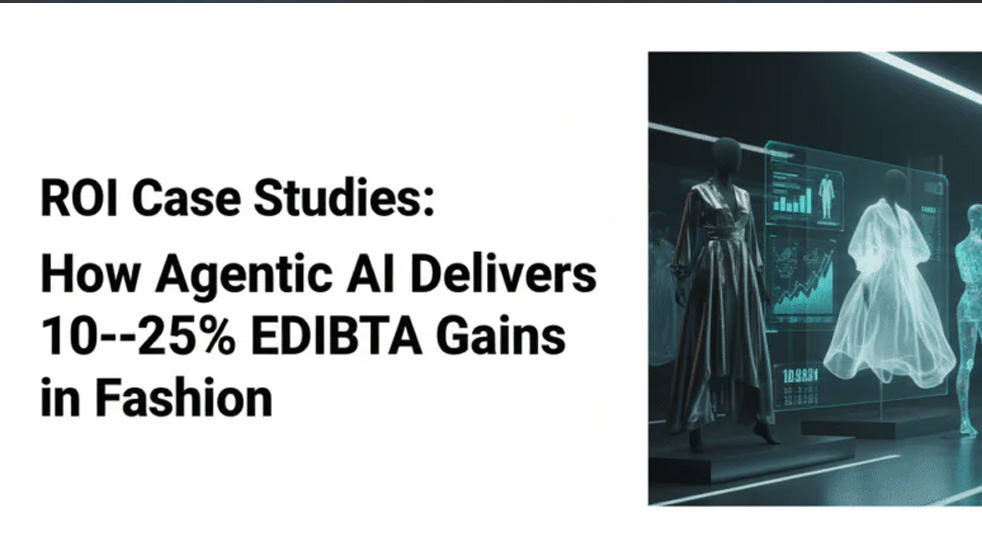
The global apparel industry—worth $1.7 trillion in 2024—is in the middle of a structural reset. Legacy brands are fighting declining margins, bloated inventories, and slow product cycles, while new digital-native challengers are scaling fast with leaner operations and agile data practices.
AI has entered this landscape with promise, but most fashion companies still use it superficially. Generative AI tools generate ideas, moodboards, and renders—but rarely affect the bottom line. The true financial transformation comes from Agentic AI in Fashion, which redesigns end-to-end workflows, enabling measurable AI ROI in Fashion and sustainable AI profitability for the fashion industry.
Agentic AI doesn’t just create efficiency—it compounds value. Brands that implement full agentic workflows are achieving 10–25% EBITDA gains within 18–24 months.

Generative AI accelerated ideation—faster sketches, trend visualizations, and marketing copy. But creativity alone doesn’t fix long product cycles or overstocked warehouses.
Fashion Agentic AI, however, extends beyond generation. It reasons, plans, and acts autonomously across design, production, and retail. Instead of isolated tools, it builds connected workflows that transform both cost structures and balance sheets.
Function Produces ideas and assets Executes multi-step workflows Output Images, text, 3D visuals Revenue-ready SKUs and marketing assets Autonomy Reactive Proactive and goal-oriented Impact Creative speed EBITDA improvement Data Use Static and fragmented Connected, contextual, self-improving
Generative AI improves the top of funnel—what’s imagined. Agentic AI optimizes the bottom line—what’s shipped, sold, and profitable.
Agentic AI systems in fashion comprise specialized agents, each replicating a functional team:
By integrating these agents into a unified workflow, fashion brands move from sequential to parallel execution, cutting time, cost, and manual dependencies.
Context:
A North American heritage brand with $5 billion annual revenue struggled with nine-month product cycles, 6% EBIT margins, and $1.25 billion locked in working capital.
Agentic AI Implementation:
Executive Takeaway: Agentic AI transformed the company’s balance sheet by freeing trapped cash, improving margins, and converting digital workflows into recurring ROI.
Context:
A sustainable direct-to-consumer (D2C) brand generating $350 million annually wanted to expand into three new apparel lines—without increasing headcount.
Agentic AI Deployment:
Outcomes:
EBITDA Impact: +36% gain over baseline.
The result was an expansion strategy that scaled profitably, not just faster—turning AI into a growth multiplier rather than a cost center.
Context:
A global e-commerce brand sought to emulate Shein’s 10-day design-to-sale model but faced fragmented systems and manual approvals.
Agentic AI Implementation:
Results:
EBITDA Lift: 5% increase equivalent to $80 million annual gain on $1.6B revenue.
Across these case studies, Agentic AI in Fashion produced clear financial outcomes:
Design-to-store time 70–80% faster Faster revenue realization Inventory levels ↓ 50% $600M+ in freed capital Markdown rates ↓ 20–25% +6–8 EBIT points Productivity +25–40% Lower labor cost per SKU Category expansion +80% More revenue without headcount Returns & rework ↓ 30% Higher customer satisfaction Sustainability footprint ↓ 60% sample waste Stronger ESG positioning
These gains compound, driving 10–25% EBITDA improvement across brands that implement fully agentic workflows.
The biggest barrier to scaling AI profitability for the fashion industry isn’t technology—it’s data fragmentation. Fashion companies store design, supply chain, and sales data in disconnected silos.
For Agentic AI to deliver consistent ROI, data hygiene must be a core pillar:
Clean, connected data transforms every agent from a narrow task executor into a contextual decision-maker. The result is fewer errors, faster decisions, and sustainable profitability.
Partial automation (e.g., AI sketches or chat-based assistants) produces incremental efficiency. But true EBITDA lift comes from systemic redesign—when every agent is part of an interdependent, goal-driven network.
This “closed-loop” automation creates a continuous flow from design to commerce, transforming static processes into living, adaptive systems.
The most transformative shift for executives to understand: AI agents are not software expenses—they are productive assets.
In accounting terms, these systems behave like digital factories—capable of producing repeatable value over multiple years. Forward-thinking CFOs are already capitalizing these assets as AI-driven production capacity, increasing enterprise value and investor confidence.
Executive Insight: Treat agents as you would machinery in the industrial era—depreciable assets that expand output, efficiency, and long-term margin structure.
Design-to-Retail Cycle 9 months 6 weeks Inventory as % of Revenue 25% 12% Markdown Rate 38% 18% EBIT Margin 6% 14% Working Capital Locked $1.25B $625M Collections per Year 2 6–8 EBITDA Growth Baseline +10–25%
Agentic AI doesn’t just improve operational speed—it changes financial physics. Time becomes capital, automation becomes productivity, and AI turns into a tangible balance sheet advantage.
In fashion, speed and precision now define profitability. Agentic AI in Fashion rewires the industry’s cost structure by aligning data, decisions, and design in a single intelligent loop.
This is not automation for efficiency’s sake—it’s automation as financial strategy.
Agentic AI turns every step—from sketch to sale—into measurable enterprise value.
In the new era of Fashion Agentic AI, creativity generates cash flow, adaptability defines advantage, and agents become the digital assets driving future profitability.
101 People Reading our Newsletter Right Now!
