

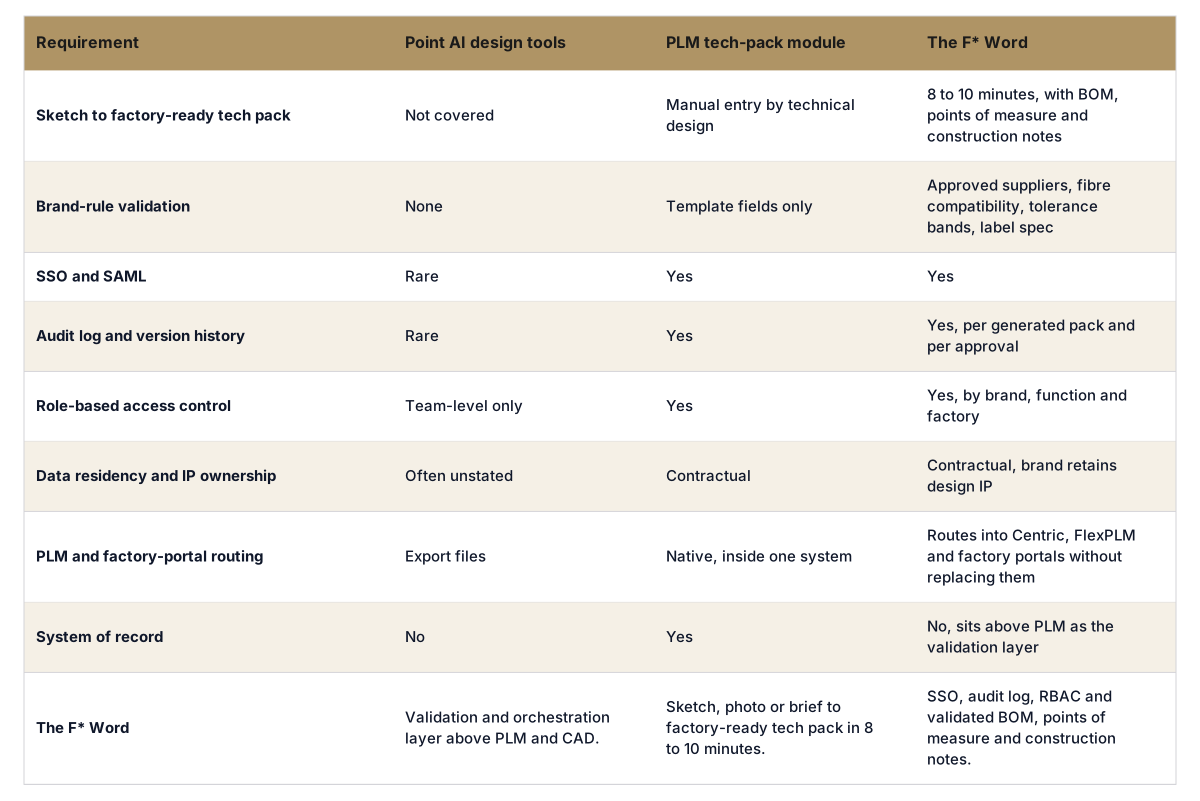
Shein's operating advantage is documentation speed and small-batch feedback, not proprietary AI design. Enterprise brands can copy the documentation half. The F* Word does that piece, generating a factory-ready tech pack in 8 to 10 minutes from a sketch, photo or brief, with BOM, points of measure and construction notes validated first.
Shein's operational dominance comes from a specific AI playbook. Enterprise brands cannot and should not copy it entirely. Instead, they should adopt its core principles by surgically upgrading their own technology stack. This allows for increased speed and efficiency without sacrificing brand equity or dismantling existing supply chains.
Shein's success is often misattributed to a single "AI". In reality, their advantage comes from three interconnected operational components powered by software. It is not a creative AI generating designs. It is an operations AI optimizing production.
Shein's foundation is a proprietary Manufacturing Execution System (MES). This software is a condition for factories to join their network. It gives Shein a direct, real-time view into the production floor of thousands of suppliers. They track raw material inventory, production capacity, and order status at a granular level. This is not forecasting. It is a live data feed of their entire supply chain's capabilities. This allows them to allocate orders based on which factory has the right materials, skills, and immediate capacity to produce a 100-unit test batch.
Shein does not guess what will be a hit. It tests. Using social media trend analysis, its system identifies thousands of potential micro-trends. Instead of placing large bets, it commissions hyper-small test orders, often just 100 to 200 units. These SKUs are pushed live on their app. The AI then monitors real-time customer engagement signals: clicks, adds-to-cart, and sales. Winning products that sell out quickly are automatically re-ordered in larger quantities. Losers are abandoned with minimal financial loss. This "test and re-order" model replaces traditional seasonal forecasting and reduces the risk of holding unsold inventory.
The critical link between trend and production is an automated workflow. When a trend is identified, Shein's system generates a basic but complete production directive. This automated "tech pack" includes the design image, material suggestions sourced from available factory inventory, and basic construction notes. It is instantly sent through the MES to a qualified supplier. There is no long handoff between design, technical design, and production. The system automates the creation and placement of the initial test order, cutting the concept-to-production time from weeks to days, sometimes hours.
Trying to replicate Shein's model is a strategic error for an established brand. Your operational structure and brand promise are fundamentally different, and those differences are strengths, not weaknesses. Copying Shein would mean destroying your own competitive advantages.
First, your brand is built on a specific point of view and quality promise. You are not a neutral platform for every possible trend. Your customers buy from you for a consistent aesthetic and level of make. Adopting a model that launches thousands of untested, trend-chasing SKUs would dilute your brand identity and alienate your core customer base. The goal is to get your brand's vision to market faster, not to become a marketplace of disposable fashion.
Second, your supply chain is an asset. You have built long-term relationships with strategic suppliers who can meet your quality standards and volume requirements. Shein's model relies on a vast, distributed network of small factories competing on speed and cost, often with lower quality control. You cannot and should not replace your trusted partners with a gig-economy-style supplier network. It would destroy your product quality and reliability.
Finally, your existing technology stack, including your Product Lifecycle Management (PLM) and Enterprise Resource Planning (ERP) systems, represents a significant investment. These systems are the central record for your products. A "rip and replace" strategy is unrealistic, expensive, and disruptive. The challenge is not to discard these systems but to make them faster by feeding them better, more complete data from the start.
Instead of copying Shein, enterprise brands should build a "fast track" capability within their existing structure. This involves adding four specific components to your operations stack. The objective is to automate the administrative and data entry parts of product development, freeing your teams to focus on creativity and quality.
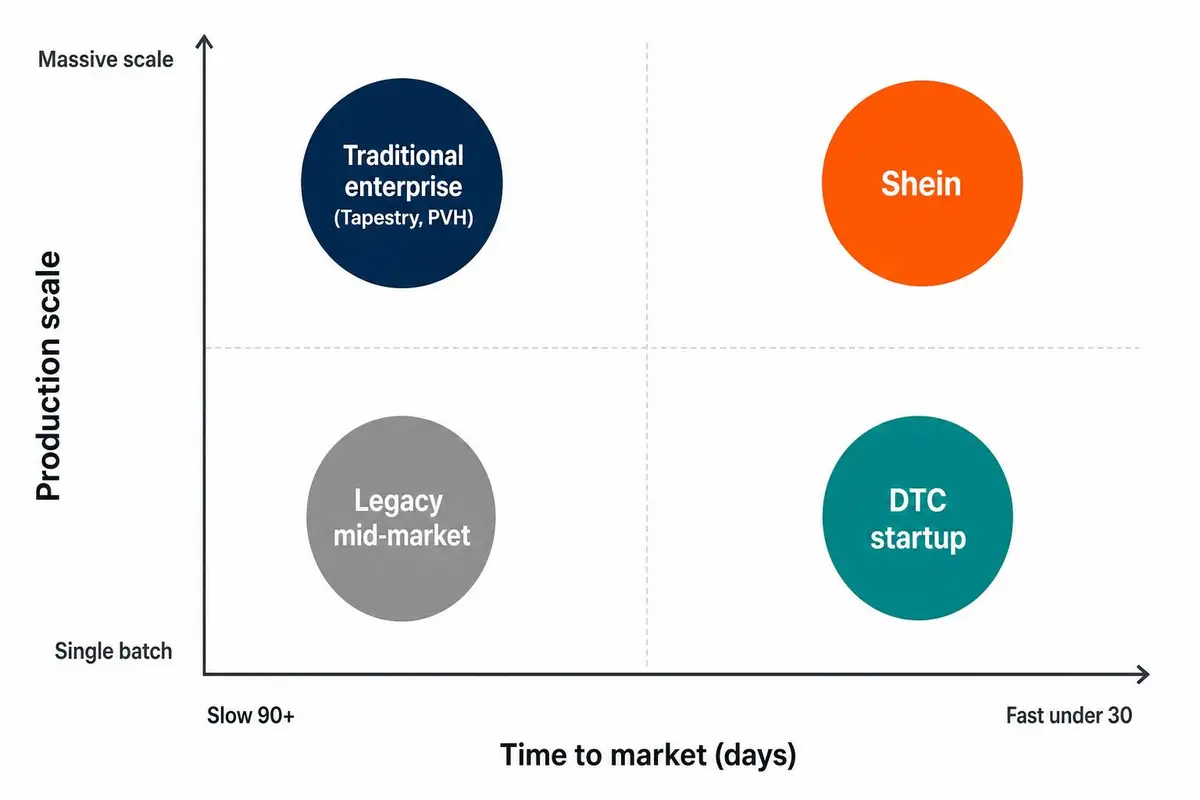
Understanding the differences in operational models highlights where enterprise brands have an opportunity to improve without changing their core business.

The F* Word provides the "Autonomous Pre-production Engine" described in component three. It is a targeted AI solution built to solve the largest bottleneck in the enterprise fashion workflow: the creation of tech packs and moodboards.
It is important to understand what The F* Word is not. It is not a PLM system. It integrates with your existing PLM, feeding it perfect, complete data. It is not a 3D simulation tool like Browzwear or Clo3D. It can include outputs from those tools in its tech packs, but it does not create the 3D assets. It is not a generative AI for creating marketing images. The F* Word is an operational tool for your product and production teams.
Its function is specific. Your designers provide a creative starting point, like a Pinterest board, a collection of runway images, or a textual description. The F* Word's AI agent then:
By automating these steps, The F* Word reduces the tech pack creation process from over a week to under 10 minutes. This allows your technical designers to move from data entry clerks to strategic quality controllers, using their expertise to refine the AI's output rather than starting from a blank page.
Adopting this technology does not require a massive organizational change. It can be done in a measured, phased approach that proves its value at each step.
Enterprise brands can realistically cut their 180-day average cycle down to 90 or even 60 days. The biggest gains are not from changing suppliers, but from eliminating white space and manual work in the pre-production phase. Automating tech packs alone can remove 2-3 weeks from the timeline. Faster internal decision-making on design, enabled by quicker sample turnaround, removes several more weeks.
No. Shein bypasses the need for a traditional PLM because its proprietary Manufacturing Execution System (MES) is directly integrated with its suppliers. The MES acts as a live, operational database and order management system. For an enterprise brand, the PLM remains essential as the system of record for product IP, but it can be made much more efficient with an AI agent feeding it data.
A tech pack agent is a specialized AI tool that autonomously generates production-ready tech packs. You provide it with creative inputs (images, text prompts). It then queries connected data sources (like your past styles in PLM) to determine the correct materials, construction techniques, and measurement specifications. It writes the entire document, turning a multi-day manual task for a technical designer into a minutes-long automated process.
Yes. The key is that this is not an all-or-nothing IT overhaul. You are not buying a new ERP. You are adding a targeted, software-as-a-service (SaaS) tool that solves a specific, expensive bottleneck. The ROI is direct and easy to calculate: hours saved by technical designers, reduced sampling costs, and the commercial upside of faster speed to market. The cost of the software is minor compared to the cost of delay and excess inventory.
The operational playbook of the last decade will not work for the next. The tools to build a faster, more intelligent, and more profitable product creation process exist. By focusing on automating pre-production bottlenecks, you can achieve new levels of speed and efficiency without sacrificing the brand and quality your customers expect. See how The F* Word's autonomous agents can remove weeks from your product development timeline.
Related: ai in fashion retail
The specification loop. The F* Word produces a factory-ready tech pack in 8 to 10 minutes with validated BOM and points of measure, which is what makes small-batch testing viable without adding technical design headcount.
Get The F* Word workflow insights in your inbox.