

Fewer than 10% of fashion brands possess product data structured enough to support true agentic AI workflows. While social media is flooded with AI-generated concept apparel, the industry's operational backbone remains untouched by this technology. The popular discourse focuses on creating novel images, a task that, while visually interesting, offers little tangible value for a product-based business. The real opportunity is not in generating more ideas but in accelerating the path from a selected idea to a market-ready product. To achieve this, AI needs to graduate from being a creative novelty to a core operational tool. This transition is impossible without a foundation of clean, structured, and accessible product data. AI agents, unlike their image-generating counterparts, do not just see pixels; they need to understand attributes, constraints, and commercial history to perform meaningful work. Without this data, they are flying blind.
The current conversation around AI in fashion is disproportionately focused on text-to-image generation. Founders and designers are shown tools that can produce an endless stream of photorealistic jackets, dresses, and sneakers based on a simple prompt. This has created a perception that AI's primary role is to act as a digital mood board or an entry-level concept artist. This framing is a critical miscalculation. It addresses the easiest part of the fashion lifecycle, ideation, which is rarely the primary bottleneck for established brands. Brands are not short on ideas; they are constrained by development timelines, sampling costs, and the risk of producing goods that do not sell.
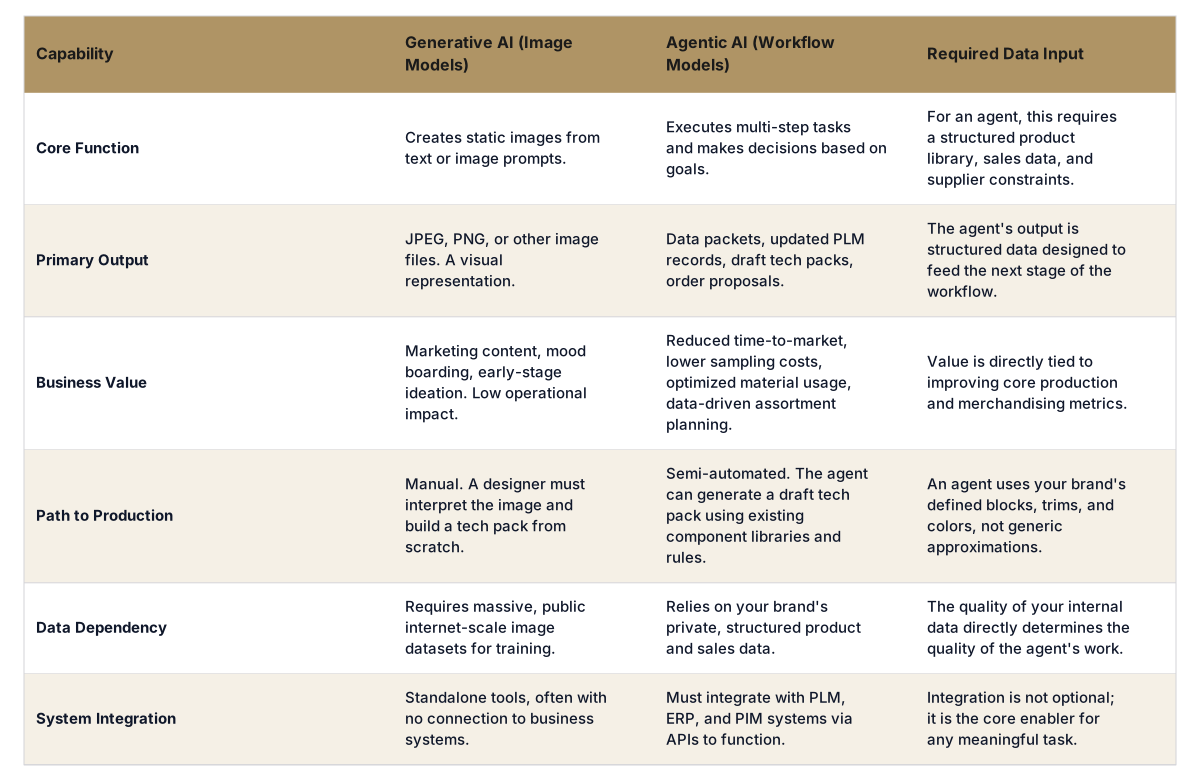
An AI that only produces a JPEG image solves none of these core business problems. The output is a dead end. It cannot be directly converted into a technical specification. It contains no information about fabric composition, weight, construction, or grading. It does not understand your brand's block library, cost targets, or supplier capabilities. In short, it is a creative asset, not a production asset. An AI agent, by contrast, is designed to perform tasks and make decisions within a specific business context. It could, for example, be tasked to "Generate three variations of our bestselling SKU#9401-B hoodie for the FW25 collection, using only approved fabrics from Supplier X, with a target margin of 65%, and ensure the design is compatible with Factory Z's flatlock stitching machinery." This is an operational task, not a creative one. Fulfilling it requires deep, structured knowledge of the product, supply chain, and commercial performance, which a simple image generator completely lacks.
Table 1: Comparing the capabilities and requirements of generative AI image models against true agentic AI workflow systems.
Workflow buyer? Get tech packs and moodboards your team will use.
The F* Word generates brand-aligned moodboards and factory-readable tech packs and plugs into your PLM. See it run on your own product. Free to try.
The term "structured data" can feel abstract. For a fashion brand, it translates into a highly specific and granular system of product information management. An AI agent cannot operate on vague descriptions like "a navy blue women's blazer." To be effective, it needs a database where that blazer is broken down into its fundamental components, or atoms. This is the difference between a simple product listing and a true digital twin.
Production-ready data includes, at a minimum:
Without this four-part data structure, any "AI agent" is merely a conversational interface layered on top of a standard image generator. It can talk about tech packs, but it cannot create a real one because it lacks the underlying knowledge of what goes into them.

As you evaluate software claiming to offer AI agents in fashion, you must be prepared to look past the slick interface and ask hard questions about data integration and workflow utility. The marketing will show you beautiful images. Your job is to ask what happens next. Use this framework to separate viable production tools from creative toys.
Ask any potential vendor the following questions:
A vendor's inability to provide specific, confident answers to these questions is a clear signal that their tool is optimized for concept generation, not for production workflow. A real agentic system is built on a reliable data architecture first and a user interface second.
The task of structuring your product data can seem monumental, especially for brands with years of disorganized archives. However, the process can be broken down into manageable steps. The goal is not to have a perfect system overnight, but to build a solid foundation for future AI implementation.
Step 1: Audit Your Current Data.
Before you can build a new system, you must understand the old one. Identify where all product-related information currently lives. This often includes a mix of PLM software, shared spreadsheets, ERP records, Dropbox folders with images, and even designers' personal notebooks. Map out the current, fragmented flow of information from concept to production.
Step 2: Define Your Core Data Schema.
You do not need to track 500 attributes for every product on day one. Convene a team of designers, product developers, merchandisers, and data analysts to define the most critical 50-100 attributes. This "Minimum Viable Schema" should cover the essentials: basic category information, key construction details, full fabric composition, and core fit blocks. Standardize the naming conventions. For example, decide if it is `Cotton` or `100% Cotton`, and enforce it.
Step 3: Establish a Single Source of Truth.
All product data must live in one central, accessible location. For most brands, this will be a modern PLM or PIM system. The key is to eliminate data silos. If your team is still using spreadsheets to manage the development process, migrating to a centralized platform is a prerequisite for any serious AI initiative.
Step 4: Begin the Backfill Project.
This is the most labor-intensive step. You must dedicate resources to tagging past collections according to your new schema. Start with your most recent two to three years of products, as this data is most relevant for trend and performance analysis. While tedious, this process creates the historical dataset that AI agents need to learn your brand's DNA and commercial patterns. This investment in data cleaning will pay for itself many times over in improved AI performance.
Step 5: Pilot a Single Agentic Task.
Do not try to automate your entire design-to-production pipeline at once. Start with a contained, high-value task. For instance, use an AI agent to analyze past sales data and suggest a color palette for the upcoming season, optimized for your bestselling categories. Or task it with creating carryover style suggestions from your core product line. Proving the value on a small scale will build momentum and justification for broader implementation.
The journey to using true AI agents in fashion is a data strategy project first and a technology project second. Brands that invest in building this structured data foundation today will be the ones who can actually deploy AI to build better products, faster and more profitably, tomorrow.
The future of AI in fashion is not about replacing designers. It is about equipping them with intelligent tools that handle the repetitive, data-heavy tasks of production, freeing them to focus on what matters most: creativity and innovation. That future is only accessible to those who do the foundational data work. Start free at thefword.ai or book a demo.
Vendors keep selling the wiring. The MCP server, the agent node, the API integration, the workflow orchestration layer. None of it produces a factory-ready output if the brand's product data underneath is unstructured. An AI agent calling an empty PLM returns the same empty PLM. A workflow node fed a free-text bill of materials returns a free-text bill of materials. The wiring is real, the value is conditional.
The table below maps the wiring layer against the product data layer for the five workflows most teams want to automate.
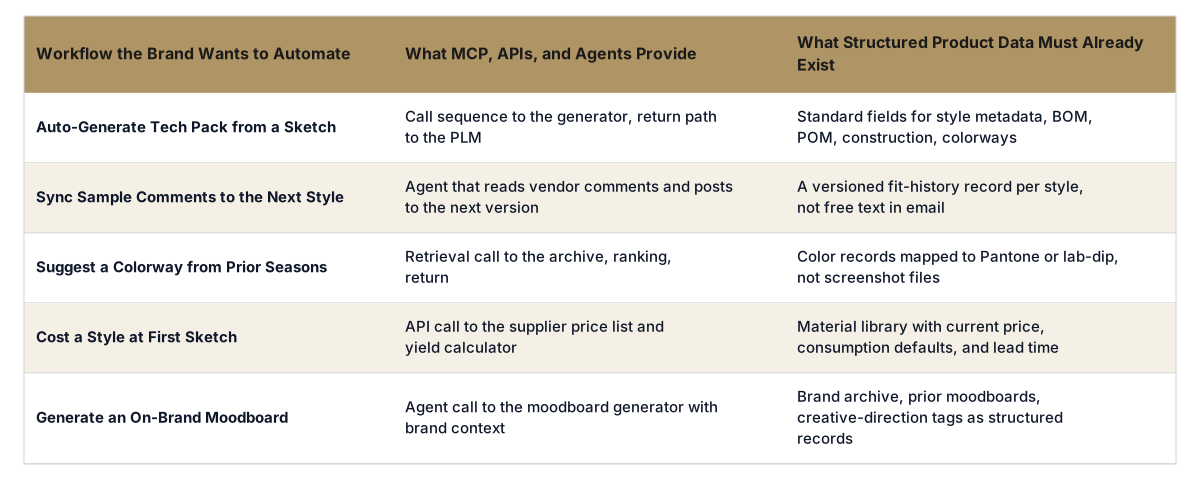
The pattern is the same in every row. MCP and APIs move data. They do not create it. Brands that buy the wiring first and ignore the data layer end up with faster ways to ship incomplete specs. The F* Word produces structured tech packs and moodboards from the brief, so the data the agents need exists before the agents are wired in. For the enterprise view, see the enterprise pillar and the sibling on agentic vs generative AI in fashion.
A standard AI model, like an image generator, performs a single, specific task in response to a prompt. An AI agent is a more advanced system that can take on a goal, break it down into multiple steps, use various tools to execute those steps, and make decisions along the way. It is the difference between an artist who paints a picture and a studio manager who plans and executes the entire production process.
No, it is never too late. The key is to not get overwhelmed by the scale of the problem. Start today by defining a core data schema for a single product category, like denim or knitwear. Focus on structuring all new products correctly from this day forward and then strategically backfill your most important historical products. Progress is more important than perfection in the early stages.
The cost varies widely. A subscription to a SaaS platform with agentic features might run from a few hundred to several thousand dollars per month, depending on the number of users and complexity. The primary "hidden" cost, however, is the internal labor required to clean, structure, and maintain your product data. This internal data readiness work is often a more significant investment than the software itself.
AI can certainly assist in the data structuring process. Modern AI models are good at extracting information from text, classifying images, and suggesting tags. However, they cannot do it without human direction. You must first provide the AI with a clear, defined data schema and the business rules it needs to follow. The most effective approach is a partnership where AI does the heavy lifting of tagging, and human experts review and correct its work.
Book an enterprise walkthrough
Related: ai agents in fashion
Get The F* Word workflow insights in your inbox.