
English
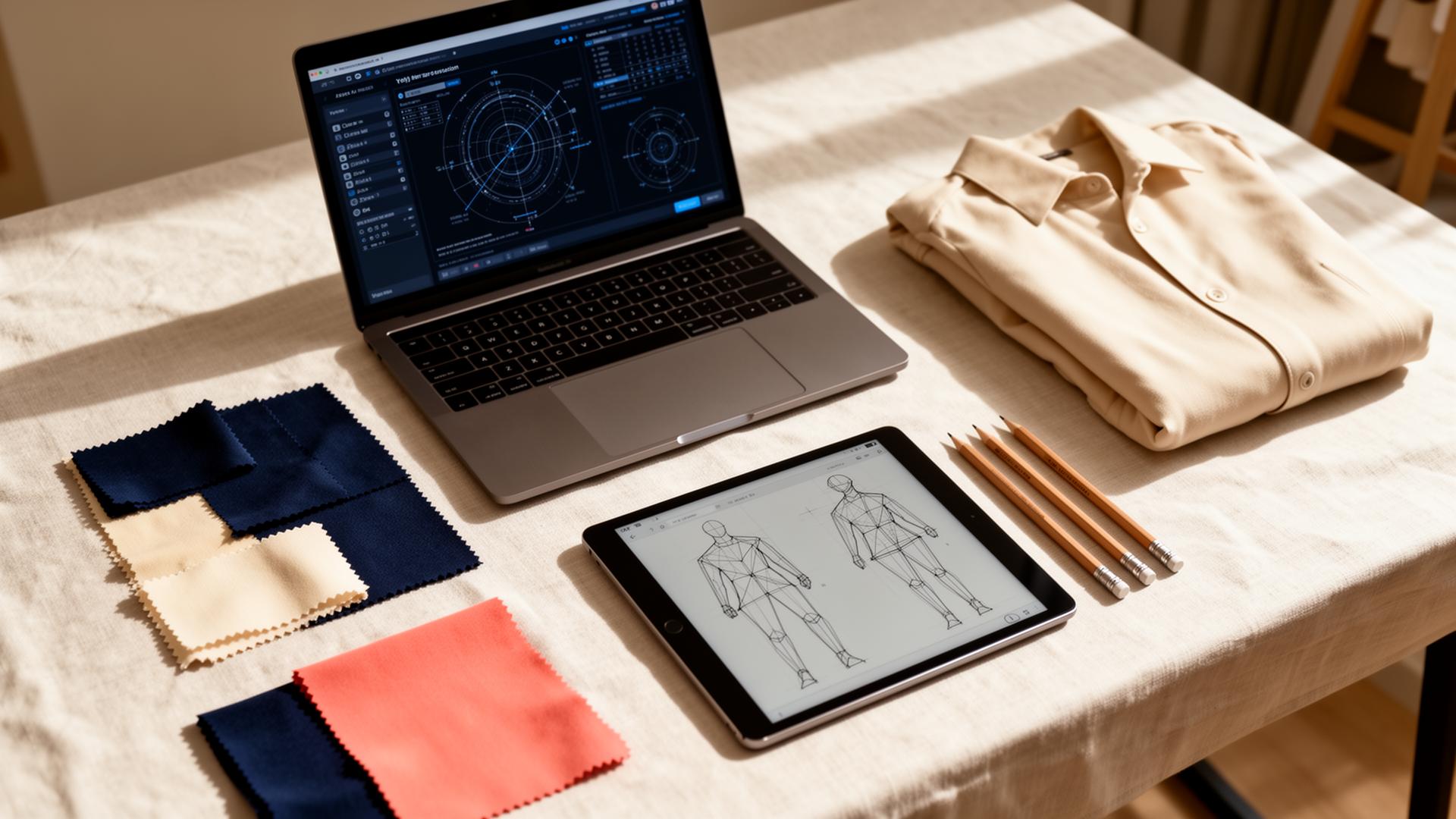
TL;DR. Tech pack generation software uses AI to automate the creation of detailed manufacturing instructions, moving far beyond traditional manual methods and basic digital tools. Modern platforms autonomously generate comprehensive tech packs from a single design input, including graded measurement charts, bill of materials (BOM), construction details, and Points of Measure (POM). Key benefits include a dramatic reduction in manual errors, accelerated pre-production timelines, and standardized communication with factories. Advanced systems like The F* Word act as a workflow orchestration layer, generating the tech pack and creating a corresponding moodboard, validating design intent against production realities, and ensuring brand consistency from concept to final garment specification.
The technical package, or tech pack, has always been the single source of truth for garment production. It is the blueprint that translates a creative vision into a tangible product. Historically, this critical document was a purely manual artifact. Technical designers would spend countless hours handwriting spec sheets, physically attaching fabric swatches, and drawing construction diagrams. This process was laborious, prone to significant human error, and created immense challenges in version control, especially when communicating with factories across different continents. A single misplaced decimal in a measurement chart could result in thousands of dollars in wasted samples and production delays.
The first digital shift moved tech packs into spreadsheets and graphic design programs. This offered some improvements in legibility and ease of duplication, but the core process remained manual. Product Development Managers and Technical Designers still copied and pasted data, increasing the risk of inconsistencies. A change in a sleeve length required manual updates across multiple documents: the main measurement spec sheet, the grading rules, and potentially the cutting markers. Legacy Product Lifecycle Management (PLM) systems provided a more structured database for this information but were often cumbersome, requiring extensive data entry and lacking true automation.
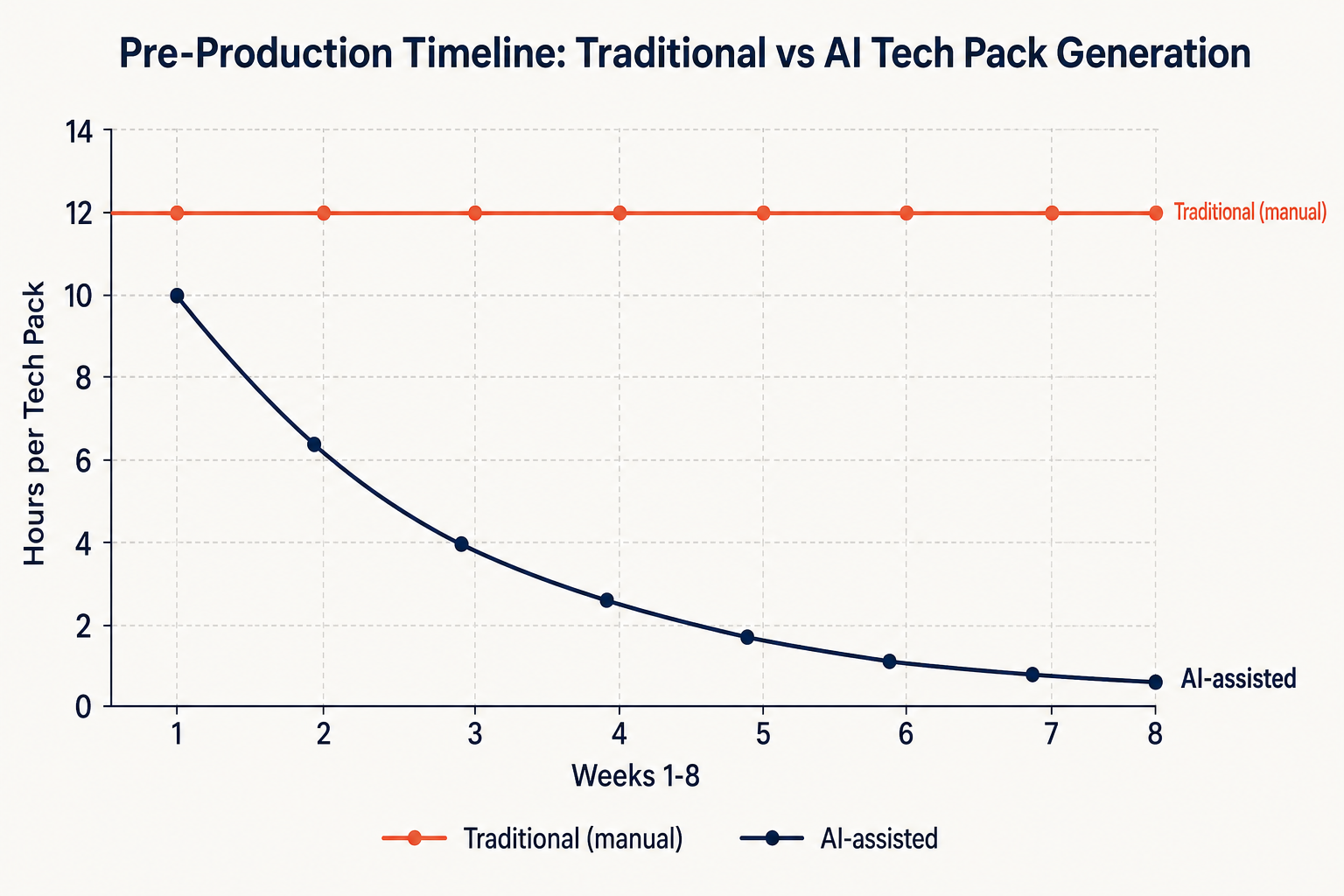
The latest evolution is the integration of AI and true automation into tech pack creation. This marks a fundamental shift from tools that simply store information to systems that actively generate it. AI-powered software can now interpret a design sketch or a 3D model, identify components, suggest construction methods, and populate an entire tech pack automatically. This is not just about filling fields faster. It is about an intelligent system that understands the relationships between design, materials, and manufacturing, creating a factory-ready spec in minutes, not days. This frees up technical and creative teams to focus on innovation and quality, not data entry.
Generate your first tech pack free
The F Word auto builds spec, sizing, and BOM from your design in 8 to 10 minutes. No template wrangling, no factory back and forth.
AI-powered tech pack generation software represents a new category of tools designed to autonomously create, validate, and manage the technical specifications for apparel production. At its core, this software uses machine learning models trained on vast datasets of garments, patterns, materials, and production standards. Unlike traditional PLM systems which function as databases requiring manual input, AI generators actively produce the content of the tech pack based on high-level creative inputs such as a moodboard, a simple sketch, or a 3D asset from Clo or Browzwear.
The fundamental mechanism involves AI automating previously manual, knowledge-intensive tasks. For example, an AI can analyze a 2D fashion flat and automatically generate a complete Points of Measure (POM) chart with industry-standard base size measurements and grading rules for a full-size run. It can identify the need for specific trims and findings, populating the Bill of Materials (BOM) by suggesting appropriate zippers, buttons, and threads from a connected material library. This process eliminates the tedious work of looking up codes and specifications, drastically reducing the chance of manual error.
The primary benefits are significant for fashion brands. Speed is the most immediate advantage, reducing tech pack creation time from days or weeks to mere minutes. This directly accelerates the entire product development calendar. Accuracy is another critical benefit, as the AI can cross-reference all a garment's specifications to flag inconsistencies, such as a zipper length that doesn't match a placket opening, before the tech pack is ever sent to a factory. This standardization ensures that every tech pack, regardless of the designer who initiated it, adheres to the brand's quality and construction standards, leading to fewer sample rounds and clearer communication with manufacturing partners.
When evaluating tech pack generation software, teams must look beyond basic data entry and focus on features that provide true automation and intelligence. A key capability is automated CAD and sketch interpretation. The system should be able to ingest a flat sketch and automatically identify style lines, seam types, and garment components to begin building the BOM and construction callouts. This eliminates the need for a technical designer to manually describe every detail of the design.
Intelligent BOM management is another critical feature. Modern software should not just provide a template for a Bill of Materials; it should actively help build it. This includes using AI to suggest fabrics, linings, and trims based on the garment type, performance requirements, or even historical sales data. An advanced system can connect to digital material libraries, pull exact supplier codes, and even suggest sustainable alternatives that meet the product's cost and quality targets. This turns the BOM from a static list into a dynamic, strategic tool for sourcing and design.
Comprehensive measurement and grading automation are non-negotiable. The software must be able to generate a complete grade rule table for all sizes from a base size measurement chart. Look for systems that can handle complex grading, apply pre-set brand-specific rules, and calculate tolerances automatically. also, strong collaboration and version control are essential. The platform must track every change, show who made it, and allow teams to revert to previous versions. This creates a clear audit trail and prevents miscommunication between designers, technical designers, and sourcing leads. Finally, look for platforms that offer autonomous moodboard generation, linking the initial creative intent directly to the final technical specification, ensuring a cohesive vision from start to finish.
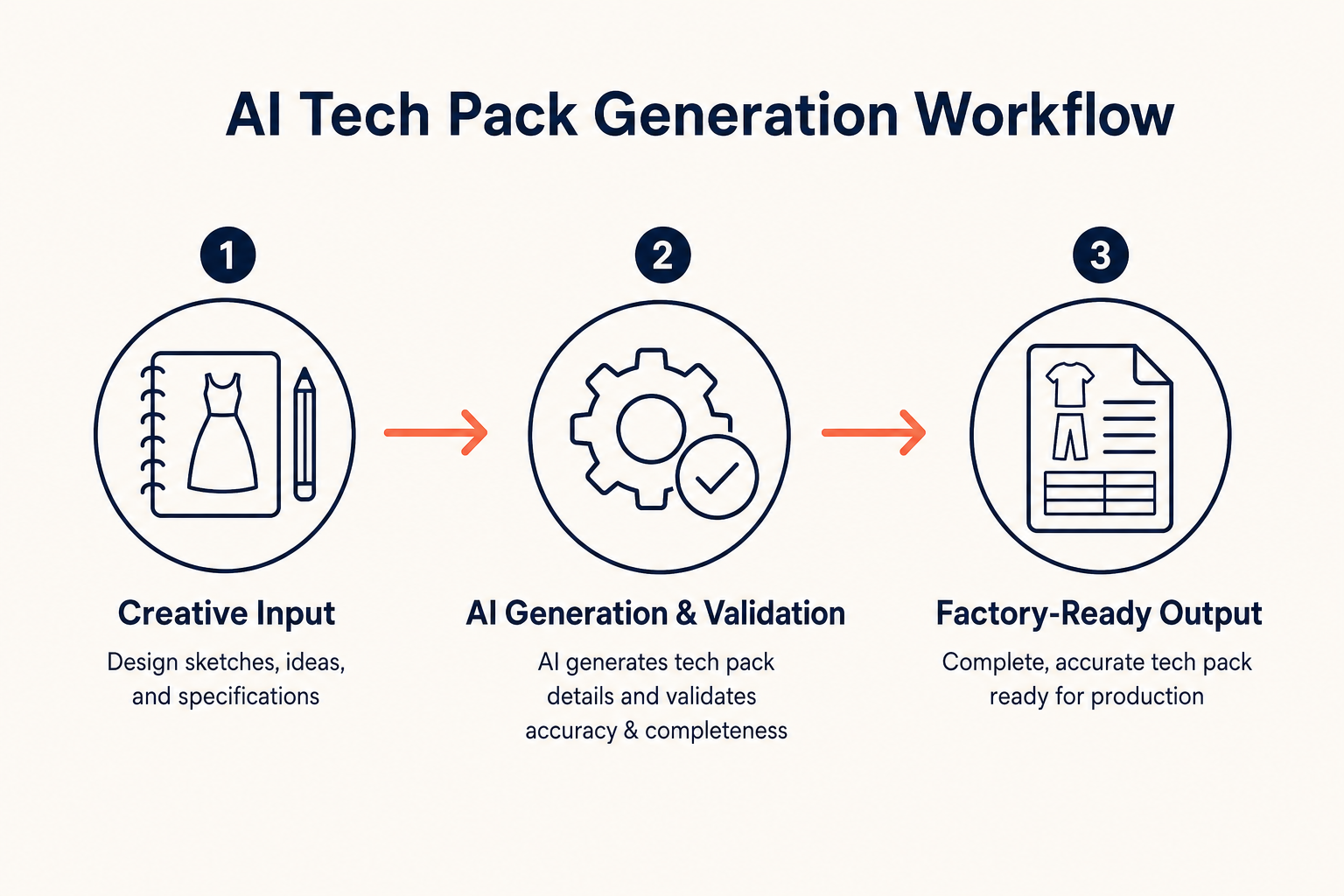
The market for tech pack software spans a wide range of solutions, from traditional manual tools to fully autonomous AI platforms. Understanding the differences is crucial for selecting a system that aligns with a brand's operational goals. Traditional methods, including spreadsheets and basic PLM modules, offer structure but require intensive manual labor. They are highly susceptible to human error and create information silos, making version control and collaboration difficult. While they have a low initial software cost, the hidden costs in labor, errors, and delayed sample rounds are substantial.
AI-assisted software, including advanced PLMs like Centric PLM or specialized design tools, represents a step forward. These systems use AI to help with specific tasks, such as suggesting materials or flagging potential measurement conflicts. They improve accuracy and speed compared to manual methods but still require significant user oversight and input. The user is still driving the process, with AI acting as a co-pilot. This approach is beneficial for teams looking to enhance their existing workflows without a complete operational overhaul, but it does not deliver the full efficiency gains of true automation.
The most advanced category is autonomous generation platforms like The F* Word. These systems are not just assistants; they are workflow engines. They take a creative input and autonomously generate both the visual moodboard and the complete, factory-ready tech pack. This approach fundamentally changes the role of the technical and design teams, moving them from documentation and data entry to validation and creative strategy. By orchestrating the entire pre-production process, these systems offer the highest level of speed, accuracy, and scalability, directly impacting time-to-market and reducing development costs.
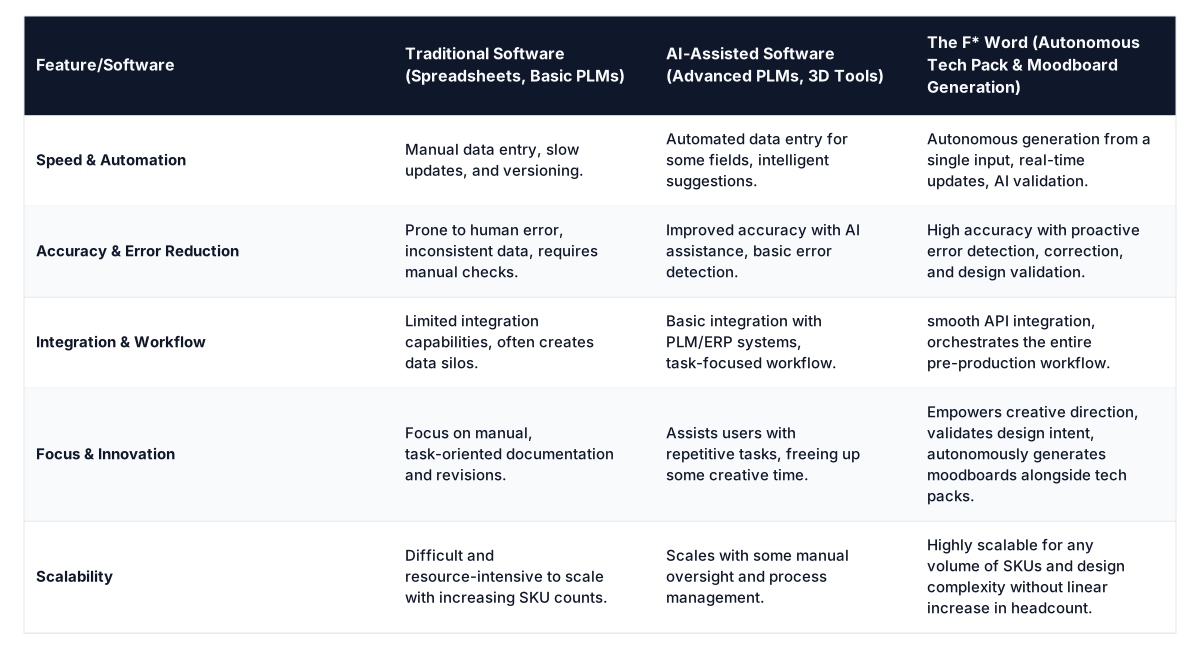
Adopting AI-powered tech pack generation software has a direct and measurable impact on a fashion brand's operations. The primary benefit is a drastic reduction in pre-production lead times. In a typical scenario, a technical designer might spend 8-10 hours building a single, complex tech pack for an outerwear piece. With an autonomous AI system, that same tech pack can be generated in under 15 minutes, needing only a final validation check from the technical designer. This efficiency gain, when multiplied across hundreds of styles per season, allows brands to compress their product development calendars by weeks, enabling quicker responses to market trends.
Cost savings are realized through multiple avenues. First, the reduction in manual errors and inconsistencies leads to fewer, more accurate initial samples from the factory. This minimizes the costs associated with sample yardage, shipping, and rework. A brand might typically go through 3-4 sample rounds to approve a style; with AI-validated tech packs, this can often be reduced to 1-2 rounds. Second, the automation of repetitive tasks frees up highly skilled technical designers and product developers to focus on higher-value activities like fit innovation, quality control, and strategic sourcing, rather than administrative data management.
also, this technology empowers creative teams. Designers can iterate on ideas more freely, knowing that the technical documentation can be generated almost instantly. They can use AI tools to quickly visualize how a creative concept on a moodboard translates into a producable garment. This tight coupling of creative vision and technical execution ensures that the final product remains true to the original design intent, a common challenge in conventional workflows where details are often lost in translation between the design studio and the factory floor.
The role of AI in fashion pre-production is set to expand far beyond just tech pack automation. The future lies in creating a fully connected, predictive, and intelligent workflow from concept to consumer. We are moving toward systems that use predictive analytics to inform design and development decisions before they are even made. For instance, an AI could analyze real-time supply chain data and automatically suggest alternative materials in a BOM if the primary choice faces potential shipping delays or price volatility, helping sourcing leads mitigate risk proactively.
Personalization at scale is another frontier. AI will enable the dynamic generation of tech packs tailored for small-batch or on-demand production. A customer could make minor modifications to a design online, and an AI system would instantly generate a unique tech pack for that single unit, complete with adjusted measurements and material callouts. This allows brands to offer customized products without the prohibitive overhead of manual technical design for each variant, bridging the gap between mass production and bespoke tailoring.
The F* Word is positioned at the center of this evolution, acting as the essential orchestration and validation layer. Our platform does not just create artifacts; it manages and optimizes the entire workflow. By autonomously generating both the moodboard and the tech pack, we ensure a direct, unbreakable link between creative intent and production reality. The system validates the design against manufacturability constraints, cost targets, and brand standards in real time. This ensures that every product conceived is a product that can be made efficiently and profitably, making The F* Word the central nervous system for modern, agile fashion brands.
Selecting the appropriate tech pack generation software requires a careful assessment of your brand's specific needs, scale, and long-term strategic goals. For small brands or startups developing a limited number of styles per season, a simpler, AI-assisted tool might suffice to bring more structure and speed to their process. However, the key consideration should be scalability. If the brand plans to grow its SKU count significantly, choosing a solution that can handle increasing complexity without a linear increase in workload is critical.
For mid-to-large brands managing hundreds of styles, the most important factor is integration and workflow orchestration. The software must be able to communicate with existing systems, especially the cornerstone PLM (like Centric or FlexPLM) and ERP platforms. Look for solutions with strong APIs that allow for a smooth flow of data, preventing the creation of new information silos. The goal is to build an ecosystem where the AI tech pack generator acts as the engine, populating the PLM system of record with accurate, validated data, not replacing it entirely.
Ultimately, the decision should be driven by ROI and strategic value. Calculate the cost of your current process, including the hours spent on manual tech pack creation, the costs of sample rework, and the financial impact of production delays. Compare this to the potential gains from automation in speed-to-market and error reduction. A platform like The F* Word, which offers autonomous generation and workflow orchestration, provides a higher initial investment but delivers exponential returns by transforming the entire pre-production operating model, empowering teams to focus on growth and innovation.
A tech pack is a comprehensive document that serves as a blueprint for manufacturing a garment. It includes all the necessary details like flat sketches, a bill of materials (BOM), measurement specifications, grading rules, construction details, and label placement. It is crucial because it ensures clear, standardized communication between the brand and the factory, minimizing misunderstandings and errors. A precise tech pack is the foundation for accurate samples and consistent bulk production, directly impacting product quality and cost.
AI improves the tech pack process by automating time-consuming and error-prone tasks. It can analyze a design sketch to automatically generate Points of Measure (POMs), create a full grading table, and populate the Bill of Materials (BOM) with suggested components. AI also acts as a validation layer, cross-referencing all data points to flag inconsistencies, such as conflicting measurements or incorrect trim specifications, before the tech pack is sent to production. This dramatically increases speed, accuracy, and standardization.
Yes, leading AI tech pack software is designed for integration. Through APIs (Application Programming Interfaces), these platforms can connect with existing enterprise systems like Product Lifecycle Management (PLM) software (e.g., Centric, FlexPLM), ERP systems, and 3D design tools (e.g., Browzwear, CLO). This ensures that the autonomously generated tech pack data cleanly populates the brand's central system of record, enhancing the existing tech stack rather than creating data silos. This connectivity is key to building an efficient, end-to-end digital workflow.
The most common challenges with traditional tech pack creation are human error, slowness, and inconsistency. Manual data entry across spreadsheets and disconnected documents often leads to typos in measurements or incorrect material codes, resulting in costly sample rework. The process is incredibly time-consuming, creating bottlenecks in the product development calendar. also, without a standardized system, tech packs created by different team members can vary in format and detail, causing confusion for factory partners and inconsistent final products.
The F* Word differs by being an autonomous workflow orchestration platform, not just a task-automation tool. While other generators may assist in filling out a tech pack, our platform takes a creative input and autonomously generates both the factory-ready tech pack AND the corresponding creative moodboard. It acts as a validation engine, ensuring the design is manufacturable and aligned with brand standards from the very start. It orchestrates the entire pre-production workflow, connecting creative intent directly to technical execution.
Yes, AI tech pack generation is suitable for brands of all sizes, though the benefits may manifest differently. For large brands, the primary value is in scalability, standardization across large teams, and compressing production timelines for hundreds of SKUs. For small brands and startups, AI provides access to expert-level technical knowledge, allowing them to create professional, factory-ready tech packs without a large in-house technical design team. This levels the playing field and enables faster growth.
Ready to eliminate manual errors and cut your pre-production timeline in half? The F* Word is the orchestration layer that turns your creative concepts into validated, factory-ready tech packs and moodboards autonomously. See the pre-production workflow in action and discover how our platform can transform your brand's operations. Explore more insights and strategies on our pre-production workflow software hub.
Related: ai tech pack generator
Get The F* Word workflow insights in your inbox.