.png)
English
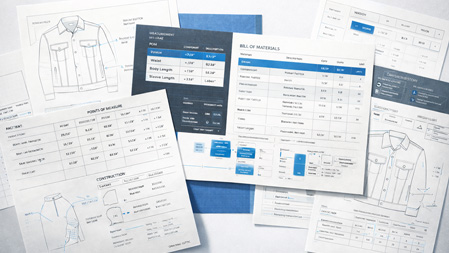
Fashion brands rarely lose because of taste; they lose because execution breaks under variability and inefficiency. The failure pattern is boring and expensive i.e., a measurement table that contradicts the flat, a BOM that never matches what sourcing approved, a last-minute trim swap that never reaches the factory, a “final” PDF that is really v7.2 floating in someone’s inbox.
A real tech pack creator is operational infrastructure. In 2026, teams buy it for three outcomes: fewer sampling rounds, tighter timelines, and less margin leakage from avoidable mistakes.
The winners treat the tech pack as a living contract between design intent and factory execution. They stop thinking of it as a document and start treating it as a system of record with rules.
The teams that struggle do the opposite, they collect templates, export PDFs, and call it “done.” The factory still has questions, and every question is time, cost, and rework.
It shows up in two places i.e., how much ambiguity the tech pack leaves behind, and how fast changes propagate without breaking downstream artifacts.
At minimum, a tech pack creator produces a factory-usable package with:
The baseline is common and the separation comes from whether the tool enforces consistency, catches contradictions, and keeps a clean change trail.
Browzwear’s VStitcher, for example, can generate tech packs off a 3D project, including specs, materials, and patterns tied to that garment state, with an editor for updates. Read more here.
AI helps when it reduces “human glue work,” the hours spent translating between sketches, spreadsheets, emails, and factory interpretation. The useful AI behaviors are concrete:
Style3D markets this as moving from sketches to 3D and into more complete tech pack outputs with auto-populated specs, measurements, and fabric details.
Genpire positions itself around generating factory-ready tech packs from prompts or uploads, then exporting to formats like PDF and Excel, with pricing tied to credits and monthly plans.
The point is not “AI is fast.” AI can draft the first 60% and reduce the error rate in the remaining 40%, if the product is designed for production reality.
Here’s the simplest way I’ve found to separate a serious tech pack creator from a pretty template system.
Execution Entropy is the amount of unanswered, high-impact ambiguity your factory still has after reading the tech pack.
High entropy looks like: “Which seam finish here?”, “Is this measurement pre-wash or post-wash?”, “Which label version?”, “Is this stitch detail mandatory or a suggestion?”, “What changed since last week?”
Low entropy looks like: the factory runs the first sample with minimal clarifications, because the pack is coherent and the deltas are explicit.
You can score Execution Entropy quickly with four checks:
A tech pack creator that reduces Execution Entropy becomes a compounding asset. Every new style inherits better defaults, and every supplier interaction gets cleaner.
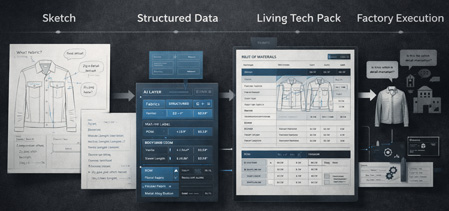
Factories don’t reward creativity in documentation. They reward clarity. Your tech pack creator should enforce units, naming conventions, and standard sections so suppliers stop reformatting your work.
If your supplier keeps rebuilding your pack into their internal template, you are paying twice.
The fastest teams start from category baselines and then apply brand-specific rules. That cuts beginner errors like inconsistent grading steps or missing tolerances.
This is where AI helps, as long as you treat suggestions as drafts and lock decisions with a human accountable for fit and construction.
Production is a multiplayer sport. When a measurement changes, you need to know who approved it, and what else it touched.
This is a place where disciplined follow-through beats speed. In M&A research, high performers consistently prioritize defined plans and measurable definitions of success over rushing activity. The same logic holds here: a fast process that produces confusion is slower in the end.
A modern tech pack creator should treat BOM as first-class, not an attachment. Fabrics, trims, packaging, thread, and cost. You want visibility before sampling locks decisions.
Some platforms explicitly position “unified workflow” between design, tech packs, and manufacturing outputs.
Factories live on PDFs, spreadsheets, and what their PLM or internal systems can ingest. Your tech pack creator must export cleanly, consistently, and repeatably.
The F* Word, supports generating and configuring tech packs from completed simulations.
Assume a DTC brand ships 30 styles per season.
If a tech pack creator reduces sampling by one round on 40% of styles (12 styles), the direct savings are:
If you pull forward delivery by even 10 days, you reduce late-season discounting pressure. For brands living on tight margins, it can exceed the sample savings.
Tech pack creation costs vary a lot. You see freelancers quoted anywhere from a few hundred dollars per style into four figures depending on complexity and service level.
AI-native tools often price as subscriptions or credits, which shifts spend from per-style labor to throughput capacity.
Early-stage brands get legitimacy fast. They stop “winging it” and start speaking factory language consistently.
Scaling DTC brands get repeatability. SKU growth increases surface area for errors, and manual duplication turns into compounding inconsistency.
Larger brands get institutional memory. A tech pack creator becomes a centralized system that survives team turnover and supplier churn.
The mistakes that keep showing up
Buy based on execution metrics, not pretty screens and ask four questions:
If you want a reference point on how AI tech pack generators are compared, The F* Word has published a 2026-oriented comparison piece that frames trade-offs across tools and workflows.
Run a 30-day pilot with a hard scoreboard:
A tech pack creator earns its keep when the factory spends less time asking questions and more time building the garment you intended. That is what “best” means in 2026.
For practical workflows and templates, check out related guides on The F* Word:
• AI Tech Pack Templates: What’s Standard, What’s Smart, What’s Next — foundational insight into how tech pack creation is evolving.
• Best AI Tech Pack Generators 2026: The F Word vs Competitors* — detailed comparison of tools and workflows.
101 People Reading our Newsletter Right Now!
