
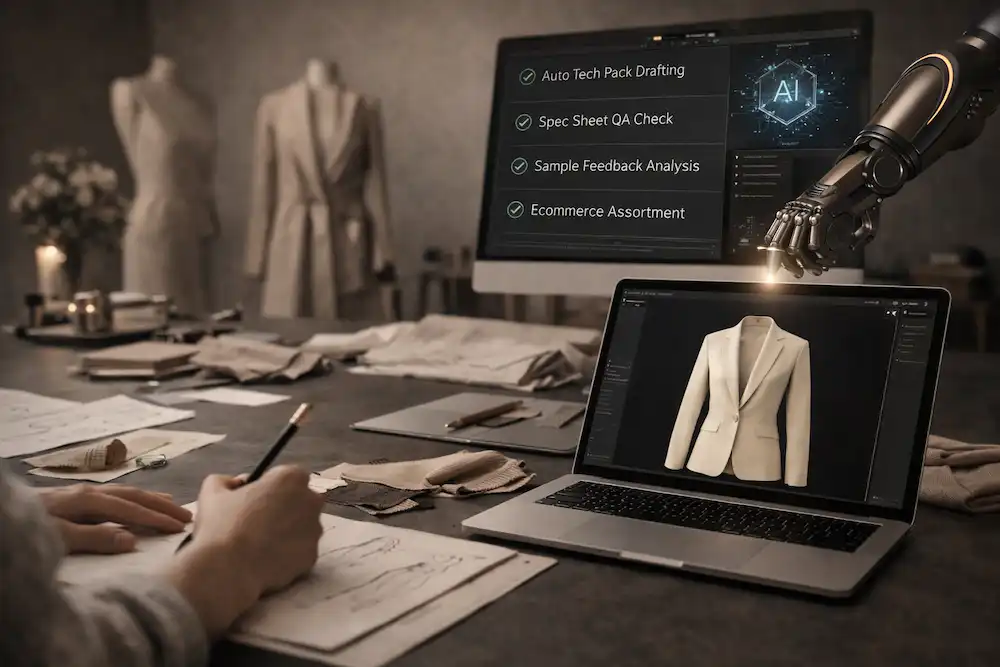
AI changes fashion GTM when it compresses product decisions, not when it creates more disconnected content. The winning workflow connects trend, design, production readiness, and launch.
This shift moves brands away from siloed departments and lossy information transfers between design, development, and merchandising. This post explains how specific AI tools connect stages from concepting and virtual sampling to pre-production approvals and tech pack generation. We will cover how this integrated workflow provides the data foundation for more accurate demand forecasting, reducing overproduction and accelerating a product’s final go-to-market plan.

The traditional fashion calendar operates on a waterfall model: a series of distinct, siloed stages. A designer ideates, a technical designer translates, a factory interprets, and a marketer sells, often with little cross-functional data flow until it's too late. A fit issue discovered during the sampling stage sends the process back weeks, if not months. A marketing campaign built around a product that is ultimately delayed or altered creates a jarring disconnect. This friction-filled system is where margin, time, and creative intent are lost.
AI introduces a new paradigm: an integrated, iterative, and data-driven workflow. Instead of a linear relay race, think of it as a central hub where all functions, design, product development, merchandising, and marketing, can collaborate around a single, evolving digital twin of the product. This isn't about replacing human creativity; it's about augmenting it with powerful tools that handle the tedious, repetitive, and error-prone tasks that bog down the creative process. It allows designers to test hundreds of ideas in the time it used to take to sketch one. It enables technical designers to generate production-ready specifications directly from a 3D model. And it empowers merchandisers to test virtual products with real consumers before a single yard of fabric is cut. This shift from sequential processing to parallel collaboration is the core of AI’s massive impact on the industry’s GTM strategy.
To truly grasp the scale of this transformation, it’s useful to place the legacy process directly alongside the new, AI-augmented workflow. The differences aren't merely incremental; they represent a complete re-architecting of how fashion gets made and sold. The following comparison breaks down each key stage of the product lifecycle, highlighting the key efficiencies and benefits unlocked by an integrated AI platform.
Comparison: Traditional vs. AI-Augmented Fashion Workflows

Designer or merchandiser? Replace the spreadsheet handoff.
The F* Word generates moodboards, factory-readable tech packs and sampling notes in one workflow, so creative, production and merchandising stay aligned. Free to try.
The table above gives a high-level overview, but the real power lies in the details of each integrated stage. Let's break down how this AI-powered engine works in practice, transforming each traditional bottleneck into a streamlined accelerator.
From Trend Forecasting to Demand Prediction
Legacy trend forecasting relies on a small group of experts interpreting lagging indicators. AI flips this model on its head by analyzing leading indicators from a massive, global dataset. It can scan millions of images on social media to identify emerging silhouettes, colors, and textures. It can scrape e-commerce sites to see which styles are selling out and which are being marked down in real time. The result is a shift from forecasting, guessing what might be popular in 12 months, to prediction, using data to model what specific customer segments will want to buy next season. This allows brands to design directly into market demand, de-risking the entire creative process.
The Iterative Design Loop and 2D-to-3D Synthesis
In the past, a designer might produce a handful of sketches for a new style. With generative AI, they can input a simple prompt, "a cropped, utilitarian jacket in olive green twill with oversized patch pockets", and receive dozens or even hundreds of visual variations in minutes. This isn't just about creating pretty pictures; it’s about exploring the entire design space at scale. The best platforms, like thefword.ai, then take this a step further. They don't just generate a flat image; they understand the fundamentals of what AI fashion design truly is and help translate that 2D concept into a workable 3D model. Designers can instantly apply different fabrics, test prints to scale, and see how the garment drapes on a lifelike avatar, all without leaving their screen. This iterative loop between 2D ideation and 3D validation collapses a multi-week process into a single afternoon.
The Death of the Manual Tech Pack
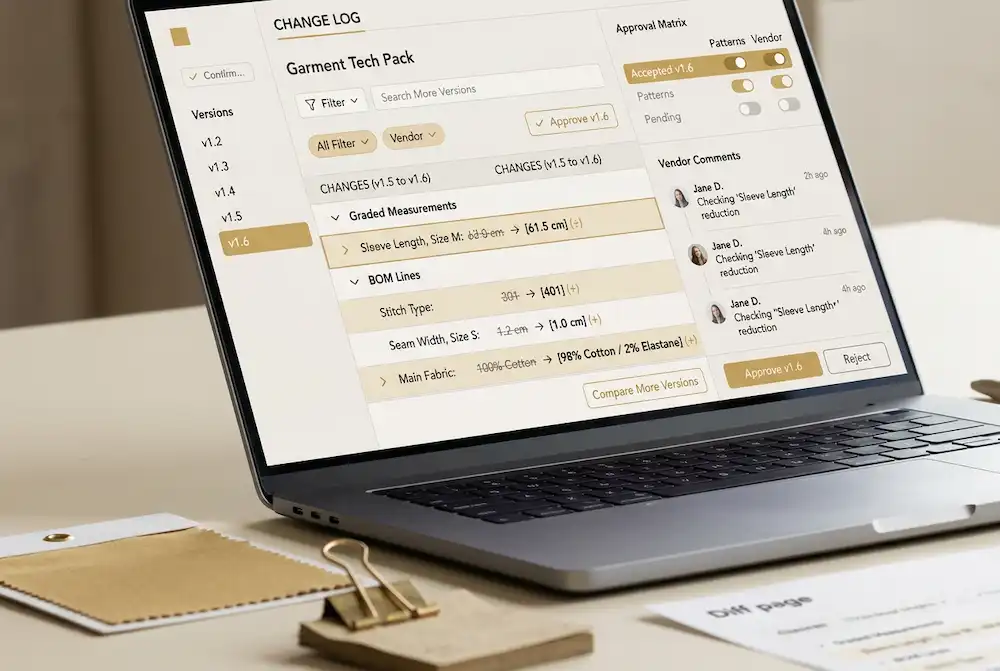
The technical specification package, or tech pack, is the single most critical and error-prone document in fashion. A single incorrect measurement or vague construction note can lead to a disastrously wrong sample, costing thousands of dollars and weeks of delay. AI is making the manual creation of tech packs obsolete. By using the validated 3D model as the "single source of truth," an AI tech pack creator can automatically extract all necessary information: graded measurement charts, point-of-measure diagrams, bill of materials (BOM), construction details, and stitch types. This digital-native document is clean, precise, and universally understood by manufacturing partners, eliminating the ambiguity that plagues traditional tech packs.
Virtual Sampling and GTM Integration
Physical sampling is the industry’s biggest time and money sink. AI-powered 3D simulation all but eliminates it. Using hyper-realistic fabric physics and custom-fit avatars, designers and technical teams can conduct fit sessions virtually, checking for pull lines, improper drape, and measurement issues with startling accuracy. Instead of 3-5 rounds of physical samples, brands can now get to a production-ready fit in one or two virtual sessions, only commissioning a single physical "gold seal" sample for final confirmation. Better yet, these high-fidelity 3D assets are not just for internal use. They become the cornerstone of a modern GTM strategy. They can be used to generate photorealistic imagery for e-commerce sites, social media campaigns, and even virtual try-on experiences, all before the first garment has been manufactured. This allows brands to gauge interest, collect pre-orders, and secure sell-through before committing to a costly production run.
Understanding the potential is one thing; implementing it is another. For brands wondering where to start, a strategic approach is essential. Instead of a boil-the-ocean strategy, focus on creating an "AI flywheel" where initial successes generate momentum for broader adoption.
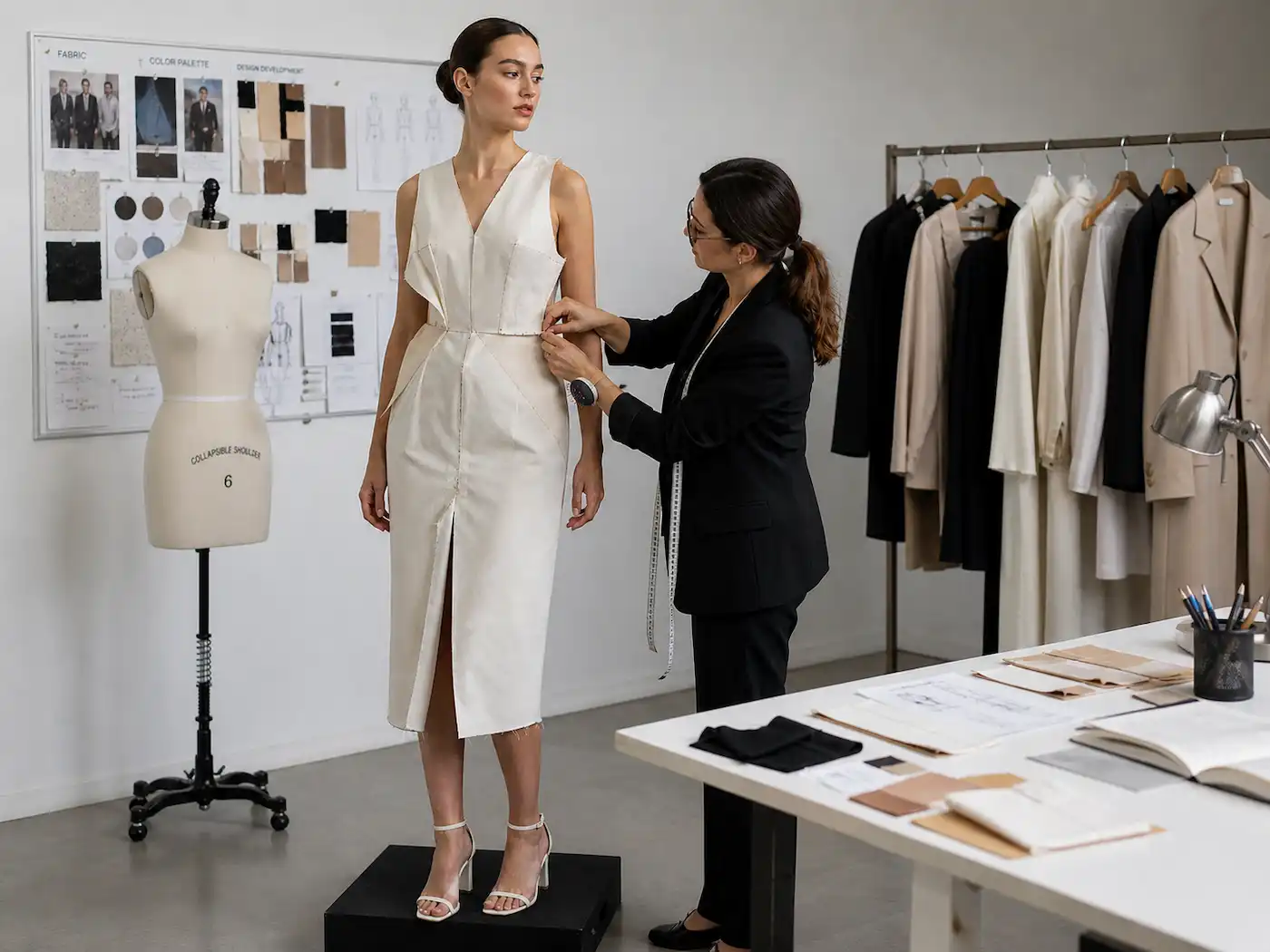
Making the leap requires more than just new software; it requires a new mindset. Here are the foundational steps to begin your journey.
The gap between brands operating on last-century timelines and those using AI is no longer a gap, it’s a chasm. The new GTM playbook isn't a distant future; it's being written today by the brands agile enough to embrace this technological shift. The tools to build faster, smarter, and more sustainably are here. It’s time to integrate them into your GTM engine. Start free at thefword.ai.
No, AI is poised to empower them. It acts as a powerful co-pilot, automating the most tedious and time-consuming aspects of the job, such as creating endless colorways, rendering technical drawings, and formatting tech packs. This frees up designers to focus on higher-level strategic work: brand vision, conceptual thinking, curation, and the fine art of taste-making. The designer's role will evolve from a "doer" to a "director."
While some enterprise solutions can be costly, the landscape is changing fast. Many modern AI platforms operate on a SaaS (Software as a Service) model, making them far more accessible. When you compare a monthly subscription fee to the immense hidden costs of the traditional model, expensive physical samples, wasted fabric, slow time-to-market, and lost revenue from overstock, the ROI for even a small brand can be surprisingly fast.
This is a critical distinction. A simple image generator like Midjourney creates beautiful but "flat" inspirational images. A dedicated fashion AI platform, like thefword.ai, understands the language of apparel production. It creates assets that contain data on construction, patterns, and materials. It's the difference between a pretty sketch and an actionable blueprint that can be used to create a 3D model, generate a technical package, and send instructions to a factory.
AI's impact on sustainability is one of its most significant benefits. The three primary ways it helps are: 1) Drastically reducing waste from physical sampling by replacing it with hyper-realistic 3D prototyping. 2) Enabling more accurate demand forecasting, which leads to smaller, more targeted production runs and less end-of-season overstock that often ends up in landfills. 3) Facilitating the creation of digital assets for marketing, which reduces the carbon footprint associated with large-scale physical photoshoots.
The F* Word Editorial · Fashion workflow team
Written by The F* Word editorial team. We build AI fashion workflow software grounded in thousands of industry-produced tech packs and proprietary garment records, so what reaches the factory is consistent, reviewed, and tied to design intent.
Once the launch is in market, these are the steps that turn one drop into a repeatable system.
Related: apparel software
Get The F* Word workflow insights in your inbox.