

} })
Press enter or click to view image in full size

What Fashion Brands Should Demand From AI Before Sending Anything to a Factory

More than 75% of pre-production delays can be traced directly back to incomplete or inaccurate tech packs. For years, the conversation around AI in fashion has been a gallery of beautiful, impossible garments generated from text prompts. These images are inspiring, but for a head of product or a founder with a purchase order on the line, they are commercially useless. The industry is saturated with digital mood boards masquerading as production tools. This is a critical failure of imagination and engineering. The actual work of fashion does not end with a compelling image. It begins there. The next frontier, and the only one that matters for your bottom line, is turning creative intent into a production-ready workflow that a factory can execute without a dozen rounds of questions and costly sample failures.

The Problem with Pretty Pictures

The current hype cycle focuses almost exclusively on generative image models. These tools are proficient at creating visually arresting concepts based on stylistic prompts. You can ask for a "Gorpcore-inspired utilitarian jacket in the style of a Japanese woodblock print" and receive a stunning render in seconds. But what happens next? The image you have contains zero actionable data for manufacturing. It is a JPEG, not a blueprint. Sending this image to a factory partner is the equivalent of sending a food photo to a chef and expecting a catered meal.

Factories do not operate on aesthetics. They operate on specifications. They need to know the exact fabric GSM, the Pantone color code, the stitch per inch, the zipper supplier, the grading rules for a size run from XS to XXL, and the precise construction sequence for assembly. A generative model, by its nature, cannot provide this. It hallucinates details like seams and closures, but these are artistic interpretations, not technical instructions. Relying on these tools for anything beyond initial ideation introduces a massive information gap in your product development process. This gap is where budgets are broken, timelines are destroyed, and brand-factory relationships are strained. The industry's obsession with AI-generated art distracts from the real, pressing need: AI that does the methodical, unglamorous work of building a factory-ready AI tech pack.

Caption: A side-by-side comparison of features available in typical image generation AI versus a production-focused AI platform. The final column highlights the non-negotiable factory requirement for each feature.
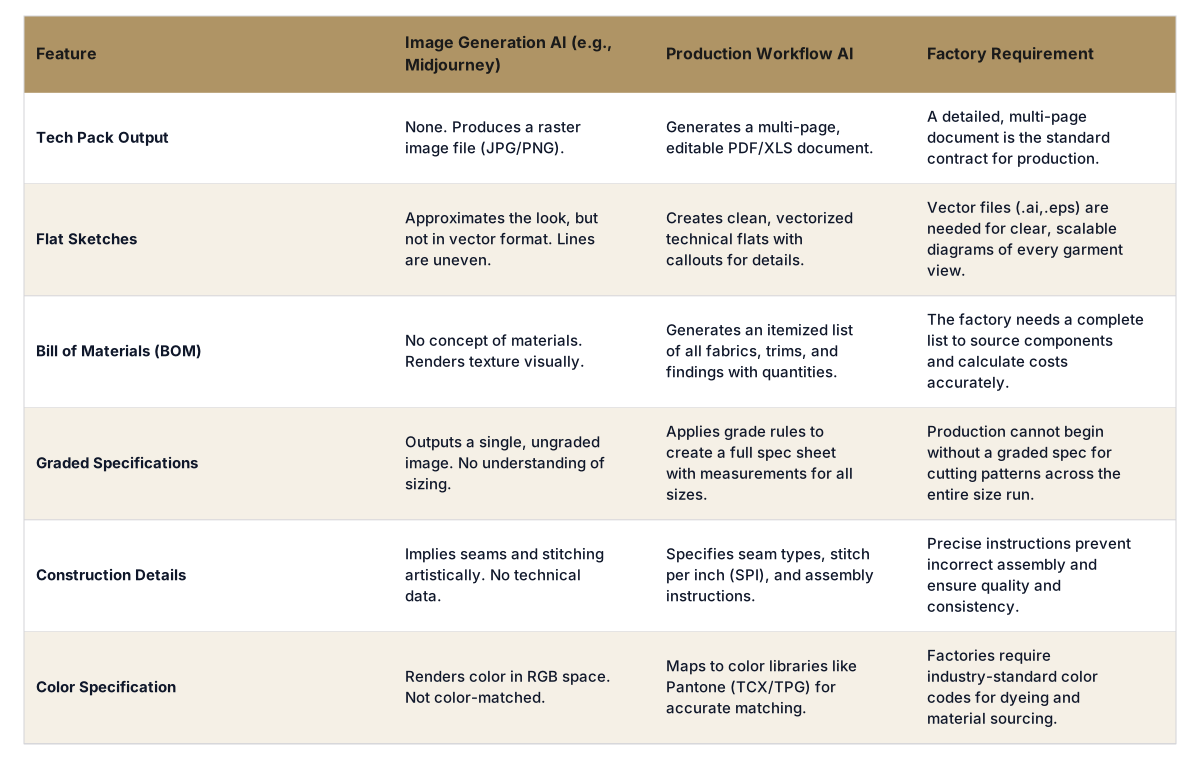
Feature Image Generation AI (e.g., Midjourney) Production Workflow AI Factory Requirement
Tech Pack Output None. Produces a raster image file (JPG/PNG). Generates a multi-page, editable PDF/XLS document. A detailed, multi-page document is the standard contract for production.
Flat Sketches Approximates the look, but not in vector format. Lines are uneven. Creates clean, vectorized technical flats with callouts for details. Vector files (.ai,.eps) are needed for clear, scalable diagrams of every garment view.
Bill of Materials (BOM) No concept of materials. Renders texture visually. Generates an itemized list of all fabrics, trims, and findings with quantities. The factory needs a complete list to source components and calculate costs accurately.
Graded Specifications Outputs a single, ungraded image. No understanding of sizing. Applies grade rules to create a full spec sheet with measurements for all sizes. Production cannot begin without a graded spec for cutting patterns across the entire size run.
Construction Details Implies seams and stitching artistically. No technical data. Specifies seam types, stitch per inch (SPI), and assembly instructions. Precise instructions prevent incorrect assembly and ensure quality and consistency.
Color Specification Renders color in RGB space. Not color-matched. Maps to color libraries like Pantone (TCX/TPG) for accurate matching. Factories require industry-standard color codes for dyeing and material sourcing.
What Fashion Brands Should Demand From AI Before Sending Anything to a Factory

What a Factory-Ready AI Tech Pack Actually Requires

A spec sheet is not a wish list. It is a binding contract between your brand and your manufacturing partner. A factory-ready AI tech pack must contain specific, structured data that leaves no room for interpretation. Anything less is an invitation for error. Here is the minimum viable output you should demand from any AI tool that claims to be built for production.

  1. Vectorized Technical Flats: Your factory needs clean, two-dimensional drawings of the garment's front, back, and any relevant side or interior views. Unlike a stylized 3D render, these flats must be in a vector format (like Adobe Illustrator's.ai files). This allows for infinite scaling without loss of quality. More importantly, it provides a clean canvas for technical callouts pointing to specific details like pocket placements, seam types, and hardware locations.
  2. A Granular Bill of Materials (BOM): The BOM is the recipe for your product. An AI tool must be able to parse an initial design and help generate an exhaustive list of every single component. This includes the self fabric, contrast fabric, lining, pocketing, fusible interfacing, thread, buttons, zippers, labels, and even hang tags. Each entry needs fields for supplier, article number, color code, and consumption per unit. A true production AI helps structure this data, it does not ignore it.
  3. Complete Points of Measure (POM) and Graded Specs: A single sample size is useless for a production run. The AI must generate a full Points of Measure chart, defining how every key measurement is taken. Then, it needs to apply your brand's specific grade rules to automatically calculate the measurements for every other size in the run. If you change a measurement on the base size M, the AI should correctly update the specs for sizes XS through XXL. This automation alone eliminates hours of manual spreadsheet work and prevents costly grading errors. For more on this, our guide to what works in production AI details the importance of dynamic grading.
  4. Actionable Construction and Sewing Details: This is where most AI tools fail completely. A production-ready tech pack must specify *how* the garment is built. This includes defining seam types (e.g., 5-thread safety stitch, single needle topstitch), stitch per inch (SPI), hem allowances and types, and the order of operations for complex assembly. An advanced AI system can infer standard constructions based on garment type (e.g., applying flat-felled seams to a denim jacket) while allowing a technical designer to override and specify every detail.

Without these four core components, your "AI tech pack" is just a prettier version of a hand-drawn sketch. It does not solve the fundamental communication challenges that lead to production errors and delays.

Technical designer? Cut sampling time before first fit.

The F* Word generates the tech packs, BOMs and sampling notes your factory actually needs. Plus a brand-aligned moodboard upstream. Free to try.

Cut your sampling time →

A Decision Framework for Evaluating AI Fashion Tools

When you are evaluating an AI platform, you must cut through the marketing language and ask direct, operator-focused questions. Your job is to determine if the tool creates real production assets or just mood board clutter. Use this framework during your next demo call.

  • Question 1: What are the exact file formats of your final tech pack export?
    If the answer is only JPG, PNG, or a locked PDF, walk away. You need editable, industry-standard formats. A complete export should include a multi-page PDF, an editable XLS or XLSX file for the spec sheet, and associated vector files (.ai,.eps,.dxf) for the flats and patterns.
  • Question 2: Show me how I can input my brand's specific grade rules and block library.
    A legitimate tool will not force you into generic sizing. You should be able to upload your own grade rules or link to your existing block patterns. The AI should adapt to your system, not the other way around. This demonstrates an understanding of how established brands actually operate.
  • Question 3: How does your tool handle version control and collaboration?
    A tech pack is a living document. Changes happen constantly. Ask how the system tracks versions. What happens when a technical designer in New York updates a spec and the merchandiser in Hong Kong needs to see the change instantly? Is there an auditable change log? This is a core function of any serious Product Lifecycle Management (PLM) or pre-production system, and proper AI adoption requires it.
  • Question 4: Can I edit every single field generated by the AI?
    Automation is valuable, but control is essential. The AI should provide a strong first draft, but the human expert must have the final say. You should be able to click into any field, from a POM measurement to a BOM item, and override the AI's suggestion. A "black box" system where the output cannot be fully edited is a liability, not an asset.
What Fashion Brands Should Demand From AI Before Sending Anything to a Factory

Getting Started with Production-Focused AI

Adopting this level of technology does not require a complete overhaul of your operations overnight. The most effective strategy is to start with a focused pilot project. Choose a single core product, perhaps a carryover style like a basic tee or a pair of jeans. Assign a technical designer to create the tech pack using your traditional method. Simultaneously, have another team member build the same tech pack using a production-focused AI platform.

Then, compare the results on three key metrics: total time spent, number of questions from the factory, and first sample accuracy. Measure the hours it takes to create the completed pack. Track every email and message required to clarify details with your manufacturing partner. Finally, evaluate how closely the first physical sample matches the spec. The data from this head-to-head comparison will provide a clear, undeniable business case for whether the tool delivers a return on investment. The goal is not just faster design, but less friction between your creative vision and the finished goods arriving at your distribution center.

The distinction between AI for ideation and AI for production is the most important conversation in fashion tech today. Demanding more from your tools is the first step toward building a more efficient, profitable, and resilient supply chain. Stop asking AI to dream for you. Start demanding that it works for you. Start free at thefword.ai or book a demo.

Factory Release Checklist (Print This, Use It Before Every PO)

Before any tech pack leaves your inbox for a factory, every item on this list needs a yes. If one is missing the factory will either ask, guess, or charge for a revision. All three cost time.

Table 1. Factory release checklist, 14 items.
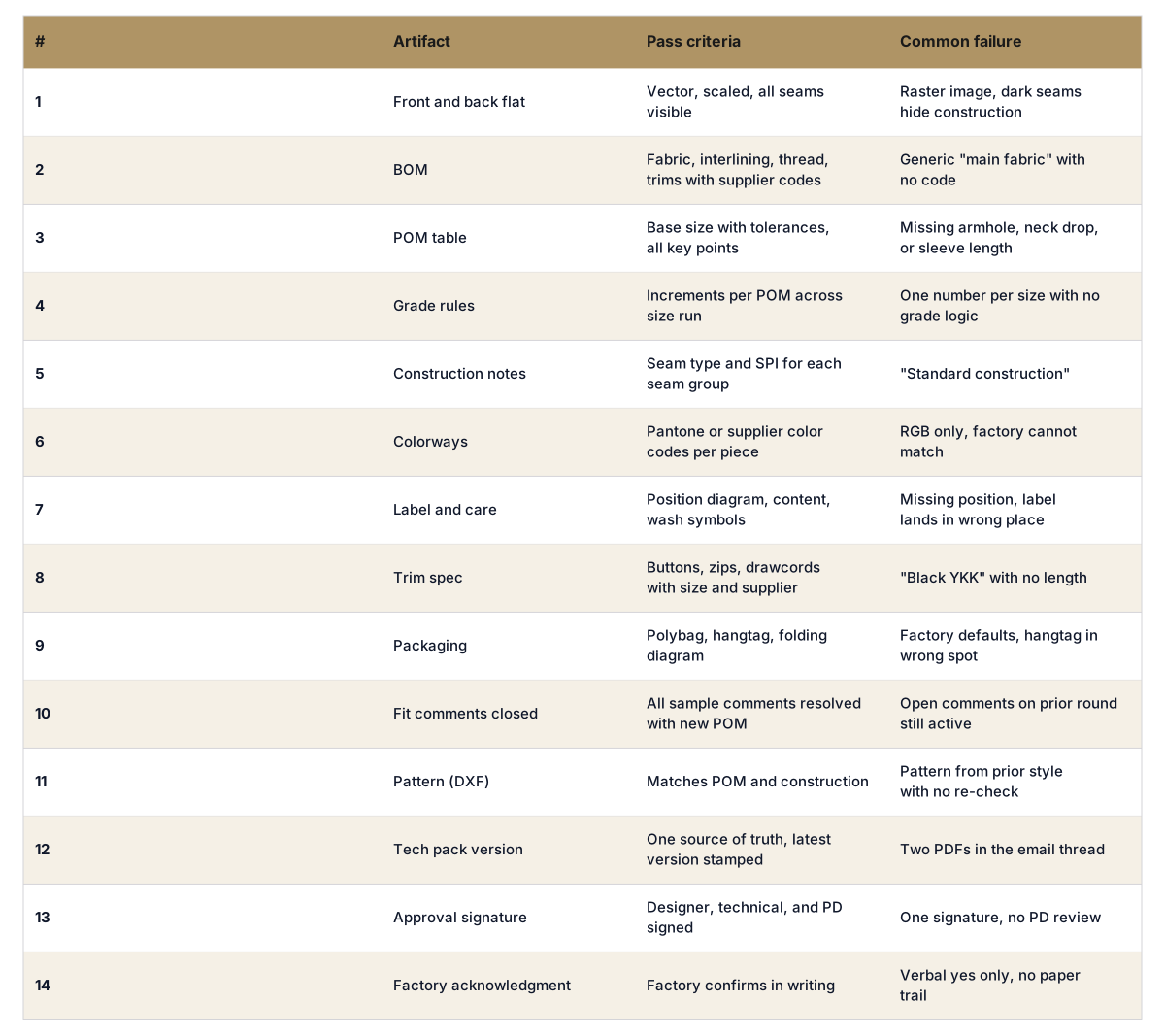
#ArtifactPass criteriaCommon failure
1Front and back flatVector, scaled, all seams visibleRaster image, dark seams hide construction
2BOMFabric, interlining, thread, trims with supplier codesGeneric "main fabric" with no code
3POM tableBase size with tolerances, all key pointsMissing armhole, neck drop, or sleeve length
4Grade rulesIncrements per POM across size runOne number per size with no grade logic
5Construction notesSeam type and SPI for each seam group"Standard construction"
6ColorwaysPantone or supplier color codes per pieceRGB only, factory cannot match
7Label and carePosition diagram, content, wash symbolsMissing position, label lands in wrong place
8Trim specButtons, zips, drawcords with size and supplier"Black YKK" with no length
9PackagingPolybag, hangtag, folding diagramFactory defaults, hangtag in wrong spot
10Fit comments closedAll sample comments resolved with new POMOpen comments on prior round still active
11Pattern (DXF)Matches POM and constructionPattern from prior style with no re-check
12Tech pack versionOne source of truth, latest version stampedTwo PDFs in the email thread
13Approval signatureDesigner, technical, and PD signedOne signature, no PD review
14Factory acknowledgmentFactory confirms in writingVerbal yes only, no paper trail

This is the bar a production-ready workflow has to hit on every PO. Skipping items 3, 4, or 5 is the most common cause of sample round 2 and sample round 3. See how the full set is generated end to end, or visit the pre-production hub for the workflow context.

Frequently Asked Questions

Can AI completely replace my technical designers?

No. Production-focused AI acts as a copilot for technical designers, not a replacement. It automates the most repetitive and data-intensive parts of their job, such as creating graded specs and populating BOM templates. This frees them to focus on higher-value tasks like perfecting fit, innovating construction techniques, and ensuring quality.

Is a factory-ready AI tech pack only for large brands?

Absolutely not. In fact, startups and small to medium-sized brands may see the biggest benefit. Lacking large teams and established PLM systems, smaller brands are more vulnerable to errors from manual data entry. An AI tech pack tool democratizes access to the kind of rigor and consistency that was once only possible with a large technical design department.

How does the AI handle unique materials or custom trims?

A reliable system operates on a library-based model that is also fully customizable. While it may suggest standard materials based on the garment type, it must allow you to add your own custom fabrics, prints, and hardware. You should be able to upload images, spec sheets, and supplier information for any unique component to build your brand's own private material library.

What is the typical learning curve for these tools?

Basic functions, like generating a first draft of a tech pack from an image and prompt, can often be learned in a single afternoon. The user interface is typically designed for fashion professionals, not software engineers. Achieving mastery and fully integrating the tool with existing workflows and a PLM system requires more planning, but a team can be running pilot projects and generating value within the first week.

Further Reading

Run pre-production on autopilot

Related: Pre-production workflow · Ai pattern intelligence vs fashion workflow software · Ai workflow vs traditional fashion design

Start building workflows around real brand rules.

Get The F* Word workflow insights in your inbox.