English
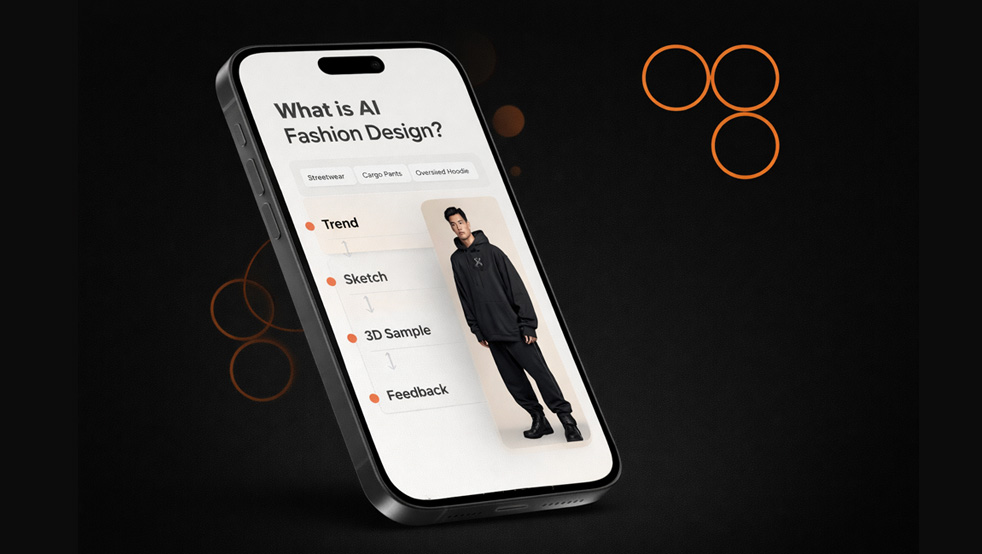
By 2026, over 70% of leading fashion houses will have integrated AI into their core design process, shifting the industry's creative paradigm from slow, manual iteration to rapid, data-informed artistry. But what is AI fashion design, really?
Forget the dystopian fear of robot couturiers. In its most practical and powerful form, AI fashion design is a new class of software that acts as a hyper-intelligent co-designer. AI fashion design starts with concept creation, but serious teams need the next layer: workflow software that turns approved ideas into specs, approvals, and launch assets. It automates the tedious translation of that vision into technical flats and mockups, drastically cutting the time from initial concept to production-ready sample and fundamentally changing the economics of creativity for designers everywhere.
That shift sounds dramatic, but inside a real fashion team it shows up in much smaller, more practical moments: faster moodboard exploration, sharper silhouette options, cleaner color variations, and fewer blank-page delays at the start of a season. The bigger change comes after the first image looks promising. A generated concept still has to survive line review, technical design, sourcing, costing, approvals, and launch planning before it becomes a product.
So the better question is not whether AI can “design.” It is whether AI can help brands move from creative intent to production clarity without losing the original idea along the way.
For decades, the fashion design workflow has been stubbornly linear and resource-intensive. It begins with abstract inspiration, painstakingly translated into hand-drawn sketches or digital illustrations. These are then refined, colorized, and eventually handed off to a technical designer to create flat sketches and a tech pack, a process fraught with potential for misinterpretation. Each step is a bottleneck, consuming precious time and limiting the number of ideas a designer can realistically pursue for a single collection. The result? A high-stakes gamble where only a fraction of designs ever make it to the sales floor, and even fewer become commercial hits.
AI fashion design directly addresses this inefficiency. It collapses the tortuous path from imagination to technical specification. Instead of drawing one jacket, you can prompt an AI with your core concept, "a 1980s cropped denim jacket with exaggerated shoulders, pearl embellishments, in a light acid wash", and see ten photorealistic variations in under a minute. More importantly, the best modern AI design platforms don't just stop at a pretty picture. They can instantly generate the corresponding front, back, and side-view flat sketches required for pattern makers and factories. They can iterate on textile designs, apply the same design logic across different garment types (a jacket, a skirt, a handbag), and maintain perfect brand consistency across an entire collection.
This isn't about surrendering creative control; it's about amplifying it. The designer’s role evolves from a manual draftsperson to a creative director. Your expertise is now focused on curating the best AI-generated options, refining the details, and making the high-level strategic decisions. AI handles the repetitive, time-consuming labor, freeing you to design at the speed of thought. This radical acceleration means less time spent on Adobe Illustrator plugins and more time spent on what matters: building a stronger brand, validating designs with your audience, and increasing your sketch-to-sell hit rate.
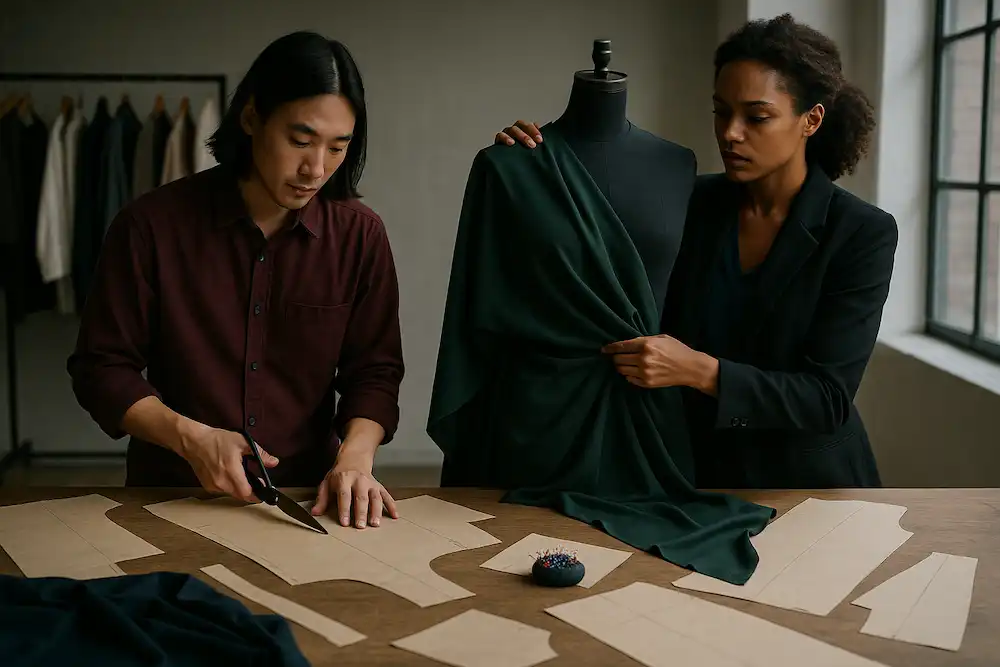
The term "AI Design" covers a spectrum of tools and methodologies, from simple image generators to fully integrated production ecosystems. Understanding the differences is crucial for choosing the right approach for your needs. This comparison breaks down the most common workflow models you'll encounter in 2026.
Comparison: Traditional vs. AI-Assisted Design Workflows

Designer or merchandiser? Replace the spreadsheet handoff.
The F* Word generates moodboards, factory-readable tech packs and sampling notes in one workflow, so creative, production and merchandising stay aligned. Free to try.
Navigating the new landscape of AI tools can be overwhelming. To simplify it, we can group the current state of AI fashion design into three distinct tiers of integration, each with its own capabilities, limitations, and ideal user.
This is the most accessible entry point into AI design, dominated by general-purpose image generation models like Midjourney and Stable Diffusion. Designers use text-based prompts to create a flood of visual inspiration. It’s fantastic for breaking creative blocks and exploring aesthetic directions that would be impossible to sketch manually in a short time. You can generate hundreds of "moods" for a collection, visualize unconventional material pairings, or see a historical garment re-imagined in a contemporary context.
However, this tier comes with significant limitations for professional use. The images produced are static, often anatomically incorrect, and inconsistent from one generation to the next. You can't ask it for a "back view" of a previous design and expect consistency. Crucially, these tools generate artistic renderings, not design assets. They produce no flat sketches, no measurement specs, and no technical details. The designer must still take this inspiration and manually re-draw everything in a program like Illustrator, re-creating the very bottleneck AI promises to solve.
This is where AI becomes a true professional tool. Tier 2 is defined by dedicated platforms like our own, thefword.ai, which are built from the ground up for the fashion design workflow. These platforms are a quantum leap from basic image generators, offering what we call an AI fashion designer solution. Instead of just a pretty picture, you get a cohesive set of design assets.
A typical workflow on a Tier 2 platform looks like this: you input a detailed prompt, and the AI generates not just a photorealistic mockup on a model, but also the corresponding front and back technical flats. The model is trained specifically on fashion silhouettes, textiles, and construction, leading to far more realistic and manufacturable outputs. You can lock a design and generate variations, different colorways, sleeve lengths, or fabrics, while maintaining the core silhouette. The platform understands concepts like "turn-down collar" and "welt pocket," and can render them consistently. The output is a design package that can be directly used to build a comprehensive tech pack, dramatically accelerating the handoff to production.
This is the modern and the future vision for 2026 and beyond. Tier 3 involves integrating AI across the entire value chain, from initial market analysis to the final production order. This ecosystem connects trend forecasting AIs that analyze social media and sales data, design AIs like those in Tier 2, 3D virtualization software like CLO 3D for virtual prototyping, and even AI-powered pattern-making and factory sourcing tools.
A key development in this tier is the rise of agentic AI. These are autonomous AI systems that can handle complex, multi-step tasks. A designer might give an agent a goal: "Develop a 5-piece capsule collection for SS27 based on the 'goblincore' aesthetic, targeting a Gen Z audience with a maximum production cost of $40 per unit." The agent could then perform trend research, generate design concepts, create the tech packs, and even source potential manufacturers that meet the cost and quality criteria. The designer's role here is to set the strategy, define the constraints, and provide final approval, acting as the CEO of their own AI-powered design team.
The best AI tool is the one that fits your specific context, your team size, budget, and ultimate goal. There is no one-size-fits-all answer, but we can create a framework to guide your decision.
Ready to dive in? Embracing AI is more about shifting your mindset than learning complex code. Here’s a practical, five-step guide to integrating AI into your creative process.
The shift to AI-native workflows is the most significant evolution in fashion design since the adoption of CAD. By embracing these tools, you're not just staying relevant; you're gaining a powerful competitive advantage. You'll be able to create more, iterate faster, and bring your unique vision to life with unprecedented clarity and speed. The tools are ready for you. Start free at thefword.ai.
No. AI is poised to augment fashion designers, not replace them. It automates repetitive and time-consuming tasks like sketching multiple variations and drawing technical flats, freeing up designers to focus on higher-level creative strategy, curation, and brand direction. The designer's taste and vision become more important than ever.
This is a complex and evolving area of law. Purely AI-generated output with minimal human input generally cannot be copyrighted. However, designs that are significantly modified, curated, and refined by a human designer have a much stronger claim to copyright protection. Professional platforms often have terms of service that grant you commercial rights to the designs you create.
The cost varies widely. General image generators (Tier 1) can be free or cost a small monthly fee ($10-$30). Professional, fashion-specific platforms (Tier 2) typically operate on a SaaS subscription model, with costs ranging from around $50 to several hundred dollars per month, depending on the feature set and usage limits.
Absolutely not. The leading AI fashion design platforms of 2026 are built with creatives in mind. They feature intuitive, visual interfaces that don't require any coding or technical expertise. If you can use tools like Instagram or Canva, you have all the technical skill you need to get started.
Once the workflow is in place, these are the steps that turn it into shipped product.
Related: AI Fashion Workflow Software
Get The F* Word workflow insights in your inbox.