Language
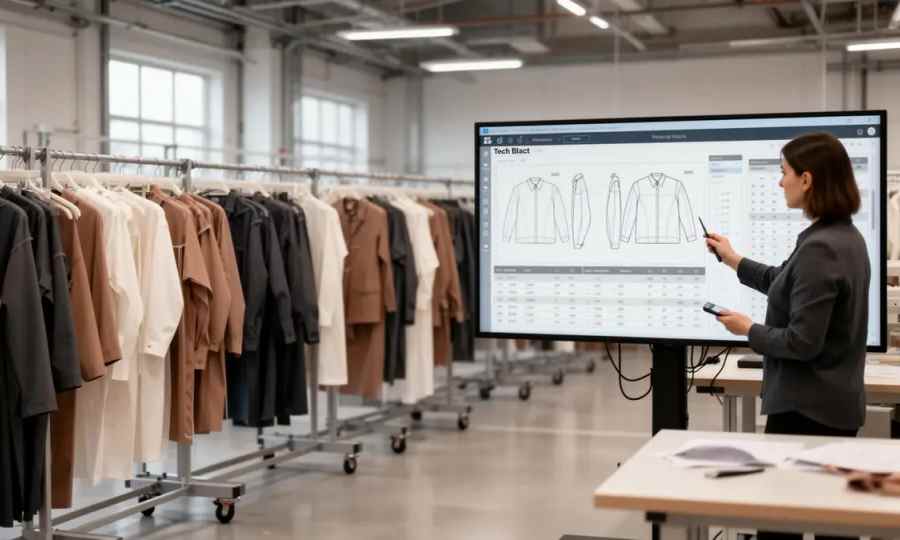
Apparel production software helps fashion teams organize the specifications, decisions, revisions, and handoffs that connect an approved garment design to sampling and manufacturing. Choose it around the work your team needs to control, whether that is preparing a tech pack, maintaining product records, or coordinating factory questions.
For an in-house designer or production manager, the buying question is not simply whether software uses AI. It is whether the team can give the factory clear, reviewed instructions and identify what remains undecided. A finished-looking document can still contain an unconfirmed material, an ambiguous construction detail, or a measurement that nobody has approved.
Separate document preparation from production approval. A tool may help prepare information without establishing that a garment fits, a component is available, or a factory can execute the proposed construction. Those decisions need named owners and evidence appropriate to the product. The software should support that review rather than make its status harder to see.
Use the production readiness workflow guide to place those checks within the wider pre-production process. For this purchase, focus on the specific handoff that is causing work to stall. Define its inputs, required output, reviewer, and release condition before comparing demonstrations.
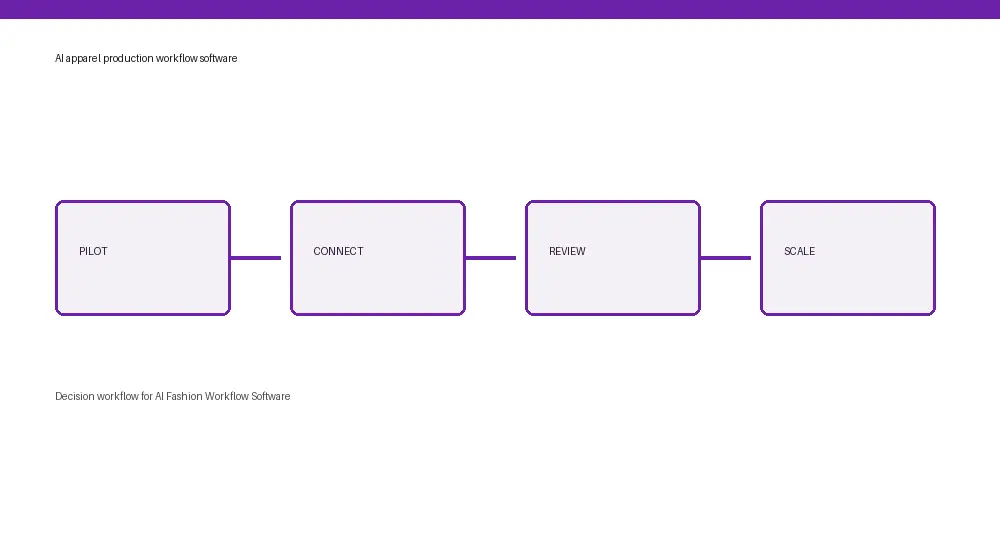
The categories below describe buying needs, not a ranking of vendors. Some products cover multiple tasks, but that does not establish that every feature is available in a particular plan. Ask for the current documentation and inspect the actual output before deciding whether a tool fits your process.
Table 1: Apparel production software categories and the checks buyers should make.
| Job to evaluate | Buyer verification | |
|---|---|---|
| Spreadsheets and shared documents | Maintain specifications and review notes through a team-managed process | Check how the team identifies approved files and prevents conflicting edits |
| Technical documentation tools | Prepare and revise garment instructions | Inspect editable fields, exports, and how revisions are communicated |
| PLM systems | Manage product records and lifecycle processes | Check the vendor's current documentation for data structure, permissions, and integration scope |
| 3D garment tools | Support virtual garment development and review | Confirm required skills, material assumptions, and technical outputs with the vendor |
| The F* Word | Generate moodboards and tech packs from a garment design | Review the generated pack against brand requirements before factory use |
Do not ask one category to prove an unrelated outcome. A visual garment review is not the same as maintaining approved product data. Generating a technical document is not the same as approving the physical sample. Where your team needs several tools, test the transfer between them instead of assuming that the information will carry over correctly.
The F* Word generates moodboards and generates tech packs in 8 to 10 minutes from a garment design. It is not a PLM, a 3D simulation tool, or an image generator. Its relevant buying test here is whether the generated tech pack gives your technical team a useful starting point for review and completion.
Treat the stated generation time as document generation time. It does not include resolving design questions, approving fabric, checking fit, or receiving a sample. Keep those activities visible in the development calendar so a faster draft is not mistaken for a completed pre-production stage.
Do not assume that generation includes access to your existing PLM records, pattern blocks, or grading rules. Any proposed connection to brand data needs a separate demonstration and written scope. If your process depends on those records, establish how approved information will reach the reviewer without treating an unverified connection as an available feature.
Before testing apparel production software, choose a garment design your team understands and has permission to upload. Record the intended silhouette, distinguishing details, and known material decisions. Identify information that is still open. This gives the reviewer a reference against which to distinguish the design brief from software-generated assumptions.
Ask the designer to resolve conflicting views before creating the draft. A pocket shown on one view but missing from another is a design question, not a reason to let the software choose. Keep the approved design reference with the resulting document so the technical designer can trace each instruction back to the intended garment.
These are responsibilities, not necessarily separate job titles. A smaller team may assign several to one person. What matters is that each decision has an owner and that unfinished work remains visible before the pack is released.
Begin with measurements. Confirm the unit, point-of-measure definition, intended value, and tolerance where your process requires them. A number inferred from a drawing is not evidence of fit. Review size specifications against the brand's approved technical references rather than accepting plausible-looking values because the document is neatly formatted.
Next, inspect materials and components. A pictured zipper does not establish its supplier, length, finish, or availability. Check each required reference against the sourcing decision, and mark substitutions for approval. If a material remains undecided, state that clearly rather than allowing the factory to read a suggestion as a confirmed purchase instruction.
Review construction with the same discipline. Confirm seam placement, attachment methods, closures, reinforcement, and label positions where relevant. When the drawing and written instruction differ, resolve the conflict in the pack. Sending a separate explanatory message without updating the document creates another instruction the factory must reconcile.
Finish with release control. Identify the style, revision, release date, and approver through your own process. Ask the receiving factory to confirm which version it is using and return unresolved questions before proceeding. A shared file location helps only if both sides understand which instructions are approved.
Use a limited set of real designs rather than a demonstration selected only for visual appeal. Include the garment details your team regularly finds difficult to document. Apply the same technical review you would use for manually prepared packs, and record what the reviewer must correct, clarify, or add.
Measure the whole task, not just the generation step. Record preparation time, review time, correction time, and time spent answering factory questions. Keep document completion separate from sample approval. A useful comparison shows whether work has actually been reduced or merely moved from drafting into checking.
Inspect the files your team receives during the trial. Check readability, how revisions will be made, and whether the receiving team can use the delivered format. Ask the vendor to demonstrate any required editing or export behavior rather than inferring those capabilities from a screenshot. Record missing requirements before committing to wider use.
Review data handling before uploading unreleased designs. Ask about access, retention, permitted use of submitted assets, and deletion procedures under the terms applicable to your account. Commercial sensitivity and reference-image rights remain brand responsibilities even when the immediate goal is only a trial document.
A reviewed tech pack tells the factory what the brand intends to make. It does not prove that the first sample meets that intent. Fit, fabric behavior, and workmanship still need the checks required by your quality process. Record sample findings against the same style and revision history used for the instructions.
When a sample review changes the garment, update the affected measurements, materials, and construction notes together. Ask the factory to acknowledge the revised instructions. Do not leave the approved change only in a meeting note while an older pack remains in circulation. The purchasing decision should support this discipline, not substitute for it.
No. Apparel production software is a broad buying term that can include documentation and coordination tasks. PLM addresses product records and lifecycle processes. Compare the specific work each product supports, and verify required features in the vendor's current documentation.
No. The F* Word generates tech packs from a garment design in 8 to 10 minutes, but your team still needs to review the document. Confirm design intent, technical values, and factory requirements before releasing it for use.
Do not assume that it does. Approved grading must be checked against your brand's technical decisions. Do not treat generated values or an unverified connection to a grading library as approved size specifications.
Test a real garment from design input through technical review and factory handoff. Inspect the delivered files, record corrections, and verify any required exports or data connections. Judge the result against your existing process, including review effort rather than generation speed alone.
Upload a garment sketch and get a draft tech pack. Have your technical designer review the output against the approved design before sharing it with a factory.
Get The F* Word workflow insights in your inbox.