
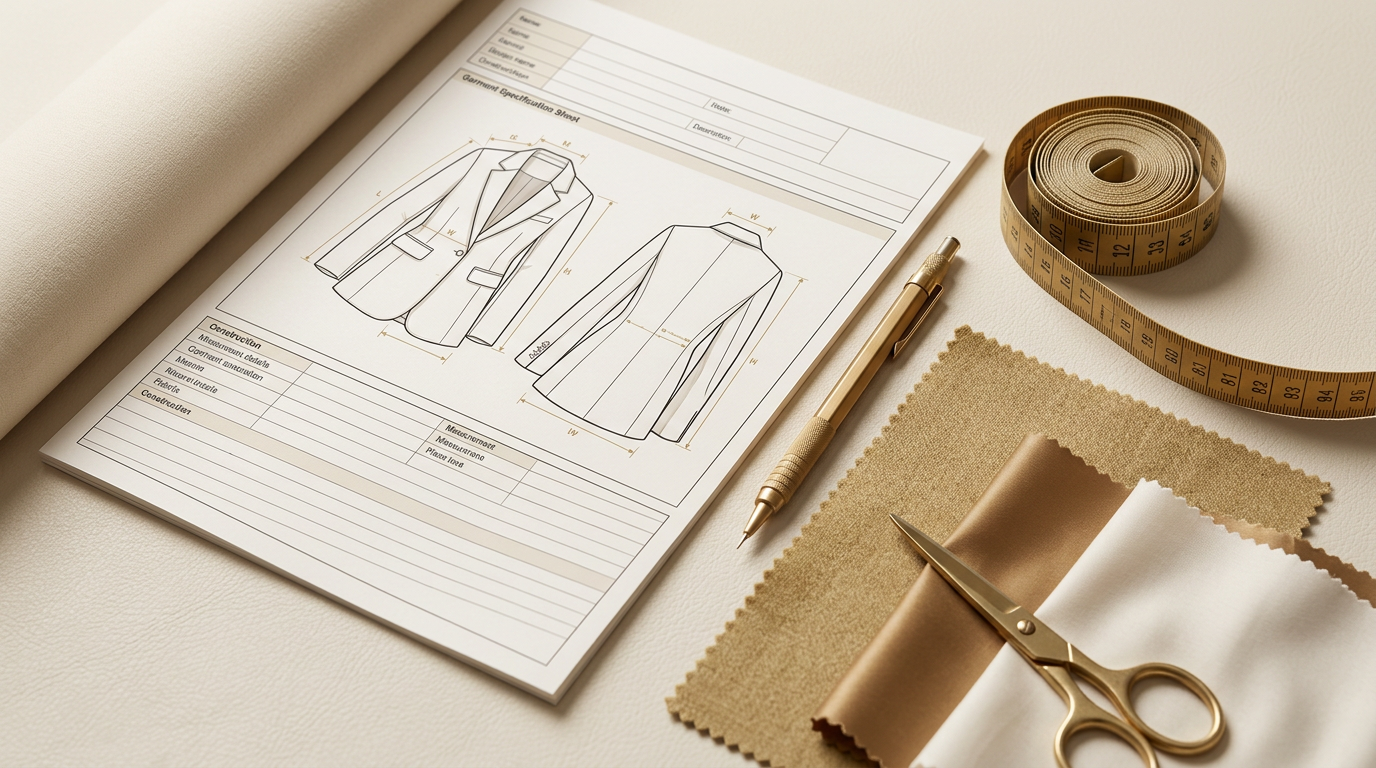
The fashion industry often faces bottlenecks during the transition from design to production. A mid-size brand juggling 200 styles per season can spend over three weeks per style revising garment specifications. This delay affects the handoff between designers and technical designers, impacting time-to-market and increasing costs. AI garment spec sheets offer a solution by automating the generation of detailed specifications, dramatically reducing revision cycles.

What this looks like in practice: For instance, a technical designer at a 200-SKU contemporary brand can now rely on AI systems to automatically generate spec sheets from initial sketches. This involves uploading the design, allowing the AI to process and fill in construction details, and then sending it for approval. This streamlined workflow reduces manual input errors and speeds up approval times.
In-house designer? Generate a factory-ready tech pack from your brief.
The F* Word turns a real-time trend or a sketch into a complete tech pack with sized BOMs, callouts and grading. Plus a brand-aligned moodboard. Free to try.
AI garment spec sheets use advanced algorithms to convert sketch inputs into comprehensive specifications. When a designer uploads a sketch, the AI system analyzes silhouette data and maps it to a brand's construction library. The result is a spec-ready tech pack complete with seam allowances, stitch types, and fabric requirements. This automation streamlines the pre-production process, ensuring accuracy and consistency.
[IMAGE: Labeled flowchart showing the 5-step AI tech pack handoff from designer to factory, each step boxed and connected with arrows]
What this looks like in practice: At a fast-fashion retailer, the AI system enables designers to focus on creativity, knowing that technical specifications will be accurately generated. This reduces back-and-forth between departments, allowing faster decision-making and reducing the overall time from concept to production.

In 2026, the fashion industry has seen significant advancements in AI technology, particularly in garment specification. The capabilities of AI have expanded, allowing for real-time adjustments and integration with virtual sampling technologies. This year, brands are experiencing unprecedented accuracy in their spec sheets, reducing production errors and improving the speed of product launches.
Common pitfalls: Despite these advancements, companies must ensure their data inputs are clean and standardized. Inconsistent data can lead to errors in AI processing, emphasizing the need for strong data management practices.

What this looks like in practice: A high-end brand using traditional methods would involve multiple rounds of revisions, while an AI-powered approach streamlines this to just a few iterations, freeing up resources and reducing costs.
The Cycle Optimization Framework is a strategic approach that aligns AI capabilities with production goals. By incorporating AI garment spec sheets into the workflow, brands can optimize their production cycles. This framework emphasizes reducing revision cycles, lowering costs, and accelerating time-to-market. However, it requires careful integration with existing processes to avoid potential misalignments, especially in the initial stages of adoption.
How to apply: Start by mapping current processes and identifying repetitive manual tasks. Implement AI for these tasks, gradually expanding its role as confidence builds. Monitor metrics like revision counts and time-to-market to measure impact and adjust strategies accordingly.
Consider a brand producing 500 styles annually. Traditional spec methods involve an average cost of $450 per style, totaling $225,000 a year. By adopting AI garment spec sheets, each style costs just $85, reducing the annual total to $42,500. This shift results in savings of $182,500 annually, illustrating the financial benefits of AI-driven processes.
Sensitivity Analysis: If production scales to 700 styles, the cost savings increase proportionally, highlighting AI's scalability potential. Conversely, smaller brands producing fewer styles might see slower ROI, emphasizing the need for scale in AI adoption.
AI garment spec sheets are not limited to technical specifications; they extend to creative direction. By integrating AI into trend intake and moodboard creation, brands can ensure that their design vision aligns with production capabilities. AI analyzes color stories, silhouette planning, and fabric selection, providing a cohesive workflow from creative concept to production execution.
What this looks like in practice: A design director at a luxury brand can use AI to analyze seasonal color palettes and forecast trends, ensuring that new collections resonate with market demands while aligning with production constraints.
The year 2026 marked a critical shift for AI in fashion. Brands began to fully integrate AI into their production cycles, moving beyond mere experimentation. The technology's ability to provide accurate, real-time spec adjustments significantly streamlined the design-to-production workflow, minimizing errors and enhancing the overall efficiency of the fashion supply chain.
Common pitfalls: Over-reliance on AI without adequate human oversight can lead to quality issues. Balancing AI automation with skilled human input remains essential for maintaining high-quality standards.
AI's role in manufacturing extends beyond spec sheets, impacting quality assurance and production efficiency. By integrating AI-driven insights into manufacturing processes, brands can enhance production quality and reduce defects. This alignment between design and manufacturing ensures a smoother transition from concept to finished product.
What this looks like in practice: A production manager at a large-scale factory uses AI to monitor production lines in real-time, identifying potential issues before they escalate, thus reducing waste and improving quality.
The financial benefits of AI integration in garment spec sheets are significant. By reducing the number of revision cycles and speeding up the production process, brands can lower their operational costs. This cost efficiency is particularly beneficial for brands looking to expand their market reach without increasing overhead.
What this looks like in practice: An emerging brand aiming to expand their e-commerce presence can use AI to reduce their cost per style, allowing them to offer competitive prices while maintaining profitability.
Common pitfalls: Initial implementation costs can be a barrier for smaller brands. Careful financial planning and phased implementation can mitigate these challenges, ensuring that the investment in AI leads to long-term savings.
Successful AI implementation in garment spec sheets requires buy-in from the entire team. Training programs must be established to ensure that all members, from designers to production managers, understand how to use AI tools effectively. This training ensures that the potential of AI is fully realized.
What this looks like in practice: A brand implementing AI might organize workshops and ongoing training sessions to familiarize their team with new tools, ensuring that everyone is aligned with the new processes.
Common pitfalls: Resistance to change can slow down AI adoption. Addressing concerns through transparent communication and demonstrating the tangible benefits of AI can help in overcoming these barriers.
Ready to streamline your production process? Discover how The F* Word's AI garment spec sheets can cut down your tech pack creation time, minimize sampling rounds, and keep up with real-time trends. Explore our platform today and see the difference it can make for your brand.
AI spec sheets provide precise specifications, reducing errors and ensuring consistency throughout the production process. By automating data entry and specification generation, these sheets minimize human error, leading to a more reliable handoff to manufacturing. The use of AI also allows for continuous improvements by learning from past data, further enhancing accuracy. For example, a brand can track error rates before and after AI adoption to quantify improvements.
Yes, AI spec sheets are designed to integrate smoothly with most existing design and production software, enhancing workflow efficiency. This integration ensures that AI tools complement existing processes rather than replace them entirely, offering a smooth transition for design teams. Many AI systems offer APIs and plug-ins that facilitate this integration, making the adoption process straightforward for most brands. A technical team may work closely with software vendors to customize the integration process.
The initial integration phase can be challenging, as it requires alignment with current processes and training for effective use. Brands often face hurdles in changing established workflows and ensuring that all team members are comfortable with new technologies. Additionally, maintaining data accuracy and consistency is crucial, as these systems rely heavily on clean data inputs to function correctly. A successful transition might involve pilot programs and gradual scaling to ensure smooth adoption.
By reducing revision cycles and providing accurate specs quickly, AI spec sheets significantly cut down the time-to-market for new styles. Faster spec generation means that designs can move to production without delay, improving overall agility. This speed advantage allows brands to respond more swiftly to market trends and consumer demands, maintaining a competitive edge in the fast-evolving fashion market. A brand might track lead time reductions to measure the impact.
Absolutely, the reduction in production errors and revision cycles can lead to significant cost savings, making it viable for brands of all sizes. Small brands may initially see slower returns due to fewer styles, but the overall efficiency improvements and error reduction can justify the investment. Over time, as production scales, these benefits become even more pronounced, offering substantial cost advantages. For instance, a small brand might calculate savings by comparing pre- and post-AI operational costs.
Get The F* Word workflow insights in your inbox.