
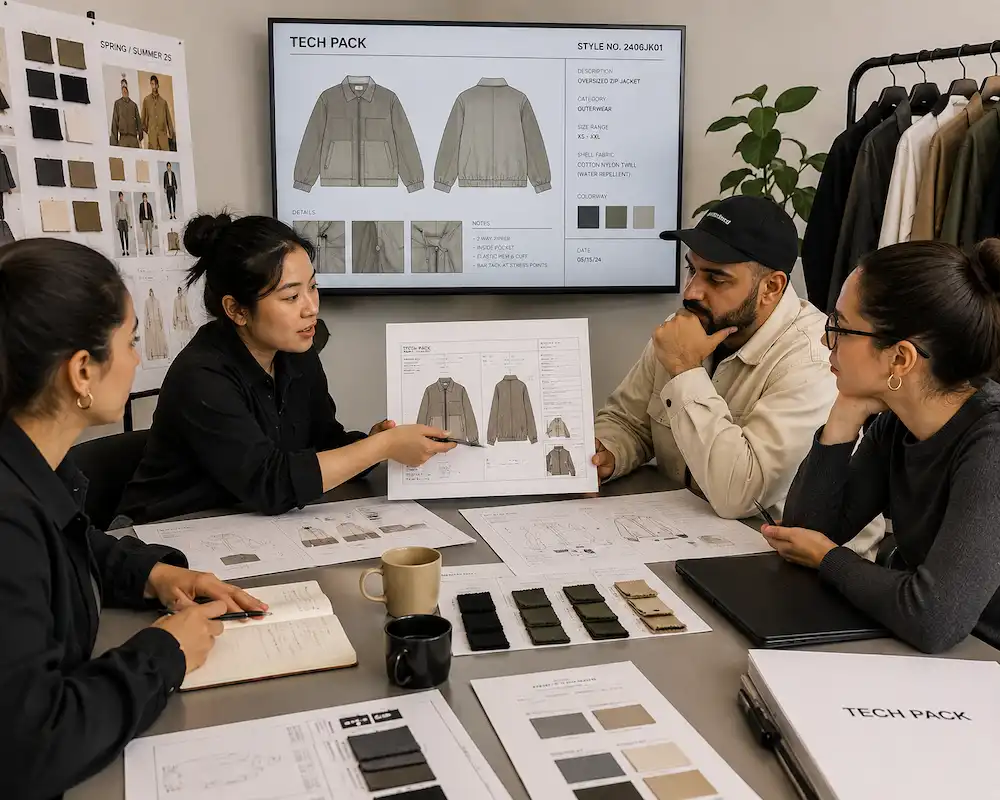
Quick answer: AI fashion workflow software covers the full path from creative brief to factory handoff: moodboards, tech packs, BOM, POM, grading, vendor handoff, and launch assets. AI pattern tools focus on a single artifact, the pattern, and stop there. The F* Word is workflow software that generates a factory-ready tech pack in 8 to 10 minutes from one approved sketch.
Direct answer. AI fashion workflow software orchestrates a brand's entire product development cycle, from concept to production. It automates the creation of tech packs, Bills of Materials (BOM), Points of Measure (POM), and grading, while managing vendor handoffs and approvals. In contrast, AI pattern tools are specialized applications focused on the single task of generating, editing, and validating 2D garment patterns. Workflow software is used by product development and technical design teams to reduce cycle time and sample costs, while pattern tools are used by designers and pattern makers to accelerate a specific design task.
The fundamental difference between these two categories of software lies in their output. An AI pattern tool's primary deliverable is a digital pattern file, typically in a format like DXF or AAMA. This file represents the 2D shapes that will be cut from fabric to construct a garment. While some advanced tools can simulate the pattern in 3D or suggest fit adjustments, their focus remains squarely on the pattern itself as the final asset.
AI fashion workflow software delivers a complete, factory-ready production package. This is not a single file but a collection of interconnected documents and data sets. The output includes a comprehensive tech pack with construction details, a validated BOM listing all materials and trims, a full POM specification sheet with tolerances, and complete grading rules for all required sizes. The workflow platform ensures all these components are consistent and ready for factory handoff, minimizing misinterpretation and costly errors downstream.
The intended user for each tool highlights their distinct purpose within a fashion brand. AI pattern tools are built for the creative and initial technical stages of design. Their users are typically fashion designers, 3D artists, and professional pattern makers. These individuals use the software to translate a sketch or 3D model into an accurate 2D pattern, focusing on silhouette, drape, and initial fit. Their work centers on the creative and engineering aspects of a single garment's structure.
AI fashion workflow software is designed for the operational and execution-focused teams responsible for bringing products to market. Product development managers, technical designers, sourcing leads, and merchandisers are the primary users. Their responsibilities include managing timelines, controlling costs, ensuring quality standards, and coordinating with manufacturing partners. They use workflow software to automate administrative tasks, validate technical data integrity, and manage the complex communication loops between internal teams and external vendors.
Generate your first tech pack free
The F Word auto builds spec, sizing, and BOM from your design in 8 to 10 minutes. No template wrangling, no factory back and forth.
Evaluating the scope of impact reveals the strategic difference between the two solutions. AI pattern tools provide a point solution that optimizes one specific, albeit critical, task in the product creation process. By accelerating pattern drafting and refinement, they can save hours or even days at the beginning of the development calendar. Their benefit is concentrated, improving the efficiency of an individual contributor or a small team working on a specific asset.
Conversely, AI fashion workflow software offers a systemic impact across the entire brief-to-launch lifecycle. It acts as an orchestration layer, connecting disparate stages that are often siloed. A workflow platform can ingest a design concept, automatically generate the first draft of a tech pack and BOM, flag potential cost issues, pre-populate grading based on established rules, and manage the sample request and feedback process. Its value is measured in weeks of reduced cycle time, fewer sample rounds, and lower material waste, affecting the brand's overall speed, cost, and profitability.
While both toolsets use AI, their features are engineered to solve very different problems. AI pattern making tools like Browzwear or CLO use AI to improve 3D simulation, automate pattern adjustments for fit, and optimize fabric nesting for marker making. Generative AI tools might suggest novel pattern shapes from a text prompt. The focus is on the geometric and physical properties of the pattern pieces.
AI workflow software applies AI to process management, data validation, and document automation. It can scan a tech sketch to identify construction details and populate a tech pack, cross-reference a BOM against a material library to check for availability and compliance, and use historical data to predict sample approval timelines. The AI is focused on the data and logic that connect the product creation process.
| Feature or Capability | AI Pattern Tool (e.g., CLO, Browzwear) | AI Workflow Software (e.g., The F* Word) |
|---|---|---|
| 2D Pattern Drafting & Editing | Core functionality | Not supported; integrates with pattern tool outputs |
| 3D Garment Simulation | Core functionality | Not supported; ingests data from 3D models |
| Automated Tech Pack Generation | Limited or none | Core functionality |
| BOM & POM Creation from Inputs | Limited data export | Core functionality with data validation |
| Automated Size Grading Rules | Sometimes supported for patterns | Core functionality for full POM specifications |
| Vendor Communication & Portal | Not supported | Core functionality for handoffs and approvals |
| Sample Round Management | Not supported | Core functionality with tracking and feedback |
| Integration with PLM Systems | Point-to-point data export | Deep, process-oriented integration |
The return on investment for each software type is measured with different key performance indicators. For an AI pattern tool, success is typically quantified by the reduction in time required to create or modify a pattern. A team might measure success in hours saved per style, the ability to create more design iterations in the same amount of time, or a reduction in the need for initial physical fit samples.
For AI fashion workflow software, success metrics are tied to the overall health and efficiency of the product-to-market engine. Key metrics include reduction in total product development cycle time (in weeks), decrease in the number of physical sample rounds per style, reduction in FOB costs due to fewer errors and better material costing, and improved on-time delivery rates. Ultimately, the ROI is measured by its direct impact on gross margin and the ability to react faster to market trends.
Neither tool exists in a vacuum. A modern fashion brand's tech stack often includes PLM (Product Lifecycle Management) systems like Centric PLM or FlexPLM, ERP (Enterprise Resource Planning) systems, and specialized design tools. AI pattern tools are specialist applications that feed into this ecosystem. A designer creates a pattern in CLO, which is then uploaded to a PLM.
An AI workflow platform functions as an intelligent connective tissue within this stack. It sits between the initial design creation (whether from a sketch or a 3D tool) and the system of record (PLM). It pulls data from a PLM (like approved material codes), orchestrates the creation of production artifacts like the tech pack, and then can push the finalized, validated package back into the PLM or send it directly to a vendor via an integrated portal. It automates the "work" of product development, whereas the PLM stores the "record" of that work.
No. A PLM system is a system of record, acting as a central database for product information. An AI workflow platform is a system of action and orchestration. It automates the tasks of creating, validating, and communicating product data, often integrating with a PLM to pull and push information. It focuses on the process, while a PLM focuses on the data storage.
Yes. AI workflow platforms are designed to work with various inputs, including traditional flat sketches, design files from Adobe Illustrator, or even simple textual descriptions. While they can ingest data from 3D models to accelerate processes like POM creation, it is not a prerequisite. The software is built to enhance any existing design process by automating the subsequent technical and administrative steps.
This depends on your goals. If your primary bottleneck is the speed of initial pattern creation and visualization, an AI pattern tool is a valuable investment. If your main challenges are long development cycles, high sample costs, communication errors with factories, and manual data entry for tech packs, then an AI fashion workflow platform will address those systemic issues more directly.
No, AI augments their skills. It automates the repetitive, low-value tasks like data entry, formatting documents, and chasing approvals. This frees up technical designers to focus on higher-value work like complex fit engineering, quality control strategy, and innovating on construction techniques. It allows them to transition from being data administrators to true product engineers.
The main benefit for a product development manager is enhanced control and visibility over the entire product lifecycle. AI workflow software provides a centralized dashboard to track progress, identify bottlenecks, manage approvals, and communicate with vendors. By automating manual work, it reduces the risk of human error and frees up the manager to focus on strategic calendar management and cost optimization.
AI workflow software automates the application of grading rules. Based on a base size POM and the company's established grade rules (e.g., how much the chest grows between a Medium and a Large), the platform can automatically calculate and generate the full set of measurements for all required sizes. This eliminates manual spreadsheet calculations and ensures consistency across the entire size range.
Yes, small brands can see significant benefits. High sample costs and long lead times disproportionately affect smaller companies with less capital and negotiating power. By using an AI workflow platform to reduce the number of sample rounds and shorten the time to market, small brands can operate more efficiently, compete with larger players, and launch new products with less financial risk.
Pattern intelligence can help teams create, reuse, or refine pattern assets. Production still needs a wider handoff: creative brief, approved concept, tech pack, BOM, POM, grading, construction notes, trims, labels, packaging, vendor questions, approvals, and launch assets. The F* Word connects those artifacts into one workflow.
| Buyer need | Pattern intelligence tool | The F* Word |
|---|---|---|
| Sketch-to-pattern | Strong fit | Supported only as part of broader workflow |
| Pattern library reuse | Strong fit | Not primary category |
| AI tech pack generation | Partial or adjacent | Core workflow |
| BOM and POM | Limited or separate | Core production-readiness layer |
| Vendor handoff | Not primary | Core workflow |
| Launch assets | Not primary | Connected workflow |
| Enterprise POC | Not primary | Supported workflow |
By automating the journey from design intent to a factory-ready tech pack, brands can significantly reduce cycle times and the high costs of physical sampling. An intelligent orchestration layer turns creative concepts into production reality faster and with greater accuracy. See the workflow in action and discover how to streamline your product development process.
Related: AI fashion workflow software pillar · AI tech packs pillar · Why factories reject tech packs
Get The F* Word workflow insights in your inbox.