Language
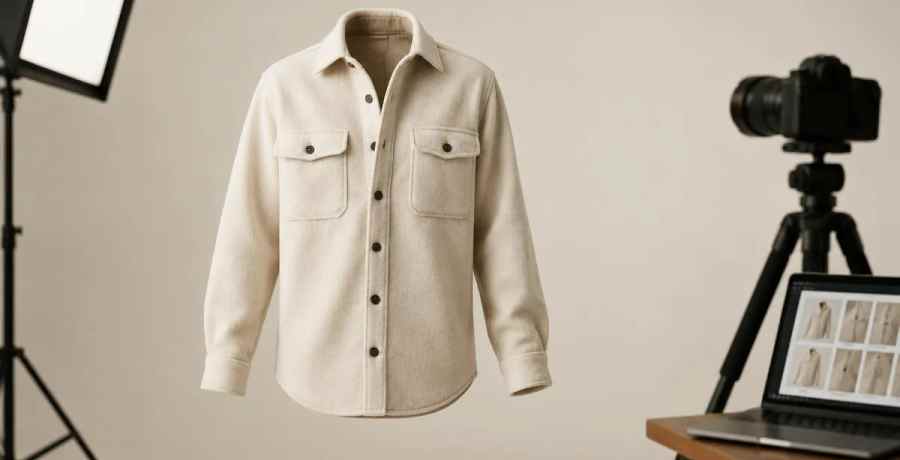
A ghost mannequin image shows a garment holding its worn shape with no model or mannequin in the frame. Studios build it from two photos, the garment on a mannequin and the inside back neck, joined by a retoucher. AI tools rebuild the hidden inside from one photo. The F* Word gives teams the approved tech pack to check each image against.
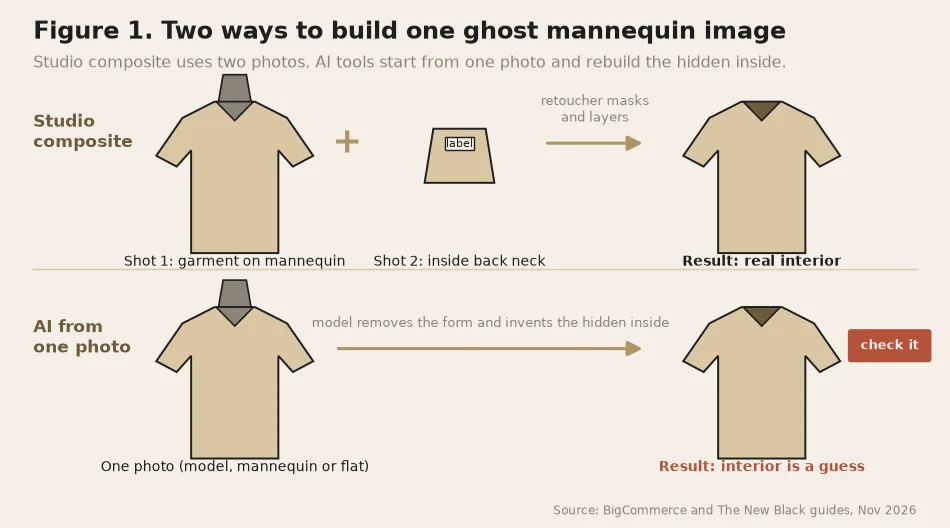
Ghost mannequin photography, also sold as invisible mannequin or hollow man photography, is the product shot where a jacket keeps its shoulders and a dress keeps its waist while nobody stands inside. BigCommerce's guide describes the traditional build as a composite: you photograph the product on a model or mannequin from several angles, then shoot the garment open or inside out so the inner back of the neck shows, and merge the frames in Photoshop. Most product pages pair the ghost image with a flat lay and an on-model shot, so it usually works as the first image in a grid rather than the only one.
I treat the ghost mannequin as a catalog format more than a creative one. A grid of 200 jackets shot this way reads as one brand, because the same form, light and crop repeat on every product, and merchandisers care about that repetition more than about any single frame.
The ghost mannequin shows fit and volume, a flat lay shows construction and prints, and an on-model image shows scale and drape on a body. The New Black's ghost mannequin guide gives the same split and puts the ghost image first on the product page and on marketplaces that want a plain ground, with the flat lay as the second image and the model shot reserved for ads and campaign pages.
The format also sets the cost. A flat lay needs a table, a camera mounted above it and a steamer. An on-model day adds a model, a stylist, hair and makeup, and a booking that has to fit everyone's calendar. The ghost mannequin sits between the two: one mannequin and one lit set, then retouching or AI work for every single image.
The studio method needs a mannequin with removable chest or neck panels, a white or light gray paper backdrop, two softboxes and a camera on a tripod that stays put between shots. BigCommerce recommends a white matte mannequin because it bounces less light and blends into the backdrop. You dress the form, pin the garment so it sits the way it would on a body, and shoot the front and back. For collared shirts you open the top so the inner back shows, and for some pieces you turn the garment inside out for a second frame of the neck.
The retoucher then masks the mannequin out of the main frame, drops the inside-neck frame into the gap, cleans out strings and pins, and adds a soft shadow so the garment does not look pasted on. BigCommerce advises saving the layered Photoshop file, which pays off when a buyer asks for a recolor three weeks later. The method gives a real interior because every pixel came from the garment. Its weak spot is labor, with two exposures per view and a skilled retoucher on every image.
Many brands keep the shoot in house and send the compositing out. BigCommerce notes that professional editors can return ghost mannequin images in 24 hours. Pixelz, a product-retouching service, lists a starting price of $0.95 per image on its Professional plan, which costs $95 a month and guarantees 200 images a day (pricing page checked November 12, 2026). Pixelz sells color matching and a 3-hour expedite as plan features, and a ghost composite takes more work than a background cutout, so treat $0.95 as the floor of a quote rather than the price.
The service model keeps the real interior, because the editor still works from your second exposure. You still pay for two shots per view on set, and you wait about a day per batch. For a brand dropping 30 styles a month, a one-day wait rarely changes anything. A marketplace seller refreshing 2,000 listings feels it more, since the editing queue then sets the pace of the whole relaunch.
AI ghost mannequin tools start from one photo and rebuild the hollow shape and the inner collar themselves. Photoroom says its tool accepts a flat lay, a hanging garment, a mannequin shot or a model photo, and offers the feature through its API for high-volume catalogs. The New Black reports that an image comes back in about fifteen seconds, measured on its own platform in August 2026, at one credit per attempt on its Standard plan and three on Pro.
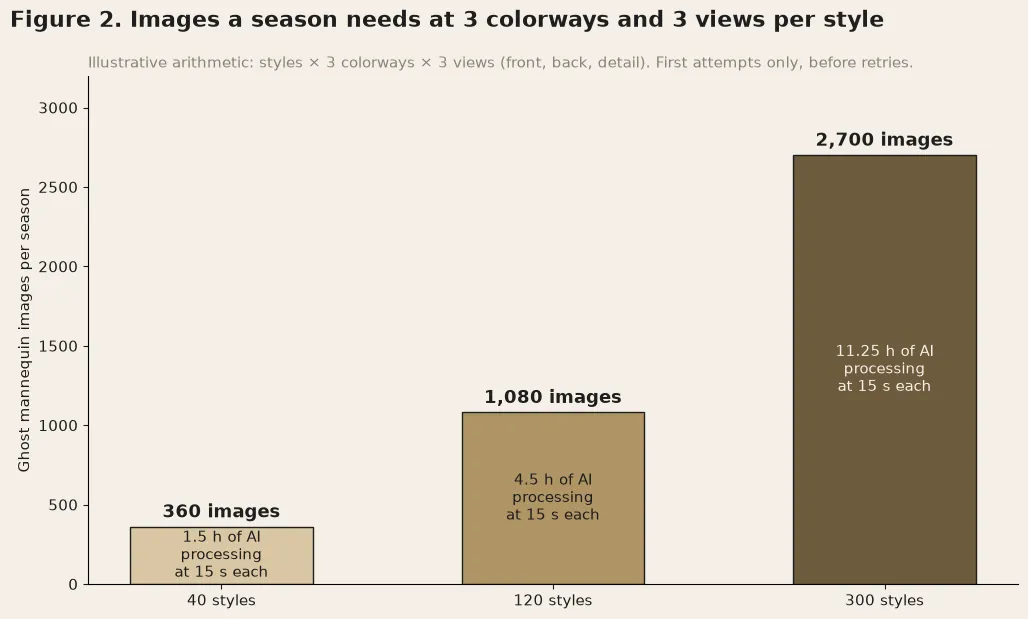
Speed changes the economics of a catalog refresh. At fifteen seconds an image, 1,080 images take 4.5 hours of processing, before retries and before a person checks each result. The second exposure disappears, so the set can shoot one view per garment and move on to the next rail. The cost moves to review, because someone has to confirm that the rebuilt neck, label and lining match the garment the factory will ship.
Table 1 compares the five ways brands produce these images today, with sourced figures where a vendor publishes them and plain estimates where none exists.

Structured pieces are the easy case for AI: jackets, coats, shirts and knitwear with a collar and a shoulder line that already suggest the body underneath. The New Black's own guide names three harder cases. Sheer and lace garments blur the edge between fabric and background, so the hollow can come back cloudier than the original. Open backs, halternecks and deep cowls ask the model to invent an interior it can barely see, and the guide admits the invention is sometimes prettier than the truth. A tight crop with the hem or a shoulder outside the frame leaves the model guessing at the missing edge.
I would add two cases from tech pack work. Contrast inner facings and printed neck labels carry brand and care details that a front photo never shows, so an AI rebuild can return a plain interior or a generic label. Garments with a functional detail at the back neck, such as a hanger loop, a locker loop or a split yoke, can lose it when the model fills the gap with plain fabric. Both errors look fine at thumbnail size and show up as complaints once the parcel arrives.
A ghost mannequin image is a promise about the product, so check it against the spec before it goes live, the same way a QC team checks the first bulk sample against the approved one. Check six points, the details a front photo hides and a model can redraw: neckline shape and depth, inner label position and content, button or zip count and placement, pocket count and position, seam and topstitch color, and lining or facing color. Any mismatch goes back for a reshoot or a second AI attempt, and the cost of that retry is one credit or one retouch, usually far below the cost of a return.
The check only works if the spec exists and is current. When the last approved spec lives in an email thread, nobody on the ecommerce team can say whether the shirt in the photo should have five buttons or six. A tech pack with points of measure, a bill of materials and construction notes answers that question in one place, and the same document tells the retoucher or the AI reviewer what the hidden interior should look like. Our guide to what a tech pack contains lists each section.
Figure 2 runs the arithmetic for three catalog sizes at three colorways and three views per style. A 120-style season needs 1,080 ghost images on first attempts alone. At the outsourced floor of $0.95 per image, the editing bill starts at $1,026 before extras and before the shoot itself. At the AI pace of fifteen seconds an image, the same season takes 4.5 hours of processing plus review time.
Review time is the line most image budgets leave out. At a planning estimate of 45 seconds per check, 1,080 images need 13.5 hours of a merchandiser's time, close to two working days. Batch the checks by style, so the reviewer opens each spec once and checks all nine images of that style against it, and book the review into the product launch workflow the same way you book studio days.
The F* Word does not make product photos. It generates a factory-ready tech pack in 8 to 10 minutes from a sketch, photo or brief, with points of measure, a bill of materials, grading, tolerances and construction notes, all editable. For ghost mannequin work the tech pack becomes the reference the reviewer checks against, since it records the neckline, label placement, trims and lining that an AI tool has to guess. Teams that already use Photoroom or a retouching service keep it and add the spec check before upload to the product page. The F* Word works before or alongside a PLM and does not replace one. See how AI tech packs are built.
Related: AI ghost mannequin images for line sheets · AI model photoshoots · AI product photography vs the product record
A ghost mannequin, also called an invisible mannequin, is a product photo where the garment keeps its worn 3D shape with no model or mannequin visible. Studios make it by combining a mannequin shot with a shot of the inside neck.
Shoot the garment on a mannequin, shoot the inside back neck as a second frame, then mask out the mannequin in Photoshop and place the neck frame in the gap. AI tools skip the second frame and rebuild the interior from one photo.
Pixelz lists a starting price of $0.95 per edited image on a $95 monthly plan, checked November 2026, and ghost composites usually cost more than a plain cutout. AI tools charge credits per attempt, such as one credit on The New Black's Standard plan.
For structured garments like jackets, shirts and knitwear it usually is, once someone checks the neckline, label, trims and lining against the tech pack. Sheer fabrics, open backs and deep cowls need extra care or a studio composite.
No. The F* Word generates the tech pack in 8 to 10 minutes, and teams use it as the reference to check ghost mannequin images from Photoroom, a retoucher or any other tool before they go live.
Get The F* Word workflow insights in your inbox.