

35 to 60 percent is the typical drop in content cost per style when a render pipeline replaces a second photoshoot. That is a real saving and you should take it. But it is a cost story, not a demand story. Cheaper pixels do not fix the reason an AI shopping agent skipped your product, or why a buyer filtered your line out of a shortlist. If the fibre content is not verifiable, if the size run does not map to a real body, or if your claims cannot be cited, no volume of AI product photography will move the needle with an agent-first shelf.
For workflow buyers, in-house designers, and merchandisers, AI product photography fashion tools feel like a gift. You get time to first asset in hours, variant coverage without booking talent again, and a refresh cadence that closes creative gaps. That matters because creative efficiency decays fast. In The Machine-Readable Brand by Nitin Kumar, Rosmon Sidhik and Akanksha Lokam, we model a roughly 40 percent fall in creative efficiency inside ten days. The fix is cadence. The faster you refresh, the less decay you pay for.
Here is the catch. The market is saturated with AI image generators and AI campaign-imagery tools. They are commoditized and interchangeable. They produce pixels. A pixel is not machine-readable. An AI shopping agent standing between the shopper and the catalog cannot verify fibre content from a render, cannot place your product in the right region of meaning space, and cannot cite it. The F* Word is not an image generator. It is the validation and orchestration layer that produces the structured garment record: the asset plus the machine placement data plus the machine recommendation data that makes an agent confident enough to surface your product.
So take the render savings, but do not confuse them with market access. To earn placement with agents and retail partners, you need a validated product record that travels with every asset, and a way to refresh imagery without breaking the link to the facts.
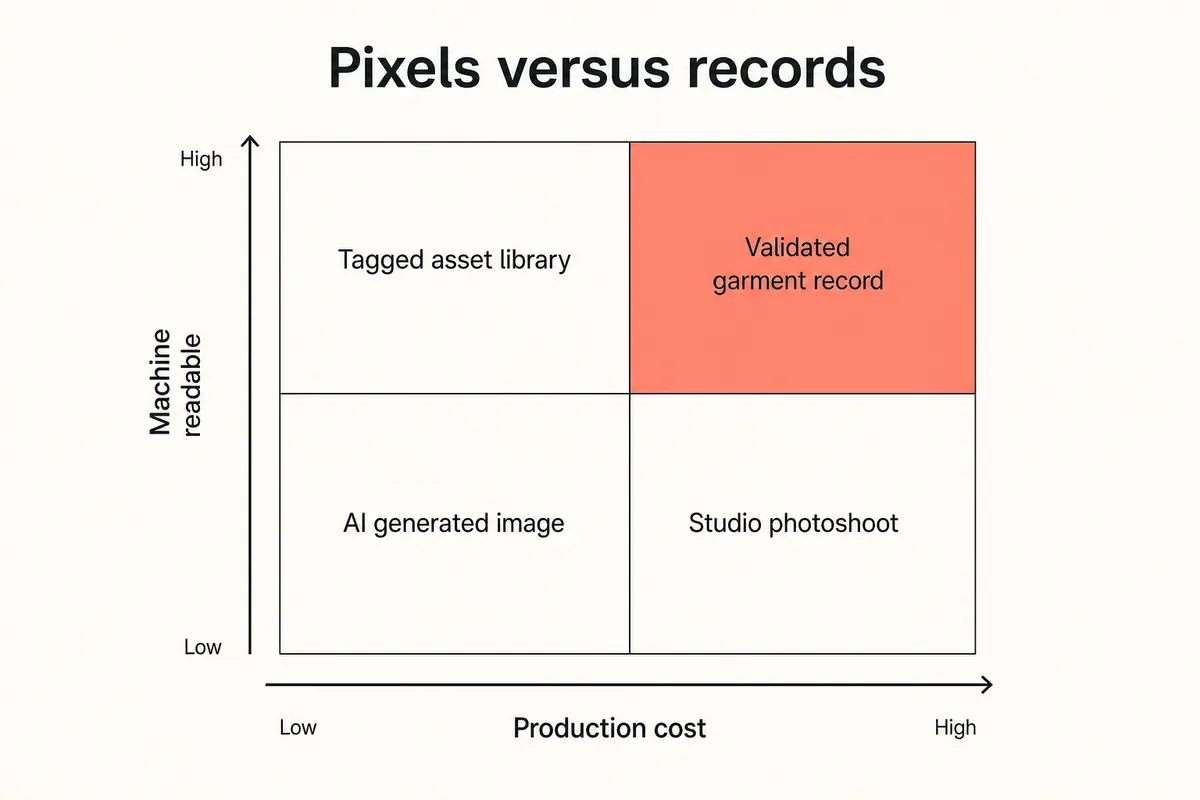
The popular framing says AI product photography will grow conversion because it looks better and costs less. That framing is incomplete. It confuses content efficiency with product validation. It also assumes that the hero image is the decision unit, when the real decision unit for an agent is the verifiable record of the garment: fibre content and certifications, construction and trims, graded size and fit data, care and durability evidence, and claims that resolve to a source the agent can cite.
Designers and creative directors are already fluent in story, mood, and on-model impact. Sourcing leaders and VPs of Product Development are fluent in tech packs, BOM, and supplier readiness. Merchandisers carry the sell-in risk and need line clarity and attribute consistency. AI product photography helps each group reduce a line item, but it does not produce the validated data that underwrites an agent-led shelf. Without that validated record, you get cheaper images of a product no agent will name.
There is another hidden trap. If you move fast on imagery but slow on record, you create asset drift. The same product appears with different fit notes and care claims across channels. Human teams can course-correct with training and checklists. An AI agent will not guess. It will suppress inconsistent items. The saving you booked on imagery then gets taxed by reduced placement and higher customer care load.
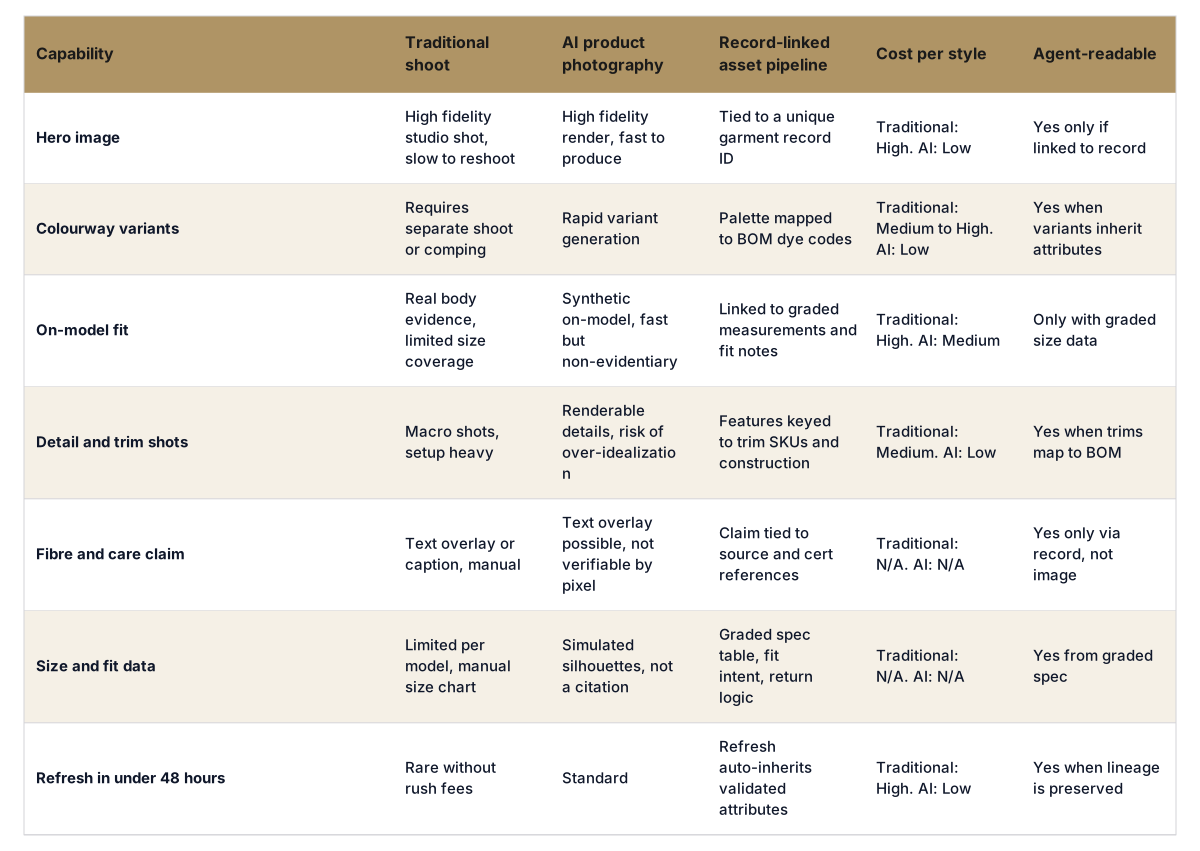

Production-ready is not a vibe. It is a record. For an agent-first market that record must be complete, consistent, and cited. At minimum you need the design intent and silhouette tags, a componentized BOM with fibre percentages, finish and dye codes, trims and placement, graded measurement tables that map to real bodies, construction notes at stitch level where relevant, care and durability claims tied to standards or test methods, and feature-level attributes that can be reasoned on. You also need lineage, so that any asset or copy can be traced to the exact record version.
This is where orchestration beats software sprawl. The F* Word is not a PLM, not a 3D simulator, and not an image generator. It is the validation and orchestration layer that turns your design into a factory-ready, machine-readable garment record. From a single garment design, The F* Word generates a factory-ready tech pack in 8 to 10 minutes, including BOM and construction notes, and also generates moodboards as the upstream half of the same workflow. That means creative direction and pre-production live on the same rail, with the same identifiers that your downstream imagery inherits. Your AI product photography can then pull exact trim SKUs, stitch counts where needed, and care claims, without manual copy-paste.
Production-ready also means the record travels with the asset. Every hero, variant, on-model composite, and detail frame must carry the same immutable garment ID and attribute snapshot. When merchandising swaps a palette or sourcing changes a trim due to MOQ, you need version control and delta flags. Without that, your beautiful refresh image misrepresents the item on sell-in decks or wholesale portals, and an AI agent will discard it as ambiguous.
For designers and creative directors, this unlocks a tighter brief. Your moodboard is not just a visual north star. It is the first, linked artifact in a chain that ends in a machine-readable product. For merchandisers, it gives you filterable, agent-readable attributes at style-level across the line plan. For workflow buyers, it creates a unit of work you can instrument: time to validated record, time to first asset, and time to assortment lock.
Use this checklist to decide where to invest first.
There is a bridge worth stating twice. The market is saturated with pure image and campaign generators. They produce pixels. A pixel is not machine-readable. Without the structured garment record that carries placement and recommendation data, an AI shopping agent cannot verify fibre content, cannot map size and fit intent to a body model, and cannot cite your claims. The F* Word ships the asset plus the facts that make that asset show up in agent-selected results. That is the difference between content efficiency and shelf access.
For workflow buyers, the ROI math is straight. Imagery savings are real and immediate. Record savings compound because they cut errors, rework, and missed placements. For creative directors, a record-linked pipeline protects your concept through production. For merchandisers, it gives you confidence that the story you sell in matches what agents will surface out.
Translate the principle into concrete checkpoints across pre-production, creative direction, and merchandising. These are the non-negotiables before you scale AI product photography.
If you adopt this list as a gate, you will find AI product photography becomes safer and more valuable. You avoid the common anti-pattern where marketing ships images that sourcing cannot stand behind and agents will not index.
Start with the validated record, then add the render pipeline. Doing it the other way round gives you cheap pictures of a product no agent will name. Here is a pragmatic start plan that fits how most teams work.
If you need an execution rail that connects creative direction, pre-production, and merchandising, see the orchestration overview at AI fashion workflow software and the launch workflow notes at merchandising and launch workflow. For enterprise controls and governance, including lineage and policy, see The F* Word for enterprise.
One more reminder on category boundaries. AI image generators and AI campaign tools produce pixels. The F* Word produces the validated garment record and orchestrates your work around it. When you connect your preferred renderer to a record that can be cited and reasoned on, you turn content savings into placement outcomes.
If you are evaluating sequence risk, remember that imagery can be parallelized after the record is live. The reverse is not true. No amount of creative iteration can retroactively fix a missing BOM, a wrong fibre percentage, or a voided claim. Build the record first, then push on refresh cadence so you stop paying the creative decay tax.
It can help by filling gaps and maintaining freshness, which often lifts click-through. But conversion depends on fit, care expectations, and clarity more than art alone. Without a validated product record that agents and shoppers can trust, the lift will be shallow and unstable.
It means your product data can be parsed, reasoned on, and cited by an AI agent. The agent needs a structured garment record with stable IDs, attributes like fibre content and fit mapped to body models, and claims that resolve to a source. Pixels do not carry this context unless you link them to the record.
No. 3D can improve visualization and fit reasoning, but it is not required for a validated record. The F* Word is not a 3D simulator or an image generator. It is the validation and orchestration layer that outputs a factory-ready tech pack, moodboards, and the structured data that downstream tools consume.
From a garment design, The F* Word generates a factory-ready tech pack in 8 to 10 minutes, including BOM and construction notes. That time box is designed so creative direction and pre-production stay in lockstep, and so merchandising can plan assortment with stable attributes earlier.
Start free at thefword.ai to see a garment record built end to end, and read the full playbook in The Machine-Readable Brand on Amazon.
Get The F* Word workflow insights in your inbox.