
Language

A tech pack template is a reusable structure for documenting a garment's measurements, materials, construction and revision history. Excel suits teams that want direct control over those fields, while AI generation can produce a draft from a garment design; either approach needs technical review before factory handoff.
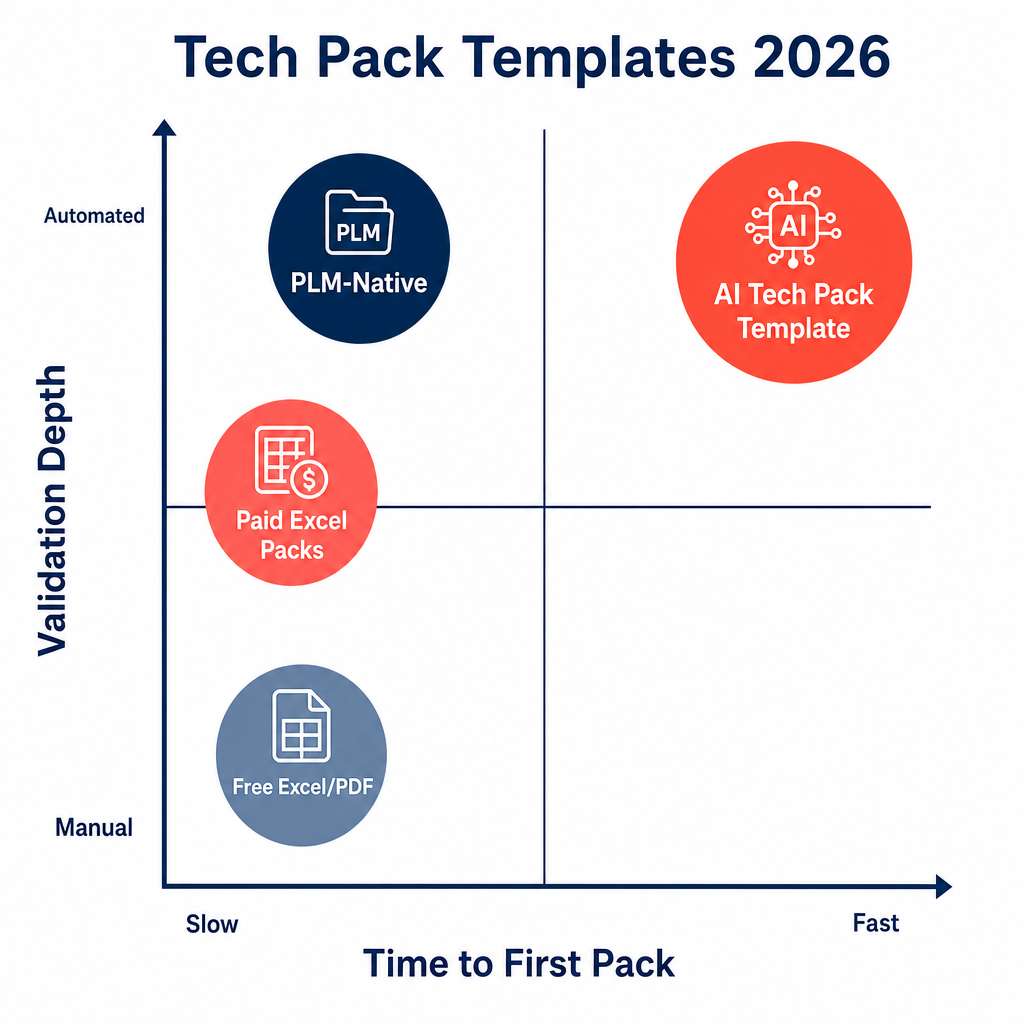
For a fashion-brand buyer comparing options in 2026, the useful distinction is who creates the information and who approves it. A spreadsheet provides a place to record decisions. An AI tool can help draft documentation, but a completed field is not evidence that the underlying decision is correct.
Start with the work your team repeats: entering material references, describing construction, updating measurements or reconciling revisions. Then test whether a different tool reduces that work without hiding assumptions. Do not choose by style volume alone. Garment complexity, review ownership and factory requirements matter more than an arbitrary monthly threshold.
Use this page-by-page layout as a starting structure, not a mandatory page count. A simple style may combine sections; a detailed garment may need several construction sheets. Keep the same style identifier and revision reference across the pack so separate pages remain traceable.
Table 1: Page-by-page tech pack template layout and review checks.
| Required content | Review before release | |
|---|---|---|
| Cover | Brand, style name and number, season, owner, date and revision | Confirm the factory has the intended version and contact |
| Technical flats | Front and back views with detail callouts | Match visible features to written construction instructions |
| Points of measure | Measurement codes, methods, units and base-size values | Define start and end points so both teams measure consistently |
| Grading and tolerances | Size range, approved size values or grade rules, permitted variation | Separate intended size changes from acceptable manufacturing variation |
| Bill of materials | Fabric, lining, trims, thread, labels and confirmed references | Resolve missing specifications and identify unapproved substitutions |
| Construction | Seams, stitches, reinforcement and finishing instructions | Check that the method matches the intended garment and material |
| Artwork and colorways | Artwork references, dimensions, placement and color standards | Confirm placement measurements and identify the approved artwork file |
| Labels and packaging | Label content, placement, folding and packing requirements | Confirm applicable requirements with the responsible brand team |
Give each field a clear status. An unknown fabric reference should remain visibly pending rather than being replaced with a plausible description. That distinction helps merchandising and production teams separate information suitable for an initial quote from information approved for sampling or bulk production.
Excel is useful when your technical team already maintains an agreed specification structure. Formulas and validation rules can support checks when someone has configured and tested them. They do not establish whether a sleeve measurement is appropriate or whether a supplier reference matches the intended fabric.
A PDF is usually a distribution format rather than the main authoring workspace. It can preserve a readable issue of the pack, but the source file still needs ownership. Ask the factory whether it needs an editable measurement sheet alongside the issued PDF, and keep both tied to the same revision.
AI generation changes how the first draft is created. Evaluate the draft against your approved design and known specifications, not against how complete it looks. For the wider process, the AI Tech Pack Generation hub explains where generation fits into technical documentation.
Table 2: Template approaches compared by authoring and review responsibility.
| Primary role | Buyer check | |
|---|---|---|
| Excel template | Editable structure populated and maintained by the team | Test formulas, protected cells, readability and revision ownership |
| Paid template pack | Purchased document structure for relevant garment categories | Inspect sample pages and confirm what must be adapted |
| PDF issue | Readable record distributed for a defined handoff | Check page completeness, legibility and matching revision references |
| PLM-based documentation | Technical records within a product management workflow | Check the vendor's current docs for authoring, approvals and exports |
| AI-generated draft | Starting documentation produced from design input | Review inferred details and confirm editing and export options |
A point of measure needs more than a number. Record the unit, measurement method and garment condition where relevant. Your technical designer should confirm the base size and the intended size range. A formula that fills adjacent sizes correctly can still reproduce an unsuitable grade rule.
Keep tolerances distinct from grading. Grading describes the intended difference between sizes; tolerance describes permitted variation around a specified value. Review both with the factory, especially where fit or assembly depends on related measurements. Neither a spreadsheet nor a generated table replaces fit approval.
A bill of materials should distinguish a material description from an approved sourcing reference. Include the specifications your team and factory need to identify the component. If the supplier or finish remains open, name the person responsible for confirming it rather than presenting the line as settled.
Cross-check construction notes against the flats. A pocket shown in a drawing needs a defined attachment method and relevant dimensions. If the design leaves a detail ambiguous, resolve it with the designer. Do not let an AI suggestion or a copied note become an unintentional production instruction.
Assign one owner to issue each pack. Record what changed and withdraw superseded instructions through your agreed factory communication process. A revised drawing can affect measurements, trims and costing, so review related pages together instead of replacing a single page without checking the rest.
Use a garment your technical team already understands and has permission to upload. Keep its approved specifications available as the review reference. Give each candidate tool the appropriate design input, then inspect the actual output rather than relying on a presentation or screenshot.
Record drafting time and review time separately during your trial. Include corrections and file preparation in the comparison. A quick first draft may still require substantial technical work, while a familiar spreadsheet may carry maintenance work that is easy to overlook. Base the decision on your observed process rather than unsupported category-wide savings.
Audit the current workbook before changing tools. Identify formulas, measurement definitions, material naming conventions and factory-specific notes that your team relies on. Decide which belong in the new documentation standard and which are obsolete. Preserve an approved reference pack for comparison.
Run the new approach alongside the existing process for a controlled trial. Assign a technical reviewer and keep unresolved items visible. Confirm where the approved record will live and how later revisions will reach the factory. Do not assume a vendor supports an integration or export until you have checked its current documentation and tested the required handoff.
The F* Word generates tech packs from a garment design in 8 to 10 minutes and also generates moodboards. That generation time describes draft creation, not the time needed to approve fit, source materials or complete sampling. Review the generated garment details before treating the pack as an issued instruction.
It is not a PLM, a 3D simulation tool or an image generator. Evaluate it for the documentation task you need, then confirm how the reviewed output will fit your existing records and factory communication. Keep technical approval with the people accountable for the garment.
It can be, if it covers the garment's requirements and your team can maintain it accurately. Check measurement methods, materials, construction and revision ownership. A paid template is not automatically more suitable, and team size alone does not determine whether you need a different tool.
No. Treat generated information as a draft to inspect against the intended garment. Confirm measurements, material references and construction decisions with the responsible team. Physical fit and workmanship still require the appropriate sample review.
Ask your factory to review an actual output. The practical criteria are readable instructions, complete specifications and a usable file format. AI authorship does not establish acceptance, and a visually polished pack can still omit information the factory needs.
Agree on the handoff with the factory. A PDF can serve as the issued reference, while an editable sheet may support measurement feedback. Identify the controlling revision and avoid distributing files with conflicting values.
Upload a garment sketch and get a draft tech pack with The F* Word. Check the measurements, materials and construction details with your technical team before sending the reviewed pack to your factory.
Get The F* Word workflow insights in your inbox.